Our Location:
No. 99, Jiazi Road, Chengdu

 authorChris Lee
The Temple of Heaven covers 273 hectares, so the biggest mistake is treating it like a single monument. Enter through the wrong gate and you can add a surprising amount of unnecessary walking.
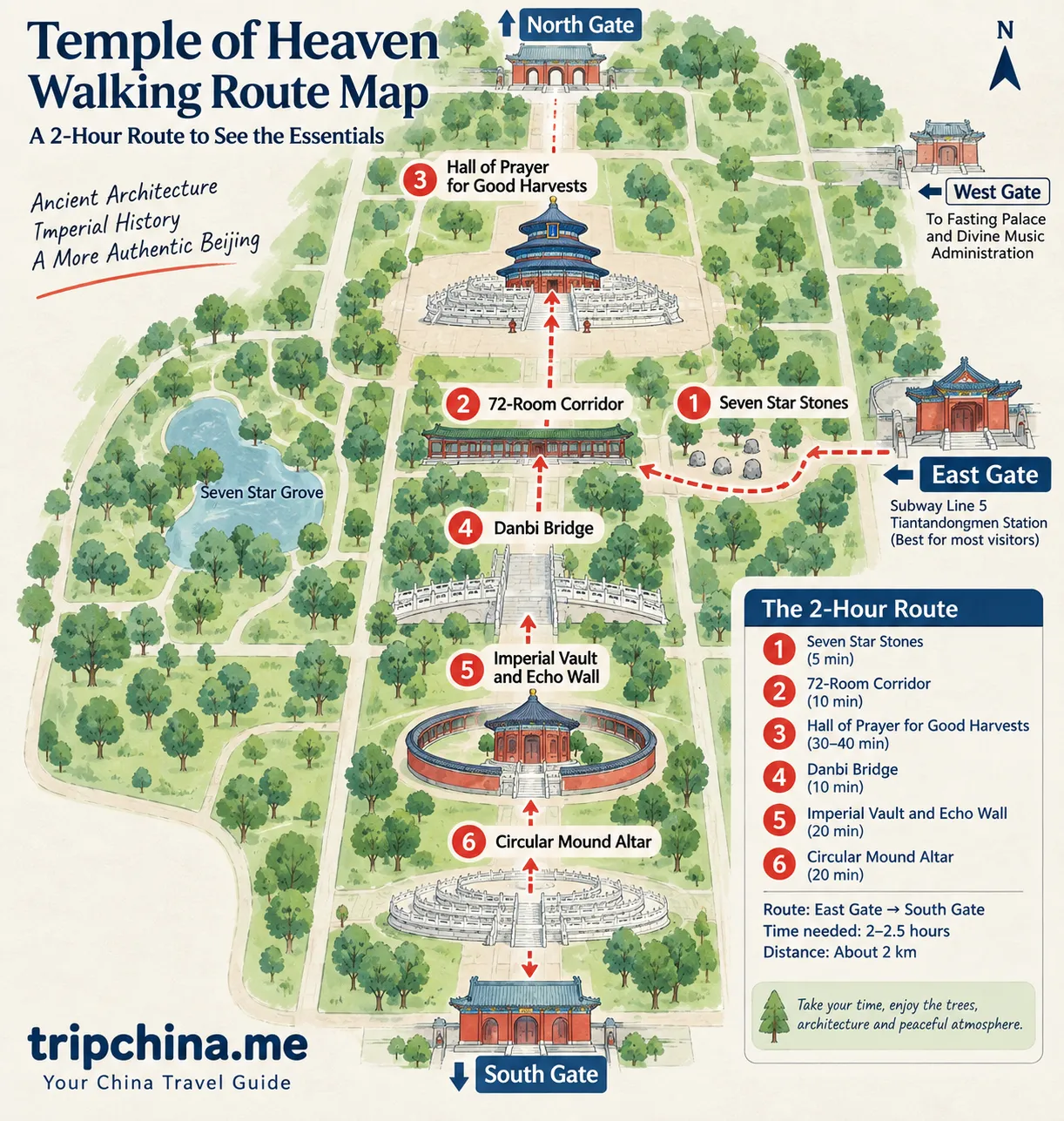
For a first visit, there is a much simpler way: enter from the East Gate, follow the major monuments south and finish at the South Gate. This guide shows you exactly how to do it in about 2–2.5 hours.
| Question | Quick Answer |
|---|---|
| Best entrance | East Gate |
| Best route | East Gate → Hall of Prayer → Echo Wall → Circular Mound → South Gate |
| Time needed | About 2–2.5 hours |
| Best time | Early morning or late afternoon |
| Monday | Core historic compounds closed; statutory-holiday Mondays may be exceptions |
| Best subway | Line 5, Tiantandongmen Station |
| Park closing | 22:00; last park entry 21:00 |
| Core monument hours | 08:00–18:00 peak (last entry 17:30) / 08:00–17:00 off-season (last entry 16:30) |
| Walking difficulty | Easy to moderate; mostly flat on this route |
All opening hours, Monday closures and lighting information below were checked in September 2026. Recheck before visiting.
If you still need to arrange admission before your visit, use TripChina’s separate Temple of Heaven ticket booking guide. This guide focuses on what to do once you arrive.
The park grounds remain open on Mondays, but the main historic compounds normally do not.
The Hall of Prayer for Good Harvests, Echo Wall, Circular Mound Altar, Fasting Palace, North Divine Kitchen and North Animal Sacrifice Pavilion have resumed their regular Monday closures.
Official rules provide an exception for statutory public holidays. In practical terms, this refers to official national holiday periods such as Spring Festival or National Day. Because arrangements can be adjusted for individual holiday periods, check that year’s Temple of Heaven notice if your visit falls on a holiday Monday.
The temporary summer arrangement that kept several historic areas open on Mondays ended on August 31, 2026.
If your only free day is Monday, the park can still be pleasant for walking and watching local life. But if the historic architecture is your reason for visiting, choose Tuesday through Sunday.
| Area | Peak Season: Apr 1–Oct 31 | Off-Season: Nov 1–Mar 31 |
|---|---|---|
| Park | 06:00–22:00 | 06:30–22:00 |
| Last park entry | 21:00 | 21:00 |
| Core historic attractions | 08:00–18:00 | 08:00–17:00 |
| Last entry to core attractions | 17:30 | 16:30 |
Do not confuse the park closing time with the monument closing time.
You can still be inside the wider park in the evening, but that does not mean you can enter the Hall of Prayer, Echo Wall or Circular Mound late at night.
The gate you choose matters more here than at many Beijing attractions. The park is enormous, and the four main entrances place you at very different points.
| Gate | Best For | Transport | Trade-Off |
|---|---|---|---|
| East Gate | First-time visitors | Line 5 | Best overall choice for the core route |
| South Gate | Following the ceremonial south-to-north route | Bus / taxi | Requires a gentle uphill walk |
| West Gate | Fasting Palace and Divine Music Administration | Line 8 | Farther from the main monuments |
| North Gate | Quick access to Hall of Prayer | Bus / taxi | Less convenient by subway |
Take Subway Line 5 to Tiantandongmen Station (天坛东门站). Exit A is the most convenient approach to the East Gate area.
For help with station names, transfers and payment, see the Beijing subway guide for foreign travelers.
The East Gate connects naturally to the most efficient sightseeing route:
East Gate → Hall of Prayer → Danbi Bridge → Echo Wall → Circular Mound → South Gate
It avoids unnecessary backtracking and follows the central monuments from north to south.
Entering from the South Gate reverses the route.
You begin with the Circular Mound, continue to the Imperial Vault and Echo Wall, then walk north across Danbi Bridge toward the Hall of Prayer.
Historically, this direction makes sense because the southern altar was central to the winter-solstice sacrifice.
The trade-off is simple: Danbi Bridge rises approximately three meters from south to north, so you are walking gently uphill.
The West Gate is useful if you specifically want to see the Fasting Palace (斋宫) or Divine Music Administration (神乐署).
Line 8 at Tianqiao Station provides subway access.
For a first 2-hour visit, however, the West Gate adds unnecessary walking.
The North Gate puts you relatively close to the Hall of Prayer for Good Harvests.
It is useful if you arrive by taxi or DiDi and want to minimize the walk before reaching the main monument.
If you plan to use ride-hailing elsewhere in Beijing, TripChina’s DiDi guide for foreign travelers explains setup and payment.
Allow about 2–2.5 hours for the essential route at a comfortable pace.
You can spend much longer in the 273-hectare park, but this route covers the monuments that matter most without unnecessary backtracking.
Route: East Gate → Seven Star Stones → 72-Room Corridor → Hall of Prayer → Danbi Bridge → Echo Wall → Circular Mound → South Gate
Soon after entering from the East Gate, look for the large stones arranged near the ancient cypress trees.
Despite the English name, you will see eight stones today. Seven were arranged earlier, while an eighth was added during the Qing period.
This is a quick stop. Allow about five minutes.
Continue toward the long covered corridor.
Historically, this area was connected with the preparation and transport of sacrificial offerings. Today it provides one of the most human glimpses of the park.
Instead of tour groups, you may see local residents sitting, talking, exercising or playing games beneath the corridor.
That contrast is worth noticing: the Temple of Heaven is both a UNESCO imperial monument and a functioning neighborhood park.
This is the building most visitors recognize immediately.
The Hall of Prayer rises about 38 meters above its three-tiered white-marble platform. Its circular blue roof has become one of Beijing’s most recognizable architectural images.
The first structure here dates to 1420. It was transformed during the Ming dynasty and received its present name during the Qianlong reign.
The interior column system is one of the most interesting details at the Temple of Heaven:
The point is larger than decorative symbolism. The building expresses the relationship between imperial ritual, time, astronomy and agriculture through architecture.
Important: Visitors may observe the hall interior from designated viewing areas; full free walking inside the hall is not permitted.
Photo tip: The classic view is from the front platform. For a cleaner composition, move toward the side corridors and use the red architectural frames around the Hall of Prayer.
Early morning gives you the best chance of avoiding large tour groups.
Walk south from the Hall of Prayer along Danbi Bridge.
Despite its English name, this is not a bridge over water. It is a broad raised ceremonial causeway connecting the northern and southern ritual complexes.
It stretches roughly 360 meters and is divided symbolically into routes associated with Heaven, the emperor and officials.
The surface rises from south to north. If you follow this guide from East Gate toward South Gate, you walk in the easier direction.
The Imperial Vault of Heaven stored tablets used in imperial sacrificial ceremonies.
Around its courtyard is the famous Echo Wall, a smooth circular wall designed in a way that allows sound to travel along its curved surface.
Yes, but conditions matter.
The official Beijing park authority still describes the wall’s acoustic effect and explains that its smooth masonry and curved surface allow sound waves to travel around the enclosure.
Try it with two people standing apart along the wall and speaking toward its surface.
In practice, crowds and background noise can make the effect difficult to hear. Early morning gives you a better chance than midday.
Treat it as a small experiment rather than expecting a dramatic theme-park echo.
Look for the stone slabs on the central approach to the Imperial Vault.
Traditionally, clapping or speaking from particular positions creates different echo patterns because of the relationship between the stones and surrounding architecture.
Again, quiet conditions make a significant difference.
The Circular Mound is a three-tiered white-marble altar associated with the emperor’s winter-solstice sacrifice to Heaven.
This is where the Temple of Heaven’s numerical symbolism becomes especially obvious.
The number nine and its multiples appear repeatedly in the stonework. In traditional Chinese cosmology, nine was associated with the highest yang number and with Heaven.
At the center of the upper platform is the Heaven’s Heart Stone (天心石).
Standing here places you at the visual center of a highly symmetrical ritual space. Sound can also feel unusually resonant because of the surrounding stone surfaces.
The architectural message is hard to miss: the emperor stood symbolically at the center of an ordered universe.
From the Circular Mound, continue south and leave through the South Gate.
If you are ready for lunch, explore local dining picks in TripChina’s Beijing Food Streets Guide rather than simply choosing the nearest tourist-facing restaurant.
For most travelers, early morning is the best overall window.
The park itself opens before the core monuments, so arriving early lets you see another side of the Temple of Heaven: Beijing residents exercising, walking, practicing tai chi and socializing beneath the trees.
Be near the core attraction entrance when it opens at 08:00.
Late afternoon is better for warmer photographic light, but watch the last-entry time for the historic compounds.
Spring is one of the easiest seasons for a long walk.
Temperatures are generally comfortable, flowers appear around the park and the summer heat has not arrived.
Crowds increase sharply around Chinese public holidays.
Expect heat, humidity and heavy visitor numbers.
The advantage is long daylight. Arriving early becomes particularly valuable because you avoid both midday heat and the biggest crowds.
For many visitors, autumn offers the best combination of weather and photography.
September and October often bring comfortable temperatures and warmer late-afternoon light. Golden foliage appears later in the season.
Winter can be cold, but weekday crowds are much lighter.
After snowfall, the blue roof, red walls and white marble platforms create one of the park’s most distinctive photographic combinations.
Do not plan a trip around a winter-solstice reenactment unless the park has officially announced one for your visit. Event schedules can change from year to year.
Yes, but treat the lighting as a bonus rather than the main visit.
The Hall of Prayer for Good Harvests landscape lighting normally activates on Friday and Saturday evenings, with additional lighting possible around major holidays.
The official 2026 Beijing guidance does not give one fixed clock time. Instead, it says the Hall is illuminated during the same period as Beijing’s street lighting, so the exact timing shifts with seasonal lighting arrangements.
Check the official Temple of Heaven website or on-site notice boards before planning a trip specifically around the lights.
Night lighting illuminates the exterior. It does not mean the core historic compounds reopen for nighttime sightseeing.
The strongest photo locations are:
A night visit cannot replace daytime sightseeing. The architectural details, interior views and acoustic sites are much easier to understand during normal monument hours.
The Temple of Heaven is not simply another imperial palace.
It was designed as a ritual landscape connecting Heaven, Earth, agriculture, time and imperial authority.
Blue represents the sky.
The Hall of Prayer’s blue-glazed roof therefore communicates its function before you understand any of the history.
Earlier versions of the structure used multiple roof colors. During the Qing dynasty, the roof was unified in blue, strengthening the association with Heaven.
Nine appears repeatedly at the Circular Mound because it was traditionally regarded as the highest single-digit yang number.
That made it particularly appropriate for an altar dedicated to Heaven.
Rather than thinking of these numbers as decoration, look at them as part of the building’s ritual language.
The Temple of Heaven’s larger layout reflects the traditional concept “Heaven is round, Earth is square” (天圆地方).
The northern boundary is rounded while the southern section is more angular.
This geometry turns the entire complex—not just one building—into a cosmological diagram.
Yes, but it makes for a full walking day.
Allow roughly 2–2.5 hours for the Temple of Heaven’s essential route and substantially more time for the Forbidden City.
A workable sequence is:
Early morning Temple of Heaven → late morning transfer → Forbidden City in the afternoon
Do not schedule the two attractions back-to-back without buffer time. Your actual transfer depends on the exit gate, Forbidden City approach, traffic and transport method.
More importantly, secure your Forbidden City reservation before building the day around this itinerary. Your confirmed Palace Museum entry time should determine the second half of the day.
TripChina’s Forbidden City ticket booking guide explains the reservation process, while the Forbidden City visitor guide covers the actual route.
Wear comfortable shoes. The essential route is manageable, but the park is enormous if you start exploring beyond the central monuments.
For navigation, save these Chinese names:
This article is part of the Beijing Travel Guide Hub.
Much of the outdoor park is relatively manageable, and the park has accessibility facilities, but historic monument platforms and individual routes can involve steps or access restrictions.
Visitors with significant mobility requirements should ask staff at the entrance for the current accessible route rather than assuming every historic staircase can be bypassed.
Yes. The Temple of Heaven’s official website lists audio guide rental at all four park gates, with English among the available languages.
Availability and rental conditions can change, so check at the entrance when you arrive.
Drones are heavily restricted across central Beijing. Do not plan to fly one at the Temple of Heaven without confirming that you have the required authorization and that the airspace is legally available.
Tripods and large camera gear are subject to current on-site park rules. Handheld personal photography is the safest default; equipment must not block visitor routes or affect protected heritage areas. Commercial filming requires separate authorization.
It may be.
The regular rule closes the core historic compounds on Mondays except statutory holidays. If a Monday falls within an official national holiday period, check the Temple of Heaven’s notice for that specific holiday before visiting, because special opening arrangements can be announced separately.
Yes—especially if you treat it as more than a blue-roof photo stop.
The Hall of Prayer is the visual icon, but the real value comes from seeing how the entire complex fits together: the seasonal symbolism of the columns, the raised Danbi Bridge, the acoustics around the Imperial Vault and the repeated use of nine at the Circular Mound.
For a first visit, keep it simple:
Enter through the East Gate. Follow the central route south. Allow 2–2.5 hours. And avoid Monday if the historic architecture is your priority.
Temple of Heaven Official Website
Beijing Municipal Government — Temple of Heaven Visitor Guide
Beijing Municipal Government — September 2026 Monday Closure Notice
Beijing Municipal Government — Temple of Heaven Night Lighting
Updated September 2026. This route guide was checked against the Temple of Heaven official website and current Beijing municipal government guidance. Opening hours, Monday closures and night-lighting arrangements reflect current 2026 notices. Ticket prices, passport booking procedures and payment instructions are intentionally covered in TripChina’s separate Temple of Heaven ticket guide rather than duplicated here. Temporary holiday opening arrangements and lighting schedules should be rechecked shortly before visiting.
TripChina.me creates practical China travel guides shaped by real local experience, helping independent travelers navigate transport, payments, food, neighborhoods, and the cultural details that make traveling in China easier and more meaningful. Find the guide for your destination at tripchina.me.