Our Location:
No. 99, Jiazi Road, Chengdu

 authorChris Lee
798 looks simple on a map. It is not. Former factory buildings, galleries, cafes, murals and side streets spread across a large industrial complex, and wandering without a plan can waste half your visit. This guide gives you a practical 3–4 hour route through the strongest parts of Beijing 798 Art District, explains which exhibitions deserve your time, and shows you when Monday is actually worth considering.
| Question | Quick Answer |
|---|---|
| Is it free? | Yes. Outdoor areas are free; individual exhibitions may charge |
| Time needed | 3–4 hours for the core route |
| Best subway | Gaojiayuan, Line 12; allow time to walk into the district |
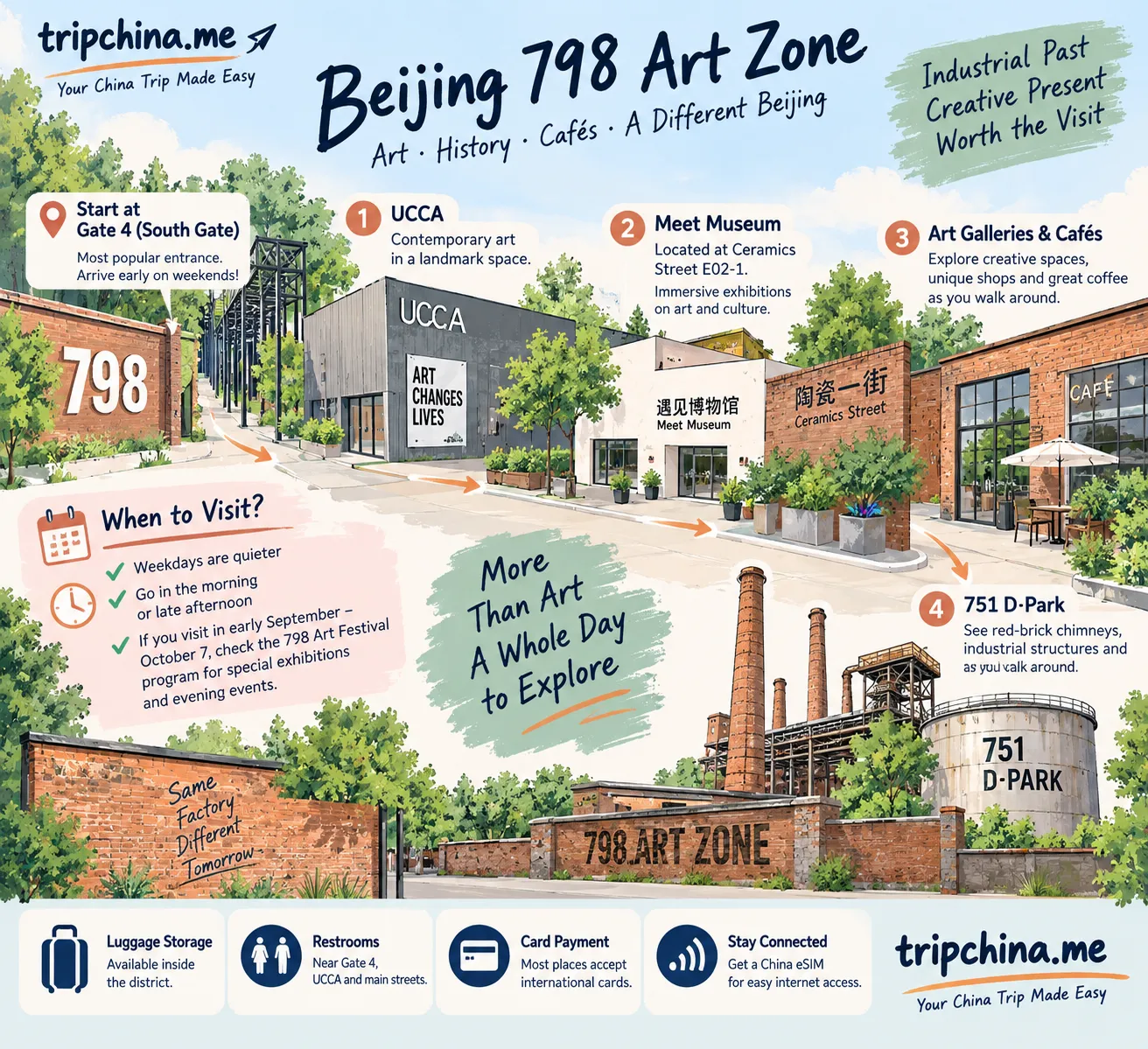
| Best route | South Gate (Gate 4) → UCCA → Bauhaus Plaza → Train Square → 751 |
| Best days | Tuesday–Friday |
| Monday verdict | Good for photos and architecture; poor for major exhibitions |
As of September 2026, the official 798 visitor guide says the district itself is open throughout the day and requires no general admission reservation. Art institutions and galleries typically operate around 10:00–18:00 or 11:00–19:00, while individual schedules vary.[1]
Before going, search “798艺术区” in WeChat and open the 798 Art District official WeChat mini-program. It provides current exhibitions, free-entry listings and reservation information.[1]
Important: Some exhibitions described as free still require a ¥0 reservation order through the official mini-program. Check this before arriving.
Yes—if you understand what it is.
798 is not one giant museum. It is a former electronics-factory complex that evolved into a contemporary-art and creative district. The experience comes from combining industrial architecture, public art, graffiti, galleries, design shops and unexpected discoveries rather than racing through a checklist of museums.
It works particularly well for first-time visitors who want something beyond Beijing’s imperial landmarks. If you are also planning the classics, TripChina’s Forbidden City Beijing guide helps you plan the historic side of the city.
798 is a good fit for:
Consider skipping it if:
If you are deciding how 798 fits into a wider Beijing itinerary, the Beijing Travel Guide Hub is the better starting point.
The subway is the simplest choice for most international visitors.
Yes.
Gaojiayuan Station (高家园站), Line 12 is the closest subway option, but published walking times vary depending on which entrance or venue is being measured.
For practical planning, budget roughly 15–20 minutes to walk from the subway area into 798 and reach your intended entrance or first stop. Do not interpret “closest subway” as meaning the station exit is inside the art district.
Once inside the district, walking times between a nearby entrance and UCCA can be considerably shorter. The difference explains why some venue-specific directions quote shorter walking times.
Wangjing South Station (望京南站), Line 14 remains a practical and familiar approach. UCCA estimates roughly a 15-minute walk from Wangjing South.
Jiangtai Station (将台站), Line 14 is another option, also followed by a walk into the district.
The official 798 visitor guide lists multiple subway approaches, so the best station can depend on which entrance you want to use.[1]
If this is your first time using Beijing public transport, read TripChina’s Beijing subway guide for foreign travelers before leaving your hotel.
Yes. Search for:
798艺术区
北京市朝阳区酒仙桥路2号
Because 798 has multiple entrances and internal streets, save the Chinese name of your intended destination rather than simply asking for “798.”
If you have not used Chinese ride-hailing before, TripChina’s DiDi guide for foreign visitors explains setup, payment and pickup.
You can, but there is little reason for most overseas visitors to do so.
Official 798 WeChat guidance has listed ¥1.50 per 15 minutes (¥6/hour) for small vehicles during daytime periods. However, individual parking lots can use slightly different tariffs, so check the posted rate when entering rather than assuming one price applies across the entire district.
For international visitors staying in central Beijing, subway or DiDi is usually simpler.
For a first visit, start your core route at South Gate (Gate 4 / 4号门) and move broadly north toward 751 D·Park. This gives you a logical progression through the main art and industrial areas without excessive backtracking.
On weekends, the southern entrance and central streets can become noticeably busier later in the day. If photography matters, arriving near opening time gives you more space around Gate 4 and the first graffiti streets.
| Stop | Suggested Time | What to Do | Pay? |
|---|---|---|---|
| South Gate + graffiti streets | 15–20 min | See murals and first factory views | Free |
| Meet Museum | 0–60 min | Check the current show; skip if it does not interest you | Exhibition-dependent |
| UCCA | 60–90 min | Prioritize the main contemporary-art exhibition | Usually ticketed |
| Bauhaus Plaza | 15–20 min | Architecture and classic 798 photography | Free |
| Train Square | 15–20 min | Industrial landmark and locomotive photos | Free |
| Side galleries / design shops | 30–45 min | Browse independent spaces; enter only if a show catches your eye | Mixed |
| 751 D·Park | 30–45 min | Explore large-scale industrial remains | Outdoor areas free |
Do not begin by immediately disappearing into a museum.
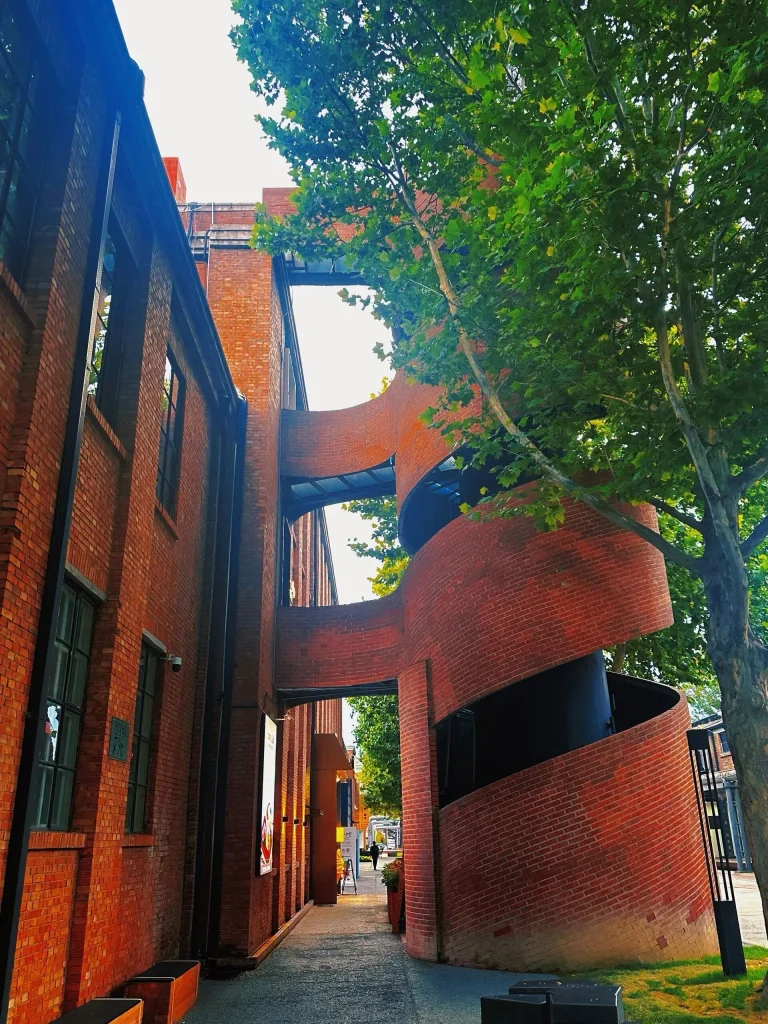
Spend your first 15–20 minutes looking at the industrial setting: red brick, exposed pipes, factory façades, murals and public artworks.
The street art changes over time, which is part of the appeal. Instead of trying to reproduce an old Instagram shot exactly, treat the first section as a visual introduction to the district.
For photography, step back far enough to include both the artwork and the industrial buildings. The contrast is what makes 798 look like 798.
Image suggestion: Wide view of the red-brick industrial buildings, exposed pipes and graffiti near the southern entrance.
Suggested alt text: “Red brick factories, industrial pipes and street art at Beijing 798 Art District”
Meet Museum (遇见博物馆) hosts changing temporary and immersive exhibitions.
The Beijing 798 branch is at E02-1, Taoci 1st Street (陶瓷一街), so it fits naturally with browsing the ceramics and design spaces nearby.[5]
Its programming can change substantially, so the practical rule is simple: check the current exhibition before buying a ticket.
Some shows may be exactly what you want. Others may add little if you already plan to spend substantial time at UCCA.
Allow around an hour only when the current exhibition genuinely interests you. Otherwise, keep moving. Opening hours, ticketing arrangements and Monday schedules should be confirmed with Meet Museum before your visit.[5]
UCCA Center for Contemporary Art (尤伦斯当代艺术中心) is the strongest major art institution to prioritize on a first 798 visit.
It opened in 2007 and occupies former industrial buildings at the heart of the district. Today, UCCA describes its Beijing venue as a roughly 10,000-square-meter contemporary-art center.
As of September 2026:
Opening hours: Tuesday–Sunday, 10:00–19:00
Last entry: 18:30
Monday: Closed
Tickets: Price varies according to the exhibitions on view.[2]
Tickets can be purchased through UCCA’s official WeChat platform or at the UCCA Beijing front desk. UCCA states that cash and credit cards are accepted at the front desk; its website does not currently provide international online ticket sales.[2]
As of September 2026, the current major exhibition is Carsten Höller: Two, running from July 14, 2026 to January 31, 2027.[3]
Allow 1–1.5 hours if you enter.
The UCCA shop is also one of the more reliable places in 798 for art books, design objects and exhibition-related merchandise.
Image suggestion: Exterior of UCCA framed by the preserved factory architecture.
Suggested alt text: “UCCA Center for Contemporary Art inside Beijing 798 Art District”
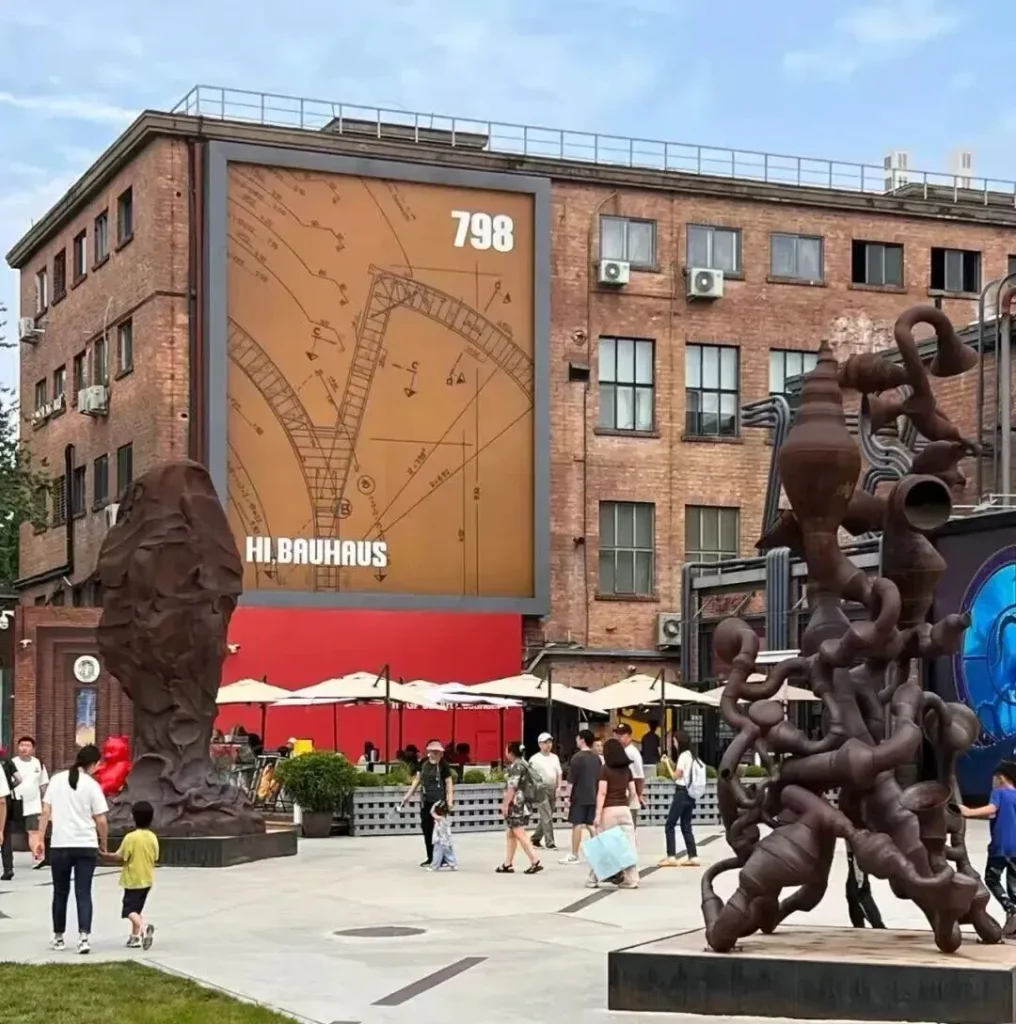
798’s industrial architecture is not just a background for galleries. It is one of the reasons to come.
The Bauhaus-influenced factory buildings originated in the former electronics-industrial complex built with East German involvement during the 1950s. The old production spaces, sawtooth roofs and functional industrial forms later became unusually well suited to galleries and studios.
Around Bauhaus Plaza, look for the familiar red 798 imagery and clean industrial lines.
At busy times, expect other visitors waiting for photographs. Take the classic shot, then move on rather than spending half an hour trying to get an empty frame.
The old locomotive and railway elements around Train Square are among the district’s most recognizable industrial features.
For photographs, use a low angle from a safe public viewing position near the platform or pathway to emphasize the locomotive against pipes and factory structures.
Do not climb onto tracks, rolling stock or industrial structures just to reproduce a photograph.
Late-afternoon light can work particularly well here because the pipes and machinery create stronger shadows.
Image suggestion: Vintage locomotive photographed from a low angle with industrial pipes behind it.
Suggested alt text: “Vintage locomotive at Train Square in Beijing 798 Art District”
This is where 798 becomes more interesting.
Do not try to enter every gallery. Browse the independent small galleries and design shops, and enter only when the current show actually catches your eye.
A small gallery with no queue may turn out to be more memorable than a heavily advertised commercial exhibition.
Use the official mini-program when you need to check whether a particular exhibition is free, ticketed or requires a reservation.[1]
Finish toward 751 D·Park, the neighboring industrial complex.
The transition is almost seamless. 751 has large pipes, old machinery, brick industrial structures and open factory spaces. It often feels less commercially concentrated than the busiest parts of 798.
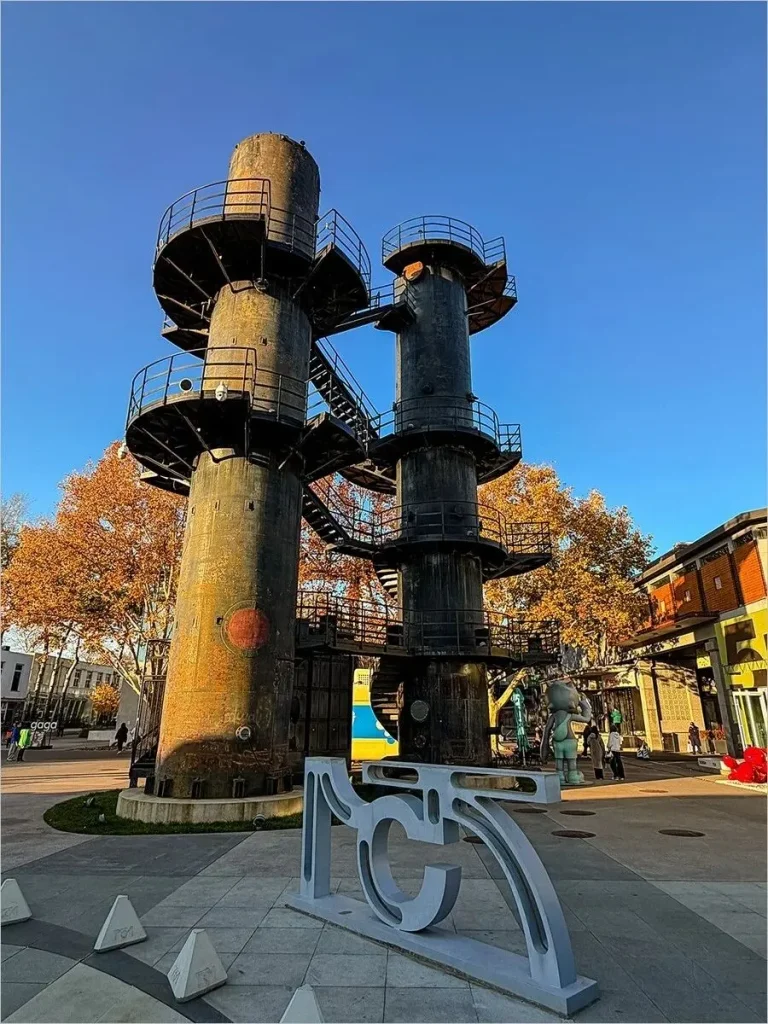
Around the former furnace and industrial areas, look for red-brick chimneys, large machinery and preserved heavy-industrial structures. The fuel-tank and furnace areas are particularly useful visual anchors for the industrial character of 751.
Photographers should leave at least 30–45 minutes for this end of the route.
Many visitors underestimate how far northeast 798 sits from Beijing’s historic center. Do not casually add it after a packed Forbidden City day without allowing for transport time.
Image suggestion: Red-brick chimney, pipes and preserved machinery at 751 D·Park.
Suggested alt text: “Industrial chimney and preserved factory machinery at 751 D Park Beijing”
| Time Available | Route | Best For |
|---|---|---|
| 2–3 hours | Outdoor core → UCCA → Bauhaus Plaza → Train Square | First visit with limited time |
| 3–4 hours | Core route + one major exhibition + side galleries | Best overall balance |
| 5–6 hours | Core route + multiple galleries + White Box / Ceramics Street + 751 | Art-focused travelers |
| Monday only | Architecture + graffiti + cafes + outdoor photography | Photographers, not exhibition-first visitors |
White Box Art Museum (白盒子艺术馆): An experimental contemporary-art venue in B07. Check its current opening schedule and admission before going; do not assume every exhibition is free.
Ceramics Street (陶瓷一街): A useful shorthand for the ceramics and design-workshop area. Meet Museum’s Beijing 798 branch is also located here at E02-1.
Individual studios and workshops can change, so treat Ceramics Street as an area to browse rather than planning your visit around one specific workshop unless you have confirmed it is operating.
More independent galleries: This is a better use of extra time than trying to squeeze in every commercial “immersive” exhibition.
If you arrive from the north, simply reverse the core route: 751 D·Park → Train Square → Bauhaus Plaza → UCCA → southern/core streets.
The answer changes constantly.
That is why a permanent list of “free galleries” is less useful than it looks.
| Type | Typical Cost | How to Decide |
|---|---|---|
| Outdoor art / architecture | Free | Always worth including |
| Independent galleries | Often free, but varies | Walk in if the current show interests you |
| UCCA | Variable | Strong priority for serious contemporary art |
| 798CUBE | Exhibition-dependent | Check the current show and price |
| Meet Museum | Exhibition-dependent | Buy only if the specific exhibition appeals |
| Temporary / special exhibitions | Free or ticketed | Verify in the official mini-program |
The official 798 visitor guide says some free exhibitions still require a ¥0 reservation order through the mini-program.[1]
That distinction matters. “Free exhibition” does not always mean “walk through any door without checking.”
No.
It is better described as the standout paid art institution to prioritize, not the only worthwhile paid venue.
798CUBE is another substantial venue. Its schedule and holiday arrangements should be checked before visiting rather than assuming the normal Monday closure applies on every public-holiday date.[4]
MACA Art Center and other institutions also host changing exhibitions.
The practical rule is simple:
Choose by the exhibition, not just by the venue name.
Yes—if your goal is photography, architecture and atmosphere.
No—if your main reason for going is to see major indoor exhibitions.
This is more accurate than saying “never visit on Monday.”
UCCA is closed Monday.[2] 798CUBE normally follows a Monday closure schedule, while the official district guide more broadly notes that some exhibitions close on Monday rather than claiming the entire art zone shuts down.[1][4]
The outdoor district remains accessible, so Monday has one genuine advantage: quieter streets can make industrial and architectural photography easier.
If you only have Monday available, focus on:
If exhibitions are your priority, choose Tuesday through Sunday, ideally a weekday.
Tuesday–Friday gives the best balance.
More galleries are open than on Monday, while weekday streets are generally calmer than weekends.
Avoid inventing precise crowd multipliers such as “weekends are 3–4 times busier” or “Tuesday has 70% fewer visitors.” Those observations may feel true on individual visits, but they are not official visitor-count statistics.
Aim for roughly 10:30–11:00 if exhibitions matter.
That puts you in the district after most major venues begin opening and still leaves enough time for a relaxed 3–4 hour route.
The official 798 guide says art institutions and galleries generally operate either 10:00–18:00 or 11:00–19:00. Cafes and restaurants often stay open later, typically around 10:00–22:30, though individual businesses set their own hours.[1]
If you visit between September 4 and October 7, 2026, the 20th 798 Art Festival is running across the district.
The festival’s theme is “Openness · Resonance” (开放·和鸣) and includes themed exhibitions, public art, technology-focused programming and other events. A 798 Night Tour Map (798夜游地图) connects restaurants, drinks, cultural retail and other evening venues, making the district more active after normal gallery hours than on an ordinary visit.
If your dates fall within the festival period, check the current festival and official mini-program listings before deciding when to leave. Temporary programming changes week by week.
Spring and autumn are the easiest seasons for a walking-heavy visit.
Summer means heat and more time seeking air-conditioning. Winter can be cold outside, but the galleries provide natural indoor breaks.
Because a typical visit involves several kilometers of walking and repeated indoor/outdoor transitions, comfortable shoes matter more here than at a conventional museum.
Neither is accurate.
Monday is poor for a gallery-focused visit but can work well for quiet outdoor photography.
Decide according to what you actually want to do.
Do not.
Choose one or two serious exhibitions. Let the rest of the visit remain flexible.
If a small gallery catches your attention, walk in. If it does not, keep moving.
Some are simply free entry. Others may require a ¥0 reservation through the official mini-program.
A venue may also contain a mix of free and ticketed programming.
Check before entering.
Expect several kilometers of walking on concrete, brick and older industrial surfaces.
A deep visit can easily become a 10,000-step day when transport and detours are included.
Wear proper walking shoes.
The busiest central streets contain the most obvious photo spots. Smaller galleries, studios and cafes are scattered throughout the lanes.
If you enjoy this kind of slower neighborhood exploration, TripChina’s Beijing hutong walking routes offer a very different, more traditional version of Beijing on another day.
Alipay and WeChat Pay are widely useful in Beijing for cafes, shops and everyday purchases.
Set up payment before you arrive. TripChina’s China payment guide for foreign visitors explains mobile payments, international cards and cash backup.
For Alipay specifically, see the Alipay setup guide for foreigners.
A modest amount of RMB cash is still a sensible backup. Individual galleries, temporary stalls and events can use different payment arrangements.
Before your China trip, install the essential apps for foreign travelers and arrange mobile data with an eSIM or local SIM strategy.
798 is exactly the kind of place where navigation, translation, exhibition listings and mobile payment all matter at the same time.
798 has enough cafes and restaurants to make a full afternoon easy, but food should not dictate your art route.
Coffee is everywhere.
Rather than crossing the district for one specific cafe that may later close or rebrand, choose a convenient shop near the point where you want a break. This keeps the guide useful even as individual tenants change.
Expect specialty-coffee pricing rather than neighborhood-local pricing.
For a completely different coffee experience elsewhere in the city, TripChina’s best hutong coffee shops in Beijing focuses on cafes inside Beijing’s older neighborhoods.
Yes, if convenience matters.
If value matters more, walking toward the surrounding Jiuxianqiao area gives you a wider range of everyday restaurants.
Restaurants inside a creative district naturally change faster than historic attractions, so check the current map rather than planning an entire visit around an old restaurant recommendation.
For broader shopping and lifestyle districts elsewhere in Beijing, see TripChina’s Beijing shopping districts guide.
Go earlier if you want cleaner frames.
Shoot straight on for the recognizable 798 composition, then step sideways to bring the industrial architecture into the frame.
Suggested image alt: “Bauhaus industrial architecture and red 798 sign in Beijing Art District”
Use a low angle from a safe public position near the locomotive and surrounding industrial structures.
Do not climb onto the tracks, train or industrial equipment for a photograph.
Late afternoon often gives the machinery stronger texture and shadow.
Suggested image alt: “Train Square locomotive and industrial architecture at Beijing 798 Art District”
Step across to the opposite side of the public roadway or pedestrian area when safe. This gives you enough distance to photograph the full artwork rather than cutting off the edges.
Suggested image alt: “Colorful graffiti and murals in Beijing 798 Art District”
Some of the strongest photographs are not at designated “Instagram spots.”
Look for quieter combinations of pipes, brick, windows, signs and old machinery, especially as you move toward 751 D·Park.
Suggested image alt: “Red brick factory buildings and industrial pipes at Beijing 798”
Even if you do not enter, the former industrial buildings around UCCA help explain how 798 transformed from a manufacturing complex into an art district.
Always follow individual venue photography rules once you move indoors.
Suggested image alt: “UCCA contemporary art center and former factory buildings in Beijing 798”
If you need a restroom, check around the larger cultural venues and public-service points near the central 798 area rather than waiting until you reach the quieter industrial sections.
Around Gate 4 and UCCA, use the current district map or ask venue staff for the nearest public restroom. Locations and accessibility can change, so avoid relying on an old static map.
Yes—but skip generic souvenirs unless you genuinely like them.
The UCCA shop is a stronger first stop for art books, exhibition merchandise and curated design objects.
For ceramics and independent design, explore the smaller studios and shops around the ceramics-workshop area rather than buying the first mass-produced “798” souvenir you see.
Prices and tenants change too quickly to make fixed shopping budgets reliable. Compare before buying, especially for handmade ceramics, jewelry or limited-edition art objects.
Outdoor pet policies can vary by area and event, and individual museums set their own rules.
Do not assume a pet-friendly outdoor district means pets are allowed inside galleries. For example, 798CUBE explicitly prohibits pets inside its exhibition venue.[4]
Check with the specific gallery or cafe before entering.
Do not assume you can.
Individual venues prohibit drone equipment indoors, and drone operation in Beijing is subject to broader aviation and security restrictions beyond the control of 798 itself.
For an ordinary tourist visit, plan on ground-level photography.
Outdoors, use photography equipment only where it does not obstruct pedestrians or controlled areas.
Indoors, rules depend on the institution and exhibition. 798CUBE, for example, states that tripods, selfie sticks and similar equipment may not be used without permission.[4]
When in doubt, ask staff before setting up equipment.
Do not assume that one district-wide luggage-storage system covers every visitor.
Individual institutions may offer storage for visitors. For example, 798CUBE states that rolling suitcases and bags larger than 40 cm must be left at its free lobby storage area before entering.[4]
UCCA and other venues can have their own visitor procedures, so check directly if you are carrying a large bag.
If you have a full-size suitcase, hotel storage remains the simplest option. Avoid building your day around old third-party claims about exact locker locations or fixed storage prices unless you verify them shortly before visiting.
This article is part of the Beijing Travel Guide Hub.
A straightforward core route is manageable, but gallery detours quickly add distance. Expect several kilometers of walking during a 3–4 hour visit, and considerably more if you continue through 751 D·Park and multiple side streets.
Uneven industrial surfaces can feel more tiring than the raw distance suggests.
Not necessarily. UCCA currently allows tickets to be purchased through its official WeChat platform or at the UCCA Beijing venue’s front desk.[2]
On weekends, holidays or for a high-demand exhibition, checking availability before traveling is still sensible.
Yes. UCCA says its Beijing front desk accepts cash and credit cards, while its website currently does not support international online ticket sales.[2]
This makes the front desk useful for overseas visitors who cannot complete WeChat ticketing.
Not district-wide. Some individual venues offer bag storage, but for a full-size suitcase, your hotel is the simplest and most reliable option.
Yes. Check the current district map or ask staff at a major venue such as UCCA for the nearest facility.
Do not wait until you are deep inside the quieter industrial sections if restroom accessibility matters to you.
Partially.
The outdoor district can be explored on paved surfaces, but some sections are uneven because of brick and older industrial paving.
Major institutions are generally easier to navigate than small galleries converted from historic factory spaces. If step-free access is essential, confirm accessibility directly with the specific venues you intend to visit.
Strongly recommended.
Do not rely on continuous public Wi-Fi across the outdoor district. Mobile data makes it much easier to use WeChat, check exhibition information, navigate between galleries, translate signs and complete any ¥0 exhibition reservations.
Yes. The 20th Beijing 798 Art Festival runs from September 4 to October 7, 2026, under the theme “Openness · Resonance.”
The program includes themed and parallel exhibitions, public art and technology-focused activities. The festival also introduces a 798 Night Tour Map, connecting restaurants, drinks, cultural retail and other evening venues. If you visit during this period, check the current festival program because activities change throughout the month.
For travelers interested in contemporary Beijing, yes.
The strongest visit is not about seeing every gallery. Give yourself 3–4 hours, choose one major exhibition that genuinely interests you, walk the industrial streets, photograph the architecture, and continue toward 751 D·Park.
If you visit on Monday, change the objective rather than cancelling automatically: go for architecture and quieter photographs. If art exhibitions are the priority, visit Tuesday through Sunday.
That distinction is what turns 798 from a confusing factory maze into one of Beijing’s most interesting modern-city walks.
[1] 798 Art District — Official Visitor Guide
[2] UCCA Center for Contemporary Art — Visit
[3] UCCA Center for Contemporary Art — Current Exhibitions
[4] 798CUBE — Official Visitor Information
[5] Meet You Museum — Official Website
Updated in September 2026 using official 798 Art District, UCCA, 798CUBE and Meet You Museum information, plus current Beijing government reporting on the 2026 798 Art Festival. Variable details—including Meet Museum’s 798-branch hours and ticketing, White Box admission, ceramics workshops, parking and holiday schedules—should be checked before visiting. Some free exhibitions require a ¥0 reservation through the official mini-program, so check current listings before arrival.
TripChina.me creates practical China travel guides shaped by real local experience, helping independent travelers navigate transport, payments, food, neighborhoods, and the cultural details that make traveling in China easier and more meaningful. Find the guide for your destination at tripchina.me.