Our Location:
No. 99, Jiazi Road, Chengdu

 authorChris Lee
China’s railway system is fast, extensive and generally easy to use once you understand how its stations work. For most foreign travelers, taking a train in China is easier than it looks. The real challenge is navigating the station: finding the correct terminal, passing passport checks, locating the boarding gate and knowing when to board.
This guide explains what happens after your ticket has been confirmed: how to prepare, enter the station with a passport, pass security, find the correct waiting area, board the train and exit or transfer at your destination.
If you have not purchased your ticket yet, start with our guide to buying China train tickets as a foreigner, including 12306, Trip.com, passport verification and payment options.
To take a train in China as a foreigner:
China mainly uses electronic train tickets. Foreign travelers normally do not need to print or collect a paper ticket, but they must carry the original identification document connected to the booking.
This guide covers travel within mainland China, not cross-border train journeys.
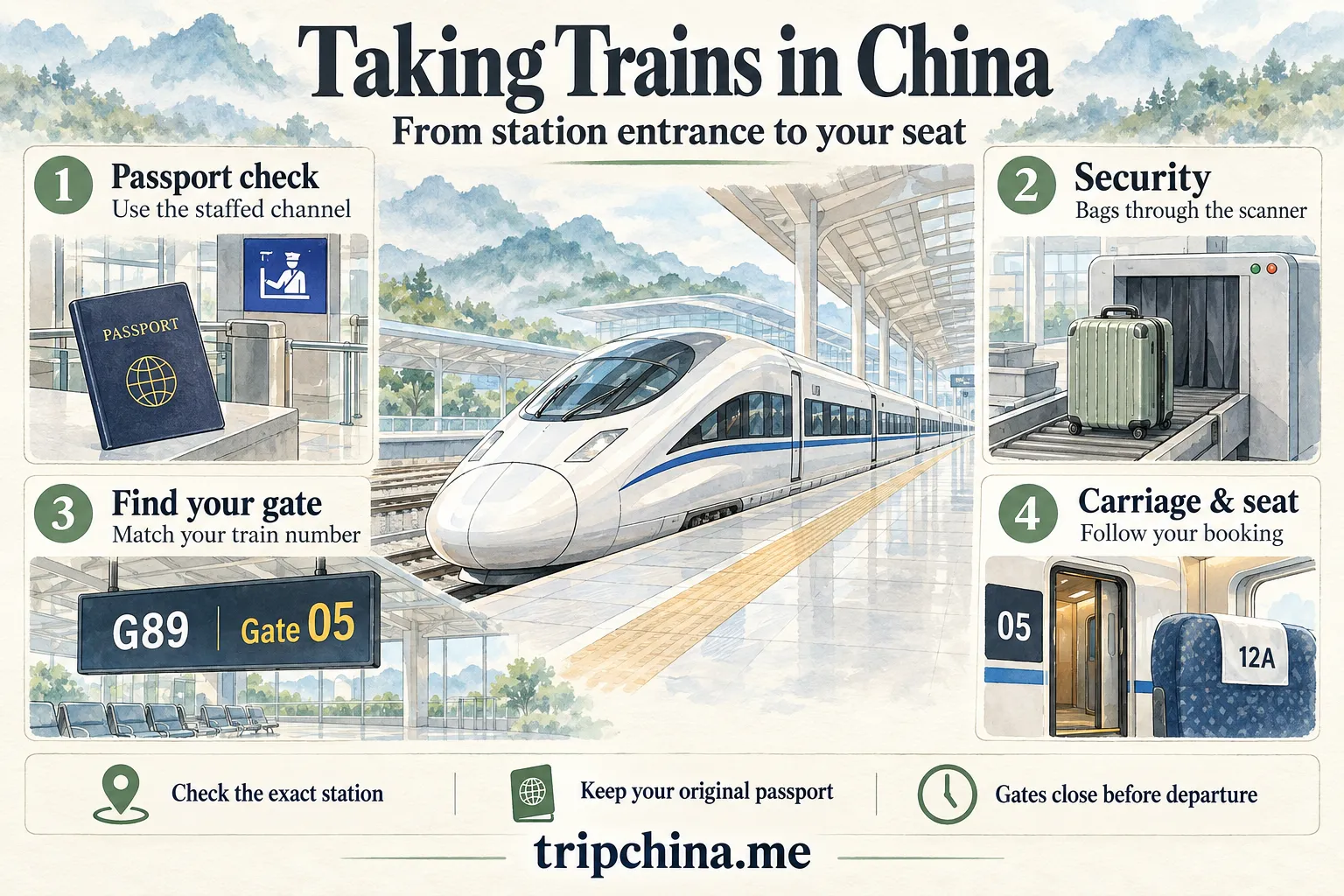
A smooth train journey begins before you leave your hotel.
Check the following details on your ticket confirmation:
Take a screenshot of the ticket information in case your internet connection becomes unreliable inside the station.
The screenshot is useful for finding your train and asking for assistance, but it does not replace the original passport used for the booking.
Large Chinese cities usually have several railway stations. These stations can be far apart and are not interchangeable.
For example:
Similarly, Shanghai has Shanghai Railway Station, Shanghai Hongqiao and Shanghai South, while Chengdu has several major stations serving different routes.
Do not tell a taxi or ride-hailing driver only the city name. Show the complete station name in Chinese from your ticket confirmation. If you are booking a ride, our DiDi guide for travelers with overseas phone numbers explains how to arrange it.
Before leaving, save the full station name in Chinese and allow enough time for traffic, metro transfers and finding the correct entrance.
If your ticket says Beijing South, arriving at Beijing West will not allow you to board the train. For the metro journey to your departure station, check how to use Beijing’s subway. In Chengdu, use our metro guide for foreign travelers to plan the local connection before setting out.
Use these TripChina planning buffers, measured from arrival at the station building—not from leaving your hotel. They are recommendations, not official check-in deadlines.
| Situation | Recommended arrival before departure |
|---|---|
| First journey at a large station | 60–75 minutes |
| First journey at a smaller station | 45–60 minutes |
| Experienced traveler at a large station | About 45 minutes |
| Chinese New Year, National Day or May Day peak | At least 90 minutes; allow more if you need counter assistance |
Large stations may require extra time for passport checks, security, long walks through the terminal and finding the correct boarding gate. Check the Chinese holiday travel calendar when choosing your arrival buffer.
Boarding gates close before the scheduled departure time, so arriving at the station building 15 minutes before departure is risky. Follow your station’s posted boarding cutoff.
Bring the original passport used to purchase the ticket.
China Railway also accepts a Foreign Permanent Resident ID Card. Station ticket counters accept additional documents, including a Foreigner’s Exit-Entry Permit and a passport-loss report certificate issued by the public security authorities. Online booking accepts a narrower document list, so do not assume every document can be used in an app. Use the same valid document for booking and travel; if it has been replaced, ask staff how to update or verify the booking.
Keep your ticket confirmation and destination address available on your phone. A passport photograph or photocopy can be useful as an emergency backup, but it does not normally replace the original passport for routine train travel.
Chinese train numbers usually begin with a letter indicating the type of service.
| Train code | General type | Typical use |
|---|---|---|
| G | High-speed train | Fast intercity journeys |
| D | Electric multiple-unit train | High-speed or regional journeys |
| C | Intercity train | Short-distance connections |
| Z | Direct express | Longer conventional routes |
| T | Express train | Conventional long-distance routes |
| K | Fast train | Slower and often less expensive routes |
G and D services are generally faster than conventional K and T services, which may offer lower fares or serve smaller stations. The letter is a general service category, not a guarantee of journey time.
Your train number is more important inside the station than the English spelling of your destination.
Departure boards are organized around train numbers such as G89, D307 or K117. Confirm both the number and departure time before following a gate displayed on the screen.
Train speeds, layouts and onboard facilities vary by route and rolling stock, so treat the code as a general guide rather than a guarantee of a specific experience.
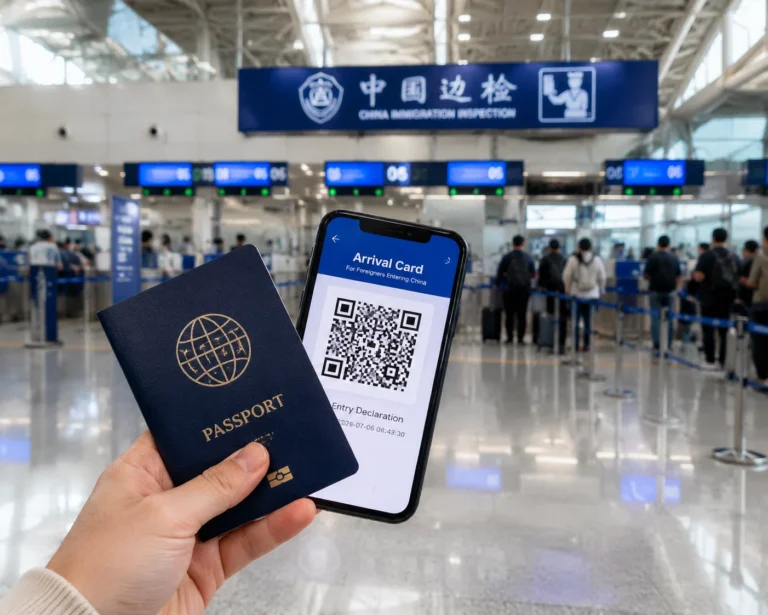
At the station entrance, passengers normally pass an identity and ticket check before entering the main departure hall.
Have your passport open to the information page.
Foreign passport holders should normally use the staffed manual channel (人工通道). China Railway’s entry-and-exit FAQ directs passengers using documents outside its listed automatically readable categories to manual checks.
Depending on the station, you may find:
If staff direct you to a passport-compatible reader, follow their instructions. Do not assume every automatic gate accepts foreign passports. If a reader fails, move to the staffed channel rather than repeatedly retrying.
Show the staff member:
Chinese railway stations use airport-style security screening, although passengers do not normally need to remove shoes or follow the full airport process.
Place your luggage, bags and loose items on the X-ray conveyor. You may also need to pass through a metal detector.
Security staff may ask to inspect:
Rules for restricted items and batteries can change. Check current China Railway guidance if you plan to carry camping equipment, professional tools, large quantities of cosmetics, alcohol or high-capacity batteries.
Clearly prohibited items include weapons, ammunition, explosives and many flammable or dangerous materials.
Do not pack important documents at the bottom of your luggage. Keep your passport and phone accessible because you will need them again at the boarding gate.
After security, look for a large electronic departure board.
Find your journey using:
The train number is usually the safest reference because English destination names may be abbreviated or translated differently.
Useful status words include:
| Chinese | Pinyin | Meaning |
|---|---|---|
| 候车 | hòuchē | Waiting |
| 检票 | jiǎnpiào | Boarding/checking tickets |
| 停止检票 | tíngzhǐ jiǎnpiào | Boarding closed |
| 晚点 | wǎndiǎn | Delayed |
| 正点 | zhèngdiǎn | On time |
| 检票口 | jiǎnpiàokǒu | Boarding gate |
| 进站口 | jìnzhànkǒu | Station entrance |
| 出站口 | chūzhànkǒu | Station exit |
| 人工通道 | réngōng tōngdào | Staffed manual channel |
| 服务台 | fúwùtái | Service desk |
| 派出所 | pàichūsuǒ | Police station / railway police office |
Some large stations divide waiting areas by gate number, while others use separate halls or floors.
Do not rely only on the platform number. In many Chinese stations, the platform is not accessible until boarding begins.
Once you locate the gate, check that the train number displayed above it matches your ticket.
Several trains may use the same gate at different times. A crowd forming near a gate does not necessarily mean your train is boarding.
Keep watching the screen for changes. At major stations, announcements are often made in Chinese and English, but smaller stations may provide limited English information.
Boarding commonly begins shortly before departure and closes several minutes before the scheduled departure time. Exact timing varies by station and train.
Stay close enough to see the display, especially if your Chinese listening ability is limited.
When boarding begins, show the original identification document connected to your electronic ticket.
Foreign passport holders normally use the staffed manual channel. If a gate is explicitly marked for passports and staff confirm that you can use it, open your passport to the information page and follow the scanner instructions. Otherwise, go directly to the staffed passage.
If the passport does not scan, show it to a staff member.
Do not panic if the gate rejects your passport. This is often an equipment or scanning issue rather than a problem with the ticket.
If staff cannot locate the booking, show the ticket confirmation and verify that:
After passing the gate, follow signs and staff instructions to the platform.
Your booking confirmation will show a carriage number, for example:
05车 12A
This means:
Platforms may have numbered sections or colored ground markers showing where each carriage is expected to stop.
Look for your carriage number before the train arrives. This reduces the need to walk through several crowded carriages after boarding.
Train formations can occasionally change, so follow the electronic signs and staff directions if the platform markers do not match your ticket.
Stand behind the safety line and allow arriving passengers to leave before boarding.
Carriage numbers are displayed beside the train doors or on electronic signs.
Inside the carriage, seat numbers are shown above or beside the seats.
On many high-speed trains:
Layouts can vary, so use the printed seat labels rather than relying only on the letter. Second Class is the standard seating option for many high-speed train journeys.
For sleeper trains, your ticket may show:
If someone is sitting in your assigned seat, politely show your booking confirmation. Passengers sometimes sit temporarily in an empty seat while waiting for the ticket holder.
Useful Chinese:
这是我的座位。
Zhè shì wǒ de zuòwèi.
This is my seat.
As of September 2026, China Railway’s published free carry-on allowance is 20 kg total for most adult passengers, 10 kg for children and 35 kg for diplomatic travelers. Each individual item must not exceed 20 kg.
| Rule / item | Limit or practical guidance |
|---|---|
| Conventional trains: suitcase dimensions | Length + width + height must not exceed 160 cm per item |
| EMU/high-speed trains: suitcase dimensions | Length + width + height must not exceed 130 cm per item |
| Rod-shaped items | Up to 200 cm on conventional trains; the published EMU restriction is 130 cm |
| Adult carry-on weight | 20 kg total, not 20 kg per suitcase |
| Backpack | Use the overhead rack or suitable space near your seat; keep aisles clear |
| Large suitcase within the limits | Use the end-of-car luggage area where provided |
| Oversized equipment | Check with China Railway or China Railway Express before travel; separate transport may be necessary |
| Valuables/passport | Keep with you |
These are carry-on limits. Do not assume that a suitcase complying with an airline’s checked-baggage rules also complies with the train’s size limit. A luggage rack does not create an exemption for oversized items.
Do not count on an airline-style checked-baggage service on your high-speed train. Any separate baggage or delivery service must be confirmed for your route in advance.
If you have oversized luggage, sports equipment or several large suitcases, check current railway rules before departure.
Facilities depend on the train type and route, but high-speed trains commonly provide:
Bring your own drinking water and snacks if you have dietary requirements. Food availability and payment methods can vary.
Mobile reception is generally available but can weaken in tunnels and remote areas. Download important information before boarding.
Smoking, including the use of electronic cigarettes, is prohibited on high-speed trains. Follow onboard announcements and crew instructions.
Electronic screens and announcements normally identify the next station. Major services often provide announcements in both Chinese and English.
Before arrival:
Pay attention to the complete station name. Some cities have several stations with similar names.
Do not get off simply because many passengers are leaving. Confirm the station using the display, announcement or map on your phone.
Stops can be short, so be ready before the train reaches your destination.
Follow signs marked:
Exit / 出站
You may need to show the same passport again at the exit gate.
As at the departure station, use the staffed manual passage with a foreign passport unless staff direct you to a compatible automatic gate.
Keep your passport available until you are completely outside the controlled railway area.
Large stations may have several exits leading to different metro lines, taxi ranks and pickup zones. Before following the crowd, check which exit is most convenient for your hotel or onward transportation.
If your journey requires a transfer, check whether both trains depart from the same station.
A ticket arriving at Shanghai Hongqiao followed by another departure from Shanghai Railway Station requires a cross-city transfer. These are not two platforms inside one station. Plan the journey between them using our Shanghai metro and public transport guide.
| Transfer type | What to do | Main risk |
|---|---|---|
| Same station | Follow 便捷换乘 / Transfer signs | Accidentally exiting the station |
| Different station | Exit and travel across the city | Missing the second train |
| Separate tickets | Allow extra buffer time | Onward seats and disruption remedies are not automatic |
Not every station uses exactly the same transfer procedure. At many large stations, 便捷换乘 signs lead to a dedicated transfer route that avoids the main exit. If you cannot find it, ask staff before exiting; leaving the controlled area normally means another entrance check and security screening.
For separate tickets, allow a generous connection. If a delay threatens your onward journey, show both bookings to staff promptly. China Railway has fee-free refund provisions for qualifying connecting tickets affected by disruption; eligibility and deadlines depend on the circumstances. Do not assume that separate purchases automatically remove all remedies, or that a seat on the next train is guaranteed.
For a cross-city transfer, calculate:
A short connection that looks possible on a map may be unrealistic in a large Chinese city.
If you miss your train, go immediately to a staffed ticket counter or service desk before buying a new ticket. Depending on the ticket, timing and current China Railway rules, staff may be able to help you change the booking.
Tickets purchased through third-party platforms may need to be handled through that platform. If you booked through 12306 or Trip.com, check the app’s change option before departure, subject to availability, processing cutoffs and any fees. Missing departure does not always make a change impossible; ask staff immediately rather than assuming the ticket is lost.
For the current rules on ticket changes and refunds, see the ticket-booking guide linked above. Our guide to useful 12306 features for your journey provides additional app guidance.
Go to the railway station police office or service desk immediately.
Explain that your passport has been lost and that you have a train booking. Staff can direct you to the appropriate authority and explain which temporary documentation is required.
Official guidance recognizes certain replacement or temporary documents in specific circumstances, including a passport-loss report certificate. However, a simple photograph of the lost passport should not be assumed to be sufficient for boarding.
Keep secure digital copies of:
These copies can support the reporting process but do not automatically replace the required travel document.
Some major railway stations provide assistance for:
Services vary by station. Look for the information desk or passenger-service counter after entering.
If you need substantial assistance, arrange it through the official railway service or ask the station in advance when possible.
Allow additional time because station layouts, elevator locations and assistance procedures differ.
| Mistake | What to do instead |
|---|---|
| Going to the wrong station | Check the full station name and Chinese characters |
| Arriving too late | Allow 60–75 minutes for a first visit to a large station; more during holidays |
| Packing away your passport | Keep it accessible until you exit |
| Following the crowd | Match the train number and departure time |
| Using the wrong gate | Use the staffed manual channel with a foreign passport |
| Confusing gate and platform | Wait at the boarding gate until access opens |
| Exiting during a transfer | Look for 便捷换乘 / Transfer signs first |
| Relying on mobile internet | Save your ticket details offline |
| Ignoring the boarding cutoff | Reach the gate before it closes, not merely before the train departs |
This article is part of the China Basics Travel Guide Hub.
A foreign driver’s license is not an accepted railway ID. A Foreign Permanent Resident ID Card can be used for booking and station access; it is different from the residence permit placed inside a passport. Most foreign tourists should bring their original passport. Always use the document linked to your ticket, and check with China Railway or the booking platform if it has changed since booking.
Large stations may offer public Wi-Fi, yet coverage and login rules are inconsistent. Do not rely on station Wi-Fi for critical travel details. Save your train number, station name, boarding details and destination address on your phone before leaving your hotel. If you still need mobile data, compare eSIM and local SIM options for China.
In many cases, you can leave and re-enter before departure, but you will normally need to pass the station entrance check and security screening again. At very large or busy stations, this can take significant time. Unless you have a long wait, it is usually safer to remain inside once you have entered the departure area.
Yes. Chinese railway stations generally have toilets in the departure area, and large stations may have facilities in several parts of the terminal. However, access after passing the boarding gate can be more limited because passengers are usually moving directly toward the platform. Use the restroom before boarding begins if possible.
Some larger railway stations have business-class lounges, VIP waiting areas or premium passenger services. Access depends on the station, train and ticket type, and not every premium ticket includes the same benefits. Check the facilities shown for your specific station or ask staff at the passenger-service desk.
Usually yes. Major railway stations commonly have convenience stores, restaurants, cafés and vending machines inside the departure area, although smaller stations may offer fewer choices. If you have dietary restrictions or are traveling late at night, bringing your own snacks is a good idea.
Ordinary personal food and non-prohibited drinks are generally allowed. Many passengers bring snacks, fruit or meals for longer journeys. Restrictions can apply to alcohol, aerosols and certain liquids or dangerous items, so check current railway rules if you are carrying anything unusual.
Many newer and larger railway stations have charging points or paid charging facilities, but availability is not guaranteed and outlets may be occupied during busy periods. Arrive with your phone charged and carry a compliant power bank rather than relying entirely on station charging.
Many modern trains provide power outlets, but location and availability vary. Bring a charged phone and an eligible power bank rather than depending entirely on onboard charging.
That is covered separately in the ticket-booking guide linked at the start of this article. It explains 12306, Trip.com, station counters, passport verification, payment, sold-out tickets and changes.
Before leaving for the station, confirm:
The first experience can feel unfamiliar, but the system is highly structured. Keep your passport accessible, follow the train number and ask staff for help when a scanner or sign is unclear.
Railway procedures and luggage rules can change. Verify important details before traveling. The following official pages were reviewed on September 30, 2026:
Reviewed September 30, 2026. This guide focuses on the station-to-train experience for foreign travelers using passports in mainland China. We reviewed China Railway guidance on entry checks, luggage, accepted documents and disruption handling. Arrival buffers are TripChina planning recommendations, not official deadlines. Station layouts, passport-reader availability and local procedures vary, so check important details before travel.
TripChina.me creates practical China travel guides shaped by real local experience, helping independent travelers navigate transport, payments, food, neighborhoods, and the cultural details that make traveling in China easier and more meaningful. Find the guide for your destination at tripchina.me.