Our Location:
No. 99, Jiazi Road, Chengdu

 authorChris Lee
Should you pay to enter Big Wild Goose Pagoda, visit Tang Paradise, or save your evening for the free Grand Tang Mall?
These three Xi'an attractions sit close together but offer very different experiences: authentic Tang-era Buddhist heritage, a landscaped cultural park, and an illuminated nightlife district. The biggest mistake is treating them as interchangeable—or arriving at the pagoda after the paid interior has closed.
This guide compares tickets, free areas, opening hours, fountain shows, transport and the best walking route so you can choose what is worth your time and money.
If you have only one evening, choose Grand Tang Mall (Datang Everbright City). The pedestrian district is free and gives you the strongest concentration of illuminated Tang-style streets, public performances and nighttime atmosphere.
Choose Big Wild Goose Pagoda if you want authentic history, Buddhist heritage and the option to enter Da Ci'en Temple or climb the pagoda. Visit during daytime opening hours.
Choose Tang Paradise if you have a larger budget and want gardens, lakes, staged performances and a more controlled cultural park experience.
For the best combination, visit the pagoda before its last-entry cutoff, enjoy Tang Paradise around sunset if it fits your budget, and finish at Grand Tang Mall after dark.
Important: Seeing the illuminated Big Wild Goose Pagoda at night is not the same as entering or climbing it. The public squares remain useful for exterior views after the temple closes.
| Attraction | What It Really Is | Cost | Best For | Best Time | Allow |
|---|---|---|---|---|---|
| Big Wild Goose Pagoda | Historic Tang-era pagoda within Da Ci'en Temple | Temple admission and separate climb ticket | History, Buddhism, pagoda views | Daytime | 1.5–2.5 hours |
| Tang Paradise | Modern Tang-themed garden and performance park | Paid; ticket products vary | Gardens, photography, shows | Late afternoon to night | 3–5 hours |
| Grand Tang Mall | Free Tang-themed pedestrian district | Free street admission | Night lights, atmosphere, Hanfu | After dark | 2–3 hours |
The distinction matters more than the fact that all three are in the Qujiang tourism area.
Big Wild Goose Pagoda is history. Tang Paradise is a curated cultural experience. Grand Tang Mall is atmosphere.
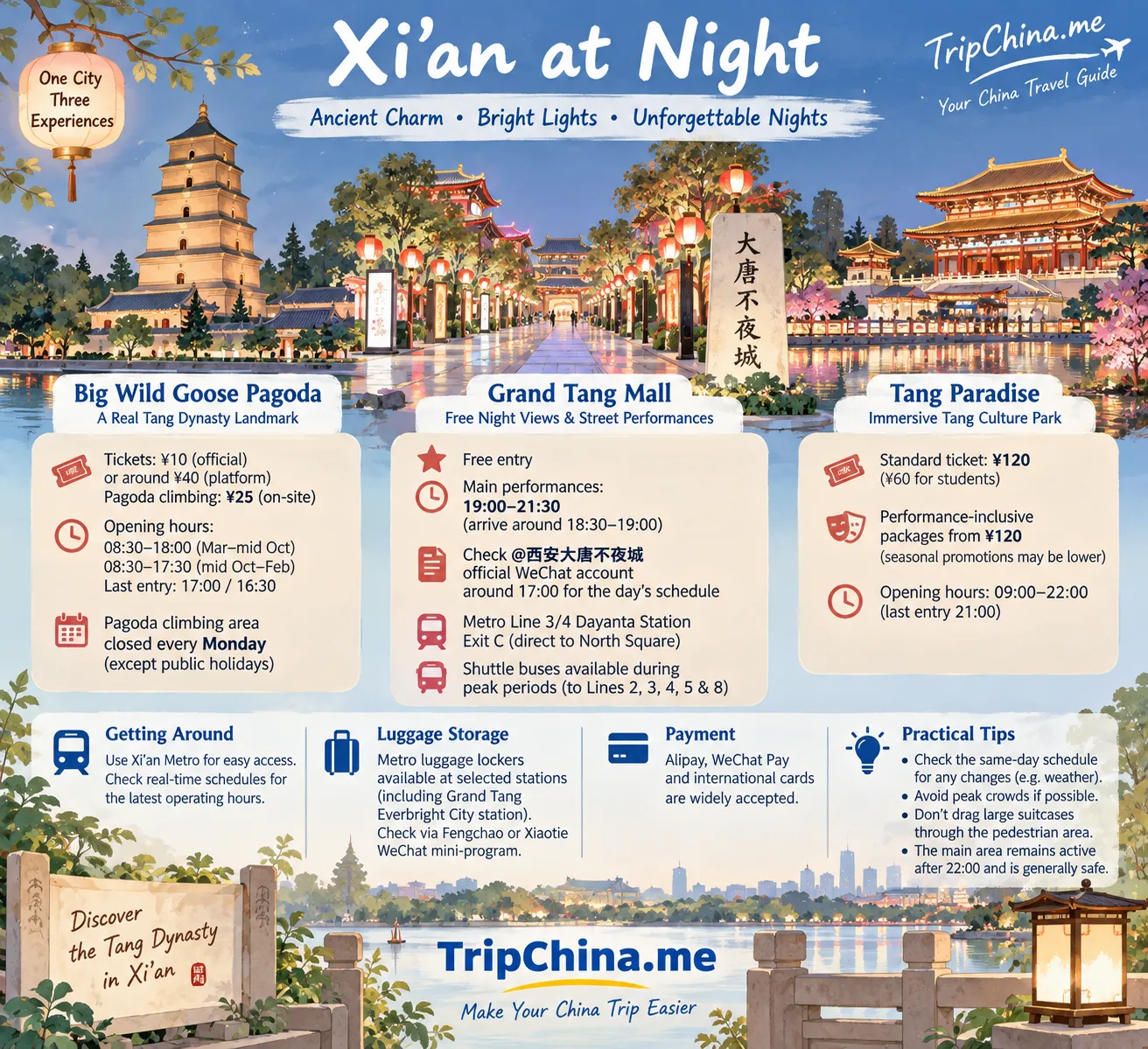
Yes—especially if you want a genuinely historical attraction before exploring Xi'an's modern Tang-themed nightlife.
Big Wild Goose Pagoda (大雁塔, Dàyàntǎ), also known as Giant Wild Goose Pagoda or Dayanta, was first built in 652 during the Tang Dynasty.
It is closely associated with the Buddhist monk Xuanzang, who traveled to India and returned with scriptures that became important to the development of Chinese Buddhism.
The pagoda is part of the UNESCO-listed Silk Roads: the Routes Network of Chang'an–Tianshan Corridor.
Unlike the illuminated Tang-style buildings around Grand Tang Mall, the pagoda is a historic monument rather than a modern recreation.
This is the most important distinction for first-time visitors.
There are several separate places around the pagoda, and they do not share one admission rule.
| Area | Free or Paid? | What You Can Do |
|---|---|---|
| Big Wild Goose Pagoda North Square | Free public area | Watch the musical fountain and photograph the tower |
| South Square | Free public area | See the Xuanzang statue and pagoda exterior |
| Da Ci'en Temple | Paid | Visit the Buddhist temple grounds |
| Big Wild Goose Pagoda interior | Separate paid climb | Ascend the pagoda when access is available |
| Grand Tang Mall | Free pedestrian street | Enjoy Tang-style lights and the evening atmosphere |
| Nearby Joy City public viewing areas | Generally accessible without a pagoda ticket | Look for elevated exterior photography viewpoints |
Free access to the public squares does not mean free entry to the temple or pagoda interior.
You can enjoy the illuminated pagoda from outside without buying a temple ticket.
Entering Da Ci'en Temple and climbing Big Wild Goose Pagoda are separate admissions.
However, publicly accessible 2026 ticket references conflict on the current standard temple price.
Some listings quote approximately ¥10 for temple entry and ¥25 for the climb. Other visitor-facing references quote approximately ¥40 for temple entry and ¥25 for the climb.
These figures should not be treated as one confirmed current official price schedule.
Before purchasing:
Some commercial listings may bundle entry with guiding services or other benefits. Do not mistake a higher package price for the basic temple admission charge.
For the wider Xi'an reservation process, see our Xi'an attraction ticket booking guide.
Climbing is worthwhile if you care about the historic structure and want an elevated view over southern Xi'an.
But it is not an essential part of every visit.
The interior uses relatively narrow and steep stairways. Travelers with knee problems, limited mobility or little time may prefer the temple grounds and exterior viewpoints.
Access can also be restricted for maintenance, safety or visitor management.
Choose the climb if: You want to experience the historic structure itself and are comfortable with stairs.
Skip the climb if: Your priority is night photography, a relaxed public-square visit or preserving time for nearby attractions.
Current major ticketing listings indicate seasonally adjusted opening hours.
| Season | Indicative Temple Hours | Reported Last Entry |
|---|---|---|
| March 1–October 14 | 08:30–18:00 | Around 17:00 |
| October 15–Late February | 08:30–17:30 | Around 16:30 |
These are visitor-listing references, not a guarantee that every part of the pagoda follows identical hours.
The pagoda climb may close earlier or be suspended.
For an October or winter visit, do not assume the last entry is always 17:00.
If you specifically want to enter Da Ci'en Temple or climb the pagoda, aim to arrive with at least two hours before the posted final admission.
Some visitor information mentions Monday maintenance or restricted interior access, while other listings describe regular daily opening.
This makes a universal Monday-closure claim unreliable.
Check the specific date with the current ticketing channel or on-site visitor information.
Even when an interior area is unavailable, the surrounding public squares may still be useful for sightseeing.
The Big Wild Goose Pagoda musical fountain is located at North Square (大雁塔北广场).
It is a free public attraction, separate from the paid temple interior.
An official Qujiang New District notice previously listed four standard performance times:
| Reference Show Time | What to Expect |
|---|---|
| 12:00 | Daytime fountain |
| 16:00 | Afternoon fountain |
| 19:00 | Evening performance |
| 21:00 | Later evening performance |
The official notice also specified a routine Tuesday maintenance arrangement affecting the noon and afternoon performances.
These are historical official reference times—not a confirmed daily 2026 timetable.
Weather, maintenance, holidays and special events may alter or cancel performances.
Before making a special trip, check a current local or operator notice. If the performance is important to your itinerary, ask your hotel to help confirm the day's schedule.
Choose an evening show if you want the lights and illuminated pagoda in the background.
A daytime show can still be attractive if you are already visiting the temple or nearby museum.
Arriving somewhat early may help you find a viewing position, particularly on weekends and public holidays.
Avoid standing where your view is blocked by dense crowds or where water spray may affect cameras and phones.
You do not have to climb the tower for a good photograph.
Useful exterior locations include:
North Square is convenient for the fountain. South Square works well when continuing toward Grand Tang Mall.
If the pagoda itself is the subject, arrive before the busiest evening period for cleaner compositions.
Yes, but mainly from the outside.
The illuminated tower, North Square, South Square and nearby streets form an enjoyable nighttime sightseeing area.
However, night photography does not imply evening access to Da Ci'en Temple or the pagoda staircase.
For a first visit, the most useful division is:
Daytime: Enter Da Ci'en Temple and climb if desired.
Evening: See the illuminated tower, fountain and Grand Tang Mall.
Trying to do both after dark is the classic planning mistake.
Tang Paradise (大唐芙蓉园) is not an ancient royal palace preserved in its original form.
It is a modern cultural park inspired by Tang-era royal garden traditions, with lakes, pavilions, performances and large illuminated structures.
That distinction matters.
Come here for landscaped scenery and cultural immersion rather than archaeological authenticity.
For a visit combining gardens, sunset and night lighting, late afternoon is usually the most efficient choice.
A useful planning arrival is around 16:00–16:30, subject to the day's opening and performance arrangements.
This allows time to explore the gardens in daylight before enjoying the illuminated architecture.
Opening hours and entry products may change for seasonal programs and special events.
Tang Paradise may offer admission-only, evening and show-inclusive packages.
Do not assume every product includes the same benefits.
Before booking, confirm:
Some advertised packages combine multiple services.
Do not buy a separate admission ticket if your chosen performance package already includes park entry.
The strongest visual centerpiece is Ziyun Tower (紫云楼) and the surrounding lake.
For most first-time visitors, a relaxed route through the gardens, waterside corridors and major architectural viewpoints is more rewarding than trying to attend every performance.
If you enjoy traditional clothing photography, this is also an attractive setting for Hanfu.
Our Xi'an Hanfu rental and photography guide explains where to find studios, compare makeup packages and avoid additional charges.
Grand Tang Mall (大唐不夜城), also commonly called Datang Everbright City or Grand Tang Ever-Bright City, is the easiest recommendation for most first-time visitors with one evening.
The pedestrian district extends south from the Big Wild Goose Pagoda area and is known for Tang-inspired architecture, illuminated streets, public sculptures, performers, Hanfu photography and food businesses.
The public pedestrian street itself does not require an admission ticket.
This makes it an excellent choice for travelers who want a memorable nighttime experience without paying for a cultural park.
A useful planning window is to arrive after sunset, often around 18:30–19:00 depending on season.
Many visitor-facing performance schedules place major evening activities within roughly the 19:00–21:30 period.
But there is no reliable permanent schedule covering every show.
Programs change with weather, maintenance, holidays and special events.
Check the official 大唐不夜城 account or current venue notices on your actual visit date.
Do not plan your whole evening around a timetable screenshot saved weeks earlier.
The Tang Dynasty Tumbler (不倒翁) has been one of the best-known public performances at Grand Tang Mall.
However, its appearance, schedule and replacement programming have changed during 2026.
Do not assume that a popular video guarantees the performance will take place on your particular evening.
Other rotating programs may include:
The safest strategy is to treat the scheduled performances as a bonus rather than the only reason to visit.
No.
The street itself is a major part of the experience.
If you pass a performance with a comfortable viewing position, stop and enjoy it.
If the area is already crowded several rows deep, keep walking.
Chasing every viral performance can leave you spending most of the evening looking over other visitors' phones.
The most useful route depends on whether you want to visit all three attractions or focus on the free evening highlights.
Big Wild Goose Pagoda → Tang Paradise → Grand Tang Mall
| Suggested Time | Stop | What to Do |
|---|---|---|
| 13:30–15:30 | Big Wild Goose Pagoda | Temple and optional climb |
| 15:30–16:00 | Transfer and buffer | Allow time between entrances |
| 16:00–19:00 | Tang Paradise | Gardens, sunset and early evening views |
| 19:00–19:30 | Transfer | Walk or take a short ride |
| 19:30–22:00 | Grand Tang Mall | Lights, performances and street atmosphere |
This is a planning example, not a timetable based on reserved admission slots.
It solves the biggest timing problem: leaving the paid historic attraction until after its last-entry cutoff.
The trade-off is that visiting all three can be tiring, especially with children or during extreme temperatures.
Big Wild Goose Pagoda North Square → South Square → Grand Tang Mall
Begin near North Square for the exterior view and, if scheduled, the fountain.
Continue around the pagoda public-square area toward South Square and the Xuanzang statue.
Then walk south into the illuminated Grand Tang Mall district.
This is the better choice if you have two to three hours, want to avoid paid attractions or are arriving after the temple has closed.
Visit Da Ci'en Temple and the pagoda during the afternoon, take a break for dinner, and return for the evening lights and fountain.
This suits travelers who want the genuine Tang-era monument without adding Tang Paradise.
Big Wild Goose Pagoda and Grand Tang Mall are within the same wider visitor district.
Tang Paradise lies farther southeast, but is still nearby.
Allow approximately 15–25 minutes for some walks between the area attractions, depending on the exact entrances, crowds and walking pace.
Check the actual route in a Chinese navigation app rather than assuming each entrance is beside the next.
For tourists who prefer a slower day, there is no need to include every attraction.
Take Xi'an Metro Line 3 or Line 4 to Dayanta Station (大雁塔站).
From there, follow signs to the Big Wild Goose Pagoda squares.
Exits B and C are commonly used for the North Square approach, but the best exit depends on your actual destination and any temporary station restrictions.
To enter Da Ci'en Temple, do not confuse the North Square fountain area with the temple entrance. Continue toward the appropriate signed entrance.
For Tang Paradise, use Line 4 to Datang Furongyuan Station (大唐芙蓉园站), then follow the current exit signs.
For line connections, foreign-card payment and last-train planning, see our Xi'an Metro guide.
Do not automatically return north to Dayanta Station if you finish farther south.
Check which nearby station or pickup point gives you the shortest route to your hotel.
Confirm the final metro departure for your actual line and direction before the evening ends.
If the subway is no longer convenient, arrange a licensed taxi or a ride through DiDi. Our foreign visitor's guide to using DiDi in China explains payment setup and first-ride difficulties.
During public holidays, temporary pedestrian flows and road restrictions may alter walking routes and vehicle pickup locations.
The busiest period around Grand Tang Mall is often the first part of the evening, particularly during weekends, holidays and popular scheduled shows.
Use a simple strategy:
For history: Visit Da Ci'en Temple earlier in the day.
For fountain photographs: Check the current show schedule and arrive before the performance.
For night atmosphere: Arrive after sunset.
For easier walking: Prefer a weekday and avoid standing at the most crowded performance points.
For photography: Look for quieter edges, side streets and architectural details instead of relying on the busiest central locations.
Chinese public holidays can change the experience dramatically. Check our China public holiday crowd-avoidance guide when choosing your visit date.
These are two different historic attractions in Xi'an.
Big Wild Goose Pagoda is the stronger choice for travelers who want to combine Tang-era heritage with evening lights, fountains and Grand Tang Mall.
Small Wild Goose Pagoda is associated with Jianfu Temple and Xi'an Museum, offering a quieter historical and museum-oriented experience.
Choose Big Wild Goose Pagoda if you have a short visit and want to combine a famous historic landmark with a lively evening district.
Choose Small Wild Goose Pagoda if your priorities are museum collections, a calmer environment and a different side of Tang-era Xi'an.
Admission and reservation rules differ, so do not assume that the two pagodas share the same ticketing arrangements.
For more historical context, see our Xi'an museum guide.
Do not leave the paid historic visit until after sunset.
Check the seasonal last-entry cutoff, and remember that the tower climb can be restricted separately.
The North and South Squares are public sightseeing spaces.
Da Ci'en Temple and the pagoda interior are different admission areas.
Compare the actual admission components with any services included in a commercial package.
For ticketing terminology and booking preparation across China, our Alipay guide for foreigners can help with compatible payment setup.
Same-day weather, maintenance and operational arrangements can change a show.
Check current venue notices before leaving your hotel.
Grand Tang Mall involves substantial walking and dense evening crowds.
If possible, leave luggage at your accommodation before visiting.
Selected metro stations may offer luggage storage, but availability and opening conditions should be confirmed rather than assumed.
If you have not chosen your accommodation yet, our Xi'an hotel area guide explains the trade-offs between central and attraction-focused locations.
Grand Tang Mall itself is free to enter.
Be cautious of anyone offering a mysterious paid fast-track ticket for the public street.
For other common local problems, see our Xi'an tourist traps and mistakes guide.
Chinese mini-programs and local navigation apps may be unfamiliar to first-time visitors.
Prepare at least one suitable digital payment option and keep a backup.
Our China payment guide for foreign tourists covers international cards, Alipay, WeChat Pay and cash.
If you need access to maps, booking platforms and same-day notices, check eSIM versus physical SIM and pocket WiFi options for China before arrival.
If you only have a few hours, prioritize the public squares and Grand Tang Mall instead of rushing through three attractions.
A relaxed visit is often more enjoyable than trying to collect every performance.
Increasingly, yes—but do not assume every Chinese booking mini-program accepts an overseas card in exactly the same way.
For paid attraction tickets, use this fallback sequence:
Payment support varies by merchant, platform and transaction type.
For preparation beyond payment, our essential China travel apps guide covers maps, translation and other useful tools.
Yes. The broader Qujiang area, including Grand Tang Mall and nearby shopping centers, has many traditional clothing rental and photography businesses.
However, costume sizes, makeup quality, package inclusions and return conditions vary.
Before booking, confirm:
Do not assume that a cheap advertised rental package includes professional photography.
The surrounding North and South Squares are free public areas. Entering Da Ci'en Temple normally requires a ticket, while climbing the pagoda is a separate paid activity when available.
Yes, when the tower interior is open to visitors. The climb involves relatively steep, narrow stairs and a separate ticket. Access may be restricted for maintenance or safety.
Major visitor listings show approximately 18:00 in the warmer season and 17:30 in the colder season, with earlier last-entry cutoffs. Confirm your specific date, especially if you plan to arrive late in the afternoon.
A previous official schedule listed 12:00, 16:00, 19:00 and 21:00, with routine Tuesday maintenance affecting some daytime sessions. These times are references only; verify current performances before travel.
Yes. The illuminated tower can be viewed from the surrounding public areas after the paid temple and climb have closed.
Allow around 1.5–2.5 hours if visiting Da Ci'en Temple and considering the climb. For exterior photographs and a fountain stop only, a shorter visit may be sufficient.
Tang Paradise is better for landscaped gardens, performances and an organized paid park visit. Grand Tang Mall is better for a free, energetic evening walk with illuminated architecture and public street entertainment.
Dayanta Station on Lines 3 and 4 is the usual starting point. Follow current station signs to the squares or continue toward the correct temple entrance.
Yes. The public pedestrian district does not require an admission ticket, although shops, dining, private experiences and certain separately ticketed activities may charge fees.
For most first-time visitors with one evening, Grand Tang Mall is the easiest choice. It is free, visually engaging and flexible.
Add Big Wild Goose Pagoda during the day if authentic history and Buddhist heritage matter to you.
Add Tang Paradise if you want a landscaped cultural experience and are willing to pay for admission or a performance package.
The most balanced full itinerary is:
Big Wild Goose Pagoda in the afternoon → Tang Paradise around sunset → Grand Tang Mall after dark.
But if you have only three hours, keep it simple.
Go to Big Wild Goose Pagoda's public squares, see the illuminated tower and continue into Grand Tang Mall.
You do not need to buy every ticket or chase every performance to enjoy Xi'an's Tang-themed district.
This guide draws on published visitor listings, the Qujiang New District fountain notice and available Xi'an travel information. Current sources disagree on Da Ci'en Temple admission prices, so this guide does not present a single disputed figure as an officially confirmed rate. Fountain schedules, interior access, paid performances, attraction tickets and metro arrangements may change. Verify date-specific details using the operator's current notice before travel. Comparisons and itineraries are independent editorial recommendations rather than guaranteed services.
Planning your China trip? TripChina.me provides practical travel guides covering transport, food, neighborhoods, and local experiences. When you are ready for a smoother journey, our Premium Travel Guides offer ready-to-follow plans designed for independent travelers.