Our Location:
No. 99, Jiazi Road, Chengdu

 authorChris Lee
Longjing Village is easy to visit badly. Stay near the entrance and you may see little more than shops and roadside tea terraces. Walk farther into the hills and the experience changes completely.
This Longjing Village guide compares three practical routes for first-time foreign visitors, including transport, tea tasting, the Shililanglang trail, seasonal timing, payments and the mistakes that can turn a peaceful tea-village visit into an overpriced tourist stop.
| Question | Quick Answer |
|---|---|
| Is Longjing Village free? | Yes. Public village roads and tea-field scenery do not require a general admission ticket. |
| How long should I allow? | About 2.5–3 hours works best for most first-time visitors. |
| Which route is best? | Route A (classic 2.5–3h) for first-time visitors and families; Route C (4+h Shililanglang hiking) for landscape and hiking lovers. |
| How should I get there? | Bus 27/27B or DiDi are the most practical options. |
| How should I pay? | Alipay and WeChat Pay are useful if already set up; carry RMB cash as backup. |
| Biggest mistake? | Only visiting the crowded entrance area and missing the quieter tea terraces and mountain scenery farther uphill. |
China National Tea Museum currently lists both its Shuangfeng and Longjing sites under 09:00–16:30 opening hours, with Tuesday as the weekly closure day except public holidays. Some third-party travel sites show conflicting information, so check the museum's official visitor information again before your trip.
| Route | Time | Difficulty | Best For | Main Trade-Off | TripChina Pick |
|---|---|---|---|---|---|
| Route A: Classic | 2.5–3 hrs | Easy | First visits, families, casual travelers | More people on main paths | Best for most visitors |
| Route B: Short | About 1 hr | Very easy | Quick photo stop only | Too little time for real tea culture | Usually skip |
| Route C: Deep | 4+ hrs | Moderate | Hikers, photographers, nature lovers | Steeper trails; requires preparation | Best experience if you have time |
If you are building a wider itinerary around this visit, start with our Hangzhou Travel Guide for first-time visitors so Longjing fits naturally with West Lake, Lingyin and the rest of Hangzhou.
Longjing Village is not a purpose-built theme attraction. It sits within the historic West Lake Longjing tea landscape, where tea cultivation remains part of everyday village life.
Near the entrance, the experience can feel surprisingly commercial: restaurants, tea sellers, passing cars and visitors photographing the nearest fields.
Walk farther uphill or onto the quieter paths and the landscape becomes the reason to come—tea terraces climbing the slopes, narrow lanes, wooded ridges and working tea plots.
During the spring harvest, you may see tea leaves being picked and processed. Outside harvest season, think of Longjing more as a landscape-and-walking destination than somewhere you are guaranteed to watch tea production.
Most first-time visitors make one simple mistake: they stop too early.
Walk at least five to ten minutes beyond the busiest entrance section before deciding what you think of Longjing.
If your schedule is already crowded, compare Longjing with the city's other major sights in our Hangzhou attractions guide before giving it half a day.
The village itself is not a single gated attraction.
| Place / Experience | Typical Cost | Reservation | Practical Note |
|---|---|---|---|
| Longjing Village public areas | Free | No | No general village admission ticket |
| Public tea-field viewpoints | Free | No | Stay on public paths and respect working fields |
| Old Longjing historic tea area | Small on-site fee may apply | Usually on site | Check current admission and inclusions locally |
| China National Tea Museum | Free | Check current requirements | Official: 09:00–16:30; Tuesday closed except holidays |
| Tea tasting | Varies | Usually no | Confirm price before sitting down |
| Tea picking / processing experience | Varies | Ask locally | Seasonal; availability is not guaranteed |
China National Tea Museum has two sites: Shuangfeng at 88 Longjing Road and Longjing at 268 Wengjiashan.
The museum's current official visitor information places both sites under the same published 09:00–16:30 schedule and Tuesday closure. Because third-party listings sometimes show different opening arrangements, use the museum's own website or official WeChat account for a final check before visiting.
Do not confuse the museum with Longjing Village itself. You do not need a museum reservation simply to walk through the village.
Spring is the most distinctive season because this is when West Lake Longjing enters its main harvest period.
The exact start changes from year to year according to weather and tea variety. Do not plan around a supposedly fixed annual harvest date.
For travelers, late March to early April is the most useful general window if seeing active spring tea harvesting is important to you. Always check the current year's harvest announcement before planning a tea-picking-focused trip.
It is also one of the busiest periods.
Autumn is arguably better if your priority is hiking rather than tea production. Temperatures are generally more comfortable and the mountain paths can be more enjoyable.
Summer can be very hot and humid. Hangzhou can experience temperatures above 35°C during heat waves, making a midday ridge hike very different from a relaxed spring walk.
Winter is quieter, but the landscape is less lush.
When coordinating Longjing with the rest of your trip, also check China's public holidays and major crowd periods.
Weekday mornings are the safest choice.
Arriving around 08:30–10:00 gives you cooler walking conditions, softer light and more time before the busiest part of the day. Spring weekends and Chinese public holidays can bring substantial road congestion and crowded buses.
Photographers may prefer early morning, when low light and occasional mist can transform the tea slopes.
If you plan to hike Shililanglang, avoid beginning an unfamiliar mountain route near sunset.
Bus 27 and 27B are among the most useful public-transport connections between the West Lake area and Longjing.
Hangzhou Public Transport Group's published service information lists Route 27 from Yuewang Road at 06:25–19:30 and from Tea Museum Longjing Terminal at 06:40–18:15.
Route 27B operates selected fixed departures. From Longjing Village, these include 05:45, 06:15, 06:45, 18:30, 19:00, 19:30 and 20:00.
Several evening Route 27 departures from Yuewang Road can also continue to Longjing Village.
That distinction explains why online sources sometimes show apparently contradictory “last bus” times.
Do not simply memorize “the last bus is at 18:15” or “the last bus is at 20:00.” Check whether you are looking at Route 27 or 27B and verify the live destination and timetable on the day.
For most visitors, leaving the village well before the final departure remains the safer strategy.
From the West Lake area, allow roughly 30–45 minutes depending on traffic.
For foreign visitors unfamiliar with Chinese transport apps, our Hangzhou transport guide explains how to combine metro, buses and DiDi without a Chinese bank card.
DiDi is easier if you are traveling with two or more people, carrying equipment or trying to reach a specific trail entrance.
Set the destination using:
龙井村 — Longjing Village
Travel time from the central West Lake area is often around 25–40 minutes depending on traffic. Fares change with demand and congestion, so treat fixed prices in older guides only as rough references.
If you have never used Chinese ride-hailing before, set it up before your trip using our DiDi guide for foreign travelers.
Usually not.
Parking capacity around the tea-village area is limited, and West Lake scenic-area traffic conditions can make weekends and holidays unpredictable.
A bus or DiDi removes most of that hassle.
Experienced hikers can connect West Lake and the surrounding tea hills through longer walking routes.
For an ordinary sightseeing visit, however, walking from central West Lake simply as transportation is inefficient. Take a bus or DiDi and save your energy for the tea hills.
Best for: First-time visitors, families and travelers who want tea scenery without a serious hike.
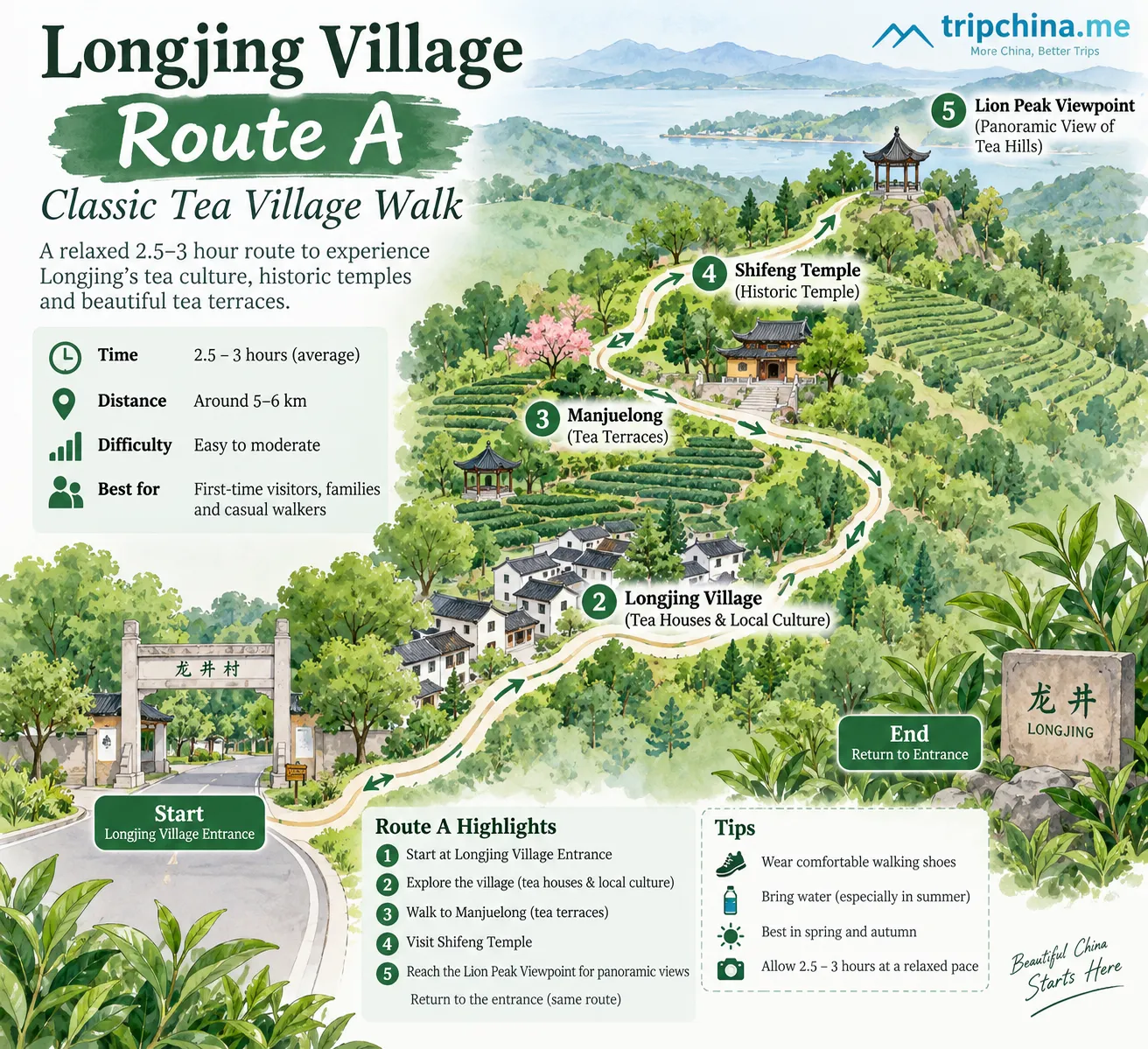
This is the route I would choose for most visitors.
A practical sequence is:
Allow roughly 2.5–3 hours rather than racing through everything.
The advantage is balance: landscape, tea culture, history and enough time to sit down for tea.
Best for: Travelers who are already nearby and only want a quick look.
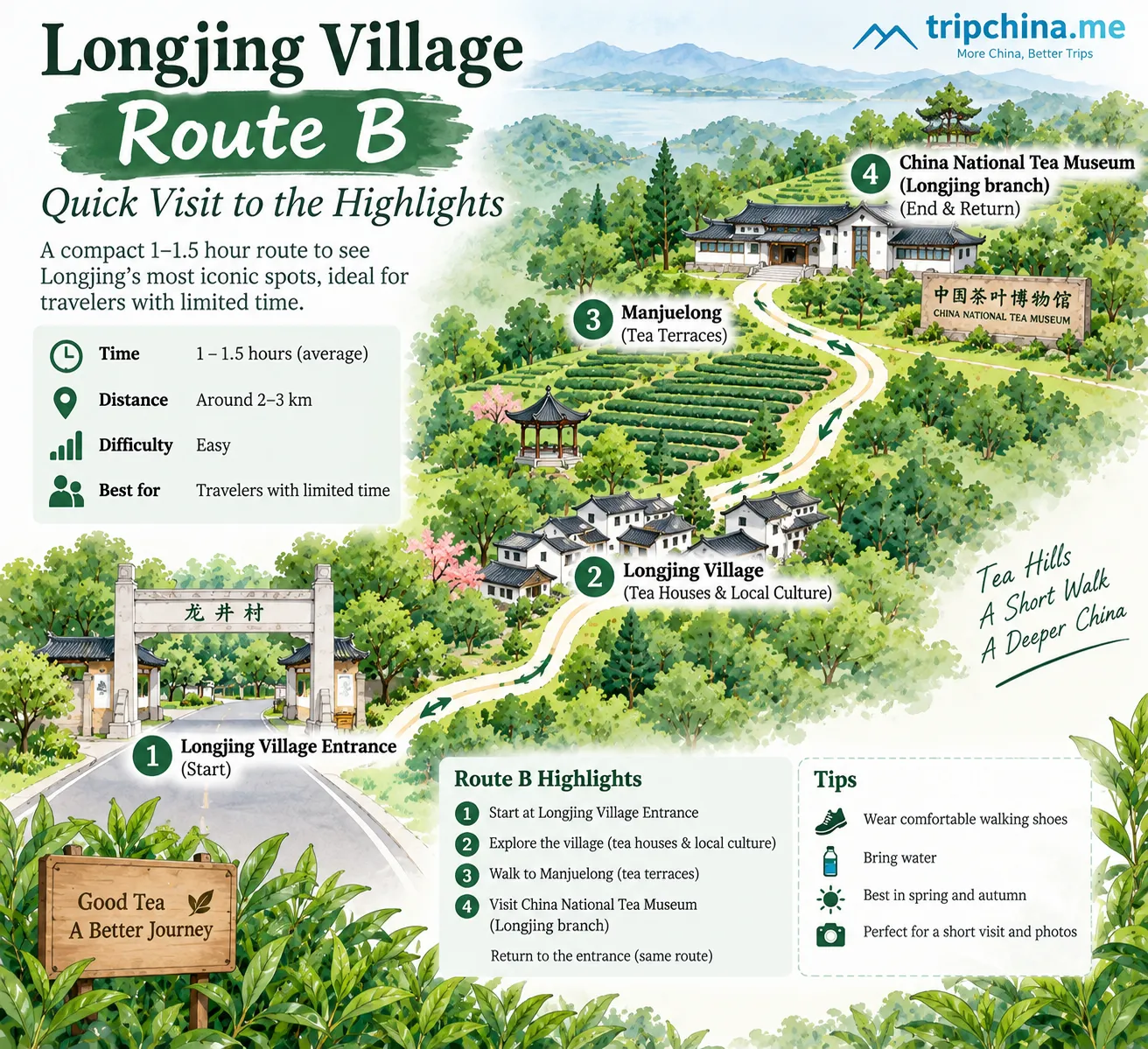
Walk through the accessible tea terraces, take photographs and explore a short section of the village before returning.
You will miss much of what makes Longjing interesting.
A one-hour visit is generally not worth making a dedicated round trip from central Hangzhou. Once transportation is included, you may spend almost as much time reaching the village as exploring it.
If you genuinely have only an hour available, spend it around West Lake instead.
Best for: Hikers, photographers and travelers who care more about landscapes than polished attractions.
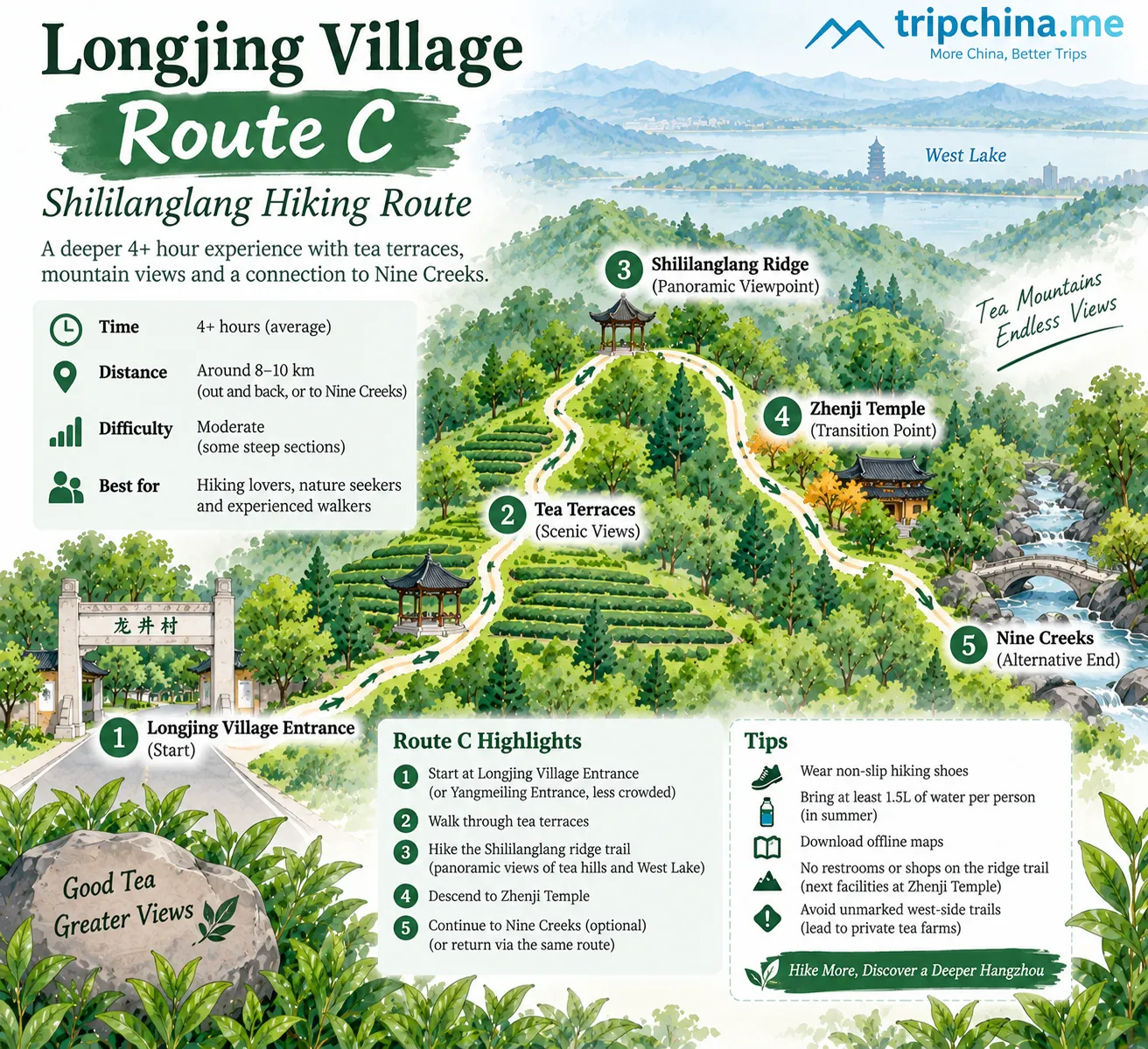
This is where Longjing becomes much more interesting.
Shililanglang (十里琅珰) is not simply a single viewpoint above the village. It is part of Hangzhou's established mountain trail network.
Longjing Village is one of its classic access points. Official Hangzhou hiking routes connect Longjing Village with Langdang Ridge, Zhenji Temple and Yunqi Bamboo Path.
A practical sequence is:
For a first-time hiker, a Longjing Village → Shililanglang ridge viewpoint → Longjing Village out-and-back route is the simplest option. Allow around half a day rather than planning around a rigid hiking time. Your pace, weather, photography stops and turnaround point will make a significant difference.
If you continue toward Nine Creeks or Yunqi, treat it as a longer point-to-point mountain hike rather than an extension of a casual village walk.
The section above Longjing gives you panoramic tea-valley views without requiring the full end-to-end hike.
Do not treat “Shizifeng” and “Shililanglang” as interchangeable trail names. For navigation, search for 十里琅珰 and follow established public paths.
The terrain becomes steeper and less forgiving than Route A. Bring non-slip walking shoes, sufficient water, a charged phone and offline navigation.
For a summer hike, around 1.5 liters of water per person is a sensible starting point. Increase that amount for longer routes or extreme heat.
Do not rely on English trail signage.
Before entering the hills, download the apps and maps you need. Our Essential Travel Apps for Foreigners in China covers navigation, translation and other useful tools.
Yes.
Longjing, Shililanglang, Yunqi and Nine Creeks sit within a broader network of mountain paths, creating several possible point-to-point hikes rather than one mandatory route.
That is why exact “Longjing to Nine Creeks hike” times vary between guides.
For a first visit, do not build your day around a rigid claim that every traveler will complete the route in a specific number of hours. Junction choice, weather, fitness, photography stops and your chosen exit point all affect the duration.
The practical distinction is simple:
Longjing Village alone is sightseeing.
Longjing + Shililanglang or Nine Creeks is hiking.
Carry enough water for the mountain section, use facilities before climbing and download your route in advance.
Tea is part of the experience, but you do not need to buy tea leaves to enjoy Longjing.
A simple rule works surprisingly well:
Choose the tea house before the tea house chooses you.
Look for a place with clearly displayed prices, or ask the price before sitting down. Confirm whether the charge is per person, per pot or per tea type.
Small tea businesses do not necessarily operate like formal urban cafés, so never assume the price structure.
A relaxed tea stop of 30–60 minutes is enough for most travelers.
If someone approaches you on the road offering to show you a “family tea farm” or sell you “real Mingqian Longjing,” you are under no obligation to follow them.
Do not judge authenticity from a sales pitch or a single price number.
“West Lake Longjing,” “Longjing,” “Mingqian,” production area, cultivar and grade are not interchangeable concepts. Prices vary substantially according to harvest date, origin, cultivar, processing, quality and seller.
There is no single retail price that proves tea is genuine.
For packaged tea sold as West Lake Longjing, look for the official West Lake Longjing origin and anti-counterfeit traceability marking. The official system records information including the year, package specification, serial number and anti-counterfeit data and is designed to verify tea originating from the protected West Lake production area.
This is much more useful than trying to judge authenticity from price alone.
A very cheap price can be a warning sign. A very high price, however, is not proof of authenticity.
When buying:
One warning deserves special attention: be cautious if a taxi or ride-hailing driver unexpectedly suggests stopping at a “family tea shop,” “local farm” or a shop that supposedly only locals know.
This is not merely hypothetical. A widely reported 2024 case involved a visitor being taken by a driver to a Longjing-area tea shop, where tea from outside the protected West Lake production area was marketed as West Lake Longjing. Local market regulators later fined the business RMB 500,000 for false or misleading promotion.
Reporting around the case also exposed claims that drivers could receive commissions as high as 50% for bringing tea-buying customers to participating shops.
The practical lesson is simple:
If you did not ask for a tea-shopping stop, do not let your driver choose one for you.
Ask to continue directly to Longjing Village or your original destination.
For broader tourist-scam patterns in the city, read our Hangzhou tourist traps and mistakes guide.
Sometimes, but treat tea picking as a seasonal experience rather than a permanent attraction.
The spring harvest date changes from year to year according to weather and cultivar.
For foreign visitors, late March to early April is the most useful general window if your main goal is to see active spring tea harvesting. Check the current year's official harvest announcement before planning a tea-picking-focused trip.
Individual farms and tea businesses may offer leaf picking, processing demonstrations, tea tasting or combined experiences during the harvest period.
There is no single official village-wide tourist price for “tea picking” or “hand roasting.” Prices and inclusions depend on the operator.
Before paying, ask what the activity actually includes:
Do not arrive outside the harvest season expecting a tea-picking experience simply because an old travel page advertises one year-round.
There are restaurants, tea houses and simple noodle options around the tea-village area, but I would not plan a Longjing trip around one specific restaurant unless you have checked it recently.
Businesses in scenic villages change, rebrand and alter opening hours.
For a casual meal, look for posted menus and prices and consider local Zhejiang dishes, noodles or tea-related dishes.
If food is a major part of your Hangzhou trip, save your serious meal for the city and use our Local Hangzhou Food Guide rather than choosing a village restaurant solely because someone waves you inside.
The developed village area has restaurants, tea houses, shops and basic visitor facilities.
Facilities become less predictable once you move onto the mountain trails.
Use a restroom before starting a longer climb. Carry your own drinking water rather than assuming the next ridge section will have a shop or refill point.
If you are connecting Nine Creeks, Longjing and Shililanglang, resupply whenever you have a convenient opportunity in a developed area. Do not plan a mountain section around the assumption that a particular small shop or vendor will be open.
For a summer hike, around 1.5 liters of water per person is a reasonable starting point. Adjust for temperature, route length and your own needs.
Mobile reception is generally better around populated areas and can vary in the hills.
Offline navigation remains worth having.
| Payment Method | Practical Use |
|---|---|
| Alipay | Very useful if your international card is successfully linked |
| WeChat Pay | Very useful if already configured |
| RMB cash | Important fallback, especially for small businesses |
| International bank card | Do not assume a small tea house can accept it |
| Apple Pay / Google Pay | Do not rely on these as your primary local payment method |
For travelers who have successfully linked an international card to Alipay or WeChat Pay before arriving, mobile payment is widely useful.
If you have not completed that setup before your visit, cash remains the reliable fallback. Carrying roughly 200–500 RMB gives you a useful buffer for tea, food, small admission charges and unexpected payment problems.
Even with mobile payment working, keeping some cash is sensible.
Set everything up before you reach the village using our China Payment Setup for Foreigners.
Do not wait until you are standing inside a small tea shop with weak reception to configure your payment account.
The first tea terraces are not the whole village.
The entrance is also where traffic, shops and casual sightseeing tend to be most concentrated.
Walk farther uphill before deciding that Longjing is “too touristy.” The quieter tea landscape and mountain scenery are a major part of why the village is worth visiting.
Taste first, compare prices and check the official origin/traceability marking when buying packaged West Lake Longjing.
A confident sales story is not proof of origin.
Be particularly cautious when an unsolicited shopping recommendation comes from someone involved in your journey—a driver, guide or stranger offering to “help” you find authentic local tea.
If you did not ask for a tea-shop stop, you do not need one.
Stone paths and mountain steps can become slippery after rain.
Wear shoes with good grip.
The developed village and the mountain ridge are very different environments.
For summer hiking, start with roughly 1.5 liters per person and adjust for your route and the weather.
English support varies considerably.
Keep 龙井村 and 十里琅珰 saved on your phone and have a translation app ready.
Route 27 and 27B have different service patterns.
Check which service you are looking at rather than relying on an old screenshot or a generic “last bus” time.
Longjing is at its best when it feels like a tea landscape rather than a traffic jam.
If possible, go on a weekday morning.
Walk beyond the obvious photo area. Five or ten extra minutes can make a surprising difference in crowd levels.
Spring mornings offer the best chance of seeing actual tea-harvest activity, but remember that agricultural work is not a staged performance. Stay on public paths and do not enter working plots simply for photographs.
For a panorama rather than a roadside tea-field shot, climb onto the Shililanglang route.
Shililanglang is a ridge trail system, not a single viewpoint. Longjing Village is a classic access point, and the section immediately above the village can give you broad tea-valley views without requiring the full hike toward Yunqi.
If you are hiking, screenshot the Chinese name of your intended exit point before starting.
Useful names include:
龙井村 — Longjing Village
十里琅珰 — Shililanglang
九溪十八涧 — Nine Creeks
云栖竹径 — Yunqi Bamboo Path
Chinese place names are much more useful than English transliterations when asking a local person for directions.
Yes—but think of it as a half-day supplement to West Lake rather than an essential attraction for every Hangzhou visitor.
It is especially worthwhile if you enjoy tea culture, agricultural landscapes, photography or mountain walking.
It is less compelling if you have only one hour, dislike walking or expect a polished international attraction with extensive English services.
For most first-time visitors, Route A is enough.
If nature is one of the main reasons you came to Hangzhou, choose Route C and give the hills enough time.
The difference between an average Longjing visit and a memorable one is surprisingly small: arrive early, do not stop at the entrance, do not rush into buying tea, and walk a little farther uphill.
This article is part of the Hangzhou Travel Guide Hub.
Longjing is usually the better choice if you want to combine historic tea culture with a compact visit and access to mountain hiking.
Meijiawu offers another large tea-village landscape and can work well for travelers exploring farther south around West Lake.
Neither is automatically “more authentic.” For a first visit focused on tea scenery plus hiking, Longjing is the easier all-round choice.
Yes.
The main appeal is not tea shopping. It is the layered tea hills, village landscape and access to mountain walking.
If you enjoy photography, scenery or hiking, Longjing can work very well even if you never sit down for tea.
Only with a generous layover.
Xiaoshan Airport is well outside the Longjing–West Lake area, and road traffic plus airport procedures make a short visit risky.
I would not build a Longjing trip around a tight international connection.
Say:
不用了,谢谢 — Bú yòng le, xièxie — No, thank you.
Then keep walking.
Do not let politeness pressure you into entering a shop or private courtyard. If your driver initiates an unsolicited tea-shop detour, ask to continue directly to Longjing Village or your original destination.
The established trail is a popular daytime hiking route, but it is still a mountain environment.
Stay on established paths, keep offline navigation available, tell someone your route if hiking alone and allow enough daylight to finish comfortably.
Avoid unmarked side trails and do not start an unfamiliar ridge hike near sunset.
Facilities are easiest to find in developed village and visitor areas and become less predictable on the ridge.
Use a restroom and buy water before beginning the mountain section. Do not depend on a specific mountain vendor or small facility being open.
Yes, and it is strongly recommended.
Download or cache your route before leaving the developed village area because English trail information is limited.
Save 十里琅珰, 龙井村, 九溪十八涧 and 云栖竹径 on your phone before setting out.
From green tea fields and mountain trails to traditional tea houses and quiet village life, this video captures the relaxing atmosphere of Longjing Village, one of Hangzhou’s most charming hidden gems.
China National Tea Museum — official visitor information, museum sites and opening hours
Hangzhou Public Transport Group — official Route 27 and 27B service times
Updated September 2026. Museum hours were checked against China National Tea Museum's official visitor information, bus schedules against Hangzhou Public Transport Group, West Lake Longjing origin and traceability rules against Hangzhou government regulations, and Shililanglang routing against official Hangzhou mountain-trail information. Variable commercial details such as tea prices, picking experiences and restaurant operations are intentionally not presented as fixed facts unless supported by a current authoritative source.
Avoiding mistakes is only the first step. TripChina.me Premium Travel Guides help independent travelers explore China with ready-to-follow routes, booking strategies, practical solutions, and local insights — so you can travel with confidence.