Our Location:
No. 99, Jiazi Road, Chengdu

 authorChris Lee
Choosing where to stay in Hangzhou matters more than choosing a famous hotel. A room that looks close to West Lake on a booking page can still leave you with awkward transfers, crowded roads or few late-night options.
For most first-time visitors, Hubin near West Lake is the easiest base—but Wulin, Lingyin, Qianjiang and cheaper alternatives each make sense for a different trip.
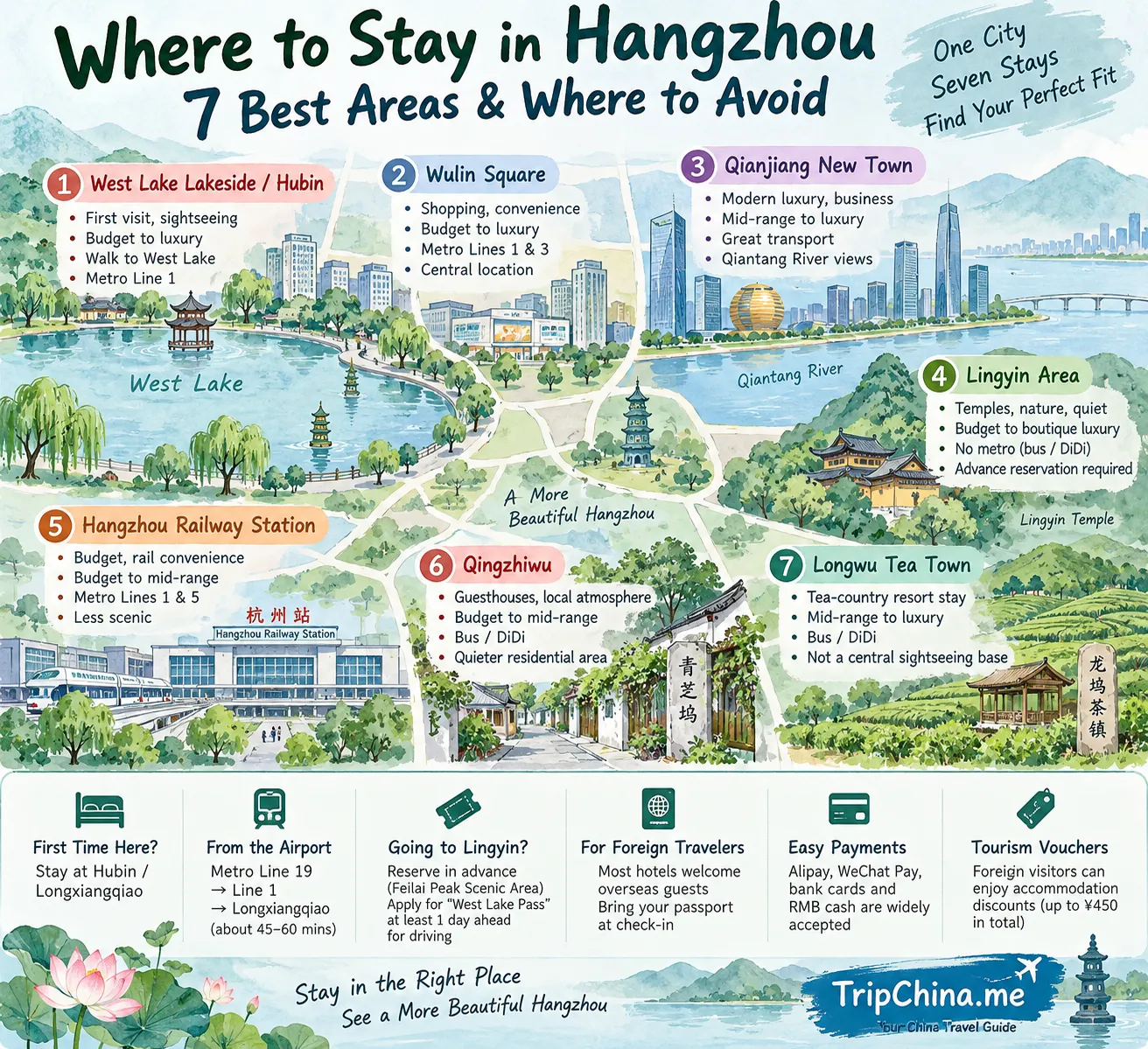
For most first-time visitors, stay around West Lake Lakeside—especially Hubin and Longxiangqiao. You can walk to the lake, use Metro Line 1, and find restaurants and shops late into the evening.
Choose Wulin Square if you want better citywide transport and shopping without being directly inside the busiest lakeside zone.
Choose Lingyin only if temples, tea hills and quiet mornings matter more to you than metro convenience.
For a lower budget, look around Hangzhou Railway Station (Chengzhan), but check the exact hotel and room rather than choosing by price alone.
If you want modern luxury rather than traditional Hangzhou atmosphere, Qianjiang New Town is the stronger fit.
| Area | Best For | Typical Price Level* | Transport | Main Trade-Off |
|---|---|---|---|---|
| West Lake Lakeside / Hubin 西湖湖滨 / 湖滨 | First visit, sightseeing | Budget to luxury | Excellent | Crowds and higher peak rates |
| Wulin Square 武林广场 | Shopping, convenience | Budget to luxury | Excellent | No immediate lake access |
| Qianjiang New Town 钱江新城 | Luxury, skyline, business | Mid-range to luxury | Excellent | Farther from classic sights |
| Lingyin Area 灵隐片区 | Temples, nature, quiet stays | Budget to boutique luxury | Bus / DiDi | No metro at Lingyin |
| Hangzhou Railway Station 杭州火车站 | Budget, rail convenience | Budget to mid-range | Excellent | Less scenic |
| Qingzhiwu 青芝坞 | Guesthouses, local atmosphere | Budget to mid-range | Bus / DiDi | No direct metro |
| Longwu Tea Town 龙坞茶镇 | Tea-country resort stay | Mid-range to luxury | Bus / DiDi | Poor sightseeing base |
*Hotel rates in Hangzhou are highly dynamic. Economy chains also operate around Hubin and Longxiangqiao, while lake-view rooms and peak dates can climb sharply into the luxury range. Prices vary by room type, weekday, season and public holiday, so check live rates rather than treating a fixed range as guaranteed.
For the bigger picture before choosing a neighborhood, TripChina's Hangzhou travel guide explains how West Lake, Lingyin and the tea country fit into a first trip.
Usually, yes.
The most convenient zone is the east side of West Lake around Hubin (湖滨) and Longxiangqiao (龙翔桥).
The advantage is not simply that you are “near West Lake.” It is that you can combine the lake with metro access, restaurants, shopping and an easy return to your hotel after dark.
Longxiangqiao Station on Metro Line 1 is particularly useful. From the Hubin side of the station, the lakeside is only a short walk away.
That changes the rhythm of a Hangzhou trip. You can walk by the lake before breakfast, return after dinner, or change plans without turning every West Lake visit into a transport project.
You get the easiest combination of:
If your Hangzhou itinerary is only two or three days, that convenience is valuable.
Budget travelers should not automatically rule Hubin out. Economy brands such as Hanting, Home Inn and other lower-cost hotels operate around the broader Hubin and Longxiangqiao area, although rates rise quickly on busy weekends and holidays.
Crowds.
Weekends, Chinese public holidays and the spring and autumn travel seasons can make the eastern lakeside extremely busy.
As of September 2026, Hangzhou's autumn peak-season traffic management applies around the West Lake Scenic Area on weekends and public holidays from 8:00 to 17:00. Small passenger vehicles follow an odd-even license-plate rule, while Lingyin and part of Nanshan Road have additional limited-entry controls.
For visitors, the practical lesson is simple: a hotel close enough to walk or use the metro can become more valuable on peak days than a theoretically better hotel that requires repeated car journeys.
Do not overpay simply for the phrase “West Lake” in a hotel listing.
A hotel may use “West Lake” in its English name even when the entrance is not particularly convenient for the part of the lake you actually want to visit. Check the exact map location and walking route.
If your sightseeing revolves around West Lake, TripChina's Hangzhou attractions guide can help you decide whether paying extra for the lakeside actually saves meaningful travel time.
At the upper end, well-known properties around the lake include Four Seasons Hotel Hangzhou at West Lake, Hangzhou Xihu State Guesthouse and Zhejiang Xizi Hotel.
For most travelers, however, I would choose location before brand.
A clean mid-range hotel near Longxiangqiao can be more useful for a first-time independent traveler than a more luxurious property on the quieter western side of the lake if you expect to use the metro frequently.
For a more detailed look at how the different sections of the lake fit together, see TripChina's West Lake Hangzhou guide.
TripChina Pick: If this is your first Hangzhou trip and you have only two or three nights, Hubin / Longxiangqiao is still the safest all-round choice.
Wulin Square is the best alternative for travelers who want central-city convenience without putting West Lake outside the hotel door.
The area is one of Hangzhou's major commercial centers and is served by Metro Lines 1 and 3.
It has large shopping malls, restaurants, established hotels and straightforward connections to other parts of the city.
Depending on exactly where your hotel is, reaching the eastern side of West Lake is generally a short metro journey or a roughly 20–30 minute walk rather than the “step outside and see the lake” experience of Hubin.
Wulin makes particular sense if:
The main compromise is atmosphere.
You are staying in central Hangzhou rather than “at West Lake.” If waking up beside the lake is part of the experience you want, stay in Hubin instead.
TripChina Pick: For a three- or four-day trip involving several parts of Hangzhou, Wulin can actually be more practical than paying a premium for a lakefront address.
For metro, DiDi and airport connections from either area, keep TripChina's Hangzhou transport guide handy.
Qianjiang New Town (钱江新城) is Hangzhou's modern CBD beside the Qiantang River.
This is the Hangzhou of glass towers, large international hotels, modern malls and skyline views—not the Hangzhou of willow trees, temples and tea fields.
Metro connections are good, and the area works particularly well for business travelers.
Choose it if you value:
Do not choose it simply because you find a good five-star hotel deal.
If West Lake, Lingyin Temple and historic Hangzhou are the reason for your trip, the time saved on the room rate may be lost in repeated journeys across the city.
TripChina Pick: Excellent for business or modern luxury; unnecessary for a classic first-time Hangzhou sightseeing trip.
Lingyin is one of the most atmospheric places to wake up in Hangzhou.
The western hills around Lingyin Temple, Feilai Peak and nearby villages feel very different from central Hangzhou. In the morning, you have greenery, temple bells and tea-country scenery instead of shopping malls and traffic.
But this is a specialist choice, not the default answer to “Where should I stay in Hangzhou?”
There is no metro station at Lingyin Temple.
You will depend on buses, taxis or DiDi for many journeys. On busy weekends and public holidays, traffic management around Lingyin and West Lake can also make car travel less predictable.
As of September 2026, during the autumn peak season from September through November, cars entering Lingyin and the controlled section of Nanshan Road on weekends and public holidays between 8:00 and 17:00 must follow the West Lake Scenic Area's odd-even license-plate rule and also obtain a limited-entry “西湖通” (West Lake Pass).
The pass must be applied for at least one day in advance through the Police Uncle (警察叔叔), Zheliban (浙里办) or Alipay channels. Same-day applications are not available, and each vehicle can use one pass per calendar month.
Taxis and ride-hailing vehicles also face controlled drop-off arrangements during those periods. For Lingyin, passengers may need to transfer to a shuttle bus at designated points such as the Xixi Road 608 parking area or Xiaoyawu bus stop.
If you stay in Hubin or Wulin and visit Lingyin during a peak weekend, metro plus bus is often more predictable than relying entirely on DiDi.
That makes Lingyin wonderful when you intend to spend real time in the western hills—and inconvenient when you merely want to visit the temple once.
Yes.
As of September 2026, Lingyin Feilai Peak Scenic Area operates a real-name, timed reservation system. Reservations must normally be made at least one day in advance; same-day reservations are not accepted.
Search for “杭州灵隐飞来峰” in WeChat or Alipay. Reservations open up to seven days ahead, and overseas visitors can book using an eligible travel document such as a passport.
Since February 1, 2026, there is no on-site registration window. If regular slots are full, the mini-program may offer an online waitlist. Waitlist applications close at 20:00 on the day before entry.
If your plans change, cancel in time rather than simply not showing up. A first recorded no-show can suspend the reservation account and the named visitor from making new reservations for 30 days.
For the full booking process, see TripChina's Lingyin Temple reservation guide for foreign travelers.
Use TripChina's Hangzhou city walk guide if you are considering combining Lingyin or Longjing with a walking-focused stay.
Check the exact map location.
“Lingyin area” can cover accommodation scattered through hills and village roads. A beautiful guesthouse may be much farther from the main temple entrance or a useful bus stop than its marketing photos suggest.
Also check:
Late-night food and shopping are much more limited here than in Hubin or Wulin.
TripChina Pick: Stay near Lingyin for atmosphere, temples and nature—not because you think it is a convenient base for all of Hangzhou.
Yes, if convenience matters more than scenery.
Hangzhou Railway Station (杭州站 / Chengzhan) is connected to Metro Lines 1 and 5, making it useful for travelers arriving by train and for reaching central Hangzhou.
The surrounding area includes many economical hotels.
The compromise is simple: this does not feel like a West Lake holiday when you walk outside.
Buildings and room quality can also vary considerably, so I would prioritize a well-reviewed property close to the metro rather than simply booking the cheapest room visible on the map.
If you arrive by train with luggage, this can still be one of the most rational low-cost bases in the city.
TripChina Pick: Chengzhan works best when budget, rail access and metro convenience matter more than scenery.
Qingzhiwu (青芝坞) sits near Zhejiang University and offers smaller guesthouses, restaurants and a more residential atmosphere.
It is much more charming than the station area, but less convenient.
There is no metro station directly inside Qingzhiwu. Expect to combine walking with buses or DiDi.
Do not interpret “near West Lake” as “five minutes from the lake.” Depending on your exact property and destination, reaching the main West Lake scenic areas can involve a substantial walk or a short ride.
The area works best for travelers who prefer a courtyard-style guesthouse or quieter residential setting and do not mind giving up immediate metro access.
TripChina Pick: Choose Qingzhiwu for character and a more local atmosphere; choose Chengzhan when transport and budget matter more.
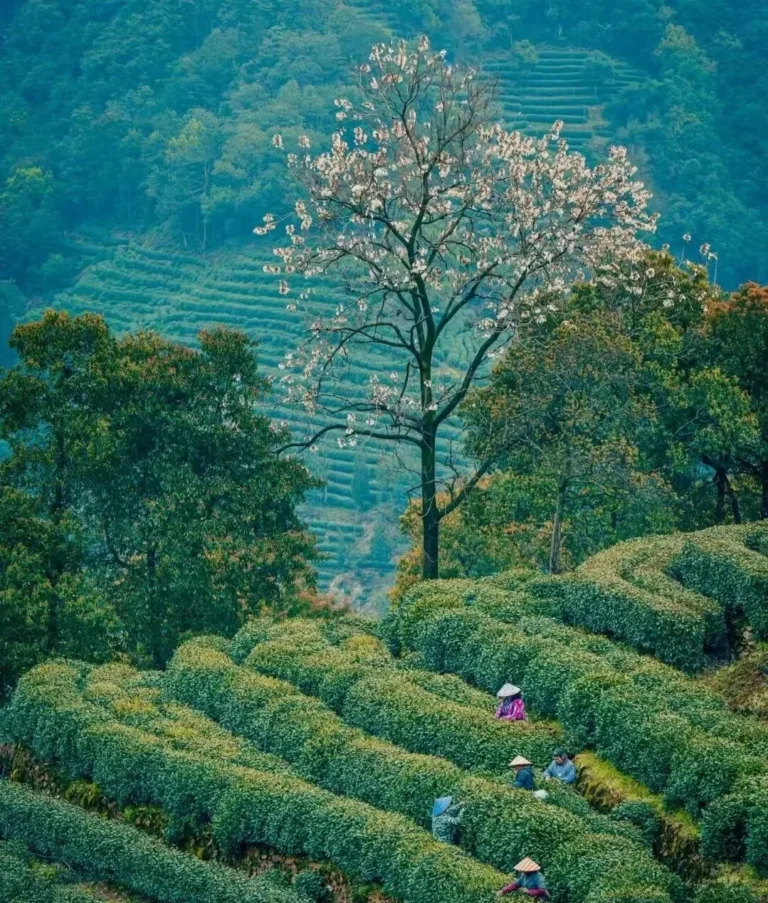
Longwu Tea Town (龙坞茶镇), southwest of central Hangzhou, is surrounded by tea landscapes and offers a completely different experience from the city center.
It can make sense for families or travelers deliberately planning a resort-style tea-country stay.
What it is not is a clever alternative base for seeing central Hangzhou.
Repeated journeys to West Lake, Hubin and Lingyin will quickly erase the appeal of staying somewhere “peaceful and cheaper.”
If the point of your stay is tea fields, slower mornings and a resort experience, Longwu can be memorable. If you intend to spend every day around West Lake and the historic center, stay closer to the city.
TripChina Pick: Treat Longwu as an experience in itself, not as your default Hangzhou hotel location.
| Your Trip | Best Base | Why | Avoid If |
|---|---|---|---|
| First Hangzhou trip, 2–3 nights | Hubin / Longxiangqiao | Walkable West Lake + metro + food | You strongly dislike crowds |
| West Lake + city sightseeing | Hubin or Wulin | Best balance of location and transport | You want rural atmosphere |
| Shopping + multiple city districts | Wulin | Strong metro connections | Lake views matter most |
| Business + luxury | Qianjiang New Town | Modern hotels and CBD access | Classic Hangzhou is your priority |
| Lingyin + temples + tea hills | Lingyin area | Immersive western-hills location | You need metro convenience |
| Tight budget | Chengzhan | Metro + cheaper inventory | You want scenic surroundings |
| Local guesthouse atmosphere | Qingzhiwu | Residential character | You dislike buses/DiDi |
| Tea-country resort stay | Longwu | Landscape and resort experience | You plan daily central sightseeing |
The important question is therefore not “What is Hangzhou's best neighborhood?”
It is:
“Which neighborhood removes the most transport from my itinerary?”
One important correction to older China travel advice: foreign travelers are not legally restricted to a special category of “foreign-qualified hotels.”
China's national authorities have instructed local authorities, online platforms and accommodation businesses not to use supposed qualification requirements as a barrier to receiving overseas travelers.
In practice, however, some small hotels and guesthouses may still have staff who rarely process foreign passports or are unfamiliar with the registration process. Operational confusion can still happen.
That is why I recommend checking the individual property's current guest policy through its booking-platform listing or messaging the hotel directly before paying.
TripChina's guide on how foreigners book hotels in China explains what to look for and what to do if a front desk is unfamiliar with foreign-passport registration.
For a first trip, I would check these six things:
Do not choose a hotel because it says “500 meters from West Lake” without opening the map.
West Lake is enormous, roads do not always follow straight lines, and the entrance you need may be on the opposite side of a wall, canal or scenic area.
Yes—if you visit before the current program ends.
As of September 2026, Hangzhou's inbound-tourism consumption voucher program runs from May 19 to October 31, 2026 and is open to foreign nationals as well as eligible visitors from Hong Kong, Macao and Taiwan.
Register through the official ZheJiangTravel / 嗨游 service using a valid travel document and activate EasyGo. Each voucher package is worth ¥150; travelers can claim once per day and up to three times during the campaign, for a maximum nominal benefit of ¥450. Each package is valid for seven days after collection.
For accommodation, participating online hotel bookings of at least ¥200 can receive a 20% discount, capped at ¥70 per transaction. The vouchers also cover eligible public transport, attractions, dining and shopping.
Because this is a time-limited 2026 program, check the official platform again before relying on it for your final hotel budget.
Yes.
Bring your original valid passport or another officially accepted travel document. Hotels register foreign guests and submit the required accommodation information to local public-security authorities.
For a normal hotel stay, the hotel handles that registration process.
If you stay in a private residence or other non-hotel accommodation, different registration responsibilities apply. Since March 20, 2026, Zhejiang has been included in the National Immigration Administration's pilot allowing eligible non-hotel accommodation registration online through NIA government-service channels.
Do not assume every hotel will accept your overseas Visa or Mastercard directly at the front desk.
Official visitor guidance lists RMB cash, bank cards, Alipay and WeChat among hotel payment methods but advises international-card users to confirm card acceptance with the property.
For everyday travel, Hangzhou is highly mobile-payment oriented.
A practical setup is:
Supported international cards can be linked to Chinese mobile-payment services without opening a mainland Chinese bank account, although individual transactions can still fail because of card-issuer or platform controls.
TripChina's official China payment guide for foreigners covers the setup and backup strategy in detail.
Hangzhou Xiaoshan International Airport is connected directly to the metro network, so most first-time travelers do not need a private airport transfer.
For Hubin / Longxiangqiao, a practical route is:
Xiaoshan International Airport → Metro Line 19 → West Lake Cultural Square (西湖文化广场) → Line 1 → Longxiangqiao (龙翔桥).
Allow roughly 45–60 minutes including the transfer, depending on waiting time.
Line 19 is particularly convenient with luggage: its trains provide dedicated luggage-storage space, and the airport express rolling stock also includes USB charging facilities.
Line 7 is useful for some southern and eastern parts of the city.
If you have heavy luggage, several travelers or a late arrival, DiDi or an official taxi may be more comfortable.
Do not build your hotel decision around a fixed airport taxi fare or travel time: road conditions can change dramatically during peak periods.
If Hangzhou is your first stop in China, TripChina's China airport arrival guide for foreigners covers the first-hour basics.
Do not depend on hotel Wi-Fi as your primary arrival plan.
Your phone may be needed immediately for:
For many short-term visitors, an international travel eSIM or international roaming is easier than buying a mainland SIM immediately after landing.
TripChina's China travel internet & eSIM guide explains the difference between data access, a Chinese +86 number and access to international services.
Jiuxi, Longjing and the hills west of West Lake contain genuinely beautiful accommodation.
But narrow roads, luggage, limited late-night food and slower transport can turn an atmospheric stay into a logistical problem.
Book these places when the landscape is the purpose of the stay—not as a cheap substitute for central Hangzhou.
A hotel's location near West Lake does not mean every room overlooks it.
“Lake view,” “partial lake view” and “distant lake view” can refer to very different experiences.
If the view is the reason you are paying extra, check the exact room category, recent guest photos and the direction the room faces.
Hangzhou East is not my preferred sightseeing base for a first visit because you will spend more time traveling to West Lake and the western attractions.
But it has one legitimate use case: a late-night arrival followed by an early train.
If you reach Hangzhou very late and leave again the next morning, staying beside the station can be much smarter than crossing the city simply to sleep near West Lake.
Saving ¥100 on a remote hotel is poor value if you then spend extra money and an hour each day getting to the places you came to see.
In Hangzhou, location often matters more than one hotel star.
This article is part of the Hangzhou Travel Guide Hub.
Accommodation registration still applies. As of September 2026, Zhejiang is part of the NIA pilot allowing foreigners or their hosts to complete eligible non-hotel accommodation registration online.
Use the NIA Government Service Platform, NIA 12367 app, or NIA 12367 WeChat or Alipay mini-program. Open the accommodation-registration service and follow the prompts. The foreign guest or host can submit the registration; if it is your first time using the system, having the host assist is often easier.
Usually, if the hotel has a 24-hour front desk or has confirmed your late arrival.
Smaller guesthouses may not staff reception overnight, so message the property before traveling and keep its Chinese name, address and phone number available offline.
If you arrive after a long travel day and have an early departure the next morning, staying near Hangzhou East can be sensible.
If Hangzhou is your destination rather than a transit stop, move to Hubin, Wulin or another sightseeing-oriented area.
Not necessarily. Being able to walk or use the metro can actually become more valuable when West Lake is extremely busy.
If you want a specific walkable lakeside hotel for the October 1–7 holiday period, consider booking roughly 30–45 days ahead rather than waiting until the last minute.
During the autumn peak-season system, weekends and public holidays from 8:00 to 17:00 bring vehicle restrictions around West Lake. Metro and shuttle buses are generally more predictable than relying entirely on cars during these periods.
Not during all peak periods.
As of September 2026, parts of Nanshan Road and the Lingyin area use designated taxi and ride-hailing transfer arrangements during autumn peak-season weekends and public holidays from 8:00 to 17:00.
For Lingyin, passengers may be directed to transfer to shuttle buses at locations such as the Xixi Road 608 parking area or Xiaoyawu bus stop.
This is one reason Hubin or Wulin can be easier than Lingyin for travelers who want to explore several parts of Hangzhou.
For a first trip, Hubin / Longxiangqiao (西湖湖滨 / 湖滨)remains the easiest answer because it puts West Lake, food, shopping and the metro in one practical base.
Wulin is the stronger alternative if citywide transport and shopping matter more than waking up beside the lake. Choose Lingyin when the western hills are a major part of the trip, Qianjiang for modern luxury or business, Chengzhan for budget and rail convenience, Qingzhiwu for a quieter local stay, and Longwu when the tea-country experience itself is the reason for staying there.
The mistake is not choosing the “wrong” famous neighborhood.
It is booking a hotel that looks good on a map without asking how you will actually spend each day.
National Immigration Administration — Online Accommodation Registration Pilot
Hangzhou — West Lake Autumn Peak-Season Traffic & Lingyin Reservation Guidance
Hangzhou — Inbound Tourism Consumption Voucher Program
Updated September 2026. This guide was rechecked against current national accommodation policy, National Immigration Administration registration rules, Hangzhou's autumn West Lake traffic controls, Lingyin Feilai Peak reservation rules and the 2026 inbound-tourism voucher program. Hotel prices remain flexible because rates vary sharply by property, room type and travel date. Time-sensitive traffic, reservation and voucher rules should be rechecked before travel.
TripChina.me creates practical China travel guides shaped by real local experience, helping independent travelers navigate transport, payments, food, neighborhoods, and the cultural details that make traveling in China easier and more meaningful. Find the guide for your destination at tripchina.me.