Our Location:
No. 99, Jiazi Road, Chengdu

 authorChris Lee
China's accommodation-registration rule sounds more complicated than it usually is. Stay in a hotel and the property normally handles it for you. Stay with friends, relatives, or in a private apartment, and you or your host generally need to register within 24 hours. The major 2026 change is NIA 12367, which allows eligible non-hotel stays to be registered online in seven pilot regions.
Update History
• July 5, 2026: Initial publication
• September 2, 2026: Updated city registration channels and NIA pilot information
• September 7, 2026: Re-checked 12367 scope, hotel-vs-private rules, penalties, and current city procedures
• Hotel stay: The hotel normally completes your accommodation registration during check-in.
• Private or non-hotel stay: You or your host must register with the local public-security authority within 24 hours after arrival at the accommodation.
• NIA 12367: As of September 2026, online registration for eligible non-hotel stays is available in seven provincial-level pilot regions.
• Outside the pilot: Use the city's official registration service where available, or the local public-security authority.
• Missed registration: Article 76 provides for a warning and may also allow a fine of up to RMB 2,000. A late registration does not automatically mean visa refusal, deportation, or that you cannot leave China.
The golden rule: Ask yourself, “Is this property registering me as a hotel guest, or am I staying at a non-hotel address?” That distinction matters more than whether you call yourself a tourist.
Under Article 39 of China's Exit and Entry Administration Law, the procedure depends mainly on where you stay.
If you stay in a hotel, the hotel records your information and reports the required foreign-guest accommodation information to public security.
If you stay somewhere other than a hotel, you or the person accommodating you must complete the registration within 24 hours after arriving at that accommodation.
The deadline is tied to your arrival at the place where you are staying, not simply to the time your international flight lands.
Private or non-hotel accommodation commonly includes:
• a friend's or relative's home
• a privately rented apartment
• your own property
• employer-provided housing
• home exchanges or similar arrangements
• other accommodation not processed through a hotel check-in system
For foreign passport holders, use the 24-hour rule. Do not rely on old travel articles describing a blanket “72-hour rural exemption.”
| Method | Effort | Reliability | Best For | Main Limitation |
|---|---|---|---|---|
| Hotel automatic registration | Very low | Very high | Most tourists | Property must successfully process the foreign passport |
| NIA 12367 online registration | Low | High | Private stays in pilot regions | Not nationwide; non-hotel accommodation only |
| Local city-government platform | Low–Medium | Medium–High | Private stays in major non-pilot cities | Menus and verification rules change |
| Host-assisted registration | Low | High with cooperation | First stay at a new private address | Host may not understand the procedure |
| Police station / public-security window | Medium | Very high | Universal fallback | Requires an in-person visit |
Important: NIA 12367 is only for private or other non-hotel accommodation. Hotels use their own public-security reporting process. You do not use 12367 to register a hotel check-in.
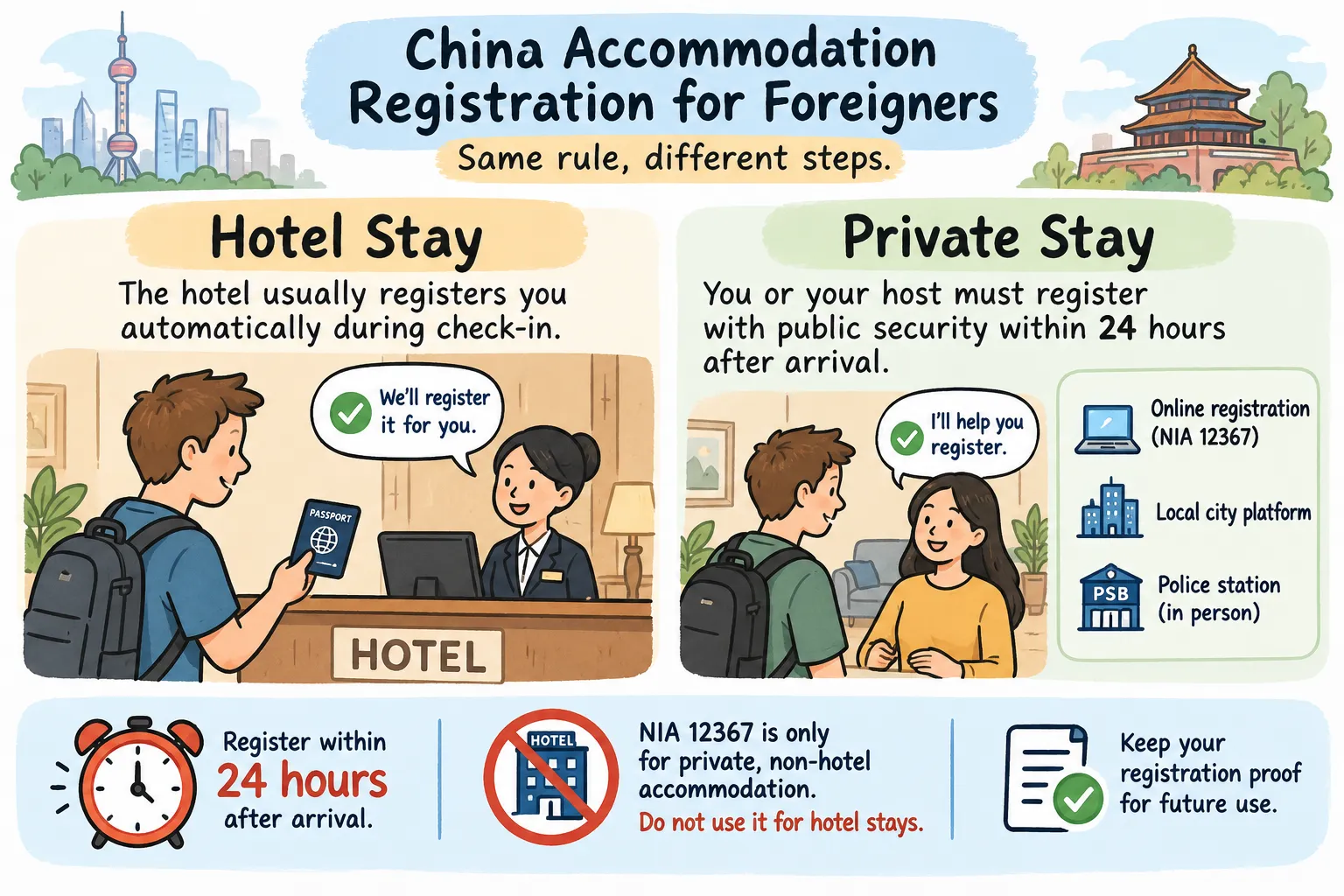
For most short-term visitors, this is the easiest situation.
Present your original valid passport or accepted travel document at check-in. The hotel records the required information and reports it through the public-security accommodation system.
After a properly completed check-in, you normally do not need to visit a police station yourself.
Move to another hotel, and the new hotel handles the registration for that stay.
Hotels do not necessarily hand every tourist a printed registration form.
For ordinary sightseeing, the important point is that the registration was completed. If you need proof for a visa extension, residence procedure, banking matter, school, driver's-license process, or another administrative purpose, ask the front desk:
“Can you provide proof of my accommodation registration?”
Save the document or electronic record if one is provided.
You may still hear that a property cannot accept foreigners because it does not have “foreign-guest qualifications.”
That should not be treated as a general nationwide legal rule. In 2024, Chinese authorities issued measures aimed at removing inappropriate accommodation barriers for overseas visitors.
In practice, some small hotels may still have staff unfamiliar with foreign passports or the reporting system.
TripChina Insight: If this happens at 11 PM with your suitcase beside you, proving a policy point at reception may not solve the immediate problem. Keep your booking confirmation, contact the booking platform, and be prepared to switch properties if necessary.
Before booking a small property, read TripChina's China Hotel Booking Guide for Foreigners.
A booking confirmation is not the same thing as official accommodation registration.
Booking platforms such as Airbnb, Booking.com, or homestay websites do not automatically prove that accommodation registration has been submitted to Chinese public security.
Before paying for a private stay, ask:
你会帮我办理住宿登记吗?
“Will you register my accommodation?”
After arrival:
你帮我登记了吗?
“Have you registered my stay?”
If your host says, “Foreigners don't need to register,” ask more precisely:
你是否通过官方住宿系统为我办理登记?
“Are you registering me through the official accommodation system?”
That question usually gets a more useful answer.
TripChina Insight: “My foreign friend stayed here last year and nothing happened” is an anecdote, not a registration policy.
From March 20, 2026, the National Immigration Administration began piloting online registration for foreigners staying outside hotels in:
Hebei · Liaoning · Zhejiang · Hubei · Guangxi · Chongqing · Sichuan
As of September 2026, nationwide implementation has not yet been announced. The NIA says the service will gradually expand based on the pilot.
Important: 12367 applies only to non-hotel accommodation. Hotel guests do not need—and should not use—this system to replace normal hotel registration.
Official channels include:
• NIA Government Service website
• 移民局12367 app
• 移民局12367 WeChat mini program
• NIA 12367 Alipay mini program
Both the foreign guest and the person providing the accommodation can use the service.

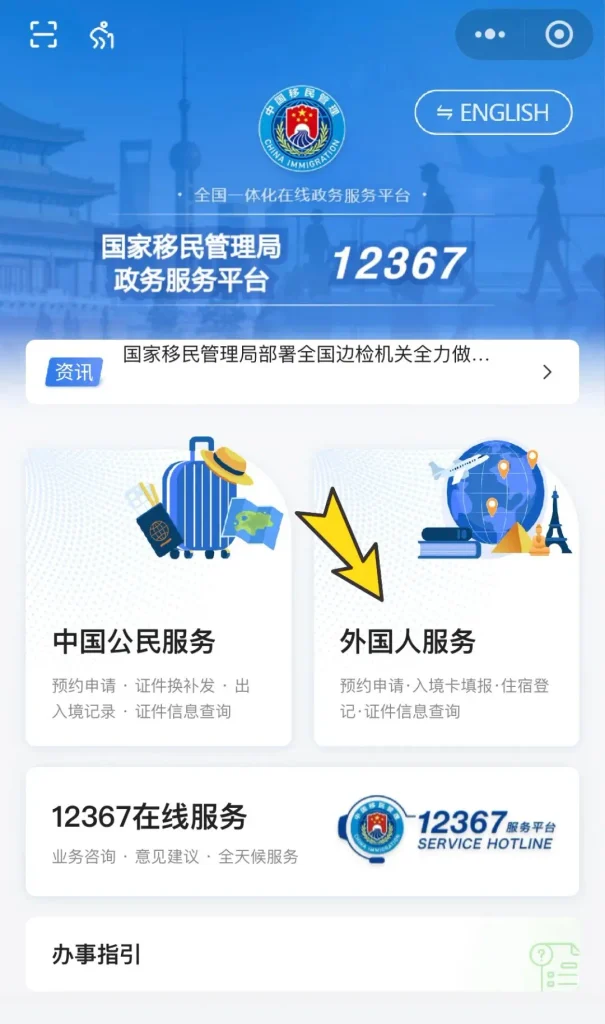


After 12367 App registration and identity verification, enter the Foreigner Services section and locate the accommodation-registration service.You can also register by searching "Immigration Bureau / 移民局" on Alipay(see third image).
The NIA confirms that successful online registration has the same legal effect as in-person registration.
For a first registration at a new private address, host assistance is usually the safest approach.
The host generally knows the exact Chinese address and property details, reducing the risk of an address mismatch.
The NIA also allows foreigners to handle registration independently in specified circumstances, including certain returns to an address previously registered through the system and stays in a self-owned residence.
Digital-government menus change faster than the underlying law.
Use the platform and search term below rather than assuming an old screenshot will still show the same buttons.
| Destination | Best Starting Point | Search / Entry Point | Practical Tip |
|---|---|---|---|
| Beijing | Beijing official online registration | 北京公安出入境 → 网上住宿登记办理 | Prepare passport and Chinese address; follow the current verification prompts |
| Shanghai | 随申办 / Suishenban International | Search “Accommodation Registration” | Switch to International version |
| Guangzhou | Guangzhou Public Security online service | 境外人员住宿登记自助申报 | Confirm private-rental registration before paying |
| Shenzhen | Shenzhen Public Security | Search foreigner temporary-accommodation registration | Use the foreign/overseas-personnel service |
| Chengdu / Sichuan | NIA 12367 | 移民局12367 | Start with the national pilot |
| Hangzhou / Zhejiang | NIA 12367 | 移民局12367 | Start with the national pilot |
| Guilin / Yangshuo | NIA 12367 | 移民局12367 | Confirm how small guesthouses register foreign passports |
| Chongqing | NIA 12367 | 移民局12367 | Start with the national pilot |
| Xi'an / Shaanxi | Local public-security service | Search 境外人员住宿登记 | Use the authority responsible for your address |
| Kunming / Dali | Current local public-security route | Check locally or call 12367 | Avoid relying on an old app button sequence |
Beijing provides an official online accommodation-registration system and the 北京公安出入境 — Beijing Public Security Exit-Entry WeChat account.
Look for:
网上住宿登记办理 — Online Accommodation Registration
Official Beijing guidance lists passport or travel-document information, a live photo, and address evidence such as property or lease information among the materials that may be required.
Beijing's official online guidance has changed over time, including verification details. Follow the current official interface instead of assuming an older phone-number or login requirement still applies.
TripChina Tip: Have your complete accommodation address written in Chinese before starting.
Shanghai provides online self-registration for foreigners staying outside hotels.
In 随申办 — Suishenban, switch to the International version and search for:
Accommodation Registration
Shanghai also provides a dedicated self-help accommodation-registration service.
Search by the current service name rather than memorizing an old sequence of buttons.
Guangzhou Public Security provides an online accommodation self-declaration service for overseas personnel.
For a private rental, ask the landlord how your foreign-passport accommodation registration will be handled before paying.
Shenzhen also provides foreigner accommodation-registration services through public-security channels. Search specifically for the foreigner or overseas-personnel temporary-accommodation service rather than ordinary mainland-resident registration.
Start with:
NIA 12367 — national pilot
If your address cannot be processed successfully, use the current local public-security service or the offline fallback.
There is little value in memorizing a city mini-program menu that may change while the legal requirement remains the same.
These destinations are outside the seven-region national pilot as of September 2026.
In Xi'an, search the current official local service for:
境外人员住宿登记
For Kunming or Dali, ask your host, check the current local public-security service, or call 12367 to confirm which route applies.
Do not assume a police station near the Bell Tower, Dali Old Town, or another tourist landmark is automatically the correct one. Registration jurisdiction is based on the accommodation address.
Do not keep submitting the same failed form until your registration window is gone.
Use this fallback order:
Requirements can vary locally, but useful documents commonly include:
• original valid passport or travel document
• complete residential address written in Chinese
• host contact or identity information
• lease or property information where applicable
• screenshot of a failed online attempt, if relevant
Say:
我要办理境外人员临时住宿登记。
“I need to complete temporary accommodation registration for a foreign national.”
Do not assume every police station or government-service window follows identical nationwide opening hours. Check locally or call 12367 before making a special trip.
A new private address generally requires a new registration.
Your previous private-address registration does not simply follow you to another apartment.
Hotels handle the registration associated with each hotel stay separately.
The NIA's 2026 policy provides simplifications for certain previously registered addresses.
If you return to the same properly registered self-owned residence—a residence owned by you or your spouse—you generally do not need a new registration merely because you traveled and returned.
A similar simplification can apply to holders of valid residence or permanent-residence documents returning to the same previously registered habitual residence during the document's validity.
For this policy, “long-term” refers to residence exceeding 180 days.
These are same-address exceptions, not blanket exemptions from accommodation registration.
Yes.
Visa-free entry does not remove the accommodation-registration requirement.
Hotel → the hotel handles it.
Private accommodation → follow the applicable non-hotel registration procedure.
For entry eligibility rather than accommodation rules, see TripChina's China Visa Guide.
For what to do immediately after landing, see the China Airport Arrival Guide for Foreigners.
Under Article 76 of the Exit and Entry Administration Law, failure to complete the non-hotel registration required under Article 39 can result in:
• a warning
• a possible fine of up to RMB 2,000
Do not confuse this with the separate hotel penalty.
If a hotel fails to properly report foreign-guest accommodation information, Article 76 provides for a warning and, where circumstances are serious, a fine of RMB 1,000–5,000.
The RMB 1,000–5,000 figure is therefore not the standard penalty for an individual foreign traveler who forgot private-stay registration.
If your registration is overdue:
• complete it as soon as possible
• provide the real arrival date and address
• explain the situation truthfully
• follow the authority's instructions
Do not invent an earlier arrival time.
The law does not state that one late registration automatically causes visa refusal, deportation, or an exit ban. Actual handling depends on the circumstances and the competent authority.
| Mistake | Why It Causes Problems |
|---|---|
| “One night doesn't count.” | There is no general one-night private-stay exemption |
| “Booking confirmation = registration.” | A reservation does not prove public-security registration was completed |
| “One registration covers my entire trip.” | Private registration relates to a specific accommodation address |
| Waiting until the last few hours | Address or verification problems leave little time for a fallback |
| Following an old WeChat screenshot literally | The law may stay the same while the interface changes |
| Losing registration proof | A screenshot or form can be useful for later administrative procedures |
The useful distinction is simple:
The legal requirement changes relatively slowly. The digital interface does not.
There is no general age-based exemption simply because the foreign guest is a child. Hotels handle the applicable guest registration; for private accommodation, make sure the minor is included as required.
If an online interface does not clearly support a child's case, ask 12367 or the local public-security authority.
Sometimes.
Banks, schools, immigration authorities, and other institutions may accept accommodation-registration records, but their document requirements differ. Ask the organization requesting proof what it specifically accepts.
You do not normally need an accommodation-registration form as a ticket or entry document for tourist attractions.
However, keeping a digital copy accessible can be useful if you later need it for an administrative procedure.
A submitted but rejected application does not count as completed registration.
Correct the passport, address, or other requested information and resubmit promptly. If you cannot resolve the problem, call 12367 or use the local offline registration route rather than waiting for the deadline to pass.
Do not assume the original submission protects you simply because it was sent before the deadline.
Correct the problem as soon as you discover it. If the online system still cannot complete the registration, contact 12367 or the local public-security authority and explain the timeline accurately.
No.
NIA 12367's 2026 accommodation-registration pilot applies to foreigners staying in places other than hotels. Hotels handle foreign-guest registration through their own public-security reporting process.
For most travelers, the rule comes down to four situations:
Hotel → show your passport; the hotel handles registration.
Private stay in a pilot region → use NIA 12367 where applicable.
Private stay elsewhere → use the current local public-security route.
Online system fails → call 12367 or use the in-person fallback.
As of September 2026, the national online system remains available in seven pilot regions for eligible non-hotel accommodation.
Take the registration requirement seriously, but do not let outdated travel advice make it sound more complicated than it is. Identify your accommodation type, use the correct official channel, save useful proof, and continue with your trip.
National Immigration Administration — 2026 Online Accommodation Registration Pilot
National Immigration Administration — Online Accommodation Registration Policy Interpretation
Exit and Entry Administration Law of the People's Republic of China
Ministry of Commerce — Measures to Facilitate Accommodation for Overseas Visitors
Updated September 2026. This guide was checked primarily against the National Immigration Administration's 2026 online-registration announcement and policy interpretation, China's Exit and Entry Administration Law, national accommodation measures for overseas visitors, and current municipal public-security guidance. Because city apps, WeChat menus, and identity-verification methods can change faster than the underlying law, this guide prioritizes official platform names and searchable service terms rather than fragile screenshot-based instructions. When a current interface differs, travelers should use the official service or call 12367.
TripChina.me creates practical China travel guides shaped by real local experience—helping independent travelers navigate transport, payments, food, neighborhoods, and the cultural details that make traveling in China easier and more meaningful. Find the guide for your destination at tripchina.me.