Our Location:
No. 99, Jiazi Road, Chengdu

 authorChris Lee
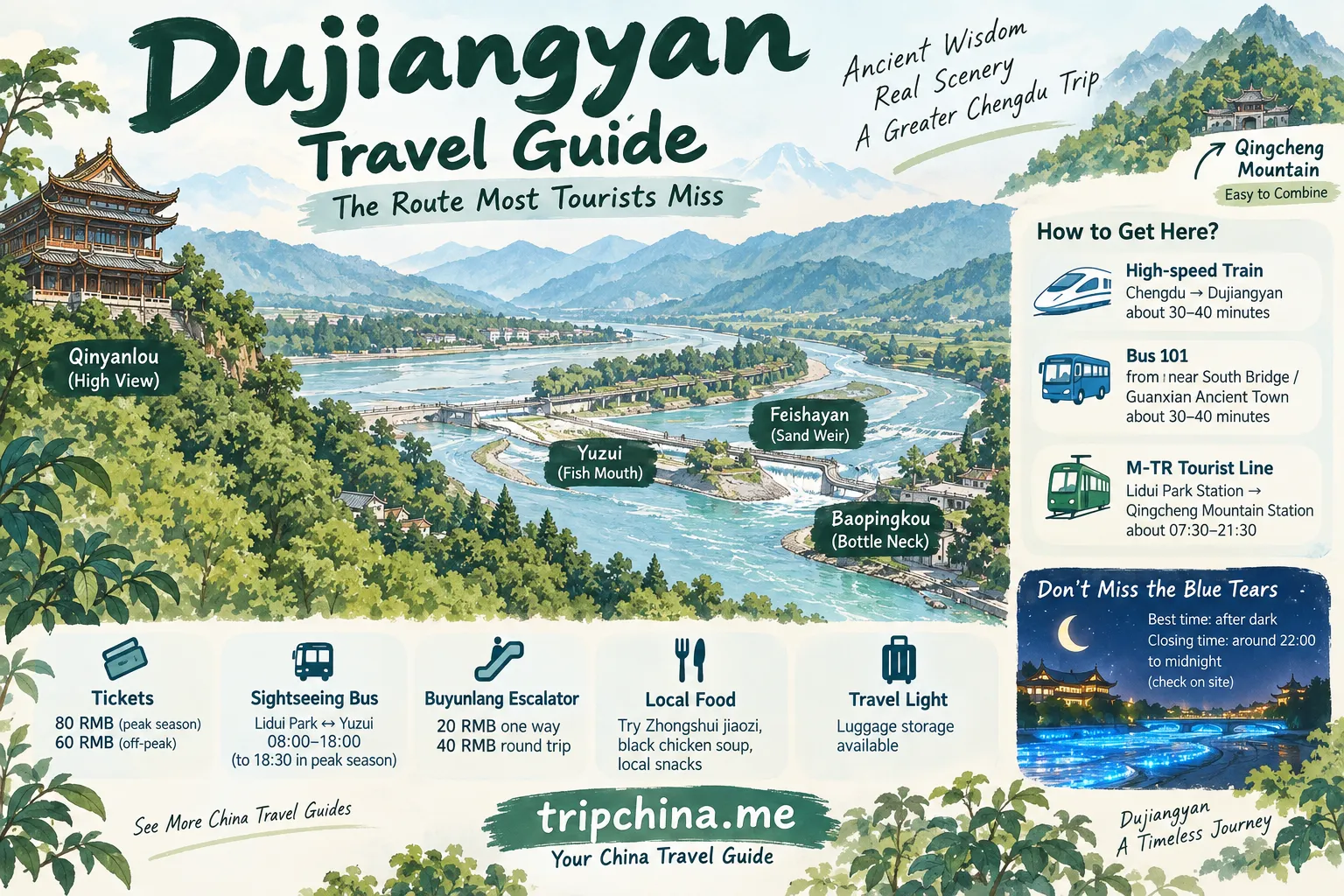
Most first-time visitors make two avoidable mistakes at Dujiangyan: getting off at the wrong railway station and entering through the wrong gate. Fix those two decisions and the visit becomes much easier. This guide uses a downhill route from Qinyanlou Entrance through the irrigation system to South Bridge, where you can finish with local food and Dujiangyan’s famous blue-lit river at night.
| Question | Best Answer |
|---|---|
| Which station? | Lidui Park Station (离堆公园站), not Dujiangyan Station |
| Best entrance? | Qinyanlou Entrance / Gate 6 |
| Best route? | Qinyanlou → Erwang Temple → Anlan Bridge → Yuzui → Feishayan → Baopingkou → South Bridge |
| Time needed? | About 2–4 hours for the core route |
| Sightseeing car? | 10 RMB one way / 15 RMB round trip |
| Best evening finish? | South Bridge and the riverside night lighting |
| Best same-day combination? | Panda Valley + Dujiangyan |
| Qingcheng Mountain too? | Give Mount Qingcheng a separate full day |
The single biggest transport mistake is buying a train ticket to Dujiangyan Station. For the scenic area, choose Lidui Park Station instead.
If Chinese rail travel is new to you, TripChina’s Taking Trains in China as a Foreigner explains passport checks and boarding, while the China Train Tickets for Foreigners guide compares 12306 with third-party booking platforms.
For most first-time visitors, I recommend Qinyanlou Entrance (秦堰楼入口 / Gate 6).
The reason is simple: Dujiangyan makes much more sense when you see the whole system before walking through its individual parts.
Qinyanlou starts you high above the Min River. From there, you descend through Erwang Temple, cross the Anlan Suspension Bridge, reach the Fish Mouth Levee, follow the water toward Feishayan and Baopingkou, then finish naturally near South Bridge and Guanxian Ancient Town.
Entering from the main Lidui Park side reverses much of that logic and adds more uphill walking.
On holidays, taxi queues and drop-off traffic around Qinyanlou Gate 6 can become heavy after about 09:30. Arriving before 09:00 gives you a better chance of avoiding the worst congestion.
| Entrance | Best For | Walking | Main Advantage | Main Drawback |
|---|---|---|---|---|
| Qinyanlou / Gate 6 | First-timers, families | Mostly downhill | See the system from above first | Requires taxi/bus transfer |
| Lidui Park Main Gate | Traditional route | More uphill | Easy to reach from the station | Less efficient for the panoramic route |
| Yulei Mountain side | Panorama-focused visitors | Easier with escalator | Access toward Yulei Pavilion | Extra transport/escalator cost |
If this is your first visit, Qinyanlou is the most practical choice.
Yes. For most independent travelers, the Chengdu–Dujiangyan intercity train is the easiest option.
Take Chengdu Metro Line 2 or Line 6 to Xipu Station (犀浦站), then transfer to an intercity train bound for Lidui Park Station (离堆公园站).
Typical rail journey time is roughly 20–30 minutes, although the exact timetable varies.
Do not confuse Lidui Park Station with Dujiangyan Station. Dujiangyan Station is several kilometers from the historic scenic area, while Lidui Park puts you close to the old town and main scenic zone.
For getting to Xipu and navigating the city before the train, see TripChina’s Chengdu Metro Guide for Foreign Visitors.
Take an official taxi or DiDi directly to Qinyanlou Entrance. The ride normally takes around 10 minutes when traffic is light.
If you have never used Chinese ride-hailing before, How to Use DiDi in China covers setup and payment for overseas visitors.
Avoid drivers or “helpers” who approach you unsolicited outside the station.
Do not build your evening around a fixed “last train” time copied from a travel blog.
As a general reference, current 2026 timetables list a late departure from Lidui Park toward Xipu around 21:22 (S5166) and a final service around 22:53 (S5090). Do not treat these as guaranteed; schedules change and seasonal adjustments occur. Check 12306 on the day of travel and reserve your return ticket in advance.
This matters particularly if you plan to stay for the South Bridge night view.
The cheapest straightforward option is Bus 101, which connects the Lidui Park / Dujiangyan scenic-area side of the city with Qingcheng Mountain for around 2 RMB.
The journey usually takes roughly 45–55 minutes, depending on traffic and where you board. Services can be less convenient later in the day, so check the current schedule before relying on it for a tight connection.
Taxis and ride-hailing are faster but more expensive.
A local M-TR tourist tram also runs between the Lidui Park/Yangtianwo area and Qingcheng Mountain. It is a slower local sightseeing option, not a fast direct transfer. It is a slower, more local alternative rather than the fastest transfer. Check current operating hours locally before using it, as published schedules may change.
If you are traveling by rail, check 12306 for the specific services available on your travel date rather than assuming every train connects Lidui Park directly with Qingchengshan Station.
But do not treat Qingcheng Mountain as a quick add-on.
Front Mountain focuses on Taoist temples and cultural sights and normally requires roughly 4–5 hours. Back Mountain is more hiking-oriented, with waterfalls and forest scenery, and can take roughly 6–8 hours depending on your route and fitness.
For a first visit, Front Mountain is generally easier to fit into a broader Sichuan itinerary; hikers and summer visitors may prefer Back Mountain.
TripChina’s Mount Qingcheng Travel Guide compares both mountains in detail.
Use this sequence:
Qinyanlou → Erwang Temple → Anlan Suspension Bridge → Yuzui → Jindi Boardwalk → Feishayan → Baopingkou → Fulong Temple → South Bridge
Allow roughly 2–4 hours for the core route.
Take a few minutes at Qinyanlou to identify the river channels and the main engineering points below. Then begin the downhill route toward Erwang Temple.
If you want a higher panorama, you can use the Buyunlang Escalator (步云廊扶梯) toward Yulei Pavilion.
Buyunlang Escalator: 20 RMB one way / 40 RMB round trip. Multiple recent local sources list these prices consistently; confirm at the gate.
This detour is optional. Qinyanlou already gives you an excellent overview.
Erwang Temple (二王庙) commemorates Li Bing and his son, traditionally associated with the construction and management of Dujiangyan.
Look for the water-management principles carved around the complex rather than rushing straight through it.
This is where Dujiangyan stops feeling like a scenic river park and starts making sense as a piece of engineering culture.
The Anlan Suspension Bridge (安澜索桥) crosses the Min River and moves noticeably under foot traffic.
It is a managed tourist crossing, but the swaying can be uncomfortable for young children, older visitors or anyone with vertigo. Hold children securely and keep moving when it is crowded.
If you suffer from severe vertigo, ask staff for the alternative crossing rather than attempting the suspension bridge.
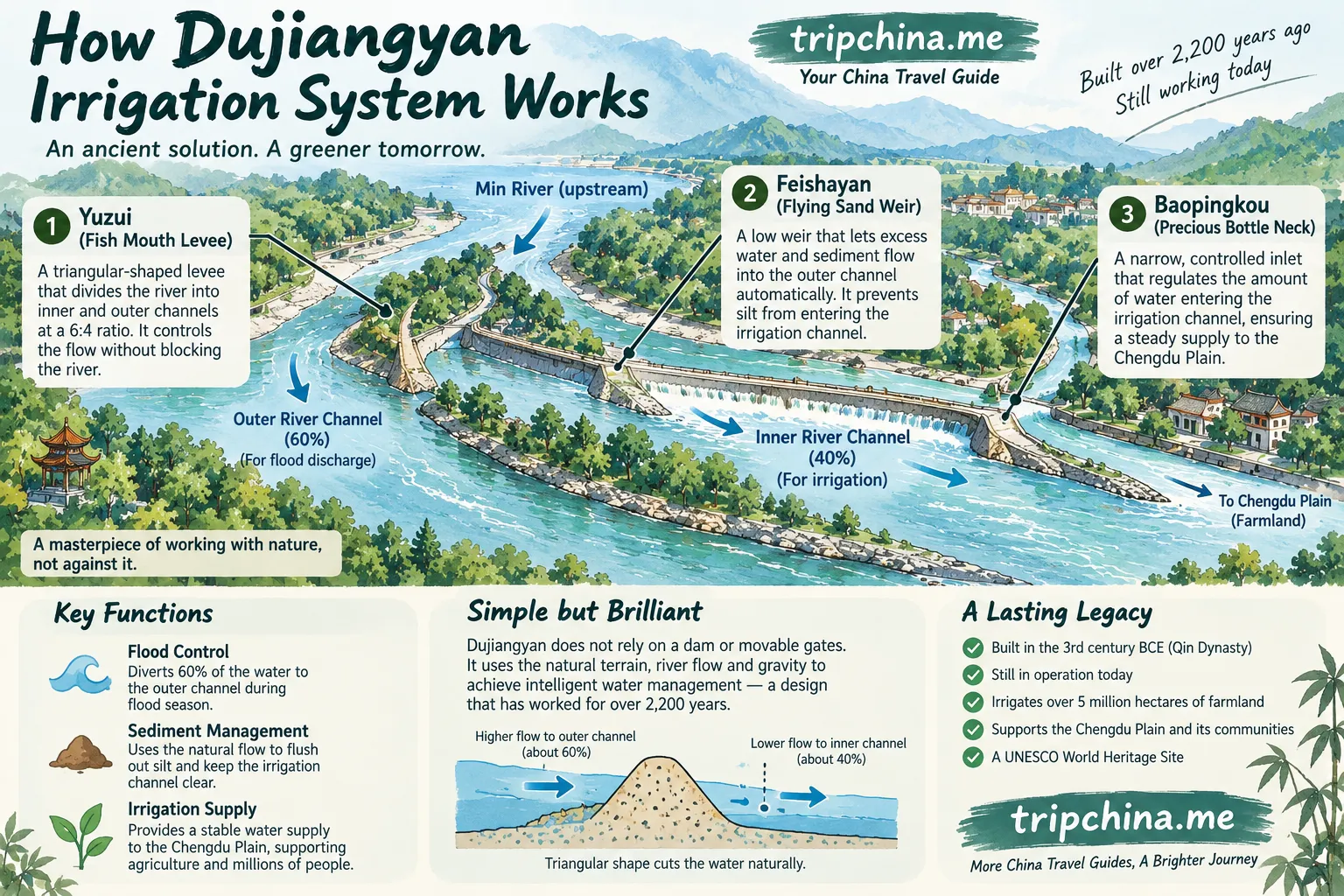
Yuzui (鱼嘴), or the Fish Mouth Levee, divides the Min River into inner and outer channels.
Its brilliance is that it works with the river rather than simply blocking it.
The broader Dujiangyan system uses the river’s topography, flow and sediment behavior to distribute water, control floods and remove sediment. More than two millennia after its creation, the system remains in operation.
Stand here for a few minutes and watch the water before moving on.
Keep phones and cameras secure near the water and remain behind barriers. The river current is powerful.
Yes, if your mobility allows it.
The Jindi Boardwalk section toward Feishayan gives you a much better feel for how water moves through the system than simply jumping between viewpoints.
Feishayan (飞沙堰), or Flying Sand Weir, helps release excess water and sediment.
Baopingkou (宝瓶口), the Precious Bottle Neck, controls the volume of water entering the Chengdu Plain.
Together with Yuzui, these are the three components you need to understand Dujiangyan.
If you are short on time or traveling with someone who has limited mobility, the sightseeing car mainly serves the Lidui Park–Yuzui section. Typical operating hours are approximately 08:00–18:30 in peak season and 08:00–18:00 in off-peak, with last ticket sales about 15 minutes before closing.Confirm the final service and ticket-sale time at the boarding point.
For travelers who can walk comfortably, I would still choose the Jindi Boardwalk. You see more of the irrigation system at ground level.
After Baopingkou and Fulong Temple, continue toward South Bridge (南桥).
This exit puts you beside Guanxian Ancient Town, local food streets and the illuminated river.
There is no reason to walk back uphill to where you started.
Dujiangyan is unusual because it is not simply an ancient monument preserved for visitors.
Construction began in the 3rd century BCE, and the water-management system continues to function today. Instead of relying on a conventional dam, its design works with the geography and hydrology of the Min River.
That is what makes Dujiangyan different from a conventional historic attraction.
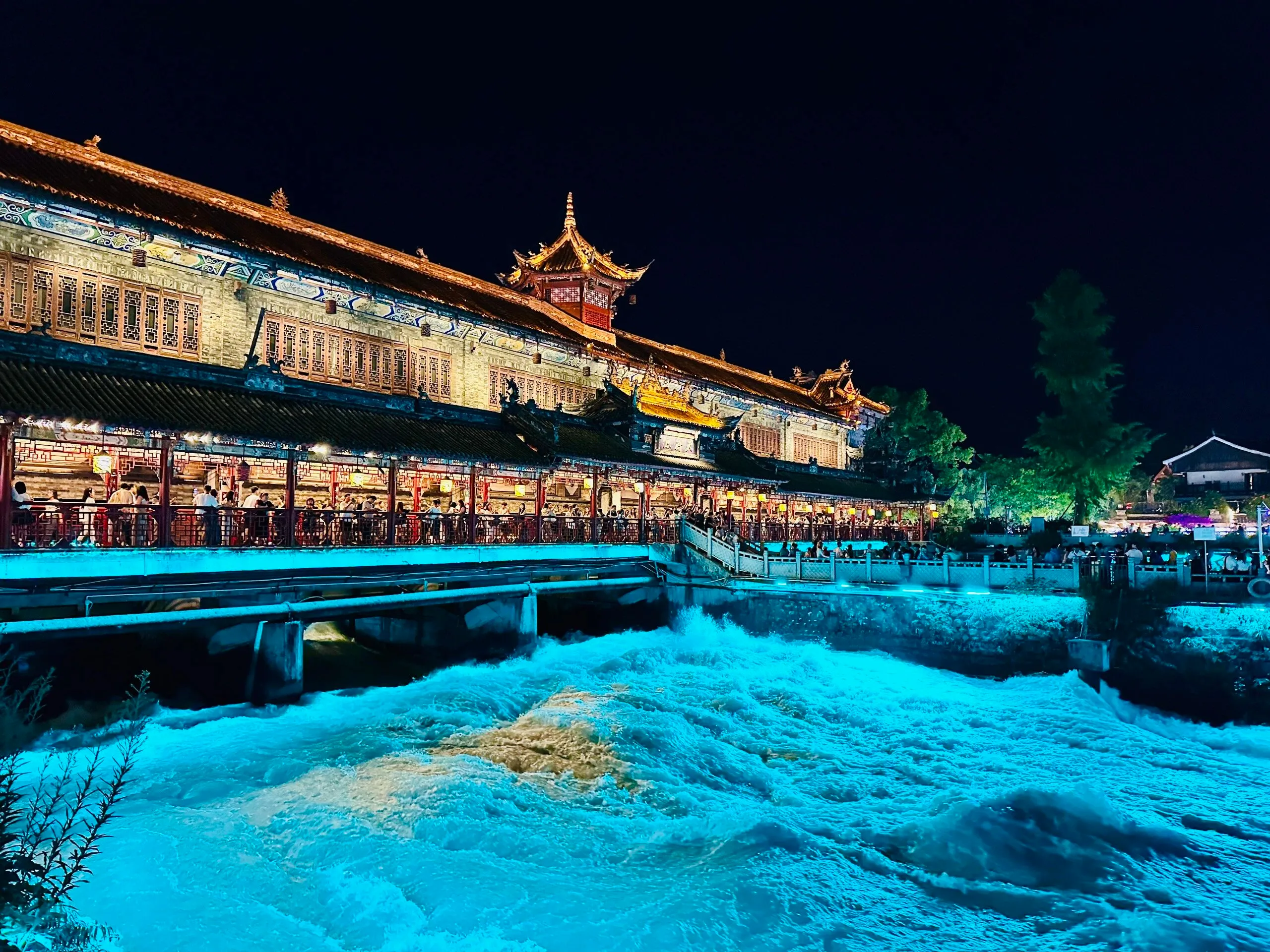
The so-called Blue Tears (蓝眼泪) are not a natural phenomenon. They are an artificial river-lighting effect that gives the water around South Bridge and nearby riverside areas an intense blue or turquoise appearance after dark.
Good viewing areas include South Bridge and the nearby riverside corridor.
Lighting times are not reliable enough to plan around one fixed hour throughout the year. In winter, illumination may begin roughly between 17:30 and 18:40 depending on the date, sunset and current management schedule. In warmer months it normally becomes effective later.
A practical target is to be around South Bridge after dinner or around 19:30–21:00, then check the situation locally.
Historically, management extended the lighting until midnight, including a July 2025 adjustment to a 24:00 closing time. Some 2026 visitor reports, however, mention shutdowns as early as 22:00 during summer periods.
Closing times can therefore change with the season, weather, river conditions or management schedule. There is no reliable public year-round timetable for the Blue Tears lighting, so on-site notices should override published guidance.
Rain, mist and high water can also weaken the visual effect. The photos you see online often look much bluer than the river appears to the naked eye, especially after phone processing.
Do not rush back to Chengdu immediately after exiting.
Guanxian Ancient Town (灌县古城) sits beside the scenic area and makes a natural dinner stop.
Look around West Street (西街), Yangliuhe Street (杨柳河街) and the streets behind the main tourist frontage rather than choosing the first restaurant beside the exit.
Local foods worth looking for include:
Small vendors increasingly accept Alipay and WeChat Pay, but carrying 100–200 RMB in cash is sensible backup.
For payment setup before your trip, see How Foreigners Pay in China and How to Use Alipay in China.
If you want to explore Chengdu street food after returning to the city, TripChina’s Chengdu Night Markets Guide covers the main local options.
The scenery is not the difficult part. The area around a major tourist attraction is where first-time visitors can make expensive mistakes.
For a wider city-level checklist, read TripChina’s Chengdu Travel Pitfall Guide.
Do not follow anyone who approaches you at Lidui Park Station claiming the scenic area is closed, inaccessible or that you need a special private route.
Check official attraction information yourself.
Use an official taxi or DiDi and go directly to the entrance you planned.
If someone aggressively harasses you, walk toward station staff, police or a staffed public area. China’s 12345 government service hotline can also be used for local complaints and assistance.
Never order a fish or other item priced by weight without confirming both the price per unit and approximate total cost before preparation.
Choose your own restaurant rather than following a guide or driver to a “recommended” one.
A menu without clear prices is a reason to leave.
No.
If someone approaches you saying taxis cannot enter, parking is closed or your chosen gate is inaccessible, verify the claim independently.
Use licensed taxis or DiDi.
Treat unsolicited photography offers cautiously.
Some vendors may provide a tiny sample image free while charging for larger prints or additional copies. Ask for the full price before agreeing—or simply use your own phone.
Be cautious with products advertised as rare wild herbs, premium tea or unusually valuable local specialties.
If authenticity matters, buy from an established retailer rather than an unsolicited street seller.
As of September 2026, standard adult admission is commonly listed at 80 RMB in peak season and 60 RMB in the off-season. Exact season boundaries and concession rules should be checked before travel because published listings are not always consistent.
| Item | Current / Typical Cost | What to Know |
|---|---|---|
| Adult admission | 80 RMB peak / 60 RMB off-peak | Verify season dates before travel |
| Student/minor concession | Usually discounted | Eligibility and ID rules apply |
| Shanghai resident offer | 15 RMB | This discounted ticket requires in-person purchase at ticket windows with valid Shanghai ID; online bookings do not qualify, and eligibility is subject to change. |
| Sightseeing car | 10 RMB one way / 15 RMB round trip | Lidui Park–Yuzui section; confirm at boarding point |
| Buyunlang Escalator | 40 RMB round trip | Published one-way prices vary; confirm at the gate |
| Taxi: Lidui Park → Qinyanlou | Roughly 10–20 RMB | Traffic and demand affect fare |
Current booking information distinguishes Chinese-national senior concessions from rules for foreign passport holders.
Chinese citizens aged 65+ generally qualify for free admission. Additional concessions apply to some Chinese citizens aged 60–64 depending on the date and current ticket policy.
Foreign passport holders should not assume these domestic senior concessions apply automatically. Check the official scenic-area booking channel before relying on a discount.
Dujiangyan tickets for foreigners can be booked through the official “青城山都江堰” WeChat channel or authorized travel platforms.
Passport-booking flows can differ from Chinese-ID booking flows. Some official mini-program functions may also be less convenient with overseas phone numbers.
If the official booking flow does not accept your details, use a reputable authorized platform that explicitly supports foreign passports. Do not enter false Chinese identity information.
Bring the original passport used for the reservation.
TripChina’s Chengdu Attraction Tickets Guide explains passport-booking issues at Chengdu-area attractions.
During Chinese public holidays, reserve earlier than you normally would. The China Public Holidays Guide explains when attractions and transport are most likely to become crowded.
Yes. This is the most realistic same-day combination.
Visit Panda Valley early, when the pandas are generally more active, then move to Dujiangyan for the afternoon and finish around South Bridge after dark.
TripChina’s Chengdu Panda Base Comparison Guide explains how Panda Valley differs from the main Chengdu Research Base and other panda sites.
Trying to combine Dujiangyan and a full Mount Qingcheng visit on the same day is much less comfortable.
A better plan is:
Day 1: Panda Valley → Dujiangyan → Guanxian Ancient Town → South Bridge night view
Day 2: Mount Qingcheng
Do not rely on Lidui Park Station having the same luggage facilities as a major Chinese railway station.
Commercial luggage-storage services operate around the scenic area and old town, and some third-party listings show storage within a few minutes’ walk of the main entrance. Published rates can be as low as roughly 5 RMB per backpack and 10 RMB per suitcase per day, with some locations operating approximately 09:00–22:00.
These are third-party businesses, not lockers operated by the scenic-area authority. Always confirm the price, location and opening hours before leaving your luggage.
If you are returning to the same Chengdu hotel, leaving large luggage there is still the simplest option.
Wear shoes with good grip. Even on the downhill route, there are stairs, slopes and long walking sections.
Bring your original passport, a charged phone, a power bank, drinking water and a small amount of RMB cash as backup.
Summer can be humid and rainy, so a compact umbrella or light rain jacket is useful. In winter, the river area can feel noticeably colder after sunset.
This article is part of the Chengdu Travel Guide Hub.
Yes, but for a completely different reason. Dujiangyan is not primarily about monumental architecture. It is an ancient water-management system that remains in use today.
Travelers interested in engineering, history, hydrology or how ancient societies solved practical problems will get much more from it than visitors looking only for dramatic ruins.
Yes. Foreign visitors can use booking channels that support international phone numbers and passports if the official WeChat booking flow does not work for them.
Bring the original passport used for the reservation because passport verification may be required at entry.
English signage is limited but present at major viewpoints. Do not expect comprehensive English explanations.
Save the Chinese names of your key stops and keep a translation app available. The main route is straightforward enough to navigate independently.
It is a managed tourist crossing, but it sways noticeably when crowded.
Hold young children securely. Visitors with severe vertigo or mobility problems should ask staff about an alternative crossing.
Only partly.
Some sections of the downhill route are manageable with a stroller, but stairs, uneven surfaces and the suspension bridge make a completely step-free visit difficult.
Do not assume the entire Qinyanlou route is stroller-accessible. Ask staff about alternative crossings and accessible sections when you enter.
Do not plan on it.
Current visitor information generally treats the ticket as valid for a single entry on the booked date. If you want to eat or explore the old town afterward, finish the scenic-area route before exiting.
Do not assume recreational drone flights are permitted.
Dujiangyan is a protected World Heritage attraction, and scenic-area or local airspace restrictions may apply. Check with scenic-area management and current aviation rules before bringing or launching a drone.
Yes—especially if you approach it as a working engineering system rather than another historic attraction.
The key is choosing the right station and entrance. Once inside, slow down enough to understand what Yuzui, Feishayan and Baopingkou actually do.
You are not simply looking at something built more than 2,000 years ago. You are seeing an ancient idea that still helps manage water across the Chengdu Plain today.
Planning more time around Chengdu? Explore TripChina’s Chengdu Travel Hub for more day trips, mountain routes and practical travel planning.
UNESCO World Heritage Centre — Mount Qingcheng and the Dujiangyan Irrigation System
Sichuan Provincial Forestry and Grassland Administration
Dujiangyan Municipal Government
Updated September 2026. Core heritage information was checked against UNESCO and government sources; train planning against China Railway 12306. Variable data includes train timetables, auxiliary transport pricing, night-lighting hours and concession eligibility. Blue Tears hours, sightseeing-car operations and M-TR information were additionally cross-checked against recent local and travel sources. Third-party luggage storage is not operated by the scenic-area authority. Always recheck variable information shortly before travel.
TripChina.me creates practical China travel guides shaped by real local experience, helping independent travelers navigate transport, payments, food, neighborhoods, and the cultural details that make traveling in China easier and more meaningful. Find the guide for your destination at tripchina.me.