Our Location:
No. 99, Jiazi Road, Chengdu

 authorChris Lee
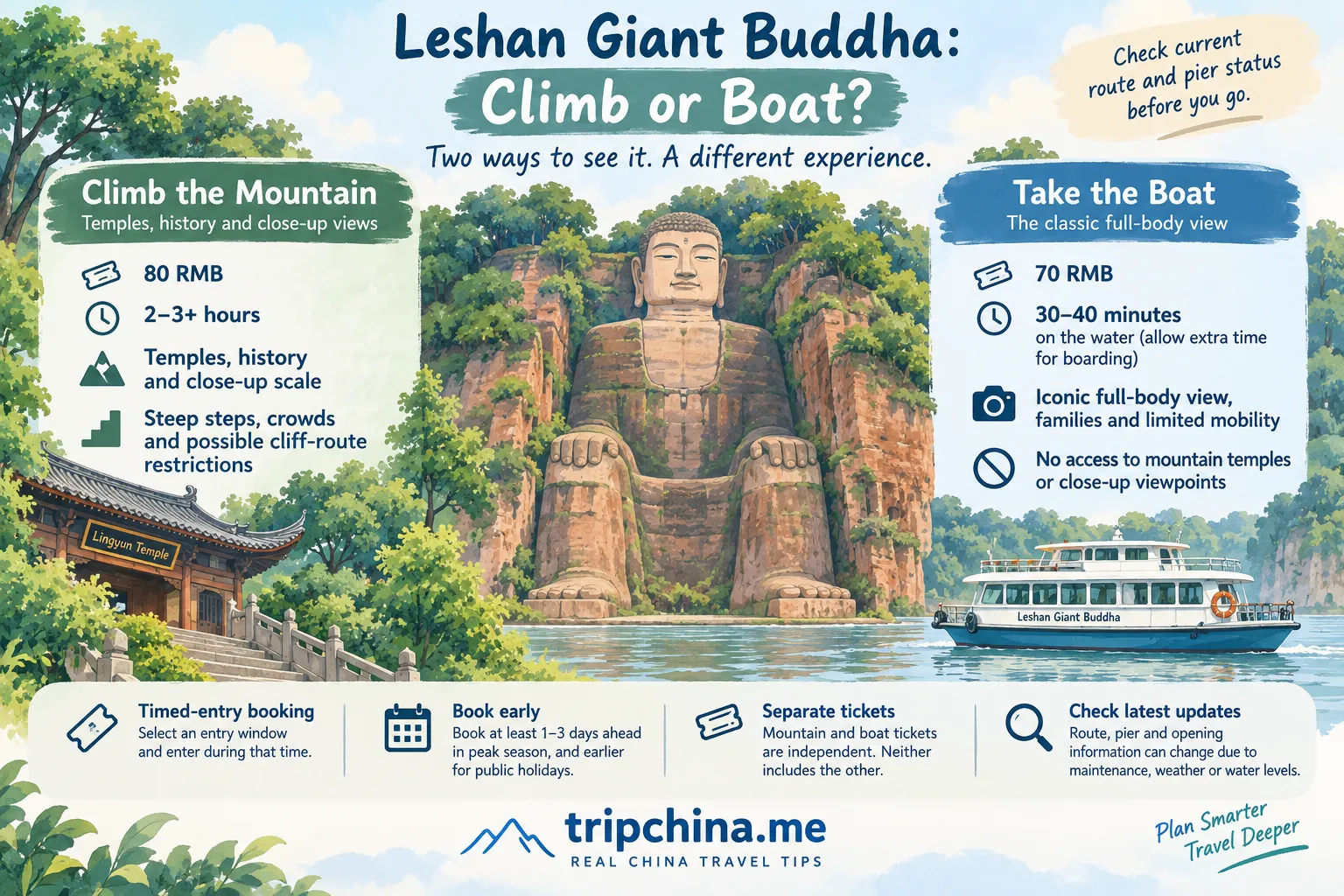
You have two very different ways to see the Leshan Giant Buddha. Walk the mountain route for temples, history and a close-up view, or take a boat for the classic full-body panorama from the river. Neither is automatically better — but temporary route closures can change the answer. This guide compares the two experiences, current access, tickets, piers and passport rules so you can choose before you arrive.
Important September 2026 update: Route, pier and opening information below reflects conditions checked in September 2026. The Nine-Turn Plank Road has been under maintenance, and access to the Buddha’s foot may be restricted. The maintenance completion date has not been pre-announced. Always cross-check the official “Great Buddha Tourism” (大佛旅游) mini-program on the day of your visit.[1]
Important: The mountain ticket and boat ticket are completely separate. Neither ticket grants access to the other experience.
| Option | Cost | Time Needed | Best For | Key Drawback |
|---|---|---|---|---|
| Climb the Mountain | 80 RMB | 2–3+ hours | Temples, history and close-up scale | Steep steps, crowds and current cliff-route restrictions |
| Take the Boat | 70 RMB | 30–40 minutes on the water; allow extra time for boarding | Classic full-body view, families and limited mobility | No access to mountain temples or close-up viewpoints |
| Do Both | 150 RMB standard tickets | 5–6 hours | First-time visitors with most of a day | Requires separate tickets and more time |
Booking rule: The scenic area uses timed-entry reservations for the mountain route. Select an entry window when booking and arrive during your reserved period. During peak season, book at least a few days ahead. For major Chinese public holidays, reserve as early as possible because popular time slots can sell out.
Climb if your priority is the historic mountain site, Lingyun Temple and seeing the Buddha from close range. During normal full-route operation, the mountain experience can include the Buddha-foot area.
Take the boat if your priority is the famous frontal view, you have limited time, or you are traveling with someone who would struggle with steep steps. During the current Nine-Turn Plank Road maintenance period, the boat becomes much more attractive because mountain visitors may not be able to reach the Buddha’s foot.
Do both if this is probably your only visit to Leshan and you can give the site most of a day — but check the current cliff-route status before paying for both experiences.
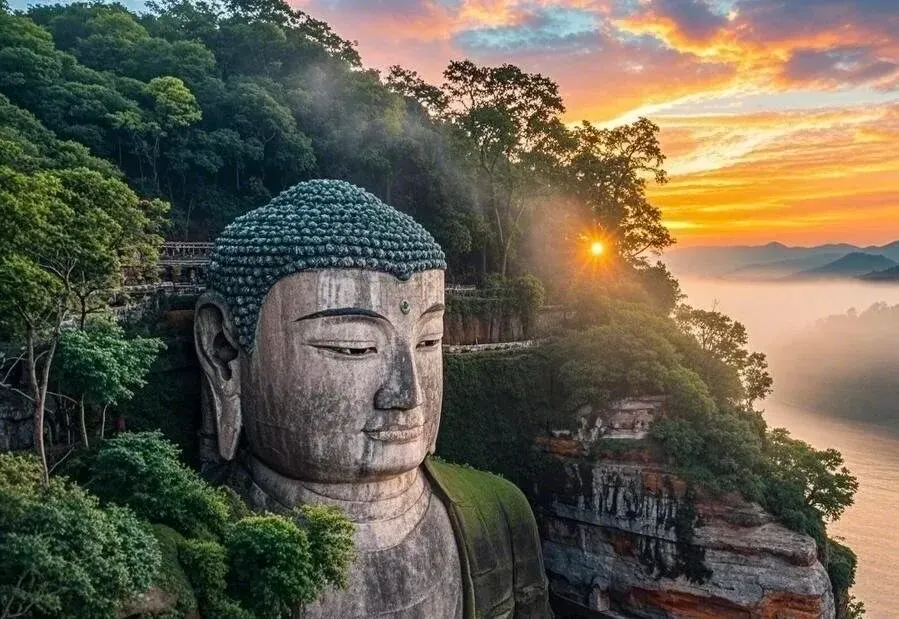
For the mountain route, go early.
During the 2026 summer operating period, April 1 through October 7, daytime mountain entry begins at 07:30 and runs until 18:30.
Early entry gives you the best chance of reaching the main mountain viewpoints before large tour groups accumulate. But do not treat “07:30 means no queue” as a guarantee. Chinese public holidays, summer weekends and major travel periods can already be busy at opening.
The mountain route uses timed-entry reservations, so arriving early does not replace booking the correct entry window. You must enter during the period attached to your reservation.
During peak season and weekends, booking several days ahead is safer than relying on same-day availability. Major public holidays can sell out much earlier.
If your China itinerary overlaps with Golden Week or another major holiday, check the dates before choosing your Leshan visit. Read our China public holiday crowd calendar.
For passport-based reservations during busy periods, read our guide to booking Sichuan attraction tickets with a foreign passport.
The entrance decision matters more than many first-time visitors expect.
For independent travelers doing the mountain route, the North Gate (北门) is the most practical starting point.
But do not confuse “North Gate” with “North Visitor Center.”
Huahuwan Parking Lot No. 2 (花湖湾2号停车场) is about 700 meters from the North Gate according to local visitor guidance, though some visitors report that the actual walk feels closer to 1 km depending on the exact parking space and path taken. Allow roughly 10–15 minutes on foot.
The North Visitor Center is farther away. No visitor parking sits directly at the North Gate entrance.
The sightseeing vehicle costs 10 RMB for a single ride, or 15 RMB for unlimited rides throughout the day.
This is especially important if you are driving. Parking near the scenic area does not mean you are already at the Buddha.
For ride-hailing between Leshan Railway Station and the scenic area, read our DiDi guide for foreign visitors in China.
The South Gate is more useful for some tour groups and visitors approaching from the southern visitor facilities, but it is not usually the most efficient starting point for an independent traveler focused on the Buddha.
The South Gate has experienced temporary closures for geological-hazard mitigation. Because access can change with construction and safety conditions, check its current status through the official scenic-area channel before planning to use it. The most recent closure ran from September 9 to September 18, 2026. Confirm reopening before travel.
The East Gate is important as an exit on some mountain routes rather than the default independent-traveler entrance.
The West Gate connects toward Oriental Buddha Capital (东方佛都), a separate modern sculpture attraction. Its admission is separate from the main Leshan Giant Buddha ticket.
Do not buy a combined product simply because someone implies Oriental Buddha Capital is required to see the historic Giant Buddha. It is not.
Under normal full-route operation, the mountain visit connects the North Gate, Lingyun Temple, the Buddha Head Platform, the cliff routes, Buddha Foot Platform and an exit toward the eastern side of the scenic area.
However, do not currently plan your visit around guaranteed access to the Buddha’s foot.
Current status — September 2026: The Nine-Turn Plank Road has been under maintenance since August 2026. During closure periods, the normal cliff circuit is interrupted and visitors may be limited to the Buddha Head Platform, Lingyun Temple and other open mountain areas rather than descending all the way to the Buddha’s foot.
The scenic area enforces one-way circulation on the cliff paths for crowd management. The specific direction can change based on maintenance and visitor flow — follow the signs and staff instructions at the Buddha Head Platform rather than relying on a fixed route from any guide.
Allow roughly 2–3 hours under normal conditions and longer when the cliff route is crowded.
The historic approach from the North Gate climbs a long series of stone steps through the wooded mountain — often cited as around 333 steps.
This sounds worse than it feels for most reasonably fit travelers because the route is shaded and broken up by carvings, viewpoints and historic features. The problem is not simply the number of steps; it is the combination of climbing, steep cliff paths, heat and possible waiting later in the visit.
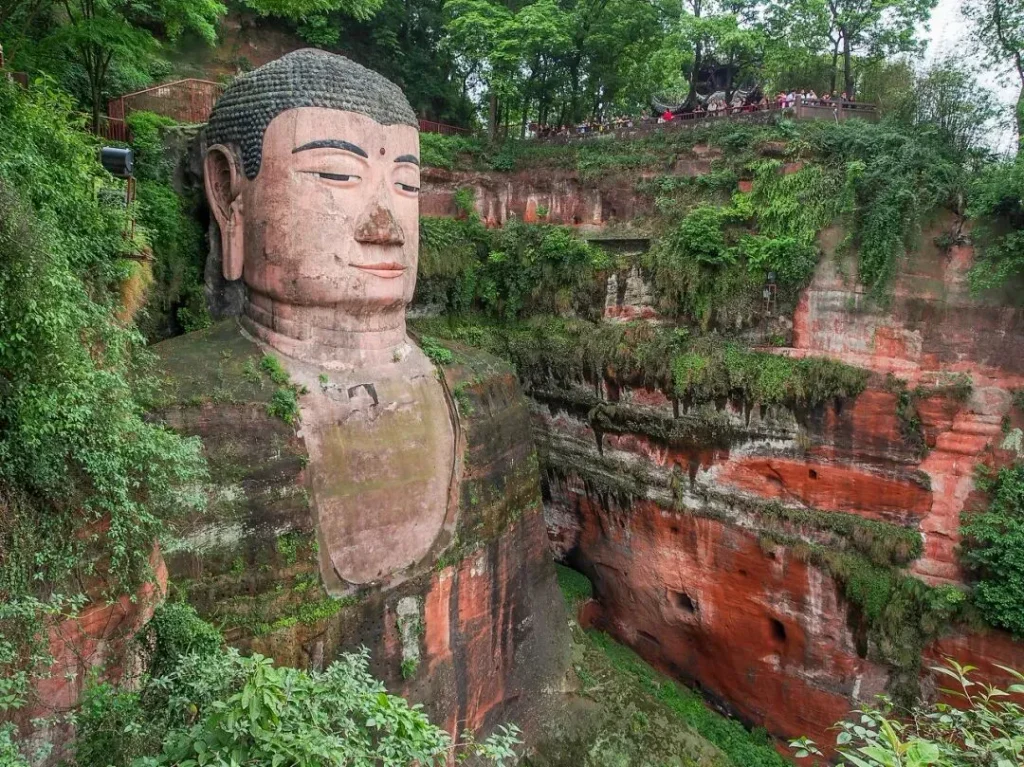
You eventually reach the area around Lingyun Temple and the Buddha’s head, where the scale begins to register.
The Buddha itself is 71 meters high. From above, you can inspect details that disappear completely from the river — including the individually constructed hair curls and the ancient drainage system integrated into the statue.
First, check whether the route is open.
As of September 2026, the Nine-Turn Plank Road has been under maintenance, so you should not assume that buying a mountain ticket means you will be able to reach the Buddha Foot Platform. The maintenance completion date has not been pre-announced.
When the full cliff circuit is operating, the Nine-Turn Plank Road is one of the most physically demanding sections.
Published step counts vary — commonly cited figures are 217 and 278 steps. What matters more for planning is the physical character of the route: roughly 70 meters of vertical change, sections as narrow as 0.6 meters and steep gradients.
The scenic area uses one-way circulation on the cliff paths for crowd management. Because the exact direction can change with maintenance and visitor flow, follow the current signs and staff instructions rather than relying on an old route map.
During rainy weather, stone steps on the cliff routes become extremely slippery, and sections may close for safety reasons.
If you have serious balance problems, significant knee trouble or a strong fear of steep heights, do not feel that you “failed” to visit Leshan by skipping the cliff route. The boat exists for exactly the kind of traveler who wants the monument without this physical challenge.
When the Buddha Foot Platform is open, this is the moment the mountain route is really about.
From the river, the Buddha looks monumental. From below, it feels architectural.
The statue rises 71 meters above you; its ears are around 7 meters long, and the foot itself is large enough to make the people around it look miniature.
You will often hear the phrase “抱佛脚” — literally “hug the Buddha’s foot.” It is also a Chinese idiom for seeking help at the last possible moment.
Treat the sculpture as a protected heritage monument rather than something to climb on or handle freely. Follow barriers and staff instructions around the platform.
The mountain ticket is not simply a more exhausting way to photograph the same Buddha.
You pass through a historic landscape of temples, pagodas, cliff carvings and archaeological remains.
Lingyun Temple sits beside the Buddha’s head and forms part of the cultural experience that boat passengers completely miss. Other sites in the broader scenic area include Lingbao Pagoda, the Mahao Cliff Tombs and Wuyou Temple.
This remains the strongest reason to choose the mountain route even when Buddha-foot access is temporarily unavailable: the climb is a historic-site experience, while the boat is primarily a visual experience.
The boat is the easier experience, but the logistics changed in 2026.
As of September 2026, the two important daytime boarding options are Jiazhou Ferry Pier (嘉州渡码头) and Wuyou Temple Pier (乌尤寺码头). The current Jiazhou Ferry daytime route began operating in 2026.[2]
| Pier Name | Daytime Route | Strength | Risks & Notes |
|---|---|---|---|
| Jiazhou Ferry Pier (嘉州渡码头) | Jiazhou Ferry → Giant Buddha → Baxian Ferry Pier (八仙渡码头) | Convenient from the northern visitor area and gives the classic frontal Buddha view | One‑way route. You disembark at Baxian Ferry Pier rather than returning to Jiazhou, so plan onward transport. Operations can change with river conditions. |
| Wuyou Temple Pier (乌尤寺码头) | Wuyou Temple Pier → Giant Buddha → Wuyou Temple Pier | Returns to the same pier and can be useful when Jiazhou operations are affected | Departures remain dependent on weather and water levels. |
Summer daytime boat boarding generally operates from around 08:00 to 18:30, with the last sightseeing boats departing around 18:00.[2]
Boats operate on a rolling basis, but actual departures can change with water levels, weather and temporary operational measures.
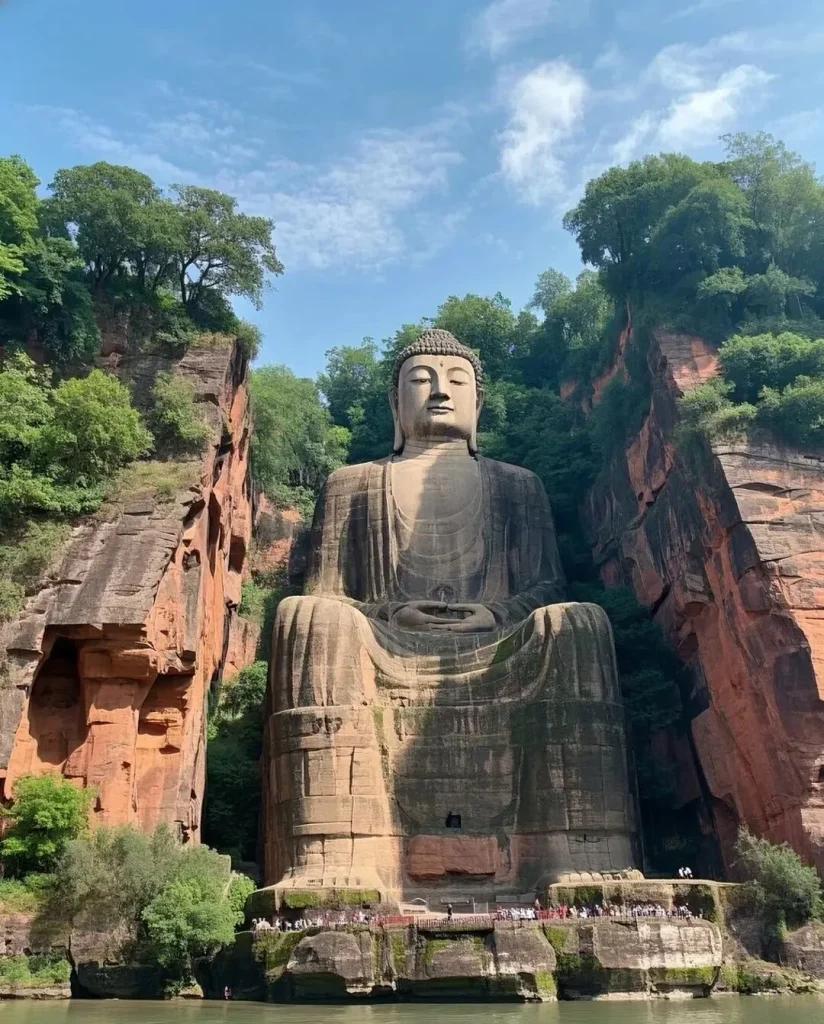
The boat gives you the classic frontal panorama: the Buddha seated against the red sandstone cliff with the surrounding mountain visible around it.
That is the image most people imagine before coming to Leshan.
It is not literally the only place from which the Buddha can be seen as a whole — distant views are possible from across the river — but it is the most accessible way for a visitor to get the iconic unobstructed frontal perspective without a long walk.
During periods when the cliff route and Buddha Foot Platform are inaccessible, the boat becomes especially valuable because it still gives you the complete frontal view of the statue.
The boat also gives you the river-level context of the confluence of the Min, Qingyi and Dadu rivers, the dangerous waters that helped inspire the Buddha’s construction.
Depending on the route and visibility, you can also appreciate the natural “Giant Sleeping Buddha” formation created by the surrounding mountains.
Yes, for most travelers.
The standard daytime boat ticket is 70 RMB as of September 2026 and provides the core on-water viewing experience.
There is also an official 150 RMB Daytime River Tour Fast Pass (白天游江优速通) available through the Jiazhou Ferry Pier operation. It includes additional services such as access to the second-floor Zen-tea waiting lounge before boarding.
It does not provide a better view of the Giant Buddha. The standard 70 RMB ticket gives you the same essential on-water Buddha perspective.
If you do not need the additional waiting-area or fast-track services, the standard ticket is sufficient.
Boat operations depend on weather and river conditions.
If Jiazhou Ferry Pier is not operating, check whether Wuyou Temple Pier is running before abandoning the boat entirely.
If neither route works and mountain tickets remain available, switch to the walking route — but first check whether the cliff route and Buddha Foot Platform are open.
Check same-day operations before leaving your hotel (see important pre-visit check above).
Yes — if you have a full day, enough energy and the mountain areas you want to see are open.
A practical sequence is:
Budget at least five hours rather than building a tight connection around exact finishing times. Crowds, route restrictions or delayed boat departures can easily shift the schedule.
The two tickets are separate, so budget 150 RMB for the standard mountain-and-boat combination.
No.
Oriental Buddha Capital, or Dongfang Fodu (东方佛都), is a separate modern sculpture park beside the historic scenic area. It contains large-scale Buddhist sculptures, but it is not required to see the UNESCO-listed Giant Buddha.
Some ticket sellers package the attractions together.
Buy the extra ticket only if you genuinely want to visit the sculpture park — not because you think it is part of the normal route to the Giant Buddha.
Yes, from a distance.
There are viewpoints on the opposite side of the river where you can see and photograph the Buddha without entering the mountain scenic area or taking the sightseeing boat.
That makes the phrase “the boat is the only way to see the full Buddha” misleading.
The difference is quality of perspective. The sightseeing boat moves into the river in front of the statue and gives you the classic centered panorama; a free opposite-bank viewpoint is farther away and is not a substitute for the close mountain experience.
No.
During major floods, river water can rise high enough to reach the Buddha’s feet — an event sometimes called “Buddha washing his feet” (大水冲佛脚).
It is real, but rare and unpredictable. The widely reported August 2020 flood was an exceptional event, not a seasonal attraction that appears every July or August.
High-water risks also apply to boat services (see boat-cancellation section above).
Do not schedule a trip hoping to see it.
High-speed rail is the easiest option for most independent travelers.
Most Chengdu–Leshan high-speed trains take roughly 50–60 minutes, although individual services may be faster. Timetables and fares vary, so check 12306 for your actual travel date rather than planning around a fixed journey time.
For passport checks, station entry and boarding procedures, read our foreign-visitor China high-speed-rail guide.
For ticket booking, compare the two main options in our 12306 vs. Trip.com China train-ticket guide.
From Leshan Railway Station, a taxi or DiDi to the Giant Buddha area generally takes around 20–30 minutes depending on traffic.
If Chengdu is your base for Leshan and other day trips, read our guide to the best areas to stay in Chengdu.
You can combine the two destinations geographically, but do not try to “do Mount Emei” properly after a full Leshan Giant Buddha visit.
High-speed trains between Leshan and Emeishan can be very quick, which makes the transfer easy.
What you cannot compress is the mountain itself.
If you only have one day, Leshan plus the Baoguo Temple area near the foot of Mount Emei is possible. If you want to go up Mount Emei rather than merely reach its gateway, give it another day.
Our Mount Emei route guide explains why a two-day mountain itinerary works much better.
| Experience | Adult Price | Notes |
|---|---|---|
| Daytime Mountain Visit | 80 RMB | Separate mountain ticket; cliff access can change because of maintenance or safety conditions |
| Daytime Sightseeing Boat | 70 RMB | Separate boat ticket; weather‑ and water‑level‑dependent |
| Jiazhou Daytime Fast Pass | 150 RMB | Official upgraded product with additional waiting/lounge services; no better Buddha viewing angle |
| Scenic Sightseeing Vehicle | 10 RMB single / 15 RMB unlimited day pass | Useful between visitor‑center and gate areas |
| Summer Mountain Hours | — | 07:30–18:30, April 1‑October 7 |
| Summer Daytime Boat | — | Boarding generally 08:00–18:30; last sightseeing boats around 18:00. Weather and water conditions apply. |
The official 2026 summer operating period runs from April 1 through October 7, with daytime mountain access from 07:30 to 18:30.
Do not confuse the two nighttime products.
Night Tour of the Three Rivers (夜游三江) is currently suspended from September 16 through September 24, 2026 for equipment maintenance. Normal operations are expected to resume afterward, subject to official confirmation. The product also depends on water levels and weather, so confirm the same-day status.
Night Tour of Lingyun Mountain (夜游凌云山) was suspended earlier in 2026 because of equipment maintenance.[1] However, the September notice suspending Night Tour of the Three Rivers directs nighttime visitors toward the mountain night-tour product instead, indicating that its operating status had subsequently changed.
Use the official “Great Buddha Tourism” (大佛旅游) mini-program in WeChat or Alipay when possible.
The scenic area uses timed-entry reservations. The same rule applies when booking with a foreign passport, so do not assume you can simply arrive at the mountain entrance and buy whichever time slot you want.
During peak season, book at least a few days ahead. Major Chinese holidays require even more advance planning.
For boat travel, foreign-passport holders who book online should bring the original passport and be prepared to complete document verification or exchange the booking for a paper ticket at the designated window before boarding.
Do not arrive at the gangway at the last minute simply because your phone shows a successful booking.
For more on passport-based attraction reservations in Sichuan, read our Sichuan attraction ticket guide for international travelers.
If mobile payments are new to you, set them up before the trip.
For WeChat setup and international-card linking, read our WeChat Pay guide for foreign visitors.
For Alipay setup, see our Alipay guide for foreign travelers.
For foreign cards, mobile wallets and cash backup strategies, read our China payment guide for foreign travelers.
Wear shoes with good grip. Stone stairs and cliff paths can become slippery when wet.
Carry water, but travel light. A small daypack is much easier than luggage on narrow stairs.
Bring sunscreen and a hat in warmer months, plus rain protection if the forecast is unstable. Sichuan summer weather can change quickly.
Most importantly, do not treat the Buddha-foot route as an ordinary paved city attraction. If heavy rain, maintenance or crowd-control measures close part of the route, follow the closure rather than trying to find a way around it.
Be skeptical of unofficial “fast track,” “VIP” or mandatory-guide pitches around the scenic area.
Remember that there is an official 150 RMB Jiazhou Ferry fast-pass product. The warning here is about unofficial sellers presenting unrelated packages as necessary for seeing the Buddha.
Likewise, make sure a taxi or DiDi destination is an actual scenic-area gate, visitor center or pier rather than an unofficial “ticket center.”
Ride-hailing is usually easier for international visitors because the destination and fare are recorded in the app.
And remember the Oriental Buddha Capital distinction: it is an optional separate attraction, not a compulsory part of visiting Leshan Giant Buddha.
Yes. Do not make Leshan a train-station-to-Buddha-to-train-station sprint if you can avoid it.
The city is famous for dishes such as sweet-skin duck (甜皮鸭), bobo chicken (钵钵鸡), qiaojiao beef (跷脚牛肉) and savory tofu pudding (豆腐脑).
The area immediately around a major scenic entrance is not where I would spend my only meal in Leshan. Once you finish the Buddha, head back toward the city and eat where the food is the destination rather than an add-on to a tour group.
If Sichuan heritage is the reason you are basing yourself in Chengdu, you can also pair Leshan with a separate day at Dujiangyan. Read our Dujiangyan route guide designed to avoid unnecessary backtracking.
This article is part of the Chengdu Travel Guide Hub.
Heavy rain can affect cliff access, while unsuitable river conditions can delay or suspend boats. Check current operations before departure and choose whichever experience remains suitable rather than forcing your original plan.
Avoid taking a large suitcase onto the mountain route.
If Leshan is a stop between cities rather than a day trip from Chengdu, plan luggage storage before reaching the mountain. Storage options may be available around Leshan Railway Station and the scenic-area visitor facilities, but locations and operating hours can change.
A small daypack is much easier for the steep stairs and narrow cliff sections.
Do not depend on a physical foreign card being accepted at every scenic-area counter.
Set up Alipay or WeChat Pay with your international card before traveling and keep some RMB cash or another payment method as backup.
Do not assume recreational drone flights are permitted simply because you can physically launch one.
The Giant Buddha is a protected World Heritage site with tightly managed visitor and heritage areas. Check current scenic-area and local airspace rules before bringing a drone, and do not fly without any authorization required on the day of your visit.
English-language support is more limited than Chinese-language interpretation, so do not depend on finding an English-speaking guide after arrival.
If a guided visit matters to you, arrange an English-speaking guide in advance and check the current visitor-center or official mini-program options before your trip.
Choose the mountain route if you want the historic landscape, temples and close-up scale of the monument.
Choose the boat if time, mobility or photography matters more. During the current Nine-Turn Plank Road maintenance period, the boat has an additional advantage: it gives you the classic unobstructed full-body view even when access to the Buddha’s foot is restricted.
And if Leshan is a once-in-a-lifetime stop and the full mountain route has reopened by the time you visit, doing both remains the most complete way to understand why “the mountain is a Buddha, and the Buddha is a mountain.”
Before you depart for Leshan Giant Buddha, pull up the “Great Buddha Tourism” mini-program to confirm your reserved entry time, cliff-route access, operating pier and opening hours for your exact travel day.
[1] Sichuan Release / Guangming Daily — Leshan Giant Buddha 2026 Summer Operating Arrangements
Confirms the April 1–October 7 summer operating season, daytime mountain hours and the earlier suspension of Night Tour of Lingyun Mountain.
[2] Leshan News / Leshan Giant Buddha Tourism Co., Ltd. — Night Tour of the Three Rivers Suspension Notice
Published September 17, 2026. Confirms that Night Tour of the Three Rivers is suspended from September 16 through September 24, 2026 for equipment maintenance.
[3] Sina News — 2026 Leshan Giant Buddha Route and Nine-Turn Plank Road Update
Used as secondary reporting for the August 2026 Nine-Turn Plank Road maintenance and temporary route restrictions.
[4] People’s Daily Sichuan — Nine-Turn Plank Road Route and Crowd-Control Reporting
Used for reporting on the cliff route, including its physical dimensions, the 278-step figure and historical crowd-management arrangements.
Updated September 18, 2026 using Leshan Giant Buddha operating notices, Leshan municipal information and current secondary reporting. Special attention was given to Nine-Turn Plank Road maintenance, timed-entry reservations, Jiazhou Ferry Pier, boat operating hours and nighttime products. Route directions are intentionally not treated as permanent because maintenance and crowd controls can change visitor circulation. Recheck cliff access, South Gate status, Jiazhou Ferry operations and both night-tour products whenever this guide is refreshed.
TripChina.me creates practical China travel guides shaped by real local experience, helping independent travelers navigate transport, payments, food, neighborhoods, and the cultural details that make traveling in China easier and more meaningful. Find the guide for your destination at tripchina.me.