Our Location:
No. 99, Jiazi Road, Chengdu

 authorChris Lee
The Terracotta Warriors look simple on a map, but a first visit involves more decisions than expected: when to arrive, how to sequence the pits, whether to visit Lishan Garden, which transport route to use, and how foreign-passport ticketing works. This guide gives you one practical first-time route without turning the day into an overplanned checklist.
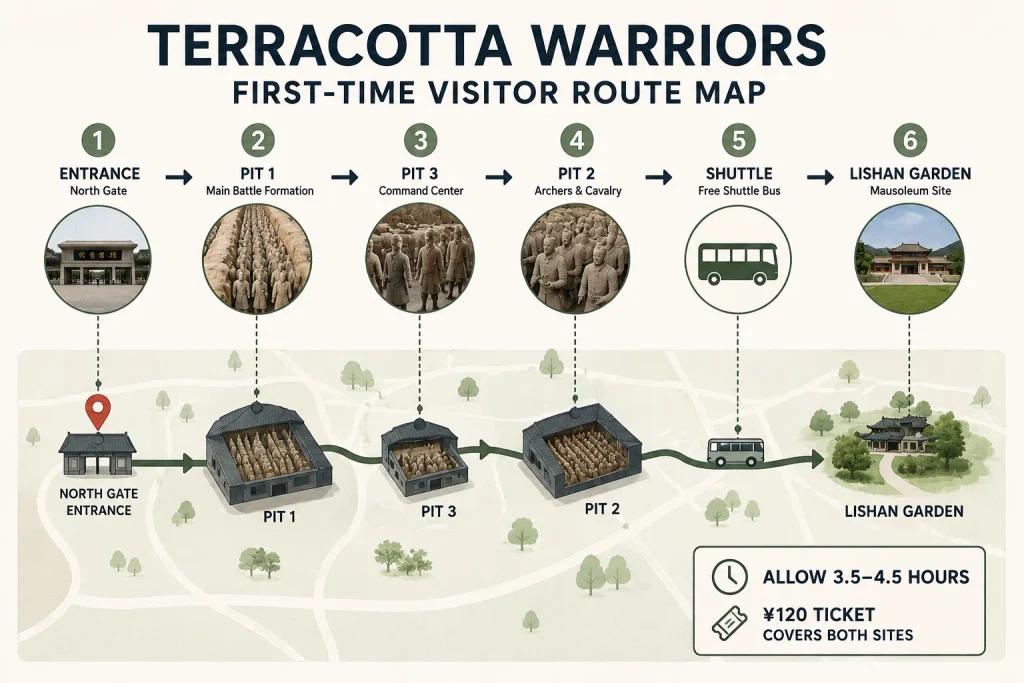
For most first-time visitors, use this order:
Pit 1 → Pit 3 → Pit 2 → key exhibitions → free shuttle → Lishan Garden
Allow roughly 3.5–4.5 hours inside the museum complex for a full first visit. This does not include round-trip transport from Xi'an.
The standard adult ticket is ¥120 and covers both the Terracotta Warriors Museum and Lishan Garden. Foreign visitors can make real-name reservations using passport information and should carry the original passport used for booking.
For public transport, the museum currently lists Metro Line 9 → Huaqingchi → Lintong 602 or Tourist 613 bus. A practical alternative for app-comfortable travelers is Line 9 to Qinling West followed by DiDi or taxi. Double-check the current bus route on Amap or Baidu Maps before travel, as route numbers can change.
The sections below show how to adapt this basic route to your available time, interests and transport preference. This guide sits within the larger Xi’an travel hub for anyone building a multi-day itinerary across the city.
• What should you know before visiting?
• What is the best first-visit route?
• What should you look for in each pit?
• Is Lishan Garden worth visiting?
• What is the best time to visit?
• How do foreign visitors book tickets?
• How do you get there from Xi'an?
• Do you need a guide?
• How much time should you allow?
• Frequently asked questions
As of September 2026:
| Visitor Question | Current Practical Answer |
|---|---|
| Adult ticket | ¥120 |
| Peak vs low-season ticket price | Same standard adult price |
| Does the ticket include Lishan Garden? | Yes |
| Can foreigners reserve with passports? | Yes |
| Original passport needed? | Yes, bring the document used for booking |
| Normal peak-season entry | 08:30–17:00 |
| Normal low-season entry | 08:30–16:30 |
| Normal maximum daily capacity | 65,000 visitors |
| Terracotta Warriors Museum visit | Museum suggests about 1.5 hours |
| Lishan Garden visit | Museum suggests about 1.5 hours |
| Shuttle between the two areas | Free |
| Recommended first-time order | Pit 1 → Pit 3 → Pit 2 → Lishan Garden |
In practice, peak season generally brings heavier visitor demand and more tour groups, while low season usually means shorter entry hours and colder weather. These are seasonal operating categories rather than guarantees of specific crowd levels on any individual day.
There is no official rule requiring one pit order.
For a first visit, the most useful sequence is:
Pit 1 → Pit 3 → Pit 2 → exhibitions → Lishan Garden
This gives you the visual impact first, then military context and finer archaeological detail, before widening the story to Qin Shi Huang's larger mausoleum landscape.
| Route | Allow | Best For | Main Trade-Off |
|---|---|---|---|
| Three pits only | 2–2.5 hrs | Very tight itinerary | Misses much of the wider mausoleum context |
| Pits + key exhibitions | 2.5–3 hrs | Limited-time first visit | Little or no Lishan Garden |
| Pits + Lishan Garden | 3.5–4.5 hrs | Best first visit | Requires more walking and planning |
| Slow full visit | 5+ hrs | Archaeology/history enthusiasts | Takes most of a sightseeing day |
The museum itself currently recommends roughly 1.5 hours for the Terracotta Warriors Museum and another 1.5 hours for Lishan Garden, with a free shuttle connecting the two.
Pit 1 is the largest and most visually dramatic of the main excavated pits.
Museum-published figures list its area at 14,260 square meters and estimate that around 6,000 terracotta figures and horses were originally buried there.
Don't stop at the first railing.
That first viewpoint naturally attracts the largest concentration of visitors. Continue around the hall for different angles and a better view toward the excavation and restoration zones.
What to notice: Look toward the restoration area at the rear of the hall, where archaeological or conservation work may be visible depending on current activity. Compare faces, hairstyles, armor and posture instead of viewing the warriors as identical copies—the figures show striking individual variation.
Recommended time: 45–60 minutes.
Pit 3 is compact and is generally interpreted as a command-related component of the military formation.
Visiting it immediately after Pit 1 gives you a quick shift from enormous army scale to military organization before moving into the more varied troop types of Pit 2.
Recommended time: 10–20 minutes.
Pit 2 is less overwhelming visually than Pit 1 but richer in troop variety.
Museum-published figures associate it with roughly 1,300 terracotta figures and horses and a wider mix of military units.
Look for:
• kneeling archers
• cavalry figures and horses
• differences in armor
• hairstyles and headgear
• posture and rank details
• differences in footwear and clothing
The kneeling archer is one of the most memorable individual figures to look for.
Recommended time: 30–45 minutes.
Photography is generally allowed in the main visitor areas, but flash photography should be avoided and posted restrictions must be followed. The museum's current security rules also restrict certain camera equipment, so do not assume tripods, selfie sticks or large camera rigs can be brought in without restriction. If you are carrying professional or large-format equipment, confirm with on-site staff before entry.
| Area | What Makes It Different | What to Notice |
|---|---|---|
| Pit 1 | Main army and dramatic scale | Formation, individual faces, hairstyles, excavation and restoration |
| Pit 2 | Greater variety of military units | Archers, cavalry, armor and troop types |
| Pit 3 | Compact command-related formation | Arrangement and contrast with Pit 1 |
| Exhibitions | Close-up artifacts | Craftsmanship, conservation and archaeological interpretation |
| Lishan Garden | Wider mausoleum landscape | Imperial burial complex, accessory pits and non-military archaeology |
Common Mistake: Don't spend almost your entire visit in Pit 1 simply because it delivers the famous postcard view. Pit 2, Pit 3 and Lishan Garden provide much of the context that turns the site from “rows of warriors” into an archaeological story.
Yes—especially on a first visit if your schedule allows it. The Bronze Chariot Exhibition Hall in Lishan Garden is the top unmissable highlight for foreign travelers
Lishan Garden is part of the Emperor Qinshihuang's Mausoleum Site Museum, and the standard admission covers both the Terracotta Warriors Museum and Lishan Garden.
The warrior pits are only one part of Qin Shi Huang's burial complex. The broader mausoleum zone contains hundreds of associated archaeological remains; the museum reports more than 600 burial pits, tombs and related remains identified within the wider complex.
At Lishan Garden, two of the clearest first-time highlights are the mausoleum mound itself and the Bronze Chariot Museum. The emperor's burial mound remains unexcavated, while the bronze chariot exhibition displays the famous painted bronze chariots unearthed near the mausoleum. Depending on your time, you can also visit the K9901 and K0006 archaeological exhibition halls.
Without the wider mausoleum context, the story can feel like:
Qin Shi Huang built an underground army.
With Lishan Garden, it becomes:
Qin Shi Huang constructed an enormous funerary landscape representing an imperial world around his tomb.
That is the main historical reason to make time for it.
Usually, no.
For most first-time visitors, the warriors are the main reason for making the trip, so seeing Pit 1 first makes sense.
Starting at Lishan Garden can be reasonable if you have visited before or care more about the mausoleum's archaeology than the famous warrior formations.
Common Mistake: Don't leave Lishan Garden until it is too late in the day to visit comfortably. Decide early whether you want the wider mausoleum context and budget your time accordingly.
As of September 2026, there is no guaranteed quiet hour inside Pit 1. Visitor volume shifts depending on weekends versus weekdays, Chinese public holidays, school vacations, summer travel demand, tour-group schedules, and temporary holiday opening extensions. This makes a broad seasonal timing strategy far more reliable than widely-shared online claims about “secret quiet windows.”
Is Opening Time Still a Good Strategy? Yes. An early reservation grants you maximum flexibility and makes it easier to fit Lishan Garden into your itinerary without rushing later in the day. Still, arriving at the 08:30 opening time does not guarantee an empty museum, as large organized tour groups may also arrive right when the gates open.
Is Late Afternoon Better? Sometimes. Some tour groups start departing later in the afternoon, but this option leaves you less time to explore the full museum complex, especially Lishan Garden. For first-time visitors, early entry with relaxed pacing tends to be more dependable than trying to predict a low-crowd time slot.
Does Rain Ruin a Terracotta Warriors Visit? Usually not. The three main warrior pits sit under covered halls, so rain rarely disrupts the core museum experience. Lishan Garden has more exposed outdoor sections. If rain falls during your trip, prioritize touring the pits first, and prepare for wet walking paths if you continue onward to the mausoleum area.
Which Days Should You Avoid If Possible? Your choice of travel day has a much larger impact than shifting your entry time by one hour. During the 2026 May Day holiday, the museum raised its daily visitor capacity to 75,000 and recorded 280,806 total visitors across the five-day holiday period, data sourced from Emperor Qinshihuang's Mausoleum Site Museum. If your Xi’an itinerary is flexible, scheduling your Terracotta Warriors trip away from major national holidays will reduce crowd pressure far more than changing entry from 09:00 to 10:00.
Common Mistake: Do not redesign your travel schedule around viral claims such as “12:30 has no crowds” or “3 PM has no tour groups.” Reserve tickets in advance and adapt to crowd conditions you encounter on site.
Yes.
An early reservation gives you maximum flexibility and makes it easier to include Lishan Garden without watching the clock later.
But don't translate that into:
08:30 = empty museum
Organized tours can arrive early too.
Sometimes.
Later in the day, some groups may already be leaving, but the trade-off is less time for the full museum complex—especially Lishan Garden.
For a first visit, early entry + flexible pacing is usually more reliable than trying to predict one magical crowd-free hour.
Usually not.
The three main warrior pits are inside covered halls, so rain has less impact on the core museum experience.
Lishan Garden is more exposed. On rainy days, prioritize the pits first and be prepared for wet outdoor walking if you continue to the mausoleum area.
The day matters more than moving your reservation by an hour.
During the 2026 May Day holiday, the museum increased capacity to 75,000 visitors per day and recorded 280,806 visitors across the five-day holiday period.
If your Xi'an itinerary is flexible, moving the Terracotta Warriors away from a major public holiday can make a much bigger difference than changing your entry from 09:00 to 10:00.
Common Mistake: Don't rebuild your itinerary around claims such as “12:30 has no crowds” or “3 PM has no tour groups.” Reserve ahead and adapt to the conditions you actually find.
The museum uses real-name online reservations, and its official channels explicitly support foreign passport information. Before your trip, review our guide for foreign visitors paying in China to handle payments and booking confirmations smoothly, and read our China eSIM vs physical SIM guide to arrange reliable mobile connectivity before arrival.
Yes.
Foreign visitors should:
The museum lists passports among the original valid identity documents accepted for ticket verification.
For a complete step-by-step walkthrough, see How Foreigners Book Terracotta Warriors Tickets.
The museum uses real-name online reservations, and foreign passports are accepted for booking.
Yes. Book through the official museum website or WeChat mini-program using your passport details, then bring the original passport used for the reservation for identity verification at entry.
The same passport can generally be used for only one reservation within an eight-day period. Walk-up ticket purchases are not available, so book online before traveling to the museum.
For step-by-step instructions, see how to book Terracotta Warriors tickets.
As of September 2026, standard adult admission is ¥120 year-round. The ticket includes both the Terracotta Warriors Museum and Lishan Garden, with a free shuttle connecting the two sites.
Visitors under 16 or aged 65+ qualify for free admission with valid identification. Eligible full-time students can purchase a ¥60 half-price ticket; international students should bring their passport and valid student ID.
Common Mistake: Bring the original passport used for booking. Do not rely on a photo or digital copy for entry.
Possibly. If the official booking system still shows same-day availability, you may reserve online. However, tickets can sell out on weekends, during summer, and on Chinese public holidays.
For a first visit, booking in advance is safer.
Possibly—but don't build your day around it.
The museum requires all visitors to make a real-name online reservation and specifically advises visitors to complete online ticket booking before traveling to the site.
If the official booking system still shows inventory for the current day, you may be able to reserve it online. But same-day availability is not guaranteed, especially on weekends, summer dates and public holidays.
For a first visit, advance booking remains the safer strategy.
There is no metro station at the Terracotta Warriors, so the final part of the journey requires a bus, taxi or DiDi.
The museum currently recommends:
Metro Line 9 → Huaqingchi Station → Lintong Tourist 613 or Lintong 602 → Terracotta Warriors
This is the best option for travelers who prefer public transport:
Xi'an Metro → Line 9 → Huaqingchi → 602/613 bus → museum
Local bus routes and schedules can change, so check Amap (高德地图) or Baidu Maps (百度地图) shortly before departure.
Another option is:
Metro Line 9 → Qinling West → DiDi/taxi → museum
This is a TripChina planning alternative, not the museum's published route. It involves fewer public-transport transfers but costs more and depends on traffic and ride availability.
| Route | Best For | Advantage | Trade-Off |
|---|---|---|---|
| Huaqingchi + 602/613 | Public-transit travelers | Official published route | Bus transfer |
| Qinling West + DiDi | Travelers using ride-hailing | Fewer transfers | Variable fare |
| Direct DiDi/taxi | Families and groups | Door-to-door | Higher cost |
| Organized transfer | Convenience-first travelers | Minimal navigation | Less flexibility |
Arriving directly from XIY Airport? A direct airport shuttle operates from Terminal 3 to the Terracotta Warriors visitor center, with a one-way fare of about ¥45 and a journey of roughly 1.5 hours. Check the latest schedule before departure.
For more detail, see our Xi'an transport guide and Xi'an metro guide. If you plan to use ride-hailing, set up DiDi before your trip.
No—but historical interpretation adds a lot here.
Pit 1 delivers visual impact without explanation. Pit 2, Pit 3 and Lishan Garden become much more meaningful once you understand military structure, excavation methods, figure types, construction and conservation.
Start with the museum's own interpretation service.
The museum currently publishes these interpretation-service landlines:
029-81399047 / 029-81399048
If calling from within China, dial them as ordinary Xi'an landline numbers. From outside China, omit the leading zero:
+86 29 81399047 / +86 29 81399048
These are museum-provided landlines. English-speaking guide availability is not guaranteed, so confirm the language, price, duration and availability before relying on the service.
The official website and on-site information or interpretation desk are the best places to check current arrangements.
For many independent visitors, yes.
An audio or written guide lets you control your own pace and spend more time where your interest is strongest.
The museum has offered digital guide and audio-interpretation services, but its current visitor page does not clearly publish a guaranteed list of available languages or rental prices. Check at the entrance or information desk for current English-language audio-guide options and pricing. If you prefer not to rely on your phone, you can also ask whether an English printed map is available that day.
The museum also provides official digital scenic-area maps and guide information.
A knowledgeable human guide is more useful if you want deeper Qin history, archaeology or conservation context.
Common Mistake: Don't assume the first person offering “official guiding” outside the entrance represents the museum. Start with the museum's official service information instead.
Use the full-visit range in the route table above as your main planning target.
A practical breakdown is:
| Part of Visit | Approximate Planning Time |
|---|---|
| Entry, orientation and security buffer | 15–30 min |
| Pit 1 | 45–60 min |
| Pit 3 | 10–20 min |
| Pit 2 | 30–45 min |
| Key exhibitions | 20–30 min |
| Shuttle / transition buffer | 15–30 min |
| Lishan Garden | 60–90+ min |
These are planning estimates, not official time limits.
Plan for the longer end of the Lishan Garden range if you want to explore more of the mausoleum area and spend time with the bronze chariot displays.
The museum's own simpler baseline is approximately 1.5 hours for each of its two main visitor areas.
Yes, if “half day” means leaving Xi'an early, already having your reservation, and treating the museum as the main activity.
If time is genuinely tight, prioritize:
Pit 1 → Pit 3 → Pit 2
But for a first visit, leaving enough time for the wider mausoleum context produces a more complete experience.
This article is part of the Xi'an Travel Guide Hub.
Official reservations cannot be rescheduled once confirmed. If your travel plan changes, cancel the existing booking and submit a new reservation subject to remaining ticket inventory.
You may still attempt entry later the same day, but admission is not guaranteed. Arriving outside your booked window risks being turned away when daily visitor capacity hits the limit.
Limited luggage lockers are available on-site, but space cannot be reserved in advance. Travel light when possible, as large bags add difficulty to walking the sprawling museum grounds.
Yes, the museum offers wheelchair rentals and marked accessible routes. Some outdoor sections at Lishan Garden have uneven ground, so notify on-site staff for assistance upon arrival.
Weekdays generally have fewer groups than weekends or holidays, but large tour parties still operate year-round. Visit Pit 1’s side viewing balconies to avoid crowded front railings.
Get the essentials right before you leave Xi'an:
reserve your ticket, bring the correct passport, know your transport plan, and leave enough time for more than just Pit 1.
Once you're inside, keep the route flexible.
That approach is more reliable than trying to predict a perfect crowd-free hour or engineer every minute of the visit.
Use these as the manually selected related guides rather than adding large numbers of generic Xi'an links:
Emperor Qinshihuang's Mausoleum Site Museum — Visitor Guide
Emperor Qinshihuang's Mausoleum Site Museum — Tickets & Opening Hours
Emperor Qinshihuang's Mausoleum Site Museum — Official Transport Routes
Emperor Qinshihuang's Mausoleum Site Museum — Lishan Garden & Bronze Chariot Museum
Updated September 8, 2026 using the Emperor Qinshihuang's Mausoleum Site Museum's current ticketing, visitor-service, transport and Lishan Garden information. Key checks covered the ¥120 adult ticket, passport reservations, 65,000 normal daily capacity, seasonal opening hours, Lishan Garden, interpretation contacts and the current Huaqingchi transport route. Route sequencing and time allocations are TripChina editorial recommendations, not official museum requirements.
TripChina.me creates practical China travel guides shaped by real local experience, helping independent travelers navigate transport, payments, food, neighborhoods, and the cultural details that make traveling in China easier and more meaningful. Find the guide for your destination at tripchina.me.