Our Location:
No. 99, Jiazi Road, Chengdu

 authorChris Lee
I spent my first Beijing evening at Wangfujing: bright lights, crowds, fried scorpions on sticks, and a skewer that tasted like cardboard. I left feeling like I had missed the point entirely.
Beijing’s food streets are not all the same. Some are genuine neighborhood institutions; others work better for sightseeing than eating. This guide compares 10 places by food, atmosphere, value, opening hours, metro access, and the trade-offs that actually matter.
For late-night energy and spicy crawfish, choose Guijie (簋街). For halal lamb, beef buns, and traditional snacks, go to Niujie (牛街). For a proper stall-based night-market atmosphere, Sheng Huatun (盛华屯) is the stronger choice, though it is well outside central Beijing. For old Beijing restaurant brands in one walkable area, choose Qianmen (前门大街).
Skip Wangfujing as a dedicated food destination, and treat Nanluoguxiang primarily as a sightseeing street rather than your main Beijing meal.
| Food Street | Best For | Typical Budget* | Best Time | Honest Trade-off |
|---|---|---|---|---|
| Guijie (簋街) | Late-night dining, crawfish | ¥80–150 | Dinner to late night | Busy, pricier, heavily spicy |
| Niujie (牛街) | Halal food, lamb, local snacks | ¥20–80 | Daytime–early evening | Many snack shops close relatively early |
| Qianmen (前门大街) | Beijing classics, old restaurants | ¥50–200 | Lunch–dinner | Tourist-heavy and often pricier |
| Sheng Huatun (盛华屯) | Full night-market atmosphere | ¥30–80 | 5–10:30 p.m. | Far from central Beijing |
| Panjiayuan (潘家园) | Market browsing + casual food | ¥20–50 | Market sessions | Food is secondary |
| Huguosi Street (护国寺街) | Traditional Beijing snacks | ¥15–50 | Morning–afternoon | Quiet, not a night market |
| Lishuiqiao Area (立水桥) | New neighborhood market scene | Varies | Depends on market | Format changed in 2026 |
| Huajie Night Market (花街夜市) | Flowers, snacks, atmosphere | ¥20–50 | 6 p.m.–midnight | Better atmosphere than food |
| Fangzhuang (方庄) | Restaurants, seasonal food events | ¥50–150 | Dinner | Not a permanent street-food market |
| Yandaixiejie (烟袋斜街) | Hutong walk + snack stop | ¥20–80 | Afternoon–evening | Very short and tourist-oriented |
*Budgets are rough per-person food estimates and exclude drinks, premium restaurant meals, and shopping.
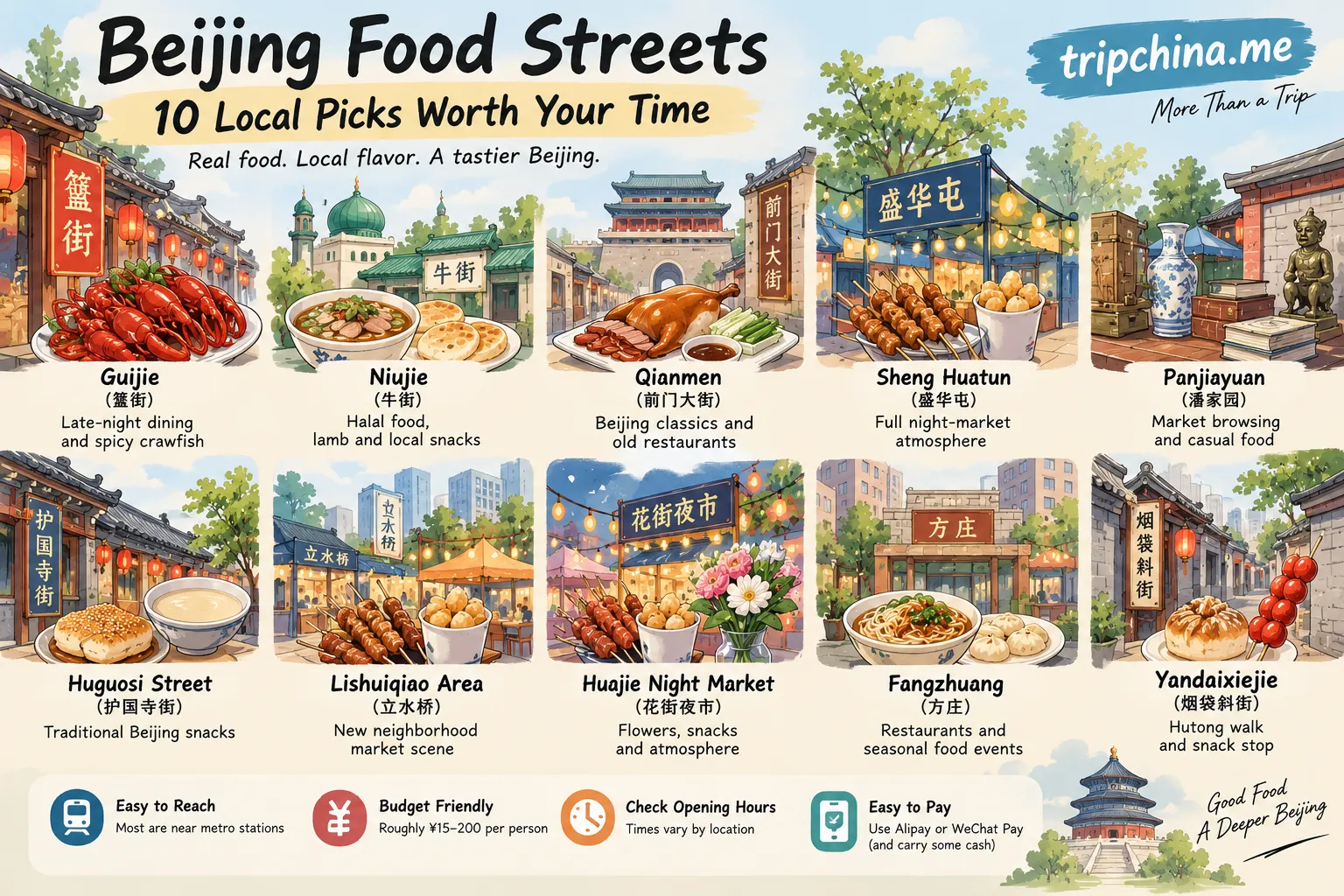
Guijie (簋街) runs roughly 1.5 kilometers along Dongzhimen Inner Street toward Jiaodaokou East Street in Dongcheng District. It is one of Beijing’s best-known late-night restaurant strips, with red lanterns, hotpot restaurants, crawfish specialists, grilled fish, and tables still turning long after many other neighborhoods have quieted down.
The nickname developed from the area’s association with late-night trading. Today, the character 簋 refers to an ancient Chinese food vessel, giving the modern street name a food-related identity.
Spicy crawfish (麻辣小龙虾) is the obvious signature. Hu Da Restaurant (胡大) is the best-known name on the street and operates around the clock at its flagship location. Crawfish are commonly priced by size and quantity, so check the menu and minimum order before sitting down.
Other staples include spicy frog (馋嘴蛙), Chongqing-style grilled fish (重庆烤鱼), hotpot, and late-night barbecue.
Guijie is loud, crowded, and strongly tilted toward spicy food. Restaurant quality varies, and the most famous places can develop long queues on weekend evenings. If you hate chili, this is probably not the food street I would build a night around.
Address: Dongzhimen Inner Street, Dongcheng District
Metro: Lines 2/13, Dongzhimen Station
Typical hours: Many restaurants continue well past midnight; individual hours vary
Budget: Roughly ¥80–150 per person
For getting around the city without guessing at exits, tickets, or payment methods, see the Beijing subway guide for foreign visitors.
Niujie (牛街) is not really a night market. That distinction matters.
This Xicheng neighborhood is one of Beijing’s most important centers for halal food, and many shops are busiest during the day and early evening. The street itself is compact enough to walk quickly, but the food density makes it worth slowing down.
Start with Jubaoyuan (聚宝源) if you want traditional lamb hotpot. It is one of the neighborhood’s most famous restaurants, and peak meal periods can mean a substantial wait.
Then look for Hongji Xiaochi (洪记小吃) for beef buns, Baiji Niangao (白记年糕) for sticky-rice sweets such as lvdagunr (驴打滚), sesame flatbreads, lamb skewers, and other halal snacks.
The practical mistake here is arriving too late. Niujie is a working neighborhood, not a purpose-built tourist night market, and many snack shops wind down earlier than Guijie restaurants.
Address: Niujie Street, Xicheng District
Metro: Line 7, Niujie Station
Best time: Late morning through early evening
Budget: Roughly ¥20–80 per person
If food location is influencing where you book your hotel, the Where to Stay in Beijing guide compares five practical areas for first-time visitors.
Yes—but not because it is hidden or especially local.
Qianmen Street (前门大街) runs south from the Zhengyangmen area and connects naturally with Xianyukou Food Street (鲜鱼口美食街) and Dashilan (大栅栏). Together, they form one of the easiest areas for first-time visitors to sample several old Beijing food traditions without crossing the city.
The area is particularly useful for famous restaurant brands: Quanjude (全聚德) for Peking duck, Du Yi Chu (都一处) for shaomai, Tianxingju (天兴居) for chaogan (炒肝), and other long-established Beijing names.
If roast duck is your priority, compare the different styles and restaurants in my Beijing roast duck guide before choosing purely by the longest queue.
Qianmen is touristy, and you will usually pay more than in an ordinary residential neighborhood. Its advantage is convenience: famous Beijing dishes, historic streets, Dashilan, and sightseeing can all fit into one walking route.
Address: Qianmen Street, Dongcheng District
Metro: Line 2, Qianmen Station
Typical restaurant hours: Around 10 a.m.–9 p.m., varying by business
Budget: Roughly ¥50–200 per person
If you specifically want rows of stalls rather than restaurant storefronts, yes.
Sheng Huatun (盛华屯) is near Guta North Road in Wangsiying, Chaoyang District. It combines food stalls with games and entertainment rather than functioning like a traditional restaurant street.
As of September 2026, Beijing Tourism lists the market as operating Wednesday through Sunday, 5 p.m.–10:30 p.m.
Expect a broad night-market mix: grilled meats, fried skewers, grilled cold noodles, stinky tofu, chicken racks, desserts, and other regional snacks. Games and entertainment add to the fairground feel.
Food quality is not the only reason to come. The appeal is wandering, sharing several snacks, playing a game, and spending an entire evening in one place.
The downside is location.
Address: Guta North Road, Wangsiying Township, Chaoyang District
Metro: Line 7 to Shuanghe Station, followed by roughly 3 km of onward travel
Hours: Wednesday–Sunday, 5–10:30 p.m. as of September 2026
Budget: Roughly ¥30–80 per person
If you do not want to deal with a shared bike after dark, use a ride-hailing car for the final stretch. My DiDi guide for foreign travelers explains how to set it up without relying on a Chinese phone number.
Because operating schedules can change with seasons, inspections, weather, or events, check a current local listing before making a special trip.
Come for the market. Eat while you are there.
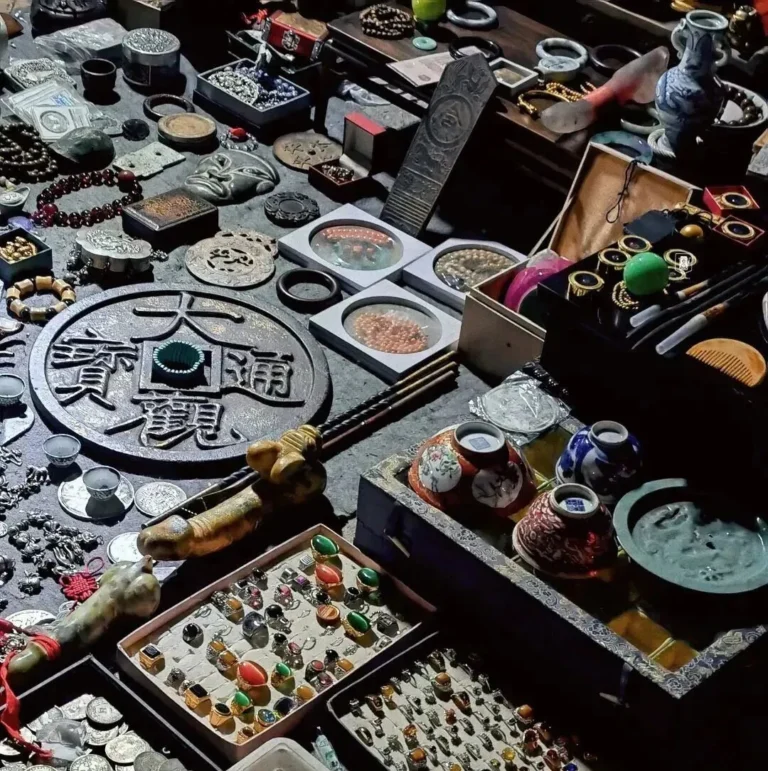
Panjiayuan (潘家园) is Beijing’s best-known antiques and collectibles market. Food stalls are part of the experience, but grilled skewers, noodles, and fried snacks are supporting characters rather than the reason to cross Beijing.
The terminology around its “ghost market” can be confusing. As of the latest published Beijing Tourism information, Wednesday and Friday night sessions run 11 a.m.–11 p.m., while the Saturday themed night-market session is listed from 2–11 p.m. The broader market also has an early-morning trading culture, so do not assume every reference to “ghost market” means a midnight market.
You will see old coins, jade, posters, traditional crafts, vintage objects, artworks, collectibles, and plenty of items whose authenticity is difficult for a casual visitor to judge.
Do not pay serious money for something simply because a seller describes it as antique. If authenticity matters, buy only when you understand what you are looking at and how it can be verified.
Address: 18 Huali, Panjiayuan Road, Chaoyang District
Metro: Line 10, Panjiayuan Station
Food budget: Roughly ¥20–50
For a deeper comparison of Panjiayuan and Beijing’s other unusual markets, use my Beijing ghost market guide.
Go to Huguosi Street (护国寺街).
The roughly 600-meter street in Xicheng District is better suited to a relaxed daytime snack crawl than a late-night outing. This is where I would go if I wanted traditional Beijing flavors without building the afternoon around a huge tourist attraction.
The Huguosi Snack Main Store (护国寺小吃总店) is the obvious starting point for old Beijing snacks. Other options in and around the street include traditional pastries, sesame-based noodles, fried snacks, and Beijing-style staples.
Bean juice (豆汁) deserves a warning: it is culturally famous, but its fermented flavor is challenging even for many Chinese visitors. Order a small portion first rather than treating it as something you have to finish.
Address: Huguosi Street, Xicheng District
Metro: Lines 4/6, Ping’anli Station
Typical hours: Many shops operate from morning to early evening
Budget: Roughly ¥15–50 per person
Do not rely on older guides describing Lishuiqiao (立水桥) as one fixed street market operating from evening until 2 or 3 a.m.
The area’s night economy changed significantly in 2026. New market projects have been introduced around the Lishuiqiao transport and commercial area, including the Xianghe Antique City “Daming Buye · Chaowan Feiyi” market (祥和古玩城“大明不夜·潮玩非遗”市集). Published information for that project lists weekday hours of 7–9 p.m. and weekend/public-holiday hours of 2–9 p.m.
The wider district is also developing new food, cultural, and retail market concepts. That makes Lishuiqiao interesting—but it also means the old “cheap night market open until 3 a.m.” description is no longer reliable enough to plan a trip around.
Area: Lishuiqiao / Litang Road area
Metro: Lines 5/13, Lishuiqiao Station
Hours: Depend on the current market or event
Budget: Varies
If Lishuiqiao is far from your hotel, check the current event before traveling there specifically for food.
Huajie Night Market (花街夜市) sits at the Beijing Flower Trading Center on Caoqiao East Road in Fengtai District.
This is the unusual one: flowers on one side, food and entertainment on the other.
The upgraded market reopened in April 2026 with a roughly 400-meter market street. Fengtai District reported operating hours of 6 p.m.–midnight, although later event notices have shown schedule variations for related flower-market programming. Check the current schedule before visiting.
There are grilled skewers, cold noodles, fried snacks, drinks, flowers, cultural products, and evening entertainment.
I would choose Huajie for atmosphere rather than for a once-in-a-lifetime Beijing dish. Buying a bouquet, grabbing several snacks, and walking the flower-lined market is the experience.
Address: Caoqiao East Road A1, Fengtai District
Metro: Caoqiao Station, served by Lines 10/19 and the Daxing Airport Express
Published hours: Around 6 p.m.–midnight; verify the current day’s schedule
Food budget: Roughly ¥20–50
Not quite.
Fangzhuang (方庄) has traditionally been a south-Beijing residential dining district dominated by sit-down restaurants rather than open-air street-food stalls. But its food identity is evolving.
The 2026 Fangzhuang Food Festival, held from June 27 to July 12, brought together 103 participating businesses and more than 200 foods, turning the area into a much larger nighttime food and entertainment destination for 16 days.
That festival has ended, so do not arrive expecting a permanent 100-vendor night market. The useful takeaway is different: Fangzhuang is increasingly being used for organized food and night-economy events.
Area: Fangzhuang, Fengtai District
Metro: Lines 5/14, Puhuangyu Station
Hours: Depend on individual restaurants or temporary events
Typical restaurant budget: Roughly ¥50–150 per person
If you are staying in southern Beijing, it is worth checking what is happening locally. I would not make a special cross-city trip unless a food festival or event is running.
Yandaixiejie (烟袋斜街) is worth visiting—but food should not be your main reason.
The short diagonal hutong street connects the Shichahai and Drum Tower area. Its old buildings, alley atmosphere, shops, and proximity to Shichahai make it easy to include in a sightseeing walk.
Use the street for snack stops rather than a full food crawl. Nearby established restaurants and grilled-meat options are generally more compelling than chasing every souvenir-oriented snack window.
The street itself is only about 232 meters long, so you can cross it quickly. Slow down for the neighborhood rather than trying to turn it into a major meal destination.
Address: Yandaixiejie, Xicheng District
Metro: Line 8, Shichahai Station
Typical shop hours: Around 10 a.m.–9 p.m., varying by business
Budget: Roughly ¥20–80 per person
Set up Alipay or WeChat Pay before you go, ideally with an international bank card already linked.
China’s official guidance confirms that overseas visitors can register for major mobile-payment services using foreign mobile numbers and link supported international cards. RMB cash remains a valid payment method, so keeping some small notes as backup is sensible.
At tiny street stalls, however, do not assume you can hand over a foreign Visa or Mastercard directly. QR payment is usually much more practical.
For setup instructions, see my China payment guide for foreign visitors.
Do not turn dinner into a checklist.
Pick two or three things you genuinely want to eat, then leave room for something you discover when you arrive. At Niujie, I would prioritize lamb, beef buns, and one traditional sweet or pastry. At Guijie, crawfish makes sense if you enjoy spicy food. At Qianmen, choose one serious Beijing restaurant and then snack as you walk.
One simple on-the-ground rule works surprisingly well: a small shop cooking continuously for a steady line of local customers is usually a better signal than a giant sign claiming to be “famous.”
This article is part of the Beijing Travel Guide Hub.
Niujie is the most useful area in this guide for travelers specifically looking for halal food. It combines halal restaurants, meat shops, bakeries, snacks, sweets, and traditional Muslim-Chinese foods in a compact neighborhood.
No. Pointing at a dish, menu photo, or displayed food works surprisingly often. Save the Chinese name of anything you specifically want to order; “zhège” (这个, “this one”) and “duōshao qián?” (多少钱, “how much?”) are also useful.
Busy central restaurant areas are generally straightforward for solo visitors, but normal city precautions still apply. Keep your phone and wallet secure in dense crowds, watch for scooters and delivery bikes, and plan your return transport before visiting remote markets late at night.
Yes, but identifying truly vegetarian dishes can be harder than simply choosing something without visible meat. Broths, sauces, fillings, and cooking oils may contain animal ingredients, so ask before ordering if your diet is strict.
Yes. They are close enough to combine comfortably into one food-focused afternoon and evening. Visit Niujie earlier, when more traditional snack shops are open, then move toward Qianmen for sightseeing and dinner.
The answer depends on what kind of night you want.
I would choose Guijie for a loud late-night dinner, Niujie when the food itself matters most, Qianmen for Beijing classics combined with sightseeing, and Sheng Huatun when the goal is the night-market experience rather than one specific dish.
That is what changed my mind about Beijing food streets. The best one is rarely the street with the most famous name. It is the one where the food matches your appetite, the opening hours match your schedule, and the crowd matches the kind of Beijing you came to experience.
Beijing Tourism — Sheng Huatun & Beijing Night Markets
Fengtai District Government — Huajie Night Market
Beijing Daily — 2026 Fangzhuang Food Festival
State Council — Payment Service Guide for Overseas Visitors
Updated September 2026. This guide combines the original TripChina field-based food-street framework with current Beijing government, Beijing Tourism, local-media, transport, and payment information. Time-sensitive details were rechecked, especially Sheng Huatun, Huajie, Fangzhuang, Panjiayuan, and the changing Lishuiqiao market scene. Opening hours, stall lineups, event schedules, and prices can change seasonally, so verify temporary markets before making a long cross-city trip.
TripChina.me creates practical China travel guides shaped by real local experience, helping independent travelers navigate transport, payments, food, neighborhoods, and the cultural details that make traveling in China easier and more meaningful. Find the guide for your destination at tripchina.me.