Our Location:
No. 99, Jiazi Road, Chengdu

 authorChris Lee
Zhangjiajie is unforgettable when planned well—but surprisingly easy to get wrong. Most frustrations aren't caused by the mountains themselves. They come from sold-out reservations, poorly timed entrances, unnecessary commuting, overloaded sightseeing days, and deals that look cheaper than they really are. Here are the five mistakes most likely to cost first-time international visitors time or money—and what to do instead.
The five mistakes first-time visitors should avoid are:
The common thread is simple: lock in the important logistics early, but keep the actual sightseeing flexible.
• Mistake #1 — Waiting to book tickets
• Mistake #2 — Starting sightseeing too late
• Mistake #3 — Treating Zhangjiajie as one compact park
• Mistake #4 — Booking your hotel in the wrong area
• Mistake #5 — Trusting ultra-cheap tours
• Bonus safety warning — Wild macaques
• Pre-trip five-question check
• FAQ for first-time international visitors
| Mistake | What Can Go Wrong | Better Approach | Risk |
|---|---|---|---|
| Waiting to book tickets | Preferred dates, gates or entry periods may fill | Reserve key attractions before arrival and confirm your entry details | High |
| Starting too late | Concentrated crowds and longer internal transport queues | Choose an earlier entry period on busy dates when practical | High |
| Overloading one day | Hours disappear into transfers instead of sightseeing | Treat each major scenic area as a separate planning unit | High |
| Staying in the wrong area | Repeated city–park commuting | Match your hotel base to your main sightseeing area | Medium–High |
| Buying suspiciously cheap tours | Hidden extras, shopping stops or aggressive upselling | Compare the full itinerary and every included cost before paying | Medium–High |
TripChina takeaway: The costliest Zhangjiajie mistake is often not an overpriced ticket. It's losing several hours because your ticket, entrance, hotel and sightseeing area don't fit together.
Not reliably.
As of September 2026, Zhangjiajie National Forest Park uses advance reservations and visitor-flow controls.
following weather‑driven operational adjustments on June 23, 2025, stated that routine visitor-flow control was set at 53,000 visitors per day and that visitors should reserve tickets in advance.
The 53,000 figure comes from that 2025 operational notice. Treat it as a published control figure rather than a permanent rule that can never change.
The park has also operated a time- and entrance-based reservation system since April 2023. Visitors may need to choose not only a date but also an entrance and entry period.
That makes the old “I'll show up tomorrow morning and figure it out” approach unnecessarily risky.
For Wulingyuan / Zhangjiajie National Forest Park, confirm:
• visit date
• designated entrance
• entry period
• passport information
• ticket inclusions
• any current re-entry instructions
Foreign passport holders should enter the identity information requested by the booking platform accurately and carry the same physical passport to the attraction.
For the complete booking workflow—including passport entry, ticket types, entrances and booking channels—see How to Book Zhangjiajie Tickets as a Foreigner.
| Travel Period | Booking Strategy |
|---|---|
| Major Chinese public holiday | Reserve as soon as your preferred date is released |
| Summer peak / busy weekend | Several days ahead is safer |
| Ordinary low-season weekday | Availability is generally easier, but advance booking still reduces risk |
Avoid old travel advice claiming that one fixed booking window works for every Zhangjiajie attraction throughout the year.
Sometimes—but 9 AM itself isn't the problem.
The real issue is visitor concentration.
Wulingyuan's time-and-gate reservation system was introduced to distribute people more evenly instead of concentrating large numbers of visitors around the same entrances and internal transport facilities.
Those internal eco-buses (景区环保车, jǐngqū huánbǎo chē) are scenic-area shuttle buses that move visitors between entrances, sightseeing zones and transport stations.
If you hear or see “环保车” inside the park, this is what it means.
So don't build your strategy around claims such as:
“Enter at 7:30 AM and you'll never queue.”
On high-demand dates, choose an earlier available entry period when practical, then stay flexible once you're inside.
The Bailong Elevator connects the lower scenic area with Yuanjiajie and has an official operating height of 326 meters.
The elevator ride itself is brief. On a busy day, the real time cost can be waiting to board.
That makes it risky to build an inflexible itinerary around reaching this one transport facility at a supposedly perfect time.
No.
Fixed “crowd hacks” such as lunchtime or after 3 PM can work on some dates, but they are not dependable rules.
Instead:
• check the crowd situation once you're inside;
• use your reserved entrance intelligently;
• if the Bailong Elevator queue is severe, consider another route—for example, using the Tianzi Mountain Cableway to reach the upper scenic area first, if that fits your route and current operations; (The Tianzi Mountain Cableway often has a different crowd pattern because it serves a different entrance and route, making it a useful alternative when the Bailong Elevator queue is extreme.)
• keep enough flexibility to change the order of your sightseeing.
No.
They are separate sightseeing areas with different tickets, entrances, transport systems and practical hotel bases.
Under normal road conditions, official Hunan tourism information has put travel between central Zhangjiajie and Wulingyuan at roughly 40 minutes by car.
That is already enough to make an overpacked itinerary frustrating.
Because sightseeing isn't your only time cost.
A real Zhangjiajie day often looks more like:
hotel → attraction → entrance → eco-bus → cableway/elevator → walking → queue → transfer → exit
Add a second major scenic area and a large part of the day can disappear into transportation.
| Scenic Area | Treat It As | Practical Base |
|---|---|---|
| Wulingyuan / Zhangjiajie National Forest Park | One major sightseeing unit | Wulingyuan |
| Tianmen Mountain | A separate mountain attraction | Central Zhangjiajie |
| Zhangjiajie Grand Canyon & Glass Bridge | A separate attraction requiring its own transfer and ticket | Usually planned from Wulingyuan or as a separate excursion |
The Zhangjiajie Grand Canyon and its Glass Bridge are not part of Wulingyuan or Tianmen Mountain. The attraction lies east of Wulingyuan; current mapping sources place it roughly 30–40 km beyond the Wulingyuan area, while driving from the Tianmen Mountain side can take well over an hour depending on traffic and your exact starting point. Do not combine it on the same day as Wulingyuan or Tianmen Mountain for most itineraries.
In other words: don't add “Glass Bridge” to a Forest Park or Tianmen Mountain day simply because it appears under the same Zhangjiajie destination label.
For day-by-day planning, use the Zhangjiajie Travel Guide for First-Time Visitors.
Yes—much more than many first-time visitors expect.
A hotel can have excellent reviews and still be badly located for your itinerary.
The basic geography is straightforward:
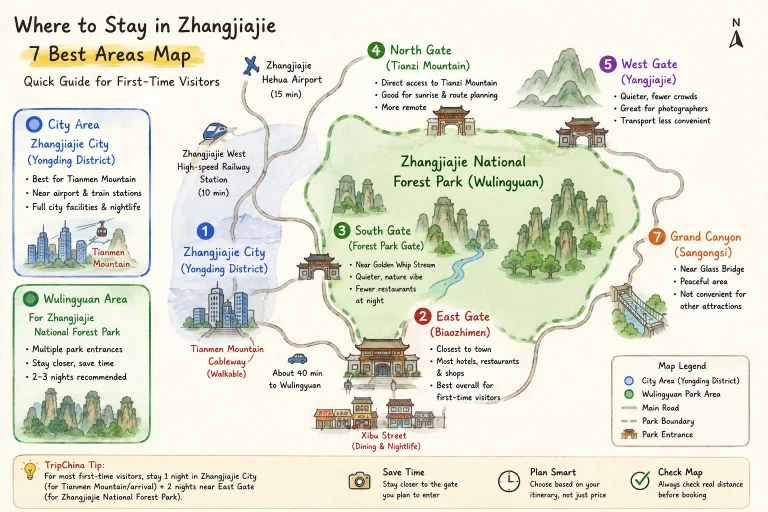
Wulingyuan is the practical base for multiple days in Zhangjiajie National Forest Park.
Central Zhangjiajie city is more practical for Tianmen Mountain, airport and railway connections, and urban services.
Repeated transfers between the city and Wulingyuan can quietly consume a meaningful amount of your trip.
The mistake isn't simply “staying in Zhangjiajie city.”
It's staying there while planning several consecutive Wulingyuan days only because the city hotel looked cheaper or more familiar online.
The reverse can happen too: staying around Wulingyuan when your next morning revolves around Tianmen Mountain or an early city departure.
Match your hotel to tomorrow morning's plan, not just tonight's room price.
Wulingyuan has five principal ticket stations.(These are often referred to interchangeably as gates, entrances, or ticket stations.)
| Entrance | Chinese Name | Simple Use Case |
|---|---|---|
| East Gate / Biaozhimen | 标志门 / 吴家峪 | Easiest all-round base for many first-time visitors; extensive hotels and dining |
| South Gate / Forest Park | 森林公园门票站 | Convenient for routes beginning around the traditional Forest Park entrance and Golden Whip Stream |
| North Gate / Tianzi Mountain | 天子山门票站 | Useful when your route deliberately starts around Tianzi Mountain |
| West Gate / Yangjiajie | 杨家界门票站 | Useful for Yangjiajie-focused routes |
| Zimugang Gate | 梓木岗门票站 | Alternative entrance for itineraries designed around this side of the park |
Don't choose North or West Gate merely because a social-media post calls it a “secret crowd-free entrance.”
Convenience is more predictable than crowd percentage.
For a detailed comparison, see Where to Stay in Zhangjiajie: 7 Best Areas + Where NOT to Book.
If you're self-driving, confirm the parking arrangement directly with your accommodation.
“Free parking” can mean limited, shared or nearby parking rather than a guaranteed private space directly outside the property.
A quick message to your hotel before arrival is more useful than relying entirely on the booking-platform amenity icon.
A very low price does not automatically mean a scam.
But it should make you inspect the package carefully.
Zhangjiajie authorities introduced tourism-market rules known as the “Eight Prohibitions” in 2023.
For international travelers, the practical message matters more than memorizing the policy wording: local authorities specifically targeted unreasonably low-priced tours, misleading advertising, unlicensed operations, aggressive solicitation, and forced or disguised shopping.
So if one package is dramatically cheaper than comparable tours, ask:
Where does the operator make the money?
| Cost | What to Verify |
|---|---|
| Main admission | Which attractions are actually included? |
| Scenic-area transport | Are necessary internal transfers included? |
| Mountain transport | Are Bailong Elevator, Tianzi Mountain Cableway or other cableways included? |
| Accommodation | Which hotel and room category? |
| Meals | How many meals, and are they compulsory package meals? |
| Transfers | Hotel pickup, station transfer and attraction transport? |
| Guide | Private, shared-group or no guide? |
| Shopping | Are shopping stops scheduled or compulsory? |
| Optional attractions | Which advertised experiences cost extra? |
| On-trip charges | Can additional mandatory fees be collected after departure? |
A ¥99 headline price tells you very little if hundreds of yuan in required extras appear later.
Be cautious.
Zhangjiajie's tourism-market rules specifically target aggressive forms of chasing, surrounding or pressuring tourists to purchase tourism, transport, dining or accommodation services.
You don't need to assume everyone approaching you is dishonest.
You simply don't need to make a travel purchase under pressure.
Wild macaques live in parts of Zhangjiajie's scenic areas.
Treat them as wildlife, not photo props.
Do not:
• feed them;
• touch them;
• hold food toward them for photographs;
• encourage them to climb onto you;
• let children approach them closely.
Keep visible food inside a closed bag and give the animals space.
A little distance can prevent an interesting wildlife encounter from turning into an unnecessary problem.
Before your trip, run this five-question check:
| Ask Yourself | If the Answer Is “No”… |
|---|---|
| Have I reserved my key attractions? | Availability could disrupt the itinerary |
| Do I know my exact entrance and entry period? | You could arrive at the wrong place or time |
| Is my hotel near the attraction I'm visiting most? | You may lose hours commuting |
| Does each day focus on one logical scenic area? | Your itinerary may be overloaded |
| Do I know exactly what my tour/package includes? | Hidden extras may change the real cost |
If all five answers are yes, you've already removed most of the logistical problems that make Zhangjiajie feel harder than it really is.
Solve the logistics before arrival—but don't over-plan the mountains themselves.
I would lock down:
• major attraction reservations;
• the correct hotel area;
• entry location;
• passport setup;
• mobile data and payment.
Then I'd leave room for:
• fog and rain;
• queue conditions;
• temporary transport changes;
• tired legs.
Zhangjiajie is one of those destinations where a rigid minute-by-minute timetable can be less useful than a strong overall framework.
You need to know where you're going and how you're getting in.
You don't need to know where you'll be standing at 11:17 AM.
Before leaving for the mountains, it also helps to have China mobile data set up, understand how foreigners pay in China, and know how to use DiDi without a Chinese phone number.
More practical questions for international visitors.
Yes.
Independent travel is practical for international visitors with mobile data, translation tools and their major reservations organized.
A guide can still be useful if you are uncomfortable navigating Chinese-language services, are traveling with family members who need more logistical help, or simply prefer someone else to manage transport and tickets.
Save screenshots of important Chinese place names such as 武陵源 (Wulingyuan) and 天门山 (Tianmen Mountain) before leaving your hotel.
Check the attraction's official notice and your original booking platform first.
Severe weather can affect trails, mountain roads, elevators, cableways or entire scenic sections. Do not immediately buy another ticket before checking whether your existing reservation qualifies for a change, refund or operational adjustment.
Yes.
You don't need to purchase every sightseeing transport product to enjoy Zhangjiajie. Choose cableways and elevators according to your route, fitness, available time and mobility needs rather than treating every ride as mandatory.
Don't rely on Google Maps as your only in-park navigation tool. Google Maps may not show accurate walking trails or POI data inside Chinese scenic areas.
For China travel, a local map app such as Amap (高德地图) or Baidu Maps (百度地图) can be more useful for Chinese place names and local road information. Inside Wulingyuan itself, also use official entrance maps, scenic-area signs and the paper or digital park map.
If you're unfamiliar with Chinese map apps, see TripChina's navigation app guide for foreign travelers in China.
Parts of the trip can be made easier with eco-buses, cableways and elevators, but Zhangjiajie remains a mountainous destination with uneven surfaces, stairs and significant walking.
Plan around the major transport links, shorten walking sections when necessary, and verify accessibility for the specific viewpoints you want to visit rather than assuming every famous spot is step-free.
Don't try to outsmart Zhangjiajie.
You don't need a secret entrance, a hidden itinerary or a “VIP no-queue” trick.
You need:
the right ticket,
the right entrance,
the right hotel base,
reasonable timing,
and realistic expectations.
Get those five things right and most avoidable frustration disappears.
The mountains can take care of the rest.
Hunan Provincial Government — Zhangjiajie National Forest Park Reservations & Visitor Control
Hunan Provincial Government — Time- and Gate-Based Reservation System
Hunan Provincial Department of Culture and Tourism — Zhangjiajie Travel & Wulingyuan Information
Hunan Provincial Department of Culture and Tourism — Zhangjiajie Tourism Market “Eight Prohibitions”
Updated September 8, 2026 using Hunan government and tourism sources covering Wulingyuan reservations, the 53,000 daily visitor-flow figure published in June 2025, entrance management and Zhangjiajie's tourism-market rules. Queue lengths, ticket availability and transport operations vary by date and conditions, so fixed “no-queue” timing claims have been avoided. Scenic-area geography and route recommendations were also cross-checked against current destination information.
TripChina.me creates practical China travel guides shaped by real local experience, helping independent travelers navigate transport, payments, food, neighborhoods, and the cultural details that make traveling in China easier and more meaningful. Find the guide for your destination at tripchina.me.