Our Location:
No. 99, Jiazi Road, Chengdu

 authorChris Lee
China isn't difficult to travel in. It's just different. The problems that derail a first trip are usually practical ones: a payment app that was never verified, a phone that loses access to familiar services, the wrong railway station, or confusion at hotel check-in. This guide focuses on the things worth fixing before they become problems.
• Check your exact visa status before booking. As of September 2026, ordinary passport holders from 50 countries qualify for China's 30-day unilateral visa-free policy; US citizens do not, although eligible Americans can use the 240-hour transit policy when traveling onward to a third country or region.
• Set up your digital life before departure. Standard mainland mobile data and hotel Wi-Fi do not provide normal access to many familiar overseas services. International roaming or a travel eSIM that uses overseas routing is usually the simplest solution.
• Prepare at least two payment methods. Alipay and Weixin Pay support many overseas bank cards, but card-issuer verification or individual transactions can still fail. Keep some RMB cash as backup.
• Treat your passport as part of your travel kit. You will use it for immigration, hotel registration, train travel and some attraction bookings.
• Download the essentials before flying: Alipay, WeChat, a suitable map app, DiDi or its mini-program, translation tools, and 12306 or another train-booking service.
China's entry rules have become considerably easier for many travelers, but nationality matters.
As of September 2026, holders of valid ordinary passports from 50 countries—including the UK, Canada, Australia, New Zealand, Japan, South Korea and many European countries—can enter China without a visa for up to 30 days for eligible purposes including tourism.
The United States is not part of this 30-day unilateral visa-free program.
For most of the eligible countries, the current arrangement runs through December 31, 2026. Russia's arrangement runs through December 31, 2027, while Brunei has a different policy timeline. Because entry rules can change, always verify your nationality against an official Chinese embassy or consular source shortly before departure.
For a nationality-by-nationality explanation, see the China Visa Guide.
Sometimes—but not under the 30-day unilateral visa waiver.
As of September 2026, China's 240-hour visa-free transit policy covers nationals of 57 countries, including the United States. Eligible travelers must hold an ordinary passport and a confirmed onward ticket to a third country or region. The policy currently covers 65 designated entry ports across 24 provincial-level regions and allows eligible travelers to remain for up to 240 hours.
The key word is transit. A simple US → China → US round trip does not satisfy the third-country requirement. A routing such as US → China → Japan → US may qualify if all other conditions are met.
There is another restriction many travelers miss: you cannot simply use the 240-hour policy to travel anywhere in China. You must remain within the administrative areas permitted under the scheme for the port or region through which you enter. Traveling outside the permitted area can violate the conditions of visa-free transit and may lead to immigration penalties.
If your itinerary includes several provinces, check the National Immigration Administration's current permitted-area list before booking domestic transport. If you are unsure whether a specific multi-city route qualifies, call the NIA 12367 immigration service before travel.
If you need a regular Chinese visa, do not assume every applicant needs exactly the same supporting documents. Requirements vary by nationality, visa type and consular jurisdiction; check the Chinese embassy, consulate or visa application center serving your location.
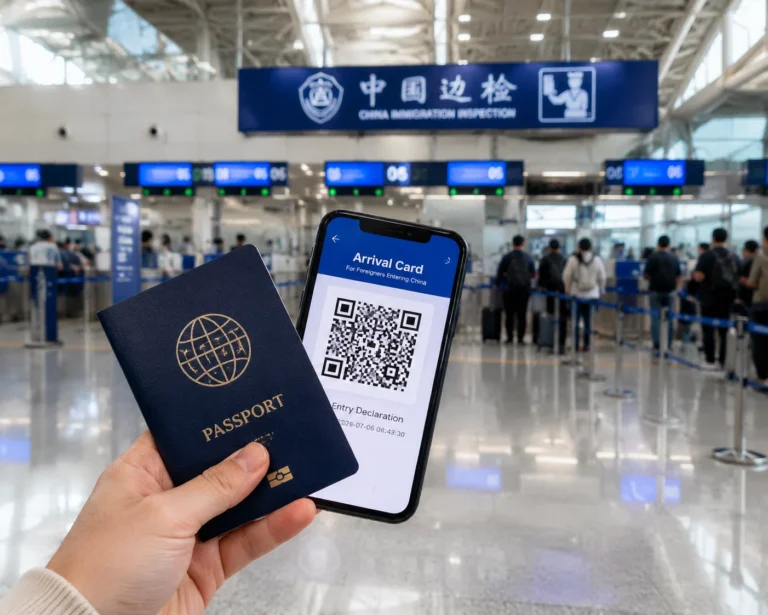
At immigration, keep your accommodation information, onward or return itinerary and passport readily available. For the practical arrival process, the China airport arrival guide explains what to do during your first hour after landing.
This is one of the biggest differences between traveling in China and traveling in many other destinations.
On standard mainland China internet connections, a number of overseas websites and services are unavailable or restricted. That means arriving with a working phone signal does not necessarily mean the apps you normally use will work as expected.
The distinction that matters is not simply “eSIM vs SIM.” It is how your data is routed.
| Connection | Mainland Data | Familiar Overseas Services | Chinese Number | Best For |
|---|---|---|---|---|
| International roaming | Yes | Generally accessible, depending on carrier routing | No | Simplest short trip |
| Travel eSIM with overseas routing | Yes | Generally accessible | Usually no | Most tourists |
| Mainland Chinese SIM | Yes | Subject to mainland network restrictions | Yes | Local calls / longer stays |
| Hotel Wi-Fi | Yes | Subject to mainland network restrictions | No | Backup/local services |
For most first-time visitors, international roaming or a travel eSIM with overseas routing is the easiest balance of convenience and access. A mainland SIM becomes more useful when having a Chinese phone number matters more than maintaining your usual overseas internet environment.
Before buying anything, confirm that the eSIM explicitly covers mainland China and check how the provider routes data. Do not assume every “China eSIM” behaves the same way.
If your phone does not support eSIM, international roaming is the easiest alternative. Mainland China SIM cards are another option and can be useful if you need a Chinese phone number, but they use mainland network routing.
My practical rule is simple: solve connectivity before the plane lands. Trying to research your connectivity solution after discovering that the sites or apps you need are inaccessible is exactly the kind of first-day problem this guide is meant to prevent.
See the detailed China eSIM vs SIM card comparison before choosing a plan.
China is heavily mobile-payment oriented. Restaurants, convenience stores, taxis, metro services and small vendors commonly use QR-code payments.
For most foreign visitors, the easiest setup is Alipay or Weixin Pay with an eligible overseas bank card.
As of September 2026, official guidance confirms that overseas visitors can register payment apps using overseas phone numbers and link supported international cards. Exact supported card brands, fees and limits can vary by payment product and issuer, so check the current in-app terms rather than assuming every card will work identically.
Do this before departure:
Don't wait until you're standing in front of a restaurant cashier with a queue behind you.
For overseas cards linked to Alipay or Weixin Pay, current official payment guidance lists regulatory maximums of US$5,000 per transaction and US$50,000 per year. Your actual usable limit can be lower because of app, bank, card or risk-control rules.
For a step-by-step setup, use the foreign visitor payment guide for Alipay, WeChat Pay, cards and cash.
Yes, but as backup rather than your primary system.
I would carry a modest amount of RMB in mixed denominations rather than relying entirely on your phone. Cash becomes useful when your battery dies, your foreign card is declined, an app triggers security verification, or you are somewhere with poor connectivity.
RMB cash remains a legitimate payment method. The practical issue at a tiny shop is often not whether cash is accepted but whether the seller has enough change.
Do not build your China trip around Google Maps.
For iPhone users, Apple Maps is generally much easier for basic navigation in mainland China. AMap/Gaode (高德地图) and Baidu Maps (百度地图) provide much richer local transit, entrance, business and walking information, although the interface can require some adjustment for non-Chinese speakers.
Before departure, I would have these functions covered:
| Need | Practical Option |
|---|---|
| Mobile payment | Alipay / Weixin Pay |
| Local navigation | Apple Maps / AMap / Baidu Maps |
| Ride-hailing | DiDi |
| Translation | Offline translation + camera translation |
| Trains | 12306 / booking platform |
| Restaurant photos | Dianping |
| Messaging / mini-programs |
One local habit that saves time: save the Chinese name and address of your hotel. English hotel names are sometimes useless to a taxi driver, while the Chinese address solves the problem immediately.
China's railway system is one of the easiest ways to move between major cities once you understand the booking and ID system.
The official 12306 English website allows foreign travelers to purchase railway tickets using valid foreign passports. Your booking is tied to the identity document used to purchase the ticket, so bring that same physical passport when traveling.
For a first trip, compare the official system with third-party booking options in the 12306 buying train-ticket guide.
For a large station you have never used, I recommend arriving 30–60 minutes before departure.
Beijing South (北京南站), Shanghai Hongqiao (上海虹桥) and other major hubs are more like airport terminals than small railway stations. You may need time for security, passport inspection, finding the correct waiting area and reaching the platform.
Official railway guidance advises passengers to allow enough time for security checks, ID verification and boarding because queues can occur.
One mistake is far more common than missing the actual train: going to the wrong station.
Beijing alone has Beijing Station, Beijing West, Beijing South and Beijing Chaoyang. Never navigate to “Beijing train station” from memory—copy the exact Chinese station name from your ticket.
| Class | What You Get | Best For |
|---|---|---|
| Second Class 二等座 | Standard comfortable seating | Most travelers |
| First Class 一等座 | Wider seat and more space | Longer trips / extra comfort |
| Business Class 商务座 | Premium reclining seating; service varies by train | Comfort-focused travelers |
Second class is completely adequate for most trips. I would spend the extra money on first class only when the journey is long enough for the extra space to matter.
For most first-time visitors, the order is simple: subway first, DiDi second.
Large Chinese cities generally have extensive metro systems, and major-city stations commonly include English signage. Fares vary by city and distance but are inexpensive compared with taxis in many Western cities.
Avoid the busiest commuting windows when possible—roughly 7:30–9:30 AM and 5:30–7:30 PM in major cities. The exact peak varies locally, but the difference in crowding can be dramatic.
For door-to-door travel, DiDi is much easier than trying to explain a destination verbally to a taxi driver. Pin your pickup point carefully: the problem is often not language but being on the opposite side of a huge intersection or at the wrong mall entrance.
The DiDi guide for foreign visitors covers setup and pickup problems in more detail.
Yes—but for a first trip, assume spoken English will be limited once you leave international hotels, major airports and the most tourist-heavy parts of large cities.
Do not plan a trip on the assumption that a taxi driver, restaurant server, station employee or hotel receptionist will speak conversational English. Beijing and Shanghai are easier, but even there you will regularly encounter situations where nobody nearby is comfortable using English.
That sounds harder than it actually is. A phone usually bridges the gap.
Three things help more than memorizing a long phrasebook:
• Keep your hotel name and address in Chinese as a screenshot.
• Use camera translation for menus and signs.
• Save important destinations in Chinese before leaving Wi-Fi.
A few phrases are still worth knowing:
Nǐ hǎo (你好) — Hello
Xièxie (谢谢) — Thank you
Mǎi dān (买单) — Check, please
Bú yào là (不要辣) — No chili/spice
Qǐng páiduì (请排队) — Please queue
Don't assume silence means hostility. I've seen plenty of interactions where both sides wanted to help but neither wanted to risk speaking the other's language. A translation screen and a smile usually get farther than repeating English more loudly.
One of the easiest local tricks is to use photos instead of language.
Open Dianping (大众点评), find the restaurant and look through customer-uploaded food photos. Show the server the dishes you want. If you're already inside a busy local restaurant, looking at nearby tables and pointing politely can work just as well.
This is especially useful in restaurants where the English translation of a dish tells you almost nothing about what will actually arrive.
In Sichuan, Chongqing and Hunan, “mild spicy” (微辣, wēi là) may still feel very spicy if you are not used to chili.
Use:
Bú yào là (不要辣) — no chili/spice
For stronger emphasis:
Wánquán bù fàng làjiāo (完全不放辣椒) — don't add any chili at all
Remember that a dish may also contain chili oil or Sichuan pepper as part of its standard preparation, so severe allergies or dietary restrictions need clearer communication than simply saying “not spicy.”
For allergies, keep a translated card naming the exact allergen. Kitchens may not provide the same level of allergen separation you expect at home.
For drinking water, do not rely on untreated tap water. Bottled water is widely available, and hotel kettles can be used to boil water.
This is an area where older China travel advice is now misleading.
You may still see websites claiming that only specially “licensed foreigner hotels” can accept overseas guests. Chinese authorities have explicitly pushed back against that practice. Accommodation operators should not refuse foreign travelers simply because they supposedly lack a special qualification to receive foreigners.
The practical problem has not disappeared completely. A small property may still have staff who do not know how to process a foreign passport or accommodation registration correctly. So for a first trip, confirming the property has recent experience with international guests remains sensible—not because foreigners are legally restricted to a special category of hotels, but because operational experience varies.
Read the China hotel booking guide for foreign passport holders if you are choosing smaller hotels, guesthouses or private accommodation.
If you stay in a hotel, the hotel handles the required accommodation registration using your passport information.
If you stay in a private residence or another non-hotel accommodation, you or your host generally must complete registration within 24 hours. As of March 2026, the National Immigration Administration has also been piloting online registration in Hebei, Liaoning, Zhejiang, Hubei, Guangxi, Chongqing and Sichuan through official NIA channels, while offline registration remains available.
This distinction between hotel and private accommodation is worth understanding before booking.
For most tourists, the problems worth planning for are ordinary travel problems rather than dramatic safety scenarios: losing a phone, being separated from your passport, overpaying at a tourist spot, missing the last train, or struggling to communicate during an emergency.
Use normal big-city precautions in crowded attractions and transport hubs. Keep your passport secure, watch your phone and bag, and avoid unofficial offers involving tours, taxis or shopping where the final price is unclear.
Emergency numbers are:
110 — Police
120 — Ambulance
119 — Fire
English assistance may not always be available immediately, so having your hotel address and current location saved in Chinese can be extremely useful.
Travel insurance is also worth arranging before departure, particularly coverage for hospitalization and medical evacuation.
Crowded metros, elevators and attraction entrances can feel tighter than many Western travelers expect. Do not interpret every close-distance interaction as aggression.
Carry tissues and hand sanitizer. Public toilets may use squat toilets, and toilet paper is not guaranteed everywhere.
Tipping is generally not expected in ordinary taxis, restaurants or hotels. Some higher-end hotels or restaurants may include a service charge, so check the bill rather than automatically adding a tip.
Ask before taking close-up photographs of strangers. Likewise, if someone asks to take a photo with you and you are uncomfortable, a simple “bù, xièxie” (不,谢谢) is enough.
There is no single “best month” for the whole country. China is too large and climatically diverse for that.
| Season | General Conditions | Good Choices | Classic Route Idea | Main Trade-Off |
|---|---|---|---|---|
| March–May | Mild in many regions | Beijing, Jiangnan, Luoyang, Guizhou | Beijing → Xi’an → Shanghai | Variable spring weather |
| June–August | Hot/humid across many cities | Northeast China, Inner Mongolia, high-altitude areas | Guilin → Yangshuo or cooler northern routes | Heat, rain, school-holiday crowds |
| September–November | Comfortable in many regions | Beijing, Sichuan, Xinjiang, Jiuzhaigou | Beijing → Xi’an → Shanghai or Chengdu → Jiuzhaigou | Popular autumn destinations get busy |
| December–February | Cold north, milder south | Harbin for winter; Yunnan/Hainan for warmth | Harbin winter trip or Yunnan circuit | Cold and shorter daylight in northern areas |
For a first-time three-city trip, Beijing → Xi’an → Shanghai works particularly well in spring and autumn because high-speed rail connections are straightforward and the weather is generally easier for long sightseeing days.
If nature matters more than major cities, Guilin and Yangshuo fit better into warmer months, while Jiuzhaigou is especially popular during the autumn foliage season.
Avoid treating seasonal advice as a weather guarantee. Check the forecast for your actual destination shortly before departure.
The bigger planning issue is often China's holiday calendar rather than temperature. Spring Festival, the May Day holiday and the National Day period can dramatically increase demand for trains, flights, hotels and major attractions. Weekends can also be crowded at famous sites even outside national holidays.
Check the China public holiday and crowd calendar before locking in an itinerary.
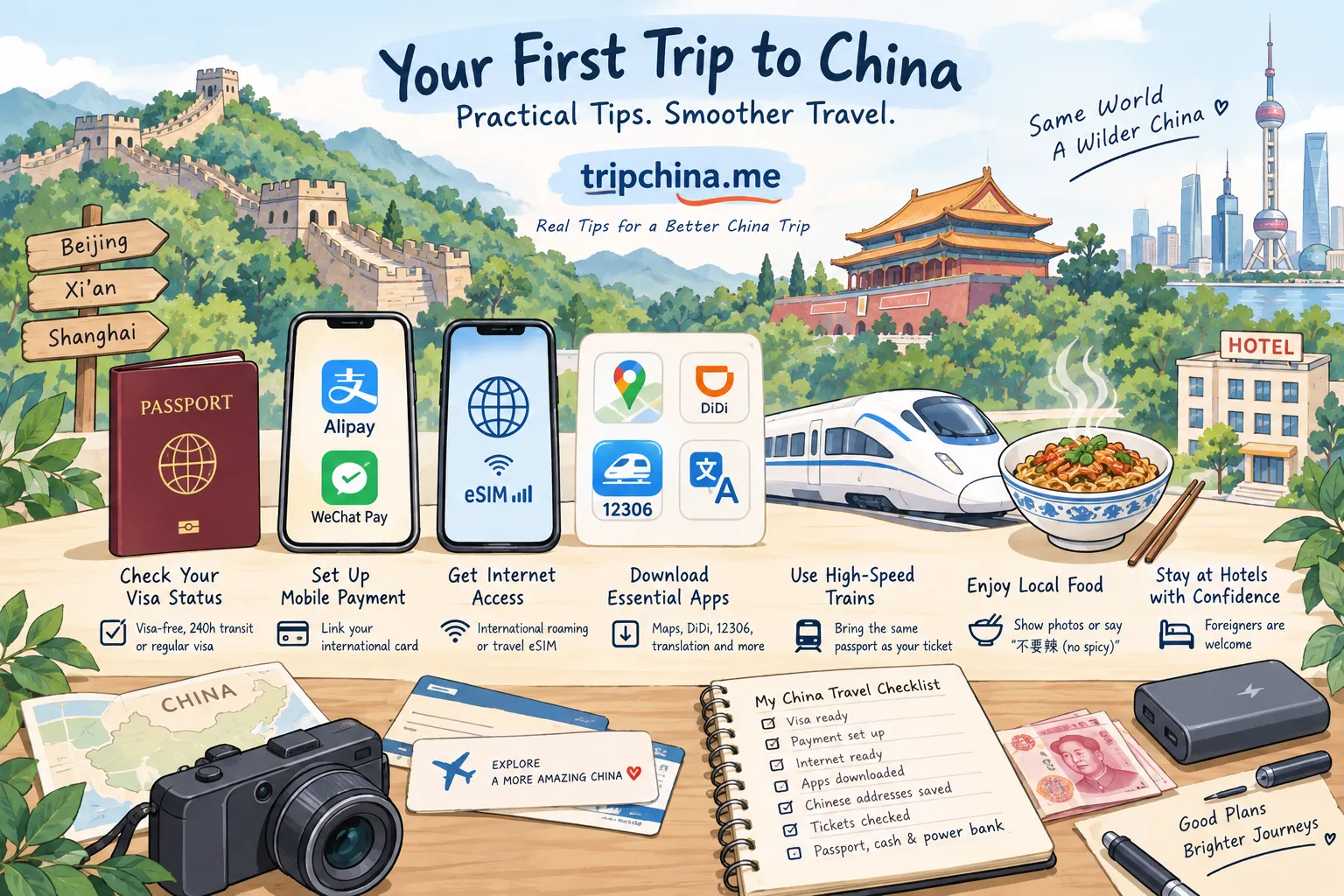
A first trip becomes much easier if these seven things are finished before departure:
If those seven things are done, most of the friction that surprises first-time China travelers is already solved before the trip starts.
👉 Explore more essential travel tips in our China Basics Hub.
Usually, personal medication in a reasonable quantity is possible, but rules depend on the medicine and its active ingredients. Keep prescription drugs in original packaging and carry your prescription or a doctor's letter, especially for controlled or unusual medications. Check Chinese customs and consular guidance before departure.
Do not assume all packaged or fresh food can enter China. Fresh fruit, meat products, plants, seeds and some animal products are subject to quarantine or import restrictions, while commercially packaged foods may be treated differently depending on their contents.
If you are unsure about a food item, check current China Customs rules before packing it rather than relying on another traveler's experience.
Do not assume an International Driving Permit alone lets you drive in mainland China. China has its own licensing requirements, although temporary Chinese driving permits and specific arrangements exist in some circumstances.
For most first-time visitors, high-speed rail, metro systems and ride-hailing are considerably simpler than self-driving.
Report the loss to the local police and contact your country's embassy or consulate as soon as possible for instructions on obtaining replacement or emergency travel documentation.
Keep a secure digital copy of your passport identity page and visa, if applicable, separate from the physical passport. Also keep your hotel details available because you may need them when reporting the loss.
Yes, but the rules for trains and flights are different.
For Chinese trains, the current railway rule allows clearly labeled power banks and lithium batteries with a rated energy of no more than 100Wh per unit. If the rated energy cannot be identified clearly, do not assume it will pass railway security.
For flights, power banks must be carried in your cabin baggage or on your person, not in checked luggage. A power bank of 100Wh or less normally does not require airline approval. A unit over 100Wh but no more than 160Wh requires airline approval, with no more than two such spare batteries or power banks allowed. Power banks over 160Wh are prohibited.
There is an additional rule that matters on domestic flights within China: since June 28, 2025, power banks without a clear CCC/3C certification mark, with an unclear mark, or belonging to officially recalled models or batches are prohibited from domestic flights.
Check the label on your power bank before leaving home—not at airport security.
The hardest part of a first China trip is usually the first 24 hours.
Once your phone connects, your payment apps work, your passport is registered at the hotel and you understand how trains and DiDi work, the trip becomes dramatically easier.
Prepare the digital infrastructure before departure. Keep a physical passport and a little cash with you. Save important addresses in Chinese. Double-check station names. And when something works differently from home, don't assume it is difficult—first work out how the local system is designed to work.
That small shift in mindset is one of the most useful China travel tips I can give you.
Save the seven-point checklist above before you fly. If you want to plan around China's busiest travel periods, use the China public holiday and crowd calendar before finalizing your dates.
Chinese Embassy — Visa-Free Entry Policy
National Immigration Administration — Visa-Free Transit Policies
China Railway 12306 — Passenger Carry-On Rules
Civil Aviation Administration of China — Power Bank Rules
Updated in September 2026 using China's National Immigration Administration, Chinese embassy guidance, China Railway 12306 and the Civil Aviation Administration of China. Visa-free transit eligibility, permitted-area restrictions, railway power-bank limits and domestic-flight CCC requirements were rechecked against official sources. Payment, entry and transport rules can change, so travelers should verify policy-sensitive details shortly before departure.
TripChina.me creates practical China travel guides shaped by real local experience, helping independent travelers navigate transport, payments, food, neighborhoods, and the cultural details that make traveling in China easier and more meaningful. Find the guide for your destination at tripchina.me.