Our Location:
No. 99, Jiazi Road, Chengdu

 authorChris Lee
Xi'an's metro looks complicated on the map, but tourists only need a handful of lines to see most of the city. The bigger problems are surprisingly practical: choosing the wrong exit, assuming the wrong payment method will work, or arriving too late for an airport train.
This guide focuses on those details so you can spend less time underground and more time exploring Xi'an.
Data note: Fares, airport metro times, payment options and period-pass information in this guide were checked against the latest available information in September 2026. Temporary service changes can still occur during major holidays, events or maintenance.
Yes. For most international visitors, Xi'an Metro is one of the easiest and most predictable ways to get around the city.
The metro works best when you know three things before entering: your line, your destination station and your exit.
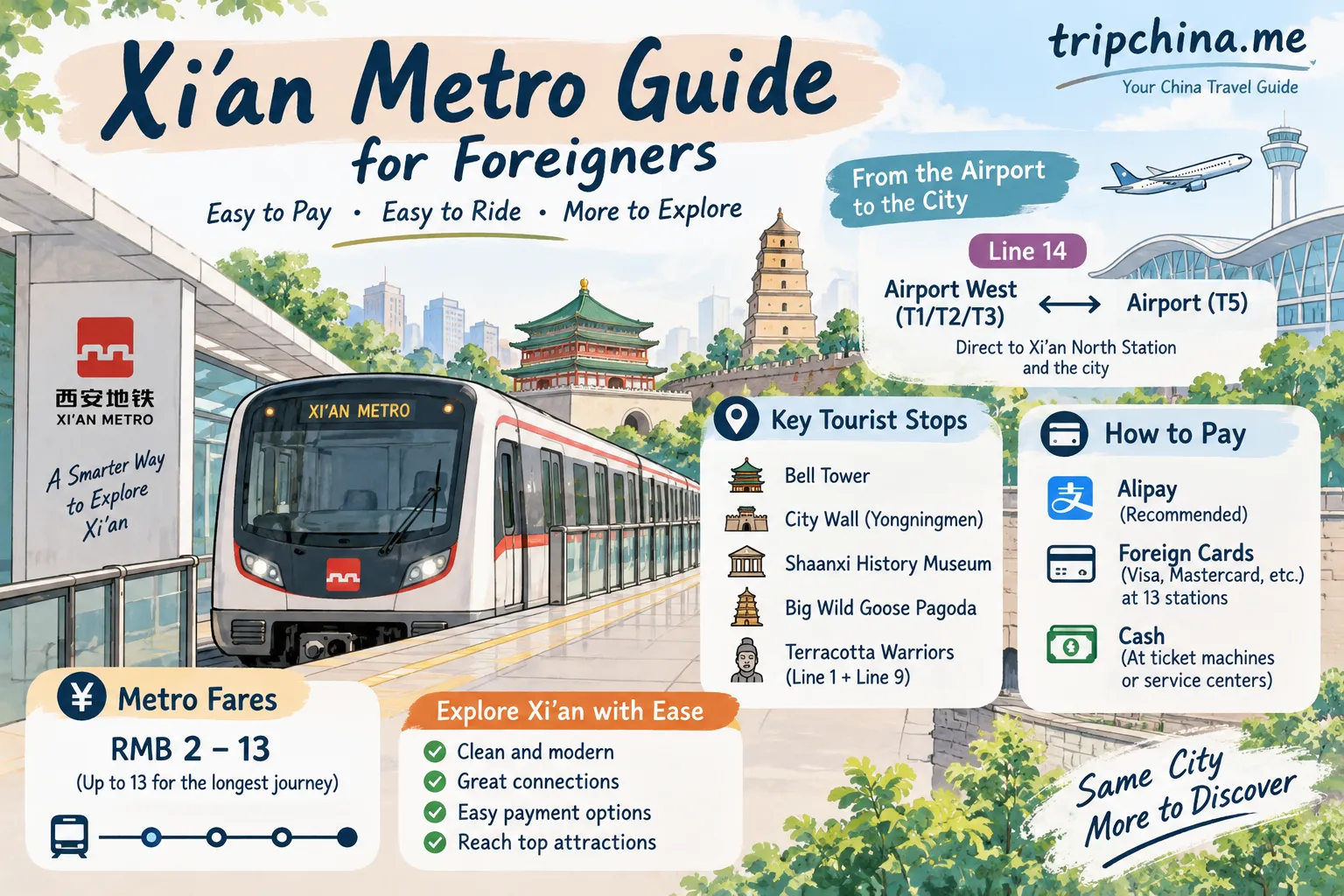
For sightseeing, the metro should usually be your default. Taxis and DiDi become more useful when luggage, late-night arrivals or awkward last-mile connections are involved.
| Situation | Best Option | Why |
|---|---|---|
| Downtown sightseeing | Metro | Predictable and avoids road traffic |
| Airport arrival before the last metro | Line 14 + Metro | Usually the easiest public-transport option |
| Large luggage | Taxi / DiDi | Less walking and fewer transfers |
| Late-night airport arrival | Taxi / DiDi | Metro service may have ended |
| Terracotta Warriors | Metro + local bus | Avoids much of the city traffic |
| First visit to Xi'an | Metro + Alipay or cash backup | Simple for most central attractions |
For ride-hailing as a backup, especially after the metro closes, set it up before you need it. TripChina's guide to using DiDi in China without a Chinese number covers the setup process for international travelers.
Yes, but the language barrier is rarely the hardest part.
The mistake I would worry about more is the exit.
A station such as Zhonglou can have several exits leading to very different sides of a busy intersection. Picking the wrong one can turn a two-minute walk into a confusing ten-minute detour.
Before leaving the train, check both the station name and the exit letter you need. I also recommend saving the destination's Chinese name on your phone.
As of September 2026, Xi'an Metro uses distance-based fares.
| Distance | Standard Fare |
|---|---|
| 0–6 km | RMB 2 |
| 6–10 km | RMB 3 |
| 10–14 km | RMB 4 |
| 14–20 km | RMB 5 |
| 20–26 km | RMB 6 |
| Beyond 26 km | +RMB 1 per additional 8 km |
For ordinary sightseeing within central Xi'an, metro fares are therefore usually only a few yuan per ride.
Short sightseeing journeys within central Xi'an commonly cost only RMB 2–4. Longer journeys toward the airport or outer districts cost more.
For example, Zhonglou and Yongningmen are close enough that the fare is at the bottom end of the system's fare scale, while a journey involving Line 14 from the airport crosses several fare bands.
Following the opening of Line 15, the maximum fare across the Xi'an Metro network is RMB 13. Most tourists will pay far less than this on normal sightseeing journeys.
Xi'an Metro offers both physical and electronic period passes.
| Pass | Price | Validity |
|---|---|---|
| 1-Day Pass | RMB 15 | 24 hours from first activation |
| 3-Day Pass | RMB 40 | 72 hours from first activation |
The pass allows unlimited metro rides during its validity period.
Electronic versions are available through the official Xi'an Metro app. Physical passes are also available through station customer service centers.
For a visitor making only three or four short central-city journeys, individual fares may still cost less. The pass becomes more attractive when you expect a metro-heavy sightseeing day and value the convenience of not buying separate tickets.
You do not need a mainland Chinese bank account simply to ride the metro.
The safest setup is:
1. Alipay or another supported QR-code payment method
2. RMB cash as backup
3. International card at supported station customer service centers when needed
Do not depend on only one method.
Yes. Alipay is often the most convenient option for international travelers who already use it elsewhere in China.
Foreign visitors can register Alipay with an overseas mobile number and link eligible international bank cards.
Before your first ride:
Do this before a busy travel day rather than assuming activation will work instantly while you are standing at the gate.
If the Xi'an transit QR code does not activate, do not keep retrying at the turnstile. Buy a single-journey ticket from a ticket machine, use cash where supported, or go to the station customer service center for assistance.
Yes.
Xi'an Metro customer service centers and ticket machines accept RMB cash for ticketing.
Carry smaller RMB notes if you plan to rely on cash. It is still worth keeping some physical RMB even if you expect to use mobile payment for almost everything else.
Yes — but at designated station customer service centers. Do not assume you can tap your foreign bank card directly at the fare gate.
International-card POS facilities are available at customer service centers in these 13 stations:
According to Xi'an Metro and Shaanxi provincial government announcements, the POS system at these customer service centers accepts Visa, Mastercard, JCB, Diners Club, Discover, American Express and UnionPay.
The important distinction is simple:
Go to the Customer Service Center to use a foreign card. Do not walk up to the normal metro gate expecting to tap a Visa or Mastercard.
Do not rely on an overseas Apple Pay or Google Pay wallet as your Xi'an Metro ticket.
A foreign Visa or Mastercard stored in a phone wallet is not the same thing as an activated local metro QR code.
For a short-term visitor, use a supported transit QR code, single-journey ticket, period pass or the customer service center instead.
Xi'an Xianyang International Airport (XIY) is connected to the metro network by Line 14.
There are two airport stations:
Terminal 5's dedicated Line 14 station opened in February 2025. The station is integrated into the airport's Ground Transportation Center (GTC), making the connection considerably easier than trying to transfer between terminals first.
If you arrive at the wrong terminal or need to transfer between terminals, you have two practical options.
Metro: Line 14 connects Airport (T5) with Airport West (T1/T2/T3), with the journey between the two airport stations taking only a few minutes during operating hours.
Free airport shuttle: The airport operates a free 24-hour shuttle bus between T2, T3 and T5. Current airport information lists stops outside T2 Door 213, T3 Door 316 and T5 Door 512. Services are frequent, but the exact interval can vary by time of day.
If you realize you have gone to the wrong terminal, airport information desks can also direct you to the appropriate free transfer service.
For most central-Xi'an destinations:
Airport → Line 14 → Xi'an North Station → Line 2 → Zhonglou / Yongningmen / Xiaozhai
Allow roughly 35–40 minutes for the Line 14 section between the airport area and Xi'an North Station, then add transfer and onward travel time.
For trains heading toward the city / Heshao (贺韶), the regular published departures are:
| Airport Station | First Train Toward Heshao | Last Train Toward Heshao |
|---|---|---|
| Airport West (T1/T2/T3) | 06:00 | 22:20 |
| Airport (T5) | 06:04 | 22:24 |
These are scheduled departure times, not recommended times to leave the terminal.
If your flight lands after 21:00, immigration, baggage claim and the walk from arrivals can significantly reduce your margin.
Do not use 22:20 or 22:24 as the time you need to leave the terminal. That is when the train departs the station.
Major holidays, events or operational adjustments can alter service, so check the official Xi'an Metro information on the day of travel if your itinerary depends on the final train.
For a late arrival, taxi or DiDi is the safer backup.
You do not need to memorize the whole network.
For a first visit, these lines cover most routes tourists repeatedly use.
Line 2 is the most useful north-south line for first-time visitors.
Useful stations include:
If you remember only one Xi'an metro line before arriving, make it Line 2.
Dayanta Station is served by Lines 3 and 4, making both useful for the Big Wild Goose Pagoda and surrounding Tang-themed sightseeing district.
Line 4 is also useful for Tang Paradise, the Daming Palace area and Xi'an Railway Station.
Line 9 runs east into Lintong District.
From central Xi'an, Line 1 connects with Line 9 at Fangzhicheng.
Get off at Qinling West Station (秦陵西站). The metro does not take you directly to the entrance of the Terracotta Warriors Museum.
You still need a bus, taxi or ride-hailing car for the final section.
Line 14 is the airport line, linking Airport West, Airport (T5) and Xi'an North Station with the wider metro network.
Exit information is useful, but pedestrian routing and temporary construction can change.
Use this table as a planning reference, then compare it with the station's physical exit directory before leaving the paid area.
| Attraction | Metro Line | Useful Station | Exit / Connection | Approx. Final Walk |
|---|---|---|---|---|
| Bell Tower | Line 2 / 6 | Zhonglou | Follow Bell Tower signs | A few minutes |
| Muslim Quarter | Line 2 / 6 | Zhonglou | Exit C is commonly convenient | About 5–10 min |
| City Wall South Gate | Line 2 | Yongningmen | Follow South Gate signs | A few minutes |
| Big Wild Goose Pagoda | Line 3 / 4 | Dayanta | Follow attraction signs | A few minutes |
| Shaanxi History Museum | Line 2 / 3 | Xiaozhai | Exit E, then walk | About 10–15 min |
| Daming Palace area | Line 4 | Hanyuandian | Depends on destination inside park | Varies |
| Terracotta Warriors | Line 9 | Qinling West | Bus / taxi connection | Not walkable as a normal final leg |
| Xi'an Airport | Line 14 | Airport West / Airport (T5) | Terminal connection | Direct |
For the Muslim Quarter from Zhonglou Station, Exit C is commonly convenient, but always check current station signage before exiting.
One local habit is worth copying:
Screenshot your destination name, Chinese characters and exit letter before your train arrives.
It is much easier to compare “Exit B or Exit D?” while still inside the station than after surfacing on the wrong side of a major road.
From central Xi'an:
Line 1 → Fangzhicheng → Line 9 → Qinling West
At Qinling West Station, transfer to local bus 617 for the Terracotta Warriors area. A taxi or ride-hailing car is another option.
The 617 route links the Qinling West metro area with the Terracotta Warriors area, but the final surface journey means this is not a true metro-door-to-museum trip.
A reasonable planning estimate from central Xi'an is around 1.5 hours each way, depending on your starting point, transfer wait and road conditions.
Do not arrive at the museum assuming that the same bus schedule will operate late into the evening.
When you arrive, check the posted return-bus information before beginning your visit.
From the Terracotta Warriors museum area back to Qinling West Station, the road journey is short. A taxi or DiDi commonly takes roughly 10–15 minutes, although actual journey time and fare depend on traffic, pickup point and demand.
During late afternoon and major holiday periods, demand around the museum can be high, so allow extra waiting time. If you plan to use DiDi, have the app set up before the trip.
If bus 617 is your planned return option, check the posted last-departure information when you arrive rather than assuming it matches the morning timetable.
The metro works particularly well when you group attractions geographically instead of crossing the city repeatedly.
Start around Zhonglou Station.
Explore the Bell Tower area and walk toward the Muslim Quarter. If food is your priority, remember that the famous main street is only one part of the neighborhood; many smaller lanes are more interesting for eating.
Then return to Line 2.
Ride one stop south to Yongningmen.
Follow the station signs for the South Gate of Xi'an City Wall. This is one of the easiest major attractions to combine with the metro because the station is very close to the wall entrance.
You can walk part of the wall or rent a bicycle if conditions and opening arrangements permit.
Continue south on Line 2 to Xiaozhai.
From Exit E, allow roughly 10–15 minutes on foot to reach the museum area.
The museum requires separate planning because admission is not simply a matter of arriving at the entrance. Advance reservation is generally required, so check the museum's current official reservation channel before building your day around it.
From Xiaozhai, take Line 3 to Dayanta.
The Big Wild Goose Pagoda area connects naturally with Grand Tang Mall (Datang Everbright City), which becomes much more atmospheric after dark.
This sequence works because you move progressively south through the city rather than repeatedly doubling back.
A station may be correct while the exit is wrong.
Around major intersections, that can mean crossing wide roads, walking around barriers or adding ten minutes to what should have been a short walk.
Check the exit before passing through the gate.
There is no single useful “Xi'an Metro closes at 11 PM” rule.
Last trains vary by line, station and direction.
Airport travel is where guessing is most risky.
They are not the same place.
| Station | Chinese | Main Role |
|---|---|---|
| Xi'an North Station | 西安北站 | Major high-speed rail hub; Line 14 airport interchange |
| Xi'an Railway Station | 西安站 | Central railway station near the old city |
Always check the Chinese station name printed on your railway ticket before leaving your hotel.
This is especially important if you are using China's rail network for the first time. TripChina's foreigner's guide to boarding trains in China explains the passport and station-entry process.
It does not.
Line 9 gets you to Qinling West, not the museum entrance.
The final leg requires a local bus, taxi or ride-hailing car.
Weekday commuting periods are busiest in the morning and early evening, particularly on central lines and major interchange stations.
If you have a large suitcase, small children or limited mobility, traveling outside the commuter peak can make a noticeable difference.
Holiday crowds can be much heavier than ordinary weekday rush hour. If possible, check China's holiday calendar before fixing a high-intensity sightseeing schedule; TripChina's 2026 China public holiday guide explains the periods when major transport systems are under the most pressure.
Yes.
Passengers are required to cooperate with metro security screening. Bags normally pass through an X-ray scanner while passengers pass through the security checkpoint.
Xi'an's urban rail regulations prohibit passengers from carrying dangerous items including flammable, explosive, toxic, radioactive and corrosive materials.
Give yourself extra time at major stations during holidays.
Do not eat inside the metro carriage.
Xi'an's urban rail regulations specifically prohibit eating inside train carriages.
Follow station signs and staff instructions for drinks and other situations inside the paid area.
Yes, ordinary tourist luggage is normally fine, but Xi'an Metro has published size and weight limits.
A passenger's luggage should not exceed:
Luggage exceeding the applicable limit may not be allowed into the paid area.
For most travelers with a normal suitcase, the bigger practical problem is not the rule — it is carrying luggage through crowded transfers.
If you have several large bags, a taxi or DiDi may be worth the extra cost.
Under Xi'an Metro's published fare rules, one adult passenger may bring one child measuring 1.3 m or below without purchasing a separate ticket.
Children above the applicable free-travel threshold need a valid ticket unless another eligible concession applies.
For families, station staff can confirm the current rule if a child's height is close to the limit.
Go to the station customer service center rather than trying to force your way through the gate.
Staff can help resolve ticketing or QR-code problems.
My rule is simple:
If your phone is your metro ticket, do not enter with 3% battery.
Major stations provide elevators and accessible routes, but not every street exit has identical step-free access.
If you use a wheelchair, stroller or have heavy luggage, check the station map or ask staff which exit has an elevator before leaving the paid area.
Do not choose an exit purely because it appears closest on a map.
Apple Maps can be useful for English-language route planning on iPhones in China.
Amap (Gaode Maps / 高德地图) is often more useful for detailed local walking navigation, station exits and locating the exact entrance to an attraction.
However, I would not rely on any navigation app alone for the final station exit.
Once inside the station, compare your app with the physical exit directory. Station signage often lists nearby landmarks more accurately than a general route planner.
Xi'an looks compact around the City Wall, but many major attractions sit outside that historic core.
Road traffic can also slow significantly around tourist areas, weekends and Chinese public holidays.
The metro gives independent travelers something taxis cannot always guarantee: predictable routing.
For:
Bell Tower → City Wall → Xiaozhai → Big Wild Goose Pagoda
the metro is usually the simplest backbone for the day.
The trick is not learning the entire network.
Learn the few lines you are likely to use, save the Chinese names of important stations, check your exit before leaving the station and keep one backup payment method.
No. Each passenger needs their own valid ticket or QR-code travel credential.
One adult passenger may bring one child 1.3 m or below without purchasing a separate ticket under the current published rule.
Sometimes. Xi'an Metro may extend operating hours or add services during major travel periods and events, but these are specific operational arrangements rather than a guaranteed holiday timetable.
Check the official announcement for your travel date.
Yes, normal tourist luggage is allowed subject to the metro's size, weight and prohibited-item rules. See the luggage section above for the current limits.
Walk to the station customer service center and show staff your code.
Do not try to force through or use another passenger's code. Staff can help resolve the QR-code problem or direct you to another ticketing option.
For most first-time visitors, yes — especially for daytime sightseeing.
The metro works very well as the backbone of a Xi'an itinerary because it connects the main sightseeing districts without exposing you to unpredictable road traffic.
The system itself is not difficult. Most visitor problems come from a few small mistakes:
the wrong exit, the wrong railway station, an unprepared payment method, assuming the Terracotta Warriors are directly on the metro, or treating the last-train time as the time you can leave the airport terminal.
Avoid those mistakes, keep some RMB as backup and save the Chinese names of your key destinations before setting out.
Updated and fact-checked in September 2026 using Xi'an Metro, Shaanxi government and Xi'an Xianyang International Airport information, with particular attention to fares, period passes, Line 14 airport service, Terminal 5 access, international-card payment, passenger rules and the Line 9 connection for the Terracotta Warriors. Temporary operating hours, individual station exits and surface bus arrangements can change, so time-sensitive details should still be checked against station signage or official notices on the travel date.
Planning your China trip? TripChina.me provides practical travel guides covering transport, food, neighborhoods, and local experiences. When you are ready for a smoother journey, our Premium Travel Guides offer ready-to-follow plans designed for independent travelers.