Our Location:
No. 99, Jiazi Road, Chengdu

 authorChris Lee
Hangzhou has traded and made silk for centuries, but “Silk Capital” does not mean every scarf labeled silk is genuine—or fairly priced. The real advantage of shopping here is choice: hundreds of market shops, historic local brands, brocade specialists and modern silk stores. This guide shows you where to shop, what to check on the label, what prices mean—and why the friendliest shopping recommendation may be the one to avoid.
| Question | Quick Answer |
|---|---|
| Best overall place? | Hangzhou China Silk City for the widest selection and easiest comparison |
| Safest easy purchase? | Established brands such as Wensli, Dujinsheng or Xidebao |
| How do I check real silk? | Start with the fiber label: 100%桑蚕丝 = 100% mulberry silk |
| Biggest shopping trap? | A driver, guide or stranger choosing the silk shop for you |
| Best buying strategy? | Compare several shops, check the label and keep the receipt |
For expensive purchases, do not rely on touch alone. Check the fiber-content label, compare similar products across several stores, and retain the product tag, receipt and payment record.
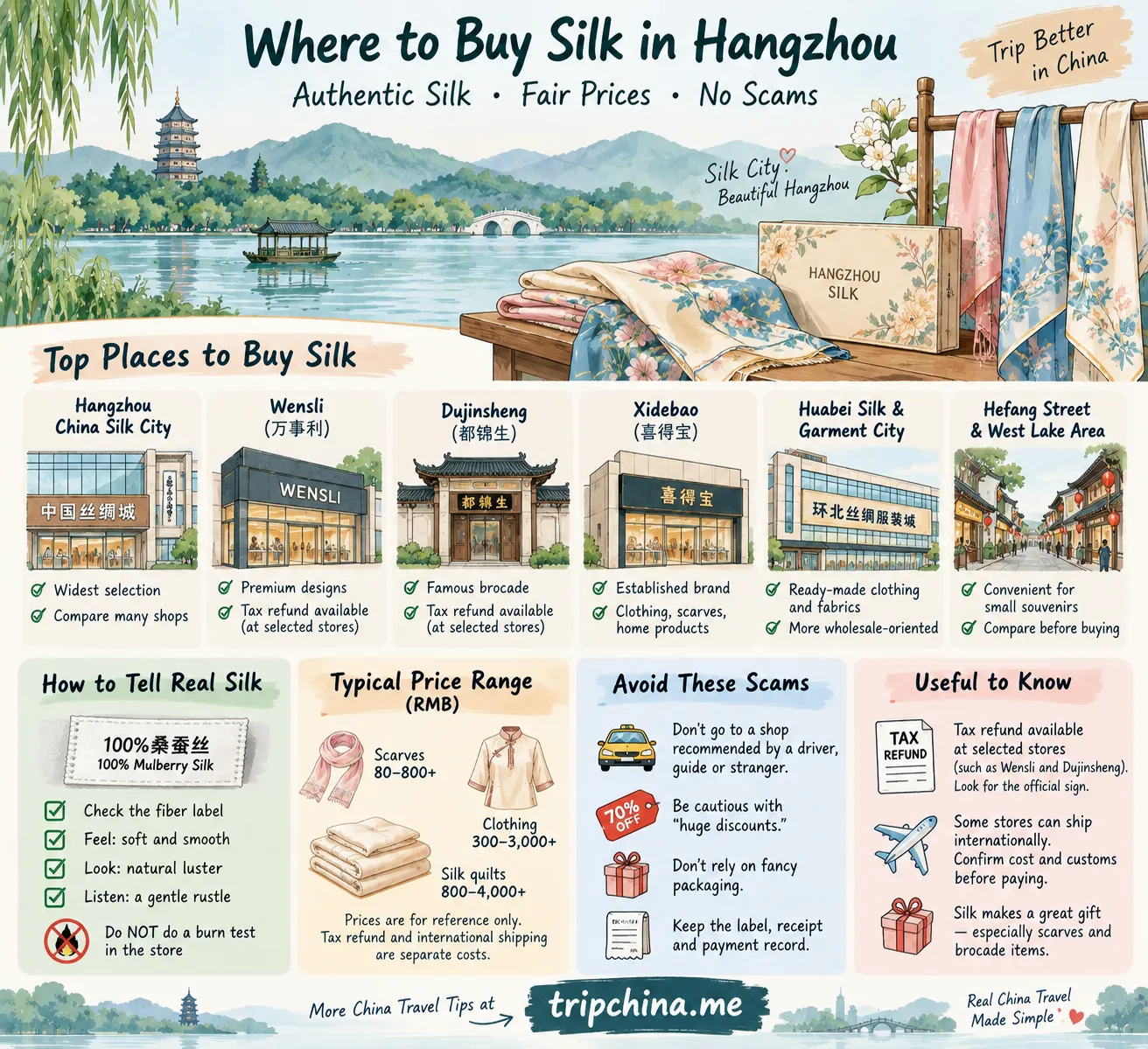
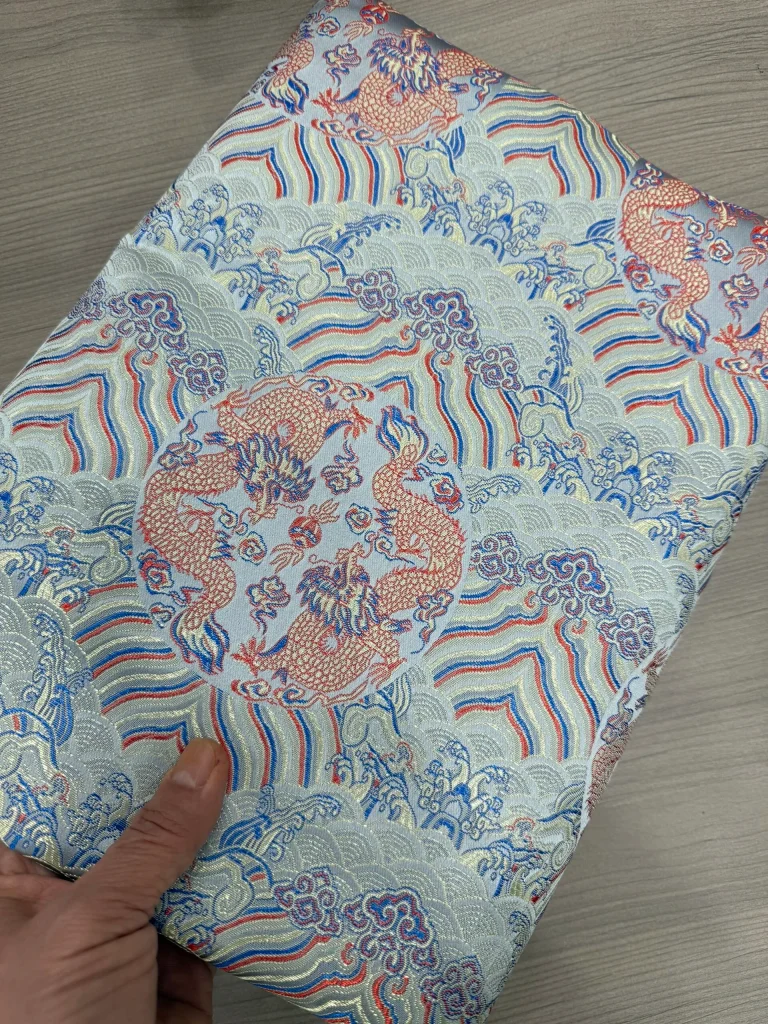
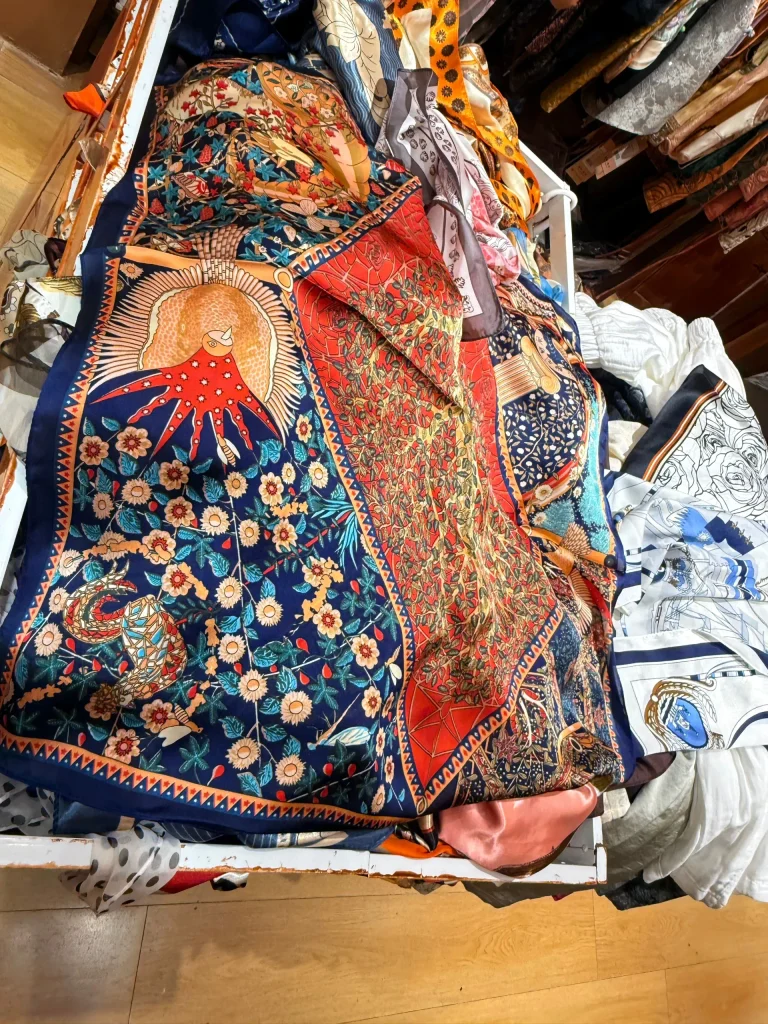
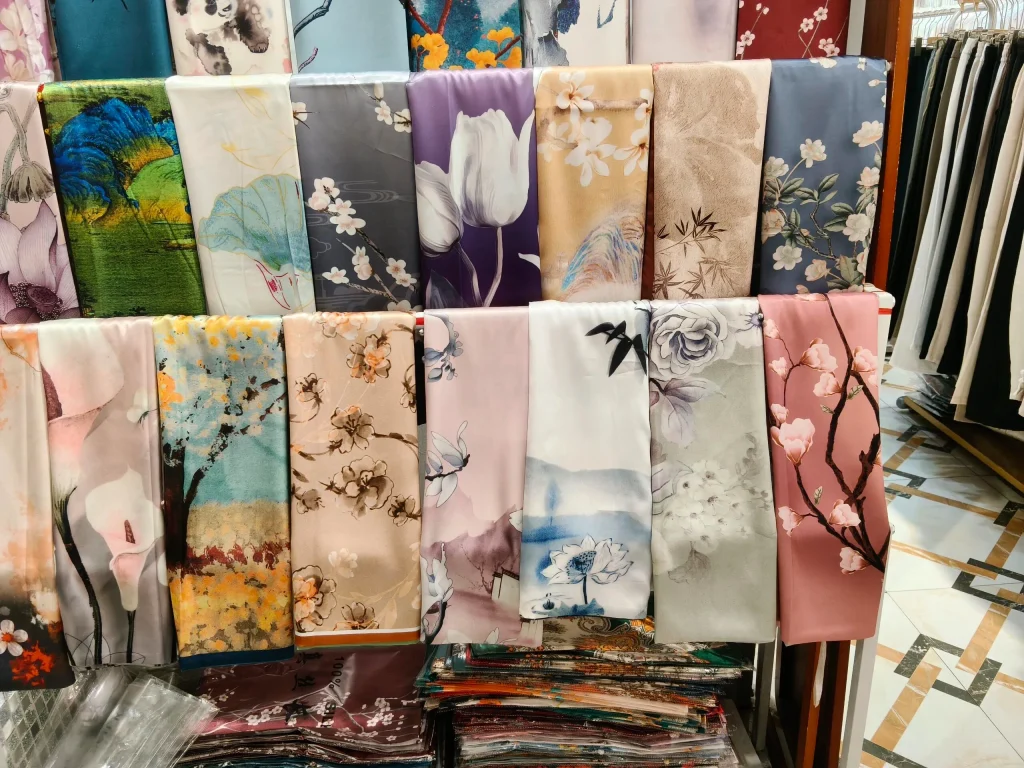
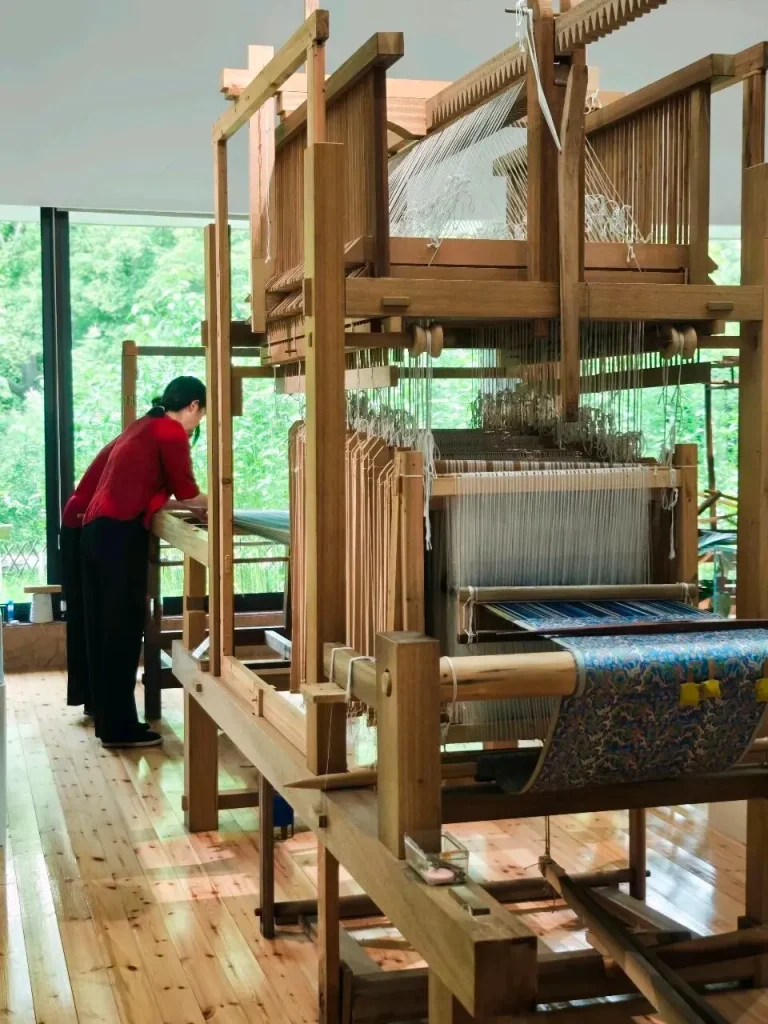
Hangzhou's connection with silk is much deeper than souvenir shopping.
Silk production in the region stretches back thousands of years, while Hangzhou later became an important center of weaving, dyeing and silk commerce. Traditional Hangzhou brocade is still recognized as part of China's national intangible cultural heritage system.
That heritage matters when shopping because Hangzhou offers something many tourist cities do not: you can move between mass-market silk, professional trading markets, historic manufacturers, modern brands and traditional woven art within the same city.
But there is a catch.
The words “Hangzhou silk” do not describe one standardized product.
A RMB 100 scarf, a RMB 1,000 branded scarf, a bolt of qipao fabric and a hand-woven Dujinsheng brocade are completely different products. Comparing them only by price leads to bad buying decisions.
The first question should therefore be:
What kind of silk product are you actually trying to buy?
| Shopping Option | Best For | Price Level | Main Advantage | Main Risk | Opening-Hours Note |
|---|---|---|---|---|---|
| Hangzhou China Silk City | Selection, comparison, fabrics | $–$$$ | 400+ businesses in recent official reporting | Quality and pricing vary | Individual shops keep their own hours |
| Wensli | Premium scarves, gifts, modern designs | $$$ | Established Hangzhou brand | Higher prices | Check the specific branch |
| Dujinsheng | Hangzhou brocade, traditional gifts | $$$ | Strong heritage value; some stores offer tax refunds | Less suited to bargain shopping | Branch hours vary |
| Xidebao / HSDP | Silk clothing, scarves, home products | $$–$$$ | Historic Hangzhou silk producer | Retail locations can change | Search the current branch before going |
| Hangzhou Huabei Silk & Garment City | Ready-made clothing and fabrics | $–$$ | More wholesale-oriented selection | Less tourist-friendly | Individual stall hours vary |
| Hefang Street / tourist areas | Last-minute small souvenirs | $$ | Convenient | Harder to judge value | Usually easiest for sightseeing-day shopping |
Yes—especially if you want to learn before you buy.
Hangzhou China Silk City (杭州中国丝绸城) was established in 1987 and remains one of China's best-known specialist silk wholesale and retail districts.
Recent official figures should be treated as a snapshot rather than a permanent vendor count. Hangzhou Daily reported more than 400 silk businesses operating in the district in 2024, while older descriptions sometimes give higher figures under different periods and counting methods.
Part of the district has also been affected by the Hangzhou Sports Center renovation. That helps explain why shop counts and individual storefront locations found in older online guides do not always match what visitors see today.
Common map address: 200 Fengqi Road (凤起路200号), Gongshu District
Nearest metro: Zhonghe North Road (中河北路)
Typical market hours: individual shops vary; check your map app on the day of your visit
The market spreads through several interconnected streets rather than feeling like a conventional American mall.
You will see silk scarves, pajamas, qipaos, dresses, shirts, bedding, bolts of fabric, brocade products and inexpensive silk-style accessories.
That variety is precisely why you should not buy from the first shop.
Walk through the market once before spending money.
Touch similar scarves in three or four stores. Ask to see the fiber label. Compare construction, weight, finish and price. After half an hour, the differences become much easier to recognize.
Some independent stores negotiate; others use more fixed pricing. If you are buying several pieces, asking politely whether there is a better price is reasonable.
The market is especially useful if you want fabric for a qipao or another custom garment because you can compare different weaves and weights rather than choosing from one brand's finished collection.
If this is your first Hangzhou trip, TripChina's Hangzhou transport guide explains metro, DiDi and payment options for getting around the city.
It is a useful second option if you are more interested in ready-made clothing and wholesale-style shopping than the cultural experience of Silk City.
Hangzhou Huabei Silk & Garment City (杭州环北丝绸服装城) is currently listed at:
Address: 160 Fengqi Road (凤起路160号), Gongshu District
As of: September 2026
Current Amap data and the market operator's registered address both use 160 Fengqi Road. Because older listings can still circulate online, the safest practical step is to search “杭州环北丝绸服装城” in Amap immediately before leaving your hotel.
Huabei is more commercially oriented and less intuitive for a first-time international visitor. Many businesses serve domestic or wholesale customers, although retail purchases are possible at individual shops.
It ranks behind China Silk City for a casual tourist, but it can be worthwhile if clothing rather than souvenir scarves is your priority.
For navigation in China, save the Chinese destination name. TripChina's China navigation app guide explains why this is more reliable than depending entirely on Google Maps.
If you want a polished gift and do not want to spend half a day comparing market stalls, Wensli (万事利) is one of the easiest choices.
The Hangzhou company was founded in 1975 and specializes in mulberry-silk products including scarves, home products, cultural gifts and printed silk fabrics. The company has supplied silk products or services for major events including the Hangzhou G20 Summit and Hangzhou Asian Games.
The attraction is not that every Wensli product is automatically “better” than every independent silk product.
You are paying for brand consistency, design, packaging, quality control and after-sales service.
For an important gift, that can be worth more than finding the lowest possible market price.
There is also a practical advantage for eligible international shoppers. As of 2026, six Wensli stores in Hangzhou were participating in a pilot “one-tap” departure tax-refund service developed with local authorities, Alipay and China Zheshang Bank.
After an eligible purchase paid through Alipay, travelers can tap the refund service card to open the Alipay tax-refund mini program, enter required entry and departure information, display the refund code and complete the Alipay pre-authorization. An official pilot example showed the process being completed in about two minutes.
This does not mean every Wensli location or every purchase automatically qualifies. Look for the official tax-refund sign and confirm eligibility before paying.
Dujinsheng (都锦生) is more interesting if the cultural side of Hangzhou silk matters to you.
The company's traditional Hangzhou brocade weaving technique (杭州织锦技艺) is recognized in China's national intangible cultural heritage system, with Dujinsheng listed as the safeguarding organization.
Traditional Hangzhou brocade is woven rather than simply printed, and can depict landscapes, flowers, figures and works based on Chinese painting.
That makes Dujinsheng particularly suitable for:
Do not confuse “intangible cultural heritage” with a guarantee that every item sold by a brand is handmade. Ask what technique was used for the specific piece you are considering.
There is also a useful advantage for international shoppers. As of August 2026, Dujinsheng operated departure tax-refund service points at three stores, including its Longyou Road flagship near West Lake.
The flagship sits close to Dujinsheng's former residence and its brocade museum, making it a particularly practical stop if you want to combine silk culture with shopping.
Tax-refund participation can change, so confirm the current service and document requirements before payment.
Xidebao (喜得宝) is another Hangzhou silk name worth knowing.
Its manufacturing heritage traces back through historic Hangzhou dyeing workshops, and the current company produces silk fabrics, clothing, scarves, home textiles and silk craft products. The brand received national China Time-Honored Brand (中华老字号) recognition in 2024.
For travelers, use the retail location rather than assuming a company's registered headquarters is a shop.
As of September 2026, map listings place Xidebao Silk Life Hall (喜得宝丝绸生活馆) at 398 Yan'an Road, on the first floor of the Zhejiang Erqing commercial building (二轻商业大厦).
Some map databases can display different district labels for the same location, so the Chinese store name and street address are more useful than the district field.
Because retail locations and opening hours can change, search “喜得宝丝绸生活馆” in Amap immediately before visiting.
The China National Silk Museum (中国丝绸博物馆) should primarily be visited as a museum, not treated as Hangzhou's main silk market.
But it is an excellent place to visit before serious silk shopping.
Its collections explain silk fibers, weaving, dyeing, costume and the development of the Silk Road. The museum also develops cultural and creative products inspired by textile collections.
For a first-time buyer, an hour spent understanding how silk is made can be more valuable than another hour wandering through souvenir stores.
If your goal is a huge selection of wearable silk, go to China Silk City or a brand store instead.
You do not need to become a textile expert.
For a tourist buying an ordinary scarf, blouse or sleepwear, start with the label—not an internet trick.
Look for:
100%桑蚕丝 = 100% mulberry silk
But do not assume anything containing the word “丝” means pure silk.
A product may legitimately contain silk blended with elastane or another fiber. That does not automatically make it fake; it simply means it is not 100% silk.
Likewise:
仿真丝 generally refers to a silk-like or imitation-silk material, not genuine mulberry silk.
For a high-value product, the label should clearly identify fiber composition and manufacturer or responsible business information. Vague handwritten claims from a salesperson should never outweigh the actual product label.
Good mulberry silk generally feels soft, light and smooth without the hard, plastic slipperiness common in inexpensive polyester satin.
It often feels cool when first placed against the skin.
But modern synthetic textiles can imitate silk surprisingly well.
Touch is therefore a screening tool, not definitive authentication.
Real silk typically has a softer, more complex luster that changes as the fabric moves under light.
Cheap synthetic satin can appear brighter, flatter and more mirror-like.
Again, this is useful for comparison—not laboratory proof.
When certain silk fabrics are gently rubbed together, they can produce a subtle crisp rustling sensation known as silk scroop.
It is an interesting traditional clue, but finishing treatments, weave and fabric construction affect the result.
Do not reject an otherwise properly labeled product simply because you cannot hear it.
You will see this advice repeatedly online:
Real silk smells somewhat like burnt hair; many synthetic fibers melt differently.
That may help identify fibers under controlled conditions, but do not burn threads or merchandise inside a store.
At best, you annoy the shopkeeper. At worst, you damage merchandise and create a compensation dispute.
For an ordinary traveler, the better combination is:
label + reputable seller + comparison + receipt.
There is no single “local silk price.”
Fiber quality, silk weight, weave, printing, construction, brand, design and craftsmanship all matter.
The following are practical reference ranges as of September 2026, not official prices or guarantees of authenticity. They are domestic RMB shopping references; departure-tax refunds and international shipping are separate variables.
| Product | Market-Level Reference | Established Brand / Premium Retail | Notes |
|---|---|---|---|
| Small silk scarf | RMB 80–300+ | RMB 300–800+ | Size, silk weight and printing matter |
| Larger premium scarf | RMB 200–600+ | RMB 500–1,500+ | Design and finishing can change prices substantially |
| Silk sleepwear | RMB 200–800+ | RMB 600–1,500+ | Check fiber content and construction |
| Ready-made silk garment | RMB 300–1,500+ | RMB 1,000–3,000+ | Cut, fabric and workmanship matter |
| Qipao | RMB 600–2,000+ | RMB 2,000–5,000+ | Tailoring and fabric create wide price differences |
| Custom / craft qipao | — | RMB 3,000 to 10,000+ | Handwork, fitting and embroidery drive cost |
One lesson from comparing silk in Hangzhou is especially useful:
Expensive does not automatically mean genuine, and cheap does not automatically mean fake.
A small lightweight scarf can genuinely cost much less than a heavy premium one. A blended silk garment can also be a perfectly legitimate product when the fiber content is clearly disclosed.
The real warning sign is a mismatch between the claim, the label, the quality and the price.
Hangzhou is a good city for this because you can buy either a finished garment or fabric for custom tailoring.
If you are new to silk, visit China Silk City first simply to handle different fabrics.
Ask:
“这是百分之百桑蚕丝吗?”
Zhè shì bǎifēnzhībǎi sāngcánsī ma?
“Is this 100% mulberry silk?”
If you are buying fabric, also ask what type of silk it is and how much fabric is needed for the garment you plan to make.
Do not let the generic word “silk” end the conversation. Two 100% silk fabrics can have very different weight, weave, texture, drape and price.
Xiangyunsha (香云纱) deserves extra caution because it is expensive and widely misunderstood.
Authentic Xiangyunsha is traditionally associated with the Shunde region of Guangdong, not Hangzhou. It uses a specialized dyeing and finishing process involving Dioscorea cirrhosa plant material and river mud.
You may encounter Xiangyunsha in Hangzhou silk markets because it is a premium textile popular with buyers, but do not assume “sold in Hangzhou” means “made in Hangzhou.”
Do not authenticate it solely by a dark glossy face, brownish reverse or a seller's burn demonstration. For an expensive purchase, ask about origin, fiber content and product documentation.
If you are commissioning a qipao, allow enough time for fitting and adjustment. A genuinely custom garment is not the same thing as choosing a ready-made dress and making one quick alteration.
For a small souvenir when you are already there? Yes.
For an expensive silk purchase? Compare elsewhere first.
Hefang Street and the West Lake tourist zone are convenient, but convenience has value—and that value can be reflected in the price.
The useful distinction is not:
tourist shop = fake
It is:
tourist shop = harder to know whether you are paying for the product or the location.
If you see a scarf you genuinely like and the fiber label and price make sense, there is nothing wrong with buying it.
But for expensive silk clothing, bedding or multiple gifts, China Silk City or an established brand gives you a better comparison point.
The most useful warning has almost nothing to do with fabric.
Pay attention to who chose the shop.
A friendly driver says:
“I know a factory shop.”
“Tourists don't know where the real silk is.”
“My friend's store gives a local price.”
You may hear similar recommendations from unofficial guides or people who approach you around tourist areas.
The shop itself may be a real business selling real products. The problem is that an undisclosed commission can distort both the recommendation and the price.
So the rule is not “never trust a Hangzhou taxi driver.”
It is much narrower:
Your driver should choose the road. You should choose the shop.
If you need transport without relying on an unsolicited recommendation, TripChina's DiDi guide for foreign travelers explains how to book rides and keep the destination and trip record in the app.
Machine embroidery and digital printing can look extremely detailed.
If a salesperson is charging a large premium because something is supposedly hand-embroidered or hand-woven, ask exactly which part was handmade.
Real craftsmanship deserves a premium. A vague story does not.
A tag showing RMB 2,000 followed by an immediate “70% discount” tells you very little about the product's actual market value.
Compare the final price with similar products elsewhere.
At market-style stores, the price you actually pay matters more than the dramatic percentage printed on the sign.
Hangzhou shops are very good at presentation.
Elegant boxes, Chinese calligraphy, gold lettering and “Silk Road” branding can make an inexpensive product look luxurious.
Buy the textile, not the box.
For a higher-value purchase, retain or photograph:
If the product later turns out to be materially different from what was represented, those records are far more useful than trying to remember what a salesperson said.
Yes, but only at participating departure-tax-refund stores and when the purchase meets the current requirements.
Hangzhou has expanded its departure-tax-refund services significantly.
As of 2026, six Wensli stores were piloting an Alipay-based “one-tap” refund process. Eligible shoppers can tap the refund service card, open the Alipay refund mini program, enter the required travel information, display the refund code and complete pre-authorization. The refund is then credited through Alipay under the pilot process.
Dujinsheng also operated tax-refund service points at three stores as of August 2026, including its Longyou Road flagship near West Lake.
Participation is not automatic across every branch.
Before paying, look for the official departure-tax-refund sign and ask:
“可以办理离境退税吗?”
Kěyǐ bànlǐ líjìng tuìshuì ma?
“Can I get a departure tax refund here?”
Then confirm what documents and receipts you need to keep.
If this is your first time using Chinese mobile payments, set them up before shopping. TripChina's China payment guide for foreign visitors covers Alipay, WeChat Pay, cards and cash.
Do not throw away the packaging or remove every label.
Keep the receipt, payment screenshot and product tags, then contact the store first.
If the issue cannot be resolved, 12345 is Hangzhou's government service hotline and can help route consumer complaints to the appropriate local authority. English assistance should not be assumed, so asking your hotel front desk to help explain the issue in Chinese can make the process easier.
For a large purchase, request a formal invoice or receipt at the time of sale rather than trying to reconstruct the transaction later.
You do not need to visit every silk market or brand store. Use this quick reference to match the shopping stop to what you actually want to buy.
| If You Want… | Go Here | Why |
|---|---|---|
| Best overall selection | Hangzhou China Silk City | Compare many sellers and products |
| Lowest-stress purchase | Established brand store | Clearer branding, receipts and after-sales service |
| Premium modern gift | Wensli | Strong presentation and contemporary designs |
| Traditional Hangzhou craft | Dujinsheng | Famous Hangzhou brocade heritage |
| Historic local silk producer | Xidebao | Established Hangzhou silk manufacturing tradition |
| Ready-made wholesale-style clothing | Huabei Silk & Garment City | Clothing-focused commercial market |
| Small last-minute souvenir | Hefang Street / West Lake | Convenient, but compare before buying |
| Learn before shopping | China National Silk Museum | Understand silk materials and craftsmanship |
For most first-time visitors, a practical sequence is:
China National Silk Museum if you want to understand the craft → China Silk City to compare → an established brand store if you prefer certainty over bargaining.
You do not need to visit all three.
It can be, particularly if you want Chinese silk bedding and can compare products at source. But silk quilts are a higher-risk purchase because the filling is much harder for an ordinary traveler to assess than the surface of a scarf or garment.
Check the full fiber-content label and seller information carefully before making a high-value purchase. Also consider luggage space: if the store offers international shipping, confirm the carrier, cost, insurance, customs responsibility and return policy before paying.
Some established stores can arrange international delivery, particularly for bedding and larger purchases, but this is not universal.
Confirm the carrier, shipping charge, insurance, delivery time, customs responsibility and return policy before paying. Do not assume an attractive in-store price includes international delivery.
Yes. China Silk City includes fabric sellers as well as stores specializing in finished scarves and clothing, so it is one of the more practical places to compare silk for a qipao or other custom garment.
Bring the approximate measurements or ask your tailor how much fabric you need before shopping. Also confirm the fabric width, fiber composition and price unit before the seller cuts it.
Do not assume every independent market stall will accept a foreign Visa or Mastercard directly. Larger brand stores are generally easier for international visitors, while small merchants often rely heavily on Alipay or WeChat Pay.
Setting up mobile payment before shopping gives you more flexibility; keep some RMB cash as a backup for smaller purchases.
Yes—especially a scarf, brocade piece or small textile product that is easy to pack.
For gifts where presentation and certainty matter more than bargain pricing, an established Hangzhou brand is usually easier than navigating wholesale-market quality differences.
Airport shopping is useful for a forgotten last-minute gift, but selection is naturally more limited and you lose the ability to compare several stores.
If silk is an important purchase rather than an emergency souvenir, shop in the city first.
Hangzhou's real advantage is not that every silk product is cheap. It is that the city gives you enough choice to compare before you buy.
Start with China Silk City for selection, choose an established brand when certainty matters more than bargaining, and remember the rule that prevents most expensive mistakes:
Choose the shop yourself, read the fiber label, compare before paying, and keep the receipt.
If you only have limited time in Hangzhou and do not want to compare stalls or bargain, go directly to an established brand store.
Good Hangzhou silk does not need an aggressive sales pitch.
Hangzhou Daily — Hangzhou China Silk City
State Taxation Administration — Wensli One-Tap Departure Tax Refund Pilot
Hangzhou Daily / Hangzhou News — Dujinsheng Tax-Refund Services
China Intangible Cultural Heritage — Hangzhou Brocade Weaving
Updated September 15, 2026. This guide was checked against Hangzhou Daily reporting on China Silk City, State Taxation Administration information on Wensli's tax-refund pilot, August 2026 reporting on Dujinsheng tax-refund services, current map data, and national intangible-cultural-heritage records. Market prices are reference ranges, not official pricing. Shop counts, retail addresses, opening hours and tax-refund locations can change; double-check the specific destination in Amap before making a special trip.