Our Location:
No. 99, Jiazi Road, Chengdu

 authorChris Lee
In Beijing, the biggest shopping mistake isn't overpaying — it's going to the wrong place for what you actually want. A luxury shopper at a bargain market wastes time. A souvenir hunter at a high-end mall leaves empty-handed.
This guide skips the generic “top 10 malls” list and answers a more useful question: based on what you want to buy, your budget and your shopping style, where should you actually go?
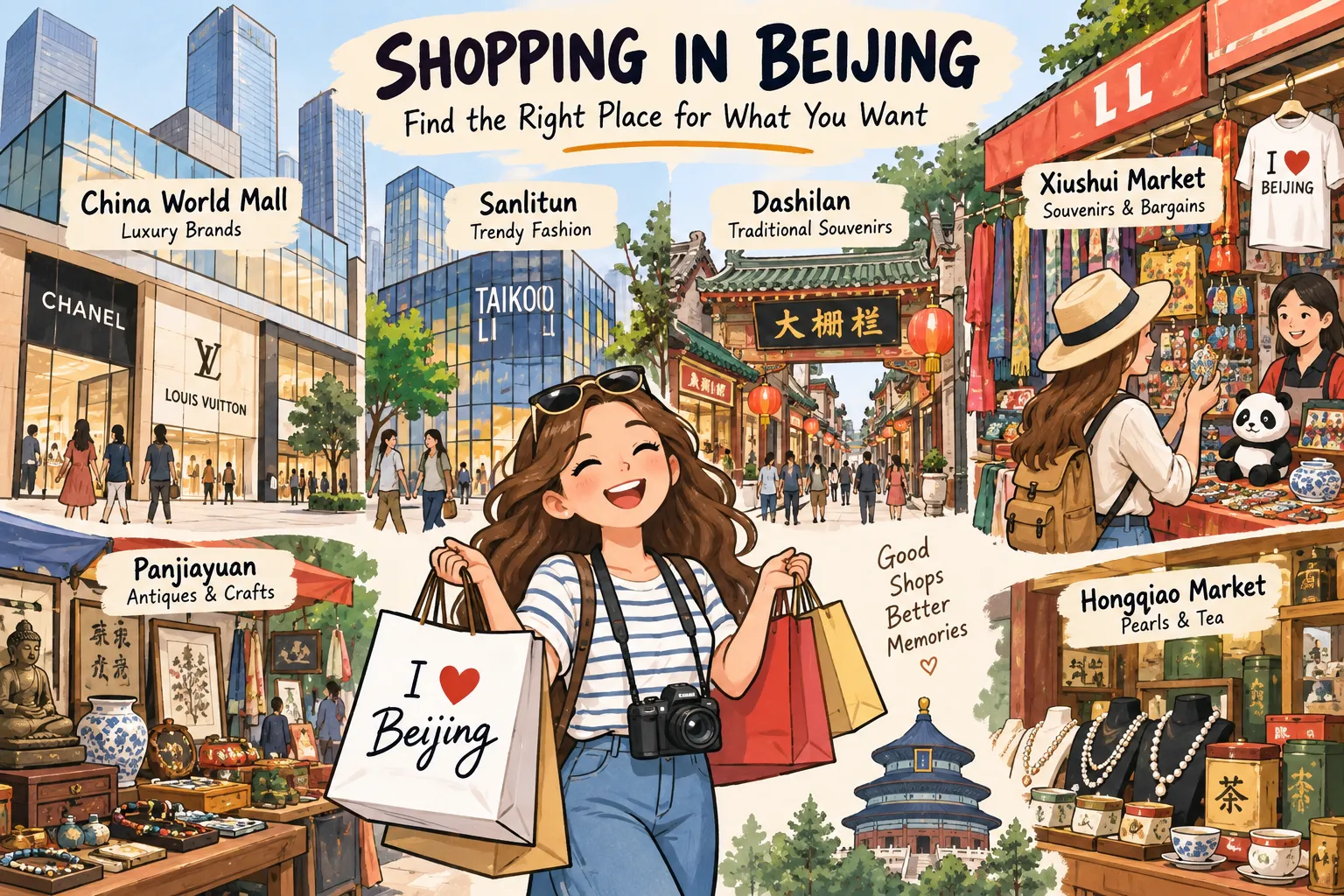
Go to China World Mall (Guomao) for the easiest all-round luxury-shopping experience. It combines international brands, direct subway access and convenient access to Beijing's departure-tax-refund services.
SKP is a better fit if luxury shopping itself is a major part of your trip and you specifically want a high-end retail environment.
Choose Dashilan (Qianmen) for established Beijing brands, traditional products and fixed-price shopping.
Choose Xiushui Market if you want silk, Chinese-style clothing, crafts and other souvenirs in one building — and you are comfortable bargaining.
For souvenir buying specifically, I would not make Wangfujing your first choice.
Go to Xidan.
It is one of the easiest central areas for mainstream Chinese fashion, beauty, accessories and everyday shopping without committing to luxury-mall prices.
| You Want to Buy | Best Place | Why Go There? | Typical Price Range (RMB) | Tax Refund? | Haggle? |
|---|---|---|---|---|---|
| Luxury brands | China World Mall | Convenient luxury selection and refund services | ¥1,000–10,000+ | At participating stores | No |
| Luxury window-shopping | China World Mall / SKP | Flagship stores without obligation to buy | Free to browse | N/A | No |
| Trendy fashion / streetwear | Sanlitun Taikoo Li | International and contemporary Chinese brands | ¥300–10,000+ | At participating stores | No |
| Affordable fashion | Xidan | Central, practical, broad price range | ¥50–800 | At participating stores | No |
| One-stop souvenirs | Xiushui Market | Silk, clothing, crafts and custom goods | ¥30–2,000+ | Varies by merchant | Yes |
| Pearls and tea | Hongqiao Market | Large pearl selection near Temple of Heaven | ¥100–5,000+ | Varies | Yes |
| Antiques and crafts | Panjiayuan | Huge mix of reproductions, collectibles and crafts | ¥20–2,000+ | Usually not the main reason to visit | Yes |
| Traditional Beijing brands | Dashilan | Heritage shops and fixed prices | ¥100–800+ | Store-dependent | No |
| Brand outlets | Yansha Outlets | Discounted branded goods | Varies | At participating stores | No |
Prices are planning ranges, not fixed quotations. Individual stores, product quality and promotions can change.
Beijing does not have one shopping culture. It has several.
This is the world of major malls such as China World Mall, SKP and Sanlitun.
Prices are fixed. Bargaining is inappropriate. Tax refunds may be available when you buy from participating departure-tax-refund stores.
This is the easiest environment for travelers buying expensive products.
Xiushui, Hongqiao and parts of Panjiayuan operate differently.
A seller's opening price can be a starting point rather than the final price. Bargaining is part of the interaction, especially at independently operated stalls.
There is no universal “correct percentage,” because margins differ enormously by product.
Temporary stalls and small independent merchants may offer lower prices, but receipts, warranties, returns and tax-refund eligibility can be limited.
For inexpensive souvenirs, that may be perfectly acceptable.
For a high-value purchase, it is a very different risk calculation.
TripChina Verdict: For most first-time visitors with limited time, the easiest combination is China World Mall for luxury + Dashilan for traditional souvenirs. Add Xiushui or Hongqiao if bargaining is part of the experience you want.
For most international visitors, it is one of the easiest choices.
Chinese name: 国贸商城
Address: 1 Jianguomenwai Avenue, Chaoyang District
Subway: Lines 1 and 10, Guomao Station
Typical hours: 10:00–22:00; individual store opening times may vary
Price range: Entry-level designer items from around ¥1,000; high luxury can run well above ¥10,000
Tax refund: Available through participating stores and refund services
Haggling: No
China World Mall sits in one of Beijing's major commercial districts and includes a wide range of international and Chinese brands.
Its biggest advantage for an overseas shopper is convenience rather than exclusivity alone.
Beijing has expanded centralized Instant Tax Refund services in major commercial districts, including China World Mall. Selected stores there also support newer QR-based refund processes through Alipay.
Why it works: If you are making a high-value purchase and do not want to negotiate authenticity, receipts or refund paperwork with a market vendor, this is the easier environment.
Caveat: Ignore people outside formal stores offering supposedly discounted luxury products.
Often, yes.
Chinese name: 三里屯太古里
Address: 19 Sanlitun Road, Chaoyang District
Subway: Line 10 via Tuanjiehu, or Line 17 via Gongti depending on your route
Typical hours: 10:00–22:00; restaurants and individual stores may differ
Price range: Roughly ¥300 for mainstream fashion to ¥10,000+ for designer goods
Tax refund: At participating stores
Haggling: No
Sanlitun is better thought of as a fashion and lifestyle district than a single luxury mall.
Come here for:
• contemporary international fashion
• Chinese designer labels
• sneakers and streetwear
• beauty
• cafés, restaurants and nightlife alongside shopping
If you want one luxury handbag and maximum efficiency, Guomao is easier.
If you want to spend half a day browsing fashion and people-watching, Sanlitun is more interesting.
Xidan works well for travelers who want normal shopping rather than a luxury experience.
Chinese name: 西单
Subway: Lines 1 and 4, Xidan Station
Typical mall hours: 10:00–21:30; individual stores may vary
Typical spend: Clothing roughly ¥100–800; beauty and accessories often lower
Tax refund: Available at some participating department stores — look for the official tax-refund logo or ask at the store's service desk
Haggling: No in normal mall stores
The advantage is density.
You have multiple malls and stores within a compact area, so it is easy to compare Chinese fashion brands without spending half your day moving across Beijing.
Caveat: Small independent basement shops may have weaker return and after-sales policies than established counters.
Yes — if you enjoy retail design.
Chinese name: 北京SKP / SKP-S
Address: 87 Jianguo Road, Chaoyang District
Subway: Line 14, Dawanglu Station
Typical hours: 10:00–22:00
Haggling: No
SKP is best for serious luxury shopping, while SKP-S is also interesting as a highly designed retail environment.
If luxury brands are not part of your budget, you can still browse without buying.
For a traveler who simply needs efficient luxury shopping, however, China World Mall may be more practical.
Yes, especially if you want variety in one place.
Chinese name: 秀水街
Address: 8 Xiushui East Street, Chaoyang District
Subway: Line 1, Yonganli Station
Typical hours: 09:00–21:00; individual shops may vary
Typical spend: Silk scarves roughly ¥80–300; Chinese-style clothing and tailoring can run from hundreds to thousands of RMB
Haggling: Yes
Xiushui is no longer just the stereotypical “fake-brand market” described in many older international guides. It also contains established Chinese brands and traditional-goods retailers.
Rather than relying on an old claim that it contains exactly “19 heritage brands,” it is safer to say that several well-known traditional Chinese brands and Beijing-oriented products can be found within the market.
For negotiable stalls, you can begin at roughly 30–50% of the opening quote when the first number appears obviously inflated.
For many ordinary souvenir items, a final price may land somewhere around 50–70% of the original asking price, but do not treat that as a formula.
Some sellers open close to their real price. Others start much higher.
The better rule is:
• know roughly what similar products cost
• make one reasonable counteroffer
• move upward gradually
• be willing to walk away
• stop when the price feels fair to you
Keep it friendly. Bargaining is normal; insulting the merchandise or turning the negotiation into an argument is unnecessary.
Caveat: Avoid high-value jade and medicinal products unless you understand exactly what you are buying. Quality, certification and pricing can be difficult for a visitor to evaluate.
Hongqiao is one of Beijing's best-known pearl-shopping destinations.
Chinese name: 红桥市场
Address: 9 Tiantan Road, Dongcheng District
Subway: Line 5, Tiantandongmen Station
Typical hours: 09:00–19:00; merchant hours may vary
Price range: From inexpensive freshwater pearl pieces to high-value jewelry
Haggling: Common
It is especially convenient because it sits near the Temple of Heaven. See TripChina's Temple of Heaven Travel Guide if you want to combine both in the same outing.
For a high-value pearl purchase, do not rely only on the seller's own card or verbal claim.
Ask for an independent third-party authenticity certificate and make sure the documentation describes the actual item you are buying.
For tea, taste before purchasing when possible.
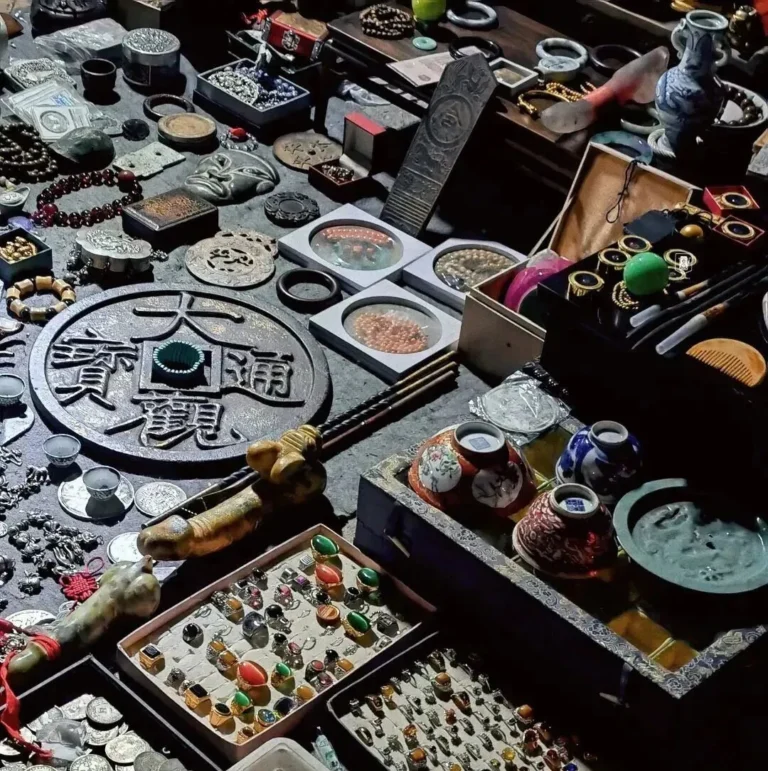
Technically, yes — but international visitors should interpret the word “antique” carefully.
Chinese name: 潘家园旧货市场
Address: 18 Hualili, Chaoyang District
Subway: Line 10, Panjiayuan Station
Current Beijing tourism information lists the market as open during both weekdays and weekends, with earlier weekend opening hours. Weekends remain the better time for the full flea-market atmosphere.
Most foreign travelers should think in terms of:
• seal stamps
• reproduction calligraphy
• replica paintings
• beads and small jewelry
• handicrafts
• carvings
• vintage-style objects
• cultural-creative souvenirs
Do not assume an item is an authentic historical antique because a seller describes it as old.
For a normal tourist, the safest assumption is:
Most inexpensive “antique-looking” objects are reproductions or modern decorative goods.
Avoid paying high prices for claimed antiquities without professional authentication. Treat the market primarily as a place for interesting craft-scale purchases and browsing, not investment collecting.
For many first-time visitors, yes.
Chinese name: 大栅栏
Location: Qianmen / Dashilan, Xicheng District
Subway: Lines 2 or 8, Qianmen Station
Street access: Open throughout the day; individual shop hours vary
Haggling: Generally no in established heritage stores
Dashilan works because you can shop by known business name rather than guessing which souvenir stall is trustworthy.
Examples include:
• Ruifuxiang (瑞蚨祥): silk, qipao (Chinese cheongsam) and traditional Chinese clothing
• Neiliansheng (内联升): traditional cloth shoes
• Zhang Yiyuan (张一元): jasmine tea
• Tongrentang (同仁堂): traditional Chinese medicine products
• Shengxifu (盛锡福): hats
• traditional Beijing pastry stores
If you want a traditional silk gift, going directly to a known heritage retailer is usually easier than randomly entering a tourist souvenir store.
Allow roughly 2–3 hours if you want to browse the wider Qianmen-Dashilan area rather than rush through one shop.
Yes — but not because it is Beijing's cheapest souvenir district.
Chinese name: 王府井
Location: Wangfujing Street, Dongcheng District
Subway: Lines 1 or 8, Wangfujing Station
Typical shopping hours: 10:00–22:00; individual businesses vary
Price range: Wide
Tax refund: Available at participating major stores — look for the tax-refund logo or ask at the service desk
Haggling: No in established retailers
Best for: Convenience, department stores, branded retail, cultural-creative products and the experience of walking Beijing's best-known shopping street.
Why go: You can combine shopping, food and central sightseeing without making a dedicated market trip.
Wangfujing also continues to expand tax-refund infrastructure; for example, Dong'an Department Store introduced a multilingual self-service tax-refund application terminal in 2026.
Caveat: For traditional Beijing souvenirs specifically, Dashilan gives you a clearer concentration of heritage stores.
For Palace Museum cultural-creative products, official museum retail channels and official online shops are another useful option rather than buying generic palace-themed souvenirs from an unrelated vendor.
Yansha Outlets is useful if discounted brands are your main goal.
Chinese name: 北京燕莎奥特莱斯购物中心
Location: Chaoyang District
Typical hours: 10:00–22:00; verify before making a dedicated trip
Tax refund: Available at participating stores
It is not a must-see sightseeing destination, but it can make sense if discounted branded clothing is one of your main shopping goals.
Only for a specific reason.
BaiRong is a huge wholesale-oriented clothing complex around the Muxiyuan/Yongdingmen area.
Most vendors focus heavily on wholesale or bulk trade, so a tourist buying only one piece may encounter higher per-item pricing than a bulk buyer.
Go if:
• you enjoy huge wholesale markets
• you are buying multiple items
• ultra-low-cost fashion browsing is part of the experience
Skip it if you only have two or three days in Beijing.
China's departure-tax-refund system was upgraded again in 2026.
| Rule | Current Guidance |
|---|---|
| Minimum purchase | ¥200 by the same visitor, at the same eligible store, on the same day |
| Standard departure deadline | Within the applicable normal departure-tax-refund period |
| Goods | Must meet tax-refund eligibility requirements |
| Eligible travelers | Overseas visitors meeting the policy conditions |
| Refund method | Depends on refund amount and available payment method |
| Instant Tax Refund departure period | Up to 28 days under the upgraded 2026 instant-refund framework |
| Smaller claims from July 1, 2026 | Purchases below ¥10,000 use random physical inspection rather than mandatory inspection for every claim |
| Paperless processing | Expanded under the upgraded 2026 system |
The 2026 national upgrade simplified customs verification for smaller claims and extended the departure period for the Instant Tax Refund mechanism to 28 days.
Important: Even inside a mall that supports tax refunds, not every individual store is necessarily enrolled. Look for the official departure-tax-refund sign or confirm eligibility before paying, especially for a high-value purchase.
Beijing's centralized service network includes major commercial areas such as:
• China World Mall
• WF Central / Wangfujing
• Seasons Place / Financial Street
• Sanlitun
• Shine Hills
The network has continued expanding, so use current Beijing government information rather than assuming an old list is complete.
The exact counter location inside a shopping center can change.
Ask the mall information desk for the current “Instant Tax Refund” or 离境退税 service point instead of relying on an old floor number from a travel blog.
Major malls, department stores and international retailers increasingly accept international cards.
Smaller market vendors may not.
Yes.
Mobile payments remain the easiest fallback across a much broader range of merchants than international cards alone.
Before your trip, see TripChina's China Payment Guide for Foreign Visitors and WeChat Pay Setup Guide.
For navigation, restaurant listings and Beijing-specific digital services, see Digital Tools for Foreign Visitors in Beijing.
Carry some RMB cash as a backup rather than assuming every small stall will accept your preferred payment method.
| Shopping Area | Typical Hours | Practical Note |
|---|---|---|
| China World Mall / SKP | 10:00–22:00 | Individual stores may vary |
| Sanlitun | 10:00–22:00 | Restaurants may stay open later |
| Xiushui Market | 09:00–21:00 | More shops are open by mid-morning |
| Hongqiao Market | 09:00–19:00 | Closes earlier than major malls |
| Panjiayuan | Earlier on weekends | Weekends are best for flea-market atmosphere |
| Dashilan | Street accessible throughout the day | Individual heritage-shop hours vary |
| Yansha Outlets | Around 10:00–22:00 | Verify before a dedicated trip |
Opening hours are among the easiest shopping details to become outdated. Check a current map listing or official venue information shortly before traveling.
• China World Mall in the morning
• Sanlitun Taikoo Li in the afternoon
• Dinner or nightlife around Sanlitun
Best for: Luxury and contemporary fashion.
• Xiushui Market in the morning
• Hongqiao Market around midday or afternoon
• Dashilan / Qianmen later in the day
Best for: Silk, pearls, tea and Beijing-style gifts.
• Panjiayuan early in the morning
• 798 Art Zone later in the day — see the full 798 Art District guide
Best for: Crafts, vintage-style objects, art and design-oriented shopping.
The same type of silk scarf might cost roughly ¥300 after bargaining at Xiushui, ¥500 at a conventional retailer, or ¥1,000 at a tourist-oriented store near a major attraction.
Those numbers are illustrative rather than fixed quotes, and the products may differ in material, workmanship and brand.
The point is simpler: identify the rule set before you shop. Know whether you are entering a fixed-price retailer, a negotiable market or an informal tourist stall, and you will avoid many of the mistakes first-time visitors make.
This article is part of the Beijing Travel Guide Hub.
Absolutely. China World Mall, SKP and Sanlitun are normal commercial spaces, and window-shopping costs nothing. SKP-S in particular may be interesting even to non-buyers because of its design-focused retail environment.
Keep negotiations short and polite. When an opening quote is clearly inflated, starting at roughly 30–50% of that quote can be reasonable, then adjust according to the product and the seller's response. See the full strategy in the Xiushui Market section above.
Yes. In fact, that may be the better mindset. Go for inexpensive crafts, seals, reproduction artwork, curios and the market atmosphere rather than expecting museum-grade antiquities.
Wangfujing is a modern commercial shopping district with department stores and major brands. Dashilan is better for established Beijing heritage shops and traditional products. Choose Wangfujing for convenience; choose Dashilan for old-Beijing shopping character.
Only if you have the expertise to evaluate them or obtain trustworthy independent authentication. For most tourists, markets are much better for inexpensive decorative goods and handicrafts than for high-value collectibles.
Do not assume that it will. Eligibility depends on the store, transaction and current tax-refund requirements. Ask the retailer before placing a custom order if tax-refund eligibility matters to you.
For most first-time travelers, keep the decision simple.
Choose China World Mall for high-value luxury shopping.
Choose Xidan for practical fashion.
Choose Dashilan for established Beijing brands and traditional souvenirs.
Choose Xiushui if you enjoy bargaining.
Choose Hongqiao for pearls.
Choose Panjiayuan for crafts, reproductions and atmosphere.
Choose Sanlitun when shopping is part of a wider fashion, dining and nightlife day.
You do not need to visit all of them.
The best Beijing shopping trip is the one where you decide what you want to buy first — then choose the shopping environment that fits it.
Shopping location also depends heavily on where you stay, so see TripChina's Where to Stay in Beijing Guide before planning cross-city shopping trips.
• State Taxation Administration — 2026 Departure Tax Refund Upgrade
• Beijing Municipal Government — Centralized Instant Tax Refund Services
• Beijing Municipal Government — One-Tap Smart Tax Refund
• Beijing Tourism — Panjiayuan Market
Updated September 6, 2026. This guide was reviewed against Beijing tourism information, State Taxation Administration rules, Beijing's current Instant Tax Refund updates and TripChina's existing Beijing shopping research. Particular attention was given to tax-refund changes, Panjiayuan opening hours, outlet locations and price estimates that change frequently. Prices and bargaining ranges are planning estimates rather than guaranteed quotes; individual stores and market inventory change frequently. No sponsored placements or paid partnerships influence the recommendations.
TripChina.me creates practical China travel guides shaped by real local experience, helping independent travelers navigate transport, payments, food, neighborhoods, and the cultural details that make traveling in China easier and more meaningful. Find the guide for your destination at tripchina.me.