Our Location:
No. 99, Jiazi Road, Chengdu

 authorChris Lee
Many travel blogs push the same overhyped Chengdu food spots. This guide separates tourist-heavy food streets from night markets locals still visit.
Most visitors to Chengdu end up eating around Jinli or Kuanzhai Alley. Convenient? Yes. The city’s best introduction to night-market food? Not really.
Chengdu night markets spread across residential neighborhoods, university districts and riverside streets. Some are serious eating destinations; others are better for atmosphere. This guide compares nine places worth knowing — including what to eat, what they cost, when to go and whether they are worth crossing the city for.
If you only have one evening, start with Fuqin Night Market. It combines classic Chengdu snacks, neighborhood atmosphere and easy metro access without requiring a long trip across the city.
| Night Market | Best For | Typical Budget | Metro | Recommended Best Time |
|---|---|---|---|---|
| Fuqin Night Market | First-time visitors | ¥30–70 | Line 5 | 18:00–20:30 |
| Jianshe Road | Famous snacks, easy sampling | ¥40–80 | Line 6 | 18:30–21:00 |
| Liulangwan | Cheap eats & students | ¥20–60 | Line 4 | 18:00–21:30 |
| Sanse Road | Riverside atmosphere | ¥40–100; snacks only can stay under ¥50 | Line 6 | 19:00–22:00 |
| Xiangxiang Alley | Sit-down food + photos | ¥60–130 | Line 2 | 18:00–21:30 |
| Xipu Night Market | BBQ & student prices | ¥30–60 | Lines 2 / 6 | 18:00–21:30 |
| Qianfeng Road | Small neighborhood market | ¥20–50 | Line 6 | 18:30–21:00 |
| Chao+Xiang Yeshi | New & easy to reach | ¥30–80 | Line 3 | 18:30–21:30 |
| Sanhe Jiangling | Large suburban market | ¥30–70 | Line 3 + walk | 18:00–21:30 |
Most are accessible by metro or a short walk/taxi connection. If Chengdu is your first experience with a Chinese subway system, TripChina’s Chengdu Metro Guide explains tickets, payments and station navigation.
Chinese public holidays can dramatically change crowd levels. Check the China Public Holidays Guide before building a food-heavy Chengdu itinerary around May Day or National Day.
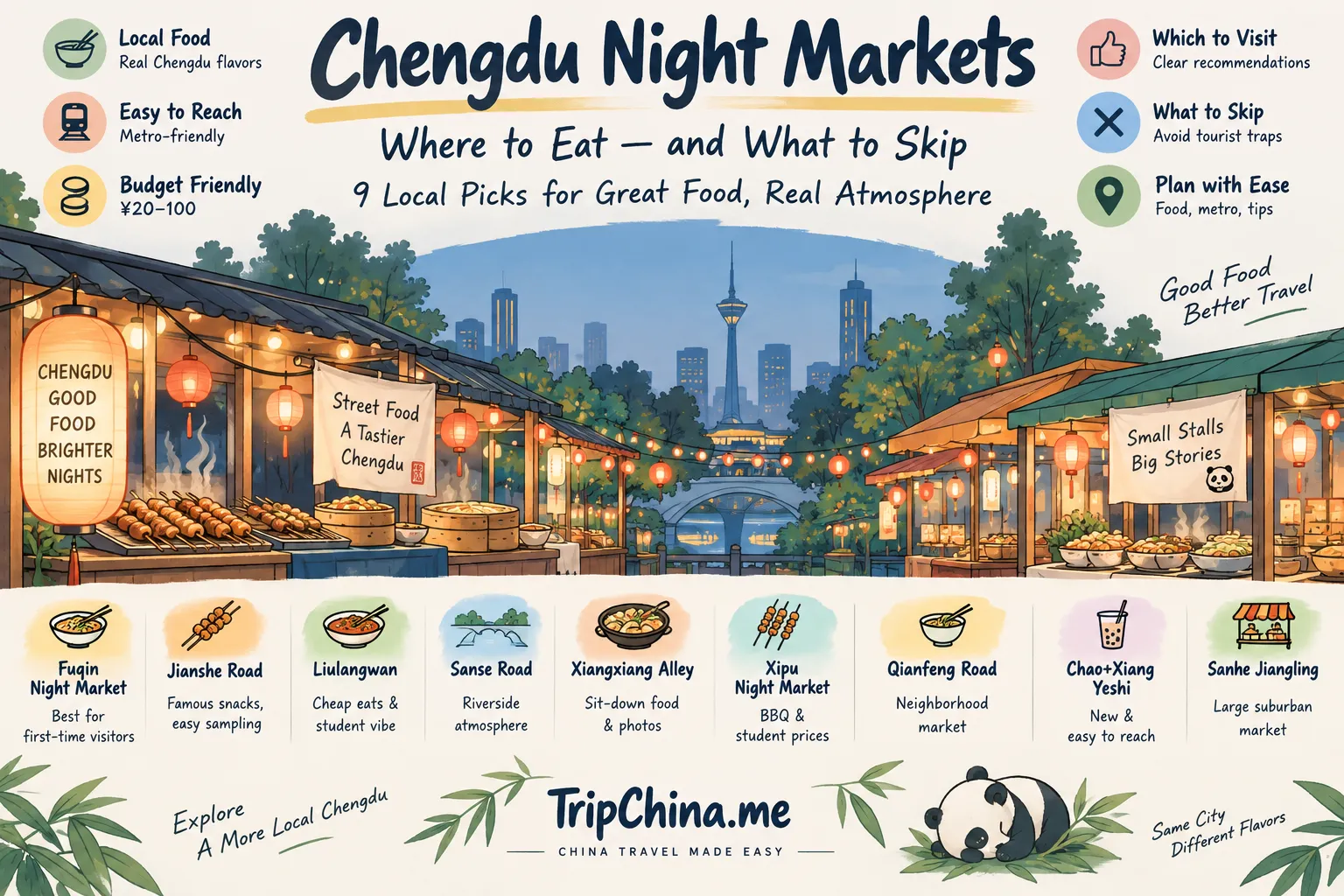
Short answer: Fuqin gives first-time visitors the best balance of local food, easy transport, variety and neighborhood atmosphere.
Fuqin Night Market (抚琴夜市) sits in an established residential area in Jinniu District rather than a purpose-built tourist zone. The crowd mixes nearby residents, families, couples and visitors who deliberately come for the food.
As of 2026-09, Fuqin has undergone a major 2.0 upgrade. Official Jinniu District reporting describes more than 300 stalls and average daily visitor numbers of around 30,000.[1] The upgraded area also includes cultural installations, performances, seating and creative retail.
The result feels more polished than the old Fuqin, but food remains the main reason to come.
Address: Fuqin area, Jinniu District (金牛区抚琴片区)
📍 Open in Amap — Fuqin Night Market (抚琴夜市)Metro: Line 5, Fuqin Station, Exit B1
Planning window: 17:00–23:30
Peak: 19:30–21:30
Typical budget: ¥30–70 per person
Best for: First-time visitors, classic snacks, neighborhood atmosphere
Individual vendors keep different hours. Monday typically has fewer active vendors than Friday through Sunday.
Must-try food:
Fuqin’s advantage is consistency rather than novelty. It gives you a broad introduction to Chengdu snack culture without the stronger tourist markup found around famous sightseeing streets.
The lanes become noticeably more crowded after dinner. If you dislike squeezing between people while holding hot food, arrive around 18:00 rather than 20:00.
For more food picks, exact directions, and what to expect after dark, see our complete Fuqin Night Market Guide.
If you enjoy seeing Chengdu beyond its headline attractions, the Chengdu City Walk Guide covers more local neighborhoods and self-guided walking routes.
Short answer: Yes for convenience and variety, but I would no longer treat it as one of Chengdu’s best examples of genuine neighborhood food culture.
Jianshe Road (建设路) became one of Chengdu’s best-known food streets among younger diners and helped push many local snacks into China’s social-media spotlight.
That popularity changed the area.
Local reporting in 2026 describes a street in visible decline, with more vacant storefronts, original vendors leaving amid higher rents and a growing share of standardized “internet-famous” food businesses.[2] These reports are local commentary rather than official statistics, but the shift is noticeable enough that travelers should adjust expectations.
Jianshe Road remains functional for visitors who want many recognizable snacks in one compact area. Do not expect the undiscovered local food street it once was.
Address: Mengzhuiwan / Jianshe Road area, Chenghua District (成华区建设路片区)
📍 Open in Amap — Jianshe Road Night Market (建设路夜市)Metro: Line 6, Jianshe North Road Station; walk toward Jianshe Alley
Planning window: 18:00–01:00
Peak: 19:30–22:00
Typical budget: ¥40–80 per person
Best for: First-time snack sampling and food trends
Individual businesses keep different hours, and the mix of vendors changes more frequently than at a traditional residential market.
Must-try food:
Jianshe Road is still useful if you want to sample many famous snacks without researching individual restaurants. Just expect more commercialization and tourist traffic than the phrase “local night market” might suggest.
Street food is only one side of Chengdu’s food identity. If you want to tackle the dish the city is most famous for, the Chengdu Hot Pot Guide for First-Time Visitors explains broths, ordering and spice levels.
Short answer: Yes if cheap food and student energy matter more to you than central location.
Liulangwan Night Market (柳浪湾夜市) is in Wenjiang University Town, outside Chengdu’s main urban core. Plan roughly 40 minutes or more from central Chengdu depending on where you start and your transfer.
Address: Near Liulangwan North First Street and Middle Yangliu West Road, Wenjiang District (温江区柳浪湾北一街与杨柳西路中段)
📍 Open in Amap — Liulangwan Night Market (柳浪湾夜市)Metro: Line 4, Yangliuhe Station, Exit C; walk about 10 minutes
Planning window: Recent 2026 sources describe an operating window of approximately 10:00–02:00, with the best food-market atmosphere after 18:00.[6]
Peak: 18:00–21:30
Typical budget: ¥20–60 per person
Best for: Students, budget travelers and adventurous eaters
Do not interpret the long operating window to mean the full night market is equally active all day. The atmosphere most travelers are looking for builds after 18:00, when student crowds arrive.
Liulangwan is less exclusively Sichuanese than Fuqin. You can move from Chengdu snacks to Guangxi luosifen, Yunnan tofu, northeastern fried skewers and other regional Chinese street foods within a few blocks.
Must-try food:
One ingredient you may encounter here is zhe’ergen (折耳根) — Houttuynia cordata, commonly called fish mint.
Its sharp, herbal and earthy flavor is famously polarizing. Try a little before asking a vendor to cover your potatoes with it.
Quality varies more here than at Fuqin. A useful local rule is simple: watch where students queue. High turnover is usually a better signal than a photogenic signboard.
Weekend evening Line 4 trains can be crowded. Add roughly 10–15 minutes of buffer time when heading back toward central Chengdu.
Short answer: Sanse Road is now a more curated riverside nightlife experience than a traditional food-first night market.
Sanse Road Night Market (三色路夜市) entered its 3.0 iteration in 2026. The newer format retains the riverside setting and car-trunk-market character but puts more emphasis on layout, atmosphere, drinks and social space.
This is not a traditional street-food market. Think of it as an outdoor riverside party with food vendors.
Address: Guohua Street / Sanse Road area, Jinjiang District (锦江区国华街三色路)
📍 Open in Amap — Sanse Road Night Market (三色路夜市)Metro: Line 6, Jinshi Road Station, Exit E2; walk roughly 5–10 minutes depending on where you enter
Planning window: 19:00–02:00
Peak: 20:00–22:30
Typical budget: ¥40–100 per person; street snacks alone can stay below ¥50
Best for: Couples, groups, photos, drinks and riverside atmosphere
What you will find:
However, expect mixed reviews on food quality. The atmosphere is the main draw. Some stalls prioritize presentation over substance, and prices can feel high for what you get.
Earlier on-site reporting also criticized the limited restroom setup. A recent resident complaint in September 2026 additionally reported late-night music, cooking fumes and disturbance to nearby homes. Treat this as a resident report rather than a general assessment of the entire market. If you are sensitive to noise or smoke, visit earlier in the evening.
Do not come here expecting the cheapest food in Chengdu. Drinks and sit-down items can push the bill up quickly.
Operations are also more weather-sensitive than at a permanent restaurant street. Rain, events or city-management adjustments can affect outdoor vendors. Check recent map reviews or local social-media posts before making a special cross-city trip.
Sanse Road is one of the better markets in this guide for night photography: riverside lighting, decorated stalls and outdoor seating give you more visual variety after dark.
For somewhere to continue the night afterward, TripChina’s Chengdu Nightlife Guide covers bars, riverside areas and late-night neighborhoods.
Short answer: It is primarily a restaurant-focused food lane rather than a classic open-air night market.
Xiangxiang Alley (香香巷) sits somewhere between the two. The lane is narrow, colorful and packed with food businesses. You can grab snacks and walk, but it works best when you sit down for a proper meal.
Address: Wangping Street 25, Chenghua District (成华区望平街25号)
📍 Open in Amap — Xiangxiang Alley (香香巷)Metro: Line 2, Dongmen Bridge Station; continue toward Wangping Street
Planning window: 17:30–22:30
Peak: 18:30–21:00
Typical budget: ¥60–130 per person
Best for: Couples, photography and travelers who prefer sitting down
Current listings show a mix of Sichuan food, hot pot, desserts and international restaurants. Examples around the area include Thai food, Korean barbecue and small Sichuan eateries, so Xiangxiang Alley is less narrowly focused on traditional street snacks than Fuqin or Xipu.
Food to look for:
The visual appeal is part of the experience. Lanterns, neon signs and the narrow alley create a different atmosphere from a sprawling student night market.
Because it sits near Wangping Street and the river, it also works well as part of an evening walk rather than somewhere you need to spend several hours.
If food and nightlife access affect your hotel decision, compare the neighborhoods in TripChina’s Where to Stay in Chengdu Guide.
Short answer: Xipu combines cheap barbecue, big portions and a university crowd — but it is a long ride from central Chengdu.
Xipu Night Market (犀浦夜市) sits in western Chengdu near major university areas.
As of 2026, local reporting still describes it as one of the city’s strongest value picks. Roughly ¥30 can buy a substantial amount of food if you stick to small snacks and barbecue.
Address: Puxing Street / Yulong Third Alley area, Pidu District (郫都区浦兴街、玉龙三巷一带)
📍 Open in Amap — Xipu Night Market (犀浦夜市)Metro: Line 2, Tianhe Road Station, Exit B, then walk about 1.3 km; or Line 6, Xipu Station, Exit A1, then walk about 1.6 km. Confirm the most convenient route on Amap before leaving.[5]
Planning window: 16:00–23:00
Peak: 18:00–21:30
Typical budget: ¥30–60 per person
Best for: BBQ, students and budget travelers
Must-try food:
Xipu is a considerable trip from tourist-heavy areas such as Chunxi Road. Do not choose it simply because you have one free hour. Go because you want the university-district atmosphere and cheap late-night food.
Lines 2 and 6 around Xipu can see heavy student traffic on Friday through Sunday evenings. Give yourself extra time for the return journey.
Short answer: Only if you are nearby.
Qianfeng Road Night Market (前锋路夜市) is a small under-bridge market near Fuqing Road. It is less polished than the other markets in this guide, with simple stalls, grills and basic seating.
Address: Near Qianfeng Road Metro Station (前锋路地铁站附近)
📍 Open in Amap — Qianfeng Road Night Market (前锋路夜市)Metro: Line 6, Qianfeng Road Station, Exit F
Planning window: 18:00–22:30
Peak: 18:30–21:00
Typical budget: ¥20–50 per person
Best for: Travelers already exploring this part of Chengdu
Must-try food:
There is an important caveat.
Complaints about the under-bridge market date back to at least 2024. Residents have repeatedly reported sidewalk occupation, traffic hazards, smoke and noise.
In 2026, local authorities said they were working on plans to turn the area into a more standardized managed vending zone. Complaints nevertheless continued into mid-2026, and no permanent resolution had been reached.[3]
Do not cross Chengdu solely to visit Qianfeng Road without checking recent map reviews first.
If you use Amap, use this corrected location rather than older online markers that duplicated Jianshe Road’s coordinates:
For foreign visitors, Amap is generally more useful in China than relying on Google Maps alone. TripChina’s China Navigation App Guide explains why and how to set it up.
Short answer: This is one of the easiest new night markets to try if you are staying in central Chengdu.
Chao+Xiang Yeshi (潮+巷夜肆) officially opened at Caojiaxiang Square on August 16, 2026. The market covers roughly 1,500 square meters and launched with 65 food stalls.[4]
Unlike an improvised street market, vendors operate within a designated site. Local reporting says vendor permits, health certificates, food traceability information and food-sampling results are publicly managed.[4]
Address: Caojiaxiang Square, Jinniu District (金牛区曹家巷广场)
Metro: Hongxing Bridge Station, Exit G1; the market is directly beside the station
Planning window: 17:30–23:00
Peak: 18:30–21:30
Typical budget: ¥30–80 per person
Best for: Easy metro access, newer stalls, families and mixed Chinese/international food
The food mix is deliberately broad. You may find Chengdu flavors alongside Thai basil rice, Leshan-style fried skewers, Xichang barbecue, northeastern guobaorou and drinks.
There is also something many older street markets lack: a central seating area with tables and chairs.[4]
Weather still matters. Local reporting from its opening week showed noticeably lower foot traffic during heavy rain and a quick rebound when the weather cleared.[4]
Because this market is new, I would treat it as an interesting current addition rather than declaring it a Chengdu classic yet.
Short answer: It is a substantial suburban night market, but I would still prioritize Fuqin, Liulangwan or Xipu on a short first trip.
Sanhe Jiangling Night Market (三河江陵烟火夜市) is in Xindu District. GoChengdu’s 2026 summer night-market roundup describes it as Xindu District’s “top night market,” stretching for around one kilometer with dedicated sections for street food, general merchandise, fresh fruit and other goods.[5]
Independent English-language traveler reviews remain limited, so the GoChengdu description is more useful for establishing its current scale and layout than for judging individual food stalls.
Address: Huimin 2nd Road, Xindu District (新都区惠民二路)
Metro: Line 3, Sanhechang Station, Exit A; walk approximately 1 km
Planning window: 17:00–23:00
Peak: 18:00–21:30
Typical budget: ¥30–70 per person
Best for: Travelers staying in northern Chengdu, variety and suburban night-market atmosphere
The food range goes beyond Sichuan snacks alone.
You may find local favorites such as:
Regional Chinese street foods may also appear, including grilled cold noodles, luosifen, rice rolls and other inexpensive snacks.
The downside is location. From central Chengdu, this is a deliberate food excursion rather than a casual post-sightseeing stop.
Alipay and WeChat Pay are the default payment methods at most Chengdu food stalls.
Foreign visitors can link eligible international bank cards to Alipay or WeChat Pay. Set up and verify the app before your first night-market visit. Trying to troubleshoot payment while a queue forms behind you is not fun.
For a step-by-step setup, use TripChina’s China Payment Guide for Foreigners or the dedicated Alipay Guide for Foreign Visitors.
Do not expect a street-food vendor to have a Visa or Mastercard terminal. Your international card normally works indirectly through Alipay or WeChat Pay rather than being tapped or inserted at the stall.
Cash remains legal tender and is useful as backup. Carry ¥10 and ¥20 notes. A ¥100 note can be inconvenient at a stall selling a ¥7 snack.
If you do not eat much chili, learn three phrases:
There is one catch: Sichuan food has both la (辣), the heat from chili, and ma (麻), the tingling or numbing sensation associated with Sichuan peppercorn.
Even “wei la” can still contain Sichuan peppercorn. If you are new to Sichuan food, the numbing sensation may surprise you even when the dish does not feel particularly hot.
If you want neither chili nor strong numbing pepper, show the vendor:
不要辣,也不要麻 — Bù yào là, yě bù yào má.
That is clearer than simply asking for mild spice.
Choose stalls with steady turnover and food cooked fresh in front of you.
If you have a sensitive stomach, grilled, fried, boiled or freshly stir-fried food is the easier starting point. Be more cautious with raw ingredients and cold-marinated dishes that have been sitting out.
Use the same judgment you would at any busy street-food market. Look at turnover, food handling and how long ingredients appear to have been sitting.
Carry tissues and hand sanitizer. Small stalls may offer napkins, but do not depend on it.
Bottled water is easy to find. Do not plan to drink ordinary tap water directly.
Most vendors do not speak much English, but ordering is usually straightforward.
Point at the food. Show a photo. Use your phone calculator for quantities if necessary. A translation app solves most remaining problems.
Useful phrases include:
Before arriving in China, it is worth installing your payment, navigation and translation tools together. TripChina’s 7 Essential Apps for China Travel covers the basic setup.
If a market requires a late taxi ride back to your hotel, the DiDi Guide for Foreign Visitors explains how to use China’s main ride-hailing platform without depending on a Chinese phone number.
Do not assume every Chengdu night market is wheelchair-friendly.
Older neighborhood markets such as Fuqin and Qianfeng Road can have narrow, crowded lanes and uneven access around temporary stalls. Xiangxiang Alley is also narrow.
Newer managed spaces such as Chao+Xiang Yeshi generally provide a more open layout, but individual stall access can still vary.
There is no single citywide pet rule covering every market in this guide. Outdoor markets may tolerate small pets, but individual managed areas and restaurants can set their own rules.
Do not assume a large dog will be comfortable or welcome in a packed food lane. Check locally if bringing a pet is important to your plans.
Public restroom quality and availability vary widely. Newer managed markets such as Chao+Xiang Yeshi have better visitor facilities, while older neighborhood food lanes may rely on nearby public or metro-station restrooms.
If in doubt, use the restroom at the metro station before entering a crowded market.
For serious eating, generally yes.
Jinli is worth visiting for lanterns, architecture and the atmosphere around Wuhou Shrine. But I would not choose it over Fuqin purely for food.
The same distinction applies to Kuanzhai Alley. It is a historic tourism district first and a local night market second.
If your priority is seeing Chengdu, Jinli and Kuanzhai can still make sense.
If your priority is eating Chengdu, go where residents are actually having dinner and late-night snacks.
This article is part of the Chengdu Travel Guide Hub.
Do not expect comprehensive English menus at any of these markets. Fuqin and Jianshe Road are more accustomed to international visitors, while newer managed markets may have clearer signage but not necessarily English translations.
A camera-translation app is more useful than searching specifically for an English-menu stall.
Chao+Xiang Yeshi is the easiest choice for families. It has direct metro access, a more open managed layout and central tables and chairs.
Fuqin also works well earlier in the evening, but weekend crowds become much denser after about 19:30. I would avoid making Qianfeng Road the priority with small children because of its under-bridge setting and uncertain management situation.
Vegetarian food exists — potatoes, tofu, grilled vegetables and some noodle dishes are easy to find — but ingredients are not always obvious.
Sauces, broths and cooking fats may contain animal products. Some chili sauces may also contain lard even when the visible dish is vegetable-focused.
For serious allergies, especially peanuts, shellfish or sesame, carry a Chinese allergy card. Cross-contact is common at small stalls, so a sit-down restaurant is safer when you need staff to confirm ingredients and preparation methods.
Facilities vary widely. Newer managed markets generally offer more seating, while traditional food lanes involve more standing.
For restroom planning, see the Restrooms section above; using a metro-station restroom before entering an older neighborhood market is often the simplest option.
Do not assume normal operations during Lunar New Year.
Independent vendors often close or reduce hours as owners return home. During May Day and National Day, the opposite problem is more common: popular markets can become extremely crowded.
Check recent map listings or local social-media posts before making a special trip during a Chinese public holiday.
A normal backpack is fine. A large rolling suitcase is possible but unpleasant once narrow markets become crowded.
There is usually no dedicated luggage storage at neighborhood night markets. Leave large luggage at your hotel or station storage facility when possible.
If this is your first visit, go to Fuqin.
For cheap food and student life, make the longer trip to Liulangwan or Xipu.
For riverside drinks, lights and photos, choose Sanse Road.
For something newly opened and easy to reach from central Chengdu, try Chao+Xiang Yeshi.
Jianshe Road remains convenient for famous snacks, but local reporting suggests its old neighborhood-food character has weakened. Qianfeng Road is local and inexpensive, but its operating environment is less stable.
Sanhe Jiangling is a substantial option if you are staying in northern Chengdu, but its suburban location makes it less practical for a short first visit.
The bigger lesson is simple: Chengdu night markets are not interchangeable attractions. Pick the one that matches how you actually want to eat.
Save this guide for your Chengdu trip. Combine it with our Chengdu Hot Pot Guide and Chengdu City Walk Guide to build your Sichuan food itinerary.
[1] Jinniu District Government — Fuqin Night Market current scale and 2026 upgrade
[2] Local Chengdu reporting — Jianshe Road vacancies, changing vendor mix and commercialization
[5] GoChengdu — Sanhe Jiangling Night Market overview and Xipu Night Market transportation
[6] 2026 local reporting — Liulangwan Night Market operating hours
Updated as of 2026-09 using Chengdu government information, GoChengdu, established local media, map listings and recent visitor reports. GoChengdu was used to verify Sanhe Jiangling’s approximate one-kilometer layout and Xipu transport routes. Liulangwan’s longer operating window is supported by 2026 local reporting. Resident complaints about Sanse Road are treated as individual reports rather than evidence that the same conditions occur every night.
TripChina.me creates practical China travel guides shaped by real local experience, helping independent travelers navigate transport, payments, food, neighborhoods, and the cultural details that make traveling in China easier and more meaningful. Find the guide for your destination at tripchina.me.