Our Location:
No. 99, Jiazi Road, Chengdu

 authorChris Lee
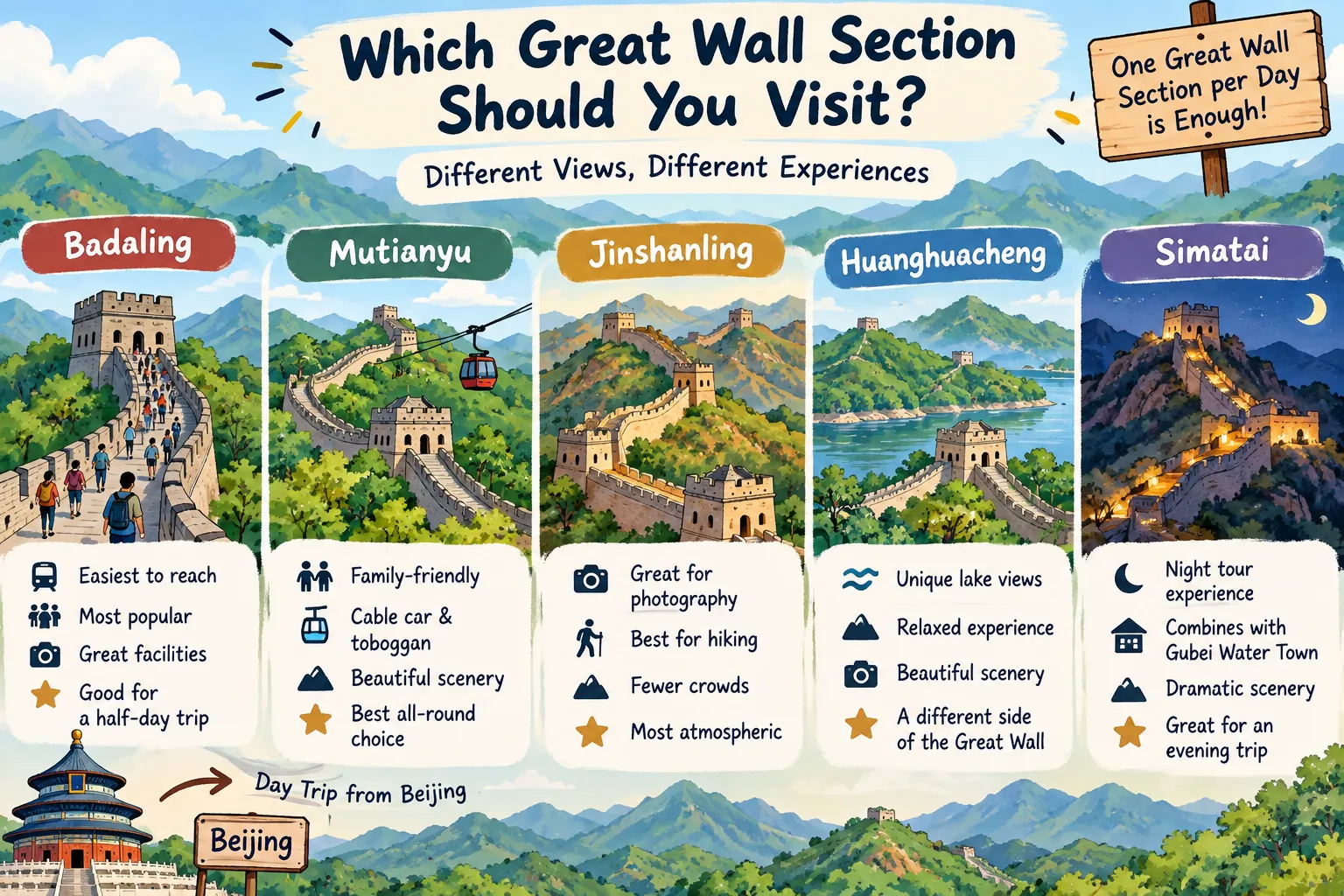
The biggest Great Wall mistake is assuming every section delivers the same experience. It does not. Badaling wins on convenience, Mutianyu on ease, Jinshanling on atmosphere and photography, Huanghuacheng on water scenery, and Simatai on the night experience. This guide compares the sections that actually make sense as Beijing day trips—so you choose once, rather than discovering halfway through the day that you picked the wrong wall.
As of September 2026:
• First visit / easiest all-round choice: Mutianyu
• Photography, hiking and fewer crowds: Jinshanling
• Fastest public-transport option: Badaling
• Lake scenery and a relaxed day: Huanghuacheng
• Most established night-wall experience: Simatai
• Wild-wall hiking: Jiankou or Gubeikou, but only with much more careful planning
For most travelers, one Great Wall section per day is enough. The differences between sections matter far more than trying to collect multiple check-ins.
| What You Want | Best Section | Why | Main Trade-Off |
|---|---|---|---|
| Best first visit | Mutianyu | Easy access to the wall, good scenery, cable car and toboggan | More restored and developed |
| Photography & atmosphere | Jinshanling | Long ridge views, varied towers, fewer visitors | Longest practical day trip |
| Fastest/easiest public transport | Badaling | Rail and bus connections, extensive facilities | Highest crowd risk |
| Family with children | Mutianyu | Cable car, chairlift/toboggan, comfortable infrastructure | Queues can build on busy days |
| Older traveler / limited mobility | Badaling or Mutianyu | Best developed access infrastructure | Not every part of the wall is step-free |
| Night tour | Simatai | Established Great Wall night experience beside Gubei Water Town | Far from central Beijing |
| Seasonal night entertainment | Badaling | Major 2026 night program through Oct. 6 | Much more event-like than quiet |
| Water & mountain scenery | Huanghuacheng | Great Wall sections meet the lake | Less of the classic high-ridge panorama |
| Serious wild-wall experience | Jiankou | Dramatic unrestored terrain | Safety/access risks; not a casual tourist walk |
| Military-history atmosphere | Gubeikou | Unrestored wall and battlefield history | Less tourist infrastructure |
My default recommendation is Mutianyu for a first-time tourist and Jinshanling if the Great Wall itself—not simply ticking it off your list—is one of the main reasons you came to Beijing.
No—and this is an important correction to a lot of current online advice.
There is not one universal ticketing rule for every Great Wall section.
Yes.
As of September 2026, Mutianyu's official site states that tickets use real-name reservation, foreign passports are accepted, and visitors can reserve as far as 30 days in advance. One ticket can be purchased per valid document per day.
Foreign travelers should enter their passport information exactly as shown in the document.
Not necessarily.
Beijing's official English visitor information currently says advance reservation is not required and tickets may be purchased on site at Badaling.
That does not mean I would wait until arrival during National Day, May Day or a busy autumn weekend.
It means the blanket statement “every Great Wall section has zero walk-in sales” is inaccurate.
Ticketing systems differ.
Jinshanling publishes admission and operating information through its ticketing system; Huanghuacheng maintains its own ticket and activity pricing; Simatai is closely integrated with the Gubei Water Town visitor system.
For these sections, check the current official booking page before arranging transport, particularly if you are visiting during a Chinese public holiday.
Practical rule: reserve early when possible—but do not invent one booking policy and apply it to every section.
Admission is surprisingly inexpensive compared with the transport, cable cars and other add-ons that can make up the real cost of the day.
| Section | Adult Admission Reference | Important Extras |
|---|---|---|
| Badaling | ¥40 peak / ¥35 off-season | Cable car and night-tour products extra |
| Mutianyu | Government base price ¥40; official booking products may differ | Shuttle, cable car, chairlift/toboggan extra |
| Jinshanling | ¥65 peak / ¥55 off-season | Cable car/shuttle if used |
| Huanghuacheng | ¥60 | Boats, train, slides and packages extra |
| Simatai | Check current official booking product | Often combined with Gubei Water Town products |
Badaling's government-set adult admission remains ¥40 in peak season and ¥35 off-season.
Jinshanling currently lists ¥65 peak-season and ¥55 off-season admission. Huanghuacheng's official pricing lists adult admission at ¥60.
Mutianyu is slightly more confusing because the Huairou government lists the government-priced adult admission at ¥40, while the attraction's own foreign-language online ticket system currently displays certain admission products at ¥45 and packages that add shuttle or cable-car services.
That is why I would compare the final package, not just the entrance fee.
For most people, yes.
Mutianyu gets recommended so often because it does not force you to make many compromises.
It is scenic without being difficult to access, heavily restored without feeling as intensely urbanized as Badaling, and developed enough that families or older travelers can simplify the climbing.
The biggest advantage is choice.
You can use a cable car to reach the wall rather than spending your energy on the approach climb. Another system combines a chairlift with the famous toboggan descent.
That means two people with very different fitness levels can still enjoy the same Great Wall outing.
One practical mistake is lining up for the wrong lift product. Mutianyu's cable-car operation and chairlift/toboggan operation are separate systems, so decide which route you want before joining a queue.
As of September 2026, Mutianyu's official booking system lists examples including:
• adult admission product: around ¥45 in the current foreign-language booking interface
• round-trip shuttle: ¥15
• round-trip cable car: ¥140
• one-way cable car: ¥100
Package prices vary according to what is included.
Check the live ticket page because bundled products can change.
Mutianyu is roughly 70 km from central Beijing.
In normal conditions, allow approximately 1.5–2 hours each way by road, depending heavily on where you start and Beijing traffic.
Once there, 3–4 hours is enough for a comfortable wall visit for most travelers.
If you already know you want Mutianyu, TripChina's detailed Mutianyu route guide explains the cable-car, chairlift and toboggan combinations without duplicating them here.
Yes—if you are willing to trade convenience for atmosphere.
Jinshanling is the section I would choose when someone says:
“I don't just want to see the Great Wall. I want to feel like I am actually on it.”
It has longer sightlines, more variation in the watchtowers and masonry, and generally more breathing room than the heavily visited sections closest to Beijing.
The official Beijing tourism listing describes a 10.5-km section with dozens of towers and defensive structures, which helps explain why the landscape feels more varied than a short restored sightseeing stretch.
The appeal is not simply “fewer tourists.”
The architecture itself changes repeatedly as you walk.
Look for:
• dense watchtower sequences
• weathered brick surfaces
• barrier walls used as additional defensive obstacles
• damaged or open-roof tower silhouettes
• long wall lines running over multiple mountain ridges
The original article's architectural detail is worth keeping because it is exactly what distinguishes this section from generic “Great Wall photo” advice.
Near General Tower, for example, the unusual stone-built branch wall near General Tower, sometimes referred to as the 'tiger-skin wall' (虎皮墙) due to its appearance.
These smaller details are one reason Jinshanling rewards people who slow down.
Do not assume the historic Jinshanling–Simatai through-hike is continuously open.
The two sections physically connect, and the route is still commonly described in older hiking guides, but access across scenic-area boundaries and individual gates can change.
Before building a 10-km traverse into your itinerary, confirm current through-access with the scenic areas or a reputable local hiking operator.
If through-access is closed, hike an out-and-back route within Jinshanling instead.
That is safer than arriving with a driver waiting at a Simatai exit you cannot legally reach.
The current admission reference is ¥65 in peak season and ¥55 off-season, while official tourism information suggests roughly 3–4 hours for the attraction itself.
Because of the road journey, I would treat Jinshanling as a full-day Beijing excursion.
Do not pick it if your only priority is getting back downtown for a 3 PM Forbidden City reservation.
Badaling gets criticized so much that some travelers swing too far in the other direction.
It is not a “bad” section.
It is simply a very specific experience.
Badaling has excellent infrastructure, one of the easiest transport connections, extensive restored wall, cable-car access and the most recognizable “Great Wall of China” branding.
If you have a half-day, mobility considerations or a strong preference for public transportation, that convenience matters.
High-speed rail makes Badaling substantially easier to reach than the more remote wall sections.
Journey times vary by train and departure station, so I would not promise the old blanket “20-minute ride” figure. In practical planning, allow around half an hour for the train itself plus station procedures and the final walk/transfer.
Reserve the train separately from the attraction ticket.
Yes, and this is a useful new option.
A direct Capital Airport–Badaling bus route began operating on February 10, 2026.
The published scheduled departures are:
| Direction | Scheduled Departures |
|---|---|
| Capital Airport → Badaling | 06:00, 08:00 |
| Badaling → Capital Airport | 14:00, 16:00 |
| Fare | ¥30–80 depending on journey |
Tickets can be checked through the 北京机场定制巴士 mini-program, and schedules may be adjusted according to demand.
This is genuinely useful if your Beijing itinerary begins or ends with the Great Wall.
I would still reconfirm the bus on the day before travel rather than building an international-flight connection around two fixed departures.
The North section gets most of the attention.
It contains some of the best-known viewpoints and therefore attracts the largest concentration of tour groups.
The South section can be a better choice when your priority is a less compressed walking experience rather than reaching the most famous northern tower.
If Badaling is your choice, I would arrive early and decide the route before following the crowd automatically toward the north.
For the detailed route differences, see TripChina's Badaling North vs South guide.
Yes—but the old statement that “Simatai is the only section with night tours” is no longer accurate.
For the most established wall-plus-evening destination, yes.
Simatai is closely associated with Gubei Water Town and has a long-running night-visit identity. Beijing tourism materials continue to promote night climbs there in 2026.
The advantage is that the night visit makes sense as part of a larger evening or overnight experience.
You can spend late afternoon in the water town, go up the wall after dark, then stay locally instead of making a late cross-city return.
Yes.
The 2026 Badaling Night Great Wall season runs from April 30 through October 6, with lighting, performances and interactive programming. The illuminated core includes areas between the North Fourth Tower and South Fourth Tower.
This is not a small exception anymore, so describing Simatai as “the only night Great Wall” would be factually wrong.
Mutianyu also ran a limited summer night-tour program in 2026. For the August reopening, the official attraction announced 17:30–21:00 operation with final ticket checking at 20:30.
That is another reason the article should distinguish:
established night experience from seasonal night events.
If night access is the reason you are traveling to a particular section, always confirm the specific date before leaving Beijing.
Yes—if landscape matters more to you than ticking off the most famous Great Wall postcard.
Huanghuacheng is different because the attraction combines wall, reservoir and mountain scenery.
Beijing's official visitor information describes sections of the wall entering the water and lists the site around 70 km from central Beijing. Adult admission is currently ¥60.
You can add boat or other recreational products, but you do not need to buy every package to enjoy the site.
Choose it if:
• you have already seen a classic restored Great Wall section
• you want water and mountain photography
• you prefer a more relaxed attraction
• you are traveling with people who do not want hours of hard ridge hiking
Do not choose it solely because someone describes it as a “secret Great Wall.”
It is a developed scenic area, just one with a very different visual character.
These sections belong in this comparison, but they should not be treated like interchangeable tourist attractions.
Jiankou is wild, unrestored and dramatically steeper than the major ticketed scenic sections.
That is precisely why it is visually famous—and why it deserves a different safety standard.
Do not approach Jiankou as:
“Mutianyu, but with fewer tourists.”
Weather, loose masonry, exposed ridges and route-finding all matter. Access rules around wild sections can also change as conservation and safety controls are enforced.
For an inexperienced hiker, I would choose Jinshanling instead.
You get historical texture and hiking without turning the day into a route-access gamble.
Gubeikou works better for travelers interested in military history and unrestored wall landscapes.
It has less polished tourist infrastructure and requires more logistics, but it can be a compelling option if you already know why you want an unrestored section.
For a first-ever Great Wall visit, it would not be my default.
Mutianyu and Badaling are the two most sensible choices.
Both have developed visitor infrastructure and uphill transport options.
However, “has a cable car” does not mean “the Great Wall is wheelchair-flat.”
The wall itself contains slopes, steps, uneven surfaces and towers. Accessibility can also differ by route, lift and operating status.
If someone in your group has significant mobility limitations:
Mutianyu's operating hours vary by season — typically 07:30–18:00 in peak season and 08:00–17:30 in off-season, with later closing on weekends. Check the official site for your specific date.
Those generous hours help—but the physical terrain still matters more than the closing time.
For most travelers:
April–May: comfortable temperatures, spring landscape
September–October: usually the best combination of temperatures and autumn scenery
Summer: green but hot, humid and busy
Winter: far fewer visitors but cold, windy and occasionally affected by snow or ice
Do not write “winter sections remain open year-round” as an unconditional guarantee.
Mountain attractions can temporarily restrict cable cars, paths or entire areas because of snow, ice, high winds, thunderstorms, wildfire precautions or maintenance.
Check the official notice on the day of travel if weather is marginal.
Earlier is usually better.
At Badaling and Mutianyu, the difficult period is typically when large day-trip groups have arrived but few have begun leaving.
That is why an early start often matters more than obsessing over whether Tuesday is 12% quieter than Wednesday.
At Jinshanling, the crowd pressure is generally lower, so light and weather become more important than beating tour buses.
For the wall itself:
| Section | Comfortable Visit |
|---|---|
| Badaling | About 2.5–4 hours |
| Mutianyu | About 3–4 hours |
| Jinshanling | About 3–5 hours |
| Huanghuacheng | About 3–5 hours |
| Simatai + Gubei Water Town | Half day to overnight |
Then add transport.
This is why “two sections in one day” looks possible on Google Maps and usually feels pointless in reality.
You are not visiting two museums separated by three subway stops.
You are crossing mountain districts around Beijing.
Badaling may be perfect for you.
Or it may be exactly wrong.
Choose according to mobility, transport, photography, hiking and crowd tolerance—not brand recognition.
It does not.
Mutianyu currently uses passport-compatible real-name reservations, while Badaling's official Beijing listing says on-site purchase remains possible.
Check the actual scenic area.
Badaling's 2026 night season has defined dates. Mutianyu has run limited summer night sessions. Simatai has the strongest established night-tour identity.
Check your exact travel date.
Physical connection does not guarantee current visitor access between scenic areas.
Verify before committing to a one-way hike.
For remote sections, solve the return journey before the outbound journey.
A private driver should have a clear pickup place and price. If using DiDi, do not assume a car will be immediately available in a mountain parking lot late in the day.
The Great Wall can feel dramatically windier and colder than central Beijing.
Bring footwear with grip, water and a light outer layer even when the city feels comfortable.
There is no single winner—but there are two answers I give most often.
Choose Mutianyu if you want the lowest-risk first visit.
It is scenic, straightforward and forgiving. Families, older travelers and people with only one Beijing Great Wall day rarely regret it.
Choose Jinshanling if you care most about the Great Wall itself.
The extra transport buys you space, architectural variety and the long mountain-ridge views many visitors imagined before coming to China.
Badaling is best when convenience wins. Huanghuacheng is for scenery. Simatai is for an evening experience.
Once you know which experience you want, the decision gets surprisingly easy.
Some major scenic areas provide luggage storage or service-center assistance, but capacity and accepted bag sizes vary. If you are visiting between a hotel and the airport or railway station, confirm storage before traveling with large suitcases rather than assuming lockers will be available.
At Mutianyu, luggage storage is available at the visitor center. At Badaling, storage lockers are located near the ticket entrance. For other sections, confirm in advance as facilities are more limited.
Do not assume you can. Drone restrictions can apply because of cultural-heritage protection, security, crowd management and local airspace controls. Check the scenic area's current rules and Chinese aviation requirements before bringing or launching a drone.
Usually light weather does not automatically close every section, but mountain conditions can change quickly. Heavy rain, thunderstorms, snow, ice or high winds may close cable cars or restrict routes, so check the attraction's same-day notice before leaving Beijing.
No. The major developed sections can be visited independently. A guide becomes more valuable if military architecture, Ming history or a complicated hiking route is a major part of your interest rather than simply seeing the wall.
Stay near the section rather than trying to force an extreme early or late transfer from central Beijing. Jinshanling-area accommodation works better for sunrise-focused travelers, while Gubei Water Town is the natural overnight base for a Simatai evening.
Beijing Municipal Government — Badaling Great Wall
Mutianyu Great Wall Official Website
Beijing Tourism — Jinshanling Great Wall
Huanghuacheng Lakeside Great Wall Official Website
Updated and fact-checked in September 2026 using official scenic-area ticketing pages, Beijing municipal tourism information and current 2026 operating announcements. Particular attention was given to foreign-passport reservations, admission prices, Badaling's seasonal night program, Mutianyu's ticketing rules and summer night opening, Huanghuacheng pricing, Jinshanling hiking claims and the new Capital Airport–Badaling bus. Universal claims such as “all sections require advance reservations” and “Simatai is the only night Great Wall” were removed because current official information does not support them.
TripChina.me creates practical China travel guides shaped by real local experience, helping independent travelers navigate transport, payments, food, neighborhoods, and the cultural details that make traveling in China easier and more meaningful. Find the guide for your destination at tripchina.me.