Our Location:
No. 99, Jiazi Road, Chengdu

 authorChris Lee
Most Chengdu Panda Base visitors make the same three mistakes: arriving too late, entering through the wrong gate, and spending far more time in queues than they expected.
All three are avoidable. This guide explains which entrance to use, when to arrive, how to see Hua Hua, and the most efficient route through a park that is now much larger than many older guides suggest.
| Question | Quick Answer |
|---|---|
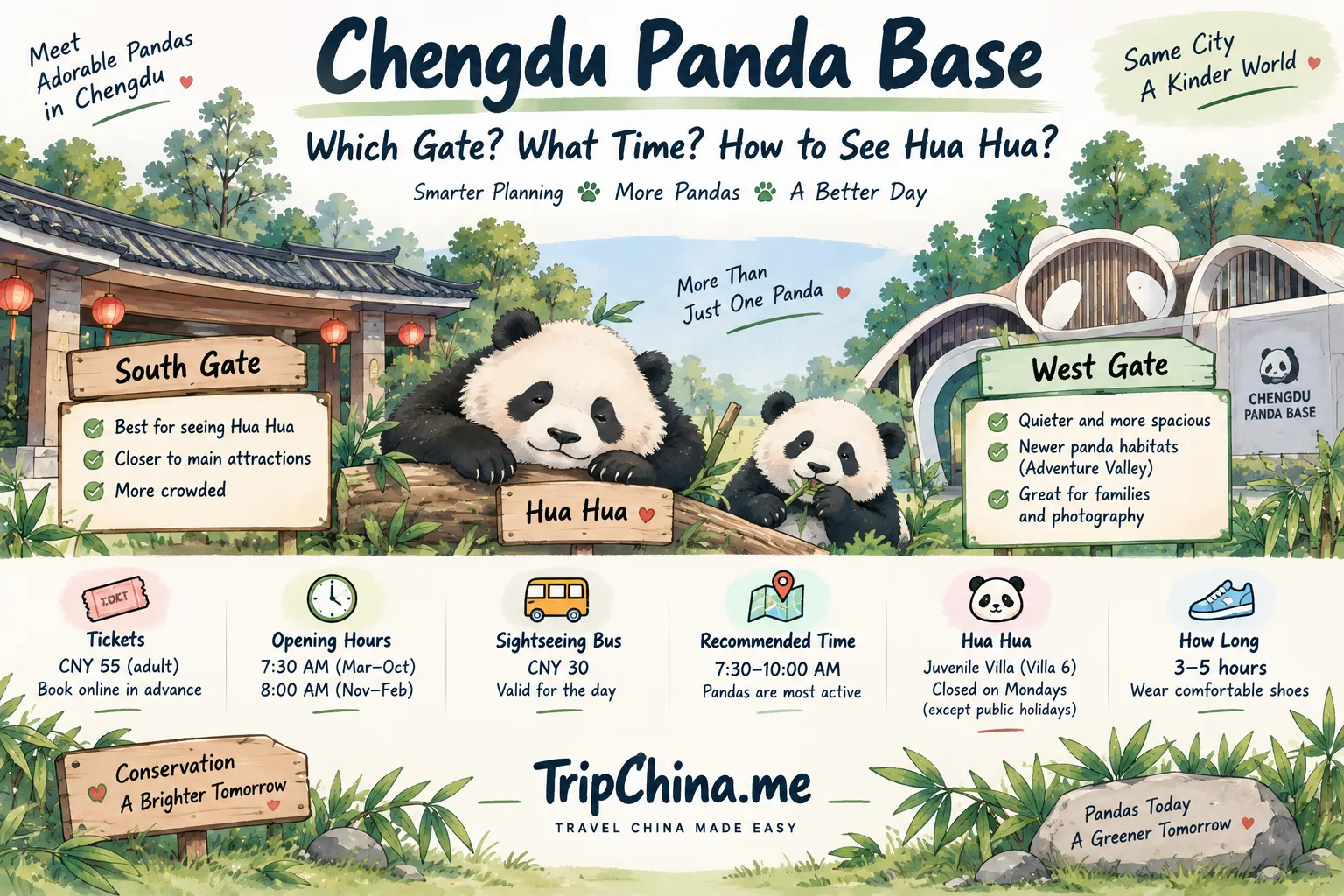
| Which gate? | Hua Hua is your priority → South Gate. A quieter, broader visit → West Gate. |
| Best time? | Go at opening. 7:30 AM Mar–Oct; 8:00 AM Nov–Feb. |
| How long? | About 3 hours for a focused route; 4–5 hours for a fuller visit. |
| Adult ticket? | ¥55 as of September 2026. |
| Sightseeing bus? | ¥30/person, valid for rides at designated stops on the day of use. |
| Hua Hua? | Juvenile Villa / Villa 6 (幼年大熊猫别墅 / 6号别墅). The area closes Mondays except national public holidays. |
| Booking? | Online real-name reservation required. Limited offline fallback available if tickets remain and online payment fails. |
| Passport? | Use the same identity document used for booking and bring the original whenever possible. |
As of September 2026, the official base states that tickets can be reserved up to 14 days ahead. mid-March through October entry windows are 7:30 AM–12:00 PM and 12:00 PM–5:00 PM; November–February shifts to 8:00 AM–12:00 PM and 12:00 PM–4:30 PM.
The expanded base covers 3,570 mu — about 2.38 km² (roughly 590 acres). That is why choosing your entrance and route matters much more than it did when the park was smaller.
For most visitors who want a relaxed half-day rather than a single famous panda, I prefer the West Gate. If seeing Hua Hua is non-negotiable, the South Gate is the more direct choice.
| Option | Best For | Main Trade-Off |
|---|---|---|
| South Gate | Hua Hua, older panda areas, shorter route | More crowded, especially early |
| West Gate | Quieter visit, newer habitats, families, photography | Farther from Hua Hua |
| Practical recommendation | West Gate for a broader visit | South Gate if Hua Hua is your priority |
The South Gate (南门) is the original entrance in the older part of the base. The Juvenile Villa, Sun Nursery, Moon Nursery and several adult panda villas are concentrated on this side.
The West Gate (西大门) serves the expanded area, including Adventure Valley (冒险溪谷), where seven newer panda pavilions are connected through a greener, more spacious landscape.
During major holidays, the base itself has specifically recommended the West Gate because the South Gate attracts heavier visitor traffic.
My experience: I used the South Gate on my first visit because it seemed like the obvious choice. The second time, I entered from the West Gate and found it much easier to spend time actually watching pandas rather than moving with the crowd.
The South Gate is the straightforward choice if Hua Hua is the reason you came.
From here, the Juvenile Villa and several of the older high-interest panda areas are relatively close. The disadvantage is that thousands of other visitors often have exactly the same plan.
From March through October, gates open at 7:30 AM. If Hua Hua matters, arriving around 7:00 AM gives you time to queue before opening. From November through February, opening moves to 8:00 AM, so shift that strategy about 30 minutes later.
Do not treat those times as a guarantee of seeing a particular panda outdoors. Animal welfare, weather and husbandry decisions always come first.
The West Gate opens into Adventure Valley, one of the newer parts of the base. Seven pavilions — Lan Yue Guan (揽月馆), Shan Yue Guan (山月馆), Yun Yue Guan (云月馆), Qiu Yue Guan (秋月馆), Wang Yue Guan (望月馆), Ming Yue Guan (明月馆) and Jiang Yue Guan (江月馆) — are concentrated here.
On my visit, the difference in atmosphere was immediate. I could stop and watch a panda eat bamboo without constantly being pushed forward by the next group.
The trade-off is geography. Hua Hua's Juvenile Villa is on the older side of the base, so starting west means eventually walking or using the sightseeing bus toward the south.
Some individual enclosures also begin outdoor viewing according to animal-management schedules rather than simply when the entrance gate opens. I would therefore not rely on a fixed “all West Gate pandas come out at 9:00 AM” rule; check the enclosure and staff guidance on the day.
If you're unfamiliar with Chinese ride-hailing before making an early-morning trip, set up DiDi for foreign travelers before leaving your hotel.
The simplest rule is: arrive just before opening, not at a fixed clock time year-round.
From March through October, aim for around 7:20 AM if you want to enter as soon as the 7:30 AM session begins. From November through February, shift that to around 7:50 AM for the 8:00 AM opening.
Morning is usually the safest bet because temperatures are lower and many pandas are feeding or moving around. On my first visit, I entered much later and saw far more sleeping pandas. On my next visit, arriving near opening changed the experience completely.
Window 1: Opening–10:00 AM
This is my first choice. Temperatures are usually cooler, crowds are still building, and your chances of seeing active animals are generally better.
Window 2: Around 2:00–4:30 PM
This can work as an alternative if you cannot visit early. Crowds often ease later in the day, and some pandas become active again after resting. Do not count on a fixed afternoon feeding time for every enclosure; animal routines vary.
The least attractive period is usually the late morning through early afternoon, when crowd pressure and warmer temperatures can overlap.
On very hot days, timing matters less than temperature. The base explicitly says pandas may be moved indoors when conditions reach its heat-management threshold, so an early ticket never guarantees outdoor viewing.
| Season | Typical Crowd Pattern | Panda Viewing | Strategy |
|---|---|---|---|
| Spring | Moderate to high | Often good in mild weather | Go at opening |
| Summer | High | Heat can reduce outdoor viewing | Go as early as possible |
| Autumn | Moderate | Often excellent in cooler weather | Strong overall choice |
| Winter | Lower | Cooler conditions can help activity | Remember the later 8:00 AM opening |
Chinese holidays are a separate category. For the 2026 National Day period, the base announced a daily cap of 85,000 visitors, split between morning and afternoon sessions, with temporary entry suspension if instantaneous attendance reaches 36,000.
Check China's holiday calendar before choosing your date; our China public-holiday guide explains when domestic travel demand spikes.
Hua Hua (和花), born in July 2020, is one of the base's biggest visitor draws. Her popularity means the viewing experience is managed very differently from a quiet panda enclosure elsewhere in the park.
The important practical detail is location: Juvenile Villa / Villa 6 (幼年大熊猫别墅 / 6号别墅) is in the older area closer to the South Gate.
The base currently operates a weekly animal-welfare rest system for the Villa 6 area. Villa 6 closes every Monday, except national public holidays. This is a closure of the visitor area, not “Hua Hua taking Monday off.”
On my second visit, I entered through the West Gate, spent the first part of the morning in Adventure Valley, then moved toward the older area.
That gave me two different experiences in one visit: quieter panda watching first, followed by Hua Hua later rather than making her queue the entire purpose of the morning.
This strategy is not guaranteed to produce a short queue every day. Weekends, school vacations, public holidays and viral interest in a particular panda can change crowd patterns dramatically.
If Hua Hua is your only priority, the more predictable strategy is still South Gate at opening and Juvenile Villa first.
If you want Hua Hua plus a broader panda experience, West Gate → newer habitats → bus toward the older area is the route I prefer.
Before making a trip specifically for Hua Hua, check the base's official notices because animal welfare, weather or maintenance can temporarily close viewing areas.
My preferred full route is:
West Gate → Adventure Valley → Sightseeing Bus → Juvenile Villa → Sun Nursery → Moon Nursery → Giant Panda Museum → South Gate
I used this general direction on my second visit because it avoids unnecessary backtracking and lets the day move naturally from the newer, quieter side toward the older high-demand exhibits.
Allow roughly 4–5 hours at a relaxed pace.
Start in Adventure Valley and work through the seven panda pavilions rather than immediately racing toward the old section.
The newer area is one of the best reasons to use the West Gate at all. Give yourself time to stop when a panda is active instead of treating every enclosure as a box to tick.
Once you have explored the west-side habitats, use the sightseeing bus to cut down the long cross-park walk.
As of September 2026, the official sightseeing-bus ticket costs ¥30 per person, not ¥10. Children aged six or under or under 1.3 meters ride free without occupying a seat, with one free child per accompanying adult. Tickets can be reserved up to 14 days ahead or purchased on the day.
The ticket is valid for the day and can be used at designated stops, but reaching the South or West Gate terminus means you must queue and validate again before another ride.
Buying the bus ticket together with your entrance ticket can save an extra transaction after you arrive.
This is the Hua Hua stop.
Crowd conditions vary too much to promise a reliable “15-minute queue at 9:15 AM.” Use the live situation on the ground: if the queue is already extreme and Hua Hua is not your main priority, continue your route and reassess rather than sacrificing an hour automatically.
Continue toward the Sun Nursery (太阳产房) and Moon Nursery (月亮产房).
These areas are popular because younger pandas may be housed here, but do not assume that newborn cubs will be on public display simply because you visit during a particular month. Birth timing, age, health and animal-care decisions determine where cubs are housed and whether they are visible.
The Giant Panda Museum is near the older section and is worth 30–45 minutes, particularly when the weather is hot or the pandas are sleeping.
It covers panda evolution, conservation, habitat and research through seven main exhibition areas and includes 3D and dome theaters. Entry is free for Panda Base ticket holders but requires a separate museum reservation; the official daily reservation quota is 5,000.(pls check official notices)
Important: the museum is open Tuesday–Sunday, 9:00 AM–5:00 PM, with last entry at 4:30 PM. It closes on Mondays except national public holidays.
Finishing at the South Gate puts you closer to the older commercial area and makes it easier to continue toward central Chengdu.
Even with the bus, expect substantial walking. Comfortable shoes matter more here than they do at many single-attraction sites.
South Gate → Juvenile Villa → Sun Nursery → Moon Nursery → South Gate
Use this when Hua Hua and the older panda areas matter more than exploring the expanded base.
West Gate → Adventure Valley → Panda Tower → Juvenile Villa → Sun Nursery → Moon Nursery → Giant Panda Museum → South Gate
This gives you the most visual variety: modern habitats, elevated landscapes, panda enclosures and the older section.
The Panda Tower currently operates daily from 9:00 AM to 5:00 PM, with last entry at 4:30 PM. The former Tuesday closure was officially abolished on April 1, 2026. The tower or its elevator can still close temporarily because of weather or equipment conditions.
South Gate → Giant Panda Museum → Sun Nursery → Moon Nursery → Juvenile Villa → South Gate
This keeps the route more compact and includes an indoor museum break.
Families should note that the South Gate visitor center currently provides free stroller and wheelchair loans, subject to on-site availability. If you plan to enter through the West Gate, ask staff there on arrival whether the same service is available. Official service listings confirm the South Gate center’s free loan service; West Gate availability should be confirmed on the day.
The base operates first as a conservation, breeding, research and education institution. Pandas follow their own rhythms; a ticket does not guarantee outdoor activity.
Three stops are particularly easy to overlook.
Yes, especially if you want context rather than only photographs.
The museum explains panda evolution, habitat, conservation and research. Its interactive design makes it useful for families, and the air-conditioned galleries are a practical midday break.
Remember the separate reservation and Monday closure.
Yes. Red pandas (小熊猫) are a separate species, with reddish fur and long ringed tails.
The base asks visitors to keep at least three meters away from free-ranging animals and walk-through red-panda areas and never feed them.
They are worth adding when your route naturally passes their enclosure, but I would not sacrifice an active giant panda just to follow a rigid checklist.
No. This is one of the most important 2026 corrections to older Chengdu Panda Base guides.
The base cancelled the Tuesday closure on April 1, 2026. Panda Tower now normally opens daily from 9:00 AM to 5:00 PM, with last admission at 4:30 PM. Weather or equipment conditions can still cause temporary closure.
The expanded base now covers 3,570 mu, roughly 2.38 km² or 590 acres. The old “1.5 km²” figure does not describe the entire expanded site.
At ¥30, the bus is not cheap relative to the ¥55 entrance ticket, but it can save a significant amount of walking when moving between the west and south sections.
Nurseries, popular enclosures and transport stops can also become congested.
If one queue looks unreasonable, remember that the base contains many pandas. Sometimes the better decision is simply to keep moving.
I almost skipped it. I am glad I didn't.
It adds context to what you are seeing outside and gives you somewhere useful to spend time when the pandas are sleeping or Chengdu is hot.
Food is available inside, but I would not build my day around it.
The base provides free drinking-water facilities around the park, including some locations with hot water.
The newer west side is excellent for panda viewing, but the older South Gate side remains more convenient if you want to continue directly into a central-Chengdu afternoon.
The current pattern is easy to confuse:
| Facility | Current Rule |
|---|---|
| Juvenile Villa / Villa 6 | Closed Mondays except national public holidays |
| Giant Panda Museum | Closed Mondays except national public holidays |
| Panda Tower | No regular Tuesday closure anymore; normally open daily |
| Animal exhibits | Can close temporarily for welfare, weather or maintenance |
As of September 2026, the standard system is online real-name reservation. Tickets can be booked up to 14 days ahead, and sold-out dates cannot be rescued by simply arriving at the gate.
Foreign visitors can use passport information when booking. For a step-by-step walkthrough, see Chengdu Panda Base Ticket Booking Guide for Foreign Visitors.
The base uses the same type of real-name booking system found at many major Chinese attractions. Our Chengdu attraction ticket guide for foreign visitors explains how passport-based reservations work elsewhere in the city.
Do not plan on walk-up availability.
The current official rule requires online real-name reservations for ordinary visitors. However, the base explicitly provides an exception: if you genuinely cannot pay online and tickets are still available, you may use the offline service window.
For foreign visitors without a Chinese mobile number, an official 2026 holiday notice specifically identified Trip.com or the on-site Cash and Cards service window when tickets remain as alternatives.
That makes the practical rule simple: book before you go; treat the window as a fallback, not a ticket strategy.
Option 1: Official WeChat
Search for “成都大熊猫繁育研究基地” in WeChat. Choose your date and morning or afternoon entry period, enter the required identity information and complete payment.
Option 2: Official Authorized Platforms
The base currently lists platforms including Trip.com/Ctrip, Meituan, Tongcheng and other authorized Chinese channels. Foreign visitors who prefer an English-language interface may find Trip.com easier.
Do not buy from an unknown reseller simply because the official session appears sold out.
Bring it whenever possible.
The safest routine is to carry the same original passport used for your reservation. However, the base's September 2026 National Day notice says visitors without the original identity document may present a relevant ID image at the “no original ID” verification channel for manual checking.
That means older advice saying a passport photo can never work is now too absolute. I would still never deliberately leave your passport behind when visiting a real-name ticketed attraction.
For other first-trip identity, payment and digital issues, first-time China travel tips covers the basics worth setting up before arrival.
| Category | Price as of September 2026 |
|---|---|
| Adult | ¥55 |
| Eligible student | ¥27 |
| Age 60+ | Free |
| Age 6 or under / under 1.3 m | Free |
| Sightseeing bus | ¥30 |
The official ticket page should be checked again shortly before travel because eligibility rules matter as much as the headline price.
If mobile payment is unfamiliar, set it up before your panda morning rather than at the entrance. Our China payment guide for foreign visitors covers Alipay, WeChat Pay, foreign cards and cash backups.
Mistake 1: Assuming South Gate is automatically best. It is best for some routes, particularly Hua Hua-first visits, but the West Gate can be much calmer when you want to explore the larger base.
Mistake 2: Using one arrival time all year. The base opens at 7:30 AM from March through October but at 8:00 AM from November through February.
Mistake 3: Skipping the sightseeing bus on a full cross-park route. I once underestimated the walking and felt it by the end of the visit. At the expanded base, ¥30 can be worthwhile simply because it preserves time and energy for watching pandas.
Mistake 4: Trying to see everything. The expanded site covers 3,570 mu. Pick several priority areas and spend time there instead of spending the entire morning walking between pins on a map.
Mistake 5: Treating animal activity like a show schedule. Early morning improves your odds, but heat, weather, husbandry and individual panda behavior always win.
Mistake 6: Confusing the weekly closures. Villa 6 and the Giant Panda Museum have Monday restrictions; Panda Tower's old Tuesday closure was abolished in April 2026.
Mistake 7: Arriving without working mobile data, maps or payment. If your China connectivity is not set up yet, read the China eSIM vs SIM guide before the morning of your visit.
Many of these problems are not unique to the panda base. Our Chengdu Travel Pitfall Guide covers other mistakes that cost first-time visitors time or money.
A 4–5 hour morning visit still leaves enough time for another part of Chengdu.
Head back toward central Chengdu for shopping, food and the IFS panda sculpture.
If you are deciding where to base yourself for an early panda morning, where to stay in Chengdu explains which neighborhoods reduce transport time.
For a history-focused afternoon, continue to Wuhou Shrine and Jinli Ancient Street.
Allow roughly 2–3 hours rather than trying to squeeze both into the final hour of the day.
Chengdu Zoo can make sense if you still want animal viewing but do not want another enormous attraction.
I would treat it as a separate experience rather than a “second panda base,” particularly after already spending several hours at the research base.
For first-time visitors navigating the city independently, the Chengdu Metro Guide covers tickets, payment and the city's public-transport basics.
Yes — and this is better than some older guides suggest.
The base currently provides free self-service luggage lockers at both the South and West Gate visitor centers. If your bag is too large for a locker or the lockers are full, staff can provide manual storage assistance.
That means arriving directly from a hotel or station with luggage is possible, although traveling light will still make the visit easier.
Yes. The South Gate visitor center lists free stroller, wheelchair, umbrella and walking-aid loans among its current services. Availability can vary on busy days, and if you enter through the West Gate you should confirm the same service at that visitor center on arrival. The official opening-hours page specifically names the South Gate visitor center for these free loans.
The park is navigable for international visitors, but detailed interpretation is not equally extensive everywhere.
The official self-guided audio devices support Chinese, English and other languages, include a park map and recommended routes, and cost ¥30 per day for the full park or ¥20 for the museum as of September 2026.
Do not assume a morning reservation remains valid indefinitely.
The official system divides admission into a morning session and an afternoon session. From March–October those are 7:30 AM–12:00 PM and 12:00–5:00 PM; from November–February they are 8:00 AM–12:00 PM and 12:00–4:30 PM. Plan to enter during the session you booked.
If disruption makes you late, ask the official service desk rather than relying on reports from another traveler's visit.
Get a glimpse of the adorable giant pandas, visitor atmosphere, and unforgettable moments that make Chengdu Panda Base one of China's most popular attractions.
This article is part of the Chengdu Travel Guide Hub.
Allow about 3 hours for a focused route and 4–5 hours for a fuller West-to-South visit with several panda areas and the museum. The sightseeing bus makes the longer route much more manageable.
Selfie sticks are banned across the entire Chengdu Panda Base, including all panda viewing enclosures. They pose risks of startling pandas, damaging exhibit barriers and causing crowd accidents. You must pack them away or leave them at the gate. Tripods and large professional camera gear need advance approval.
Bring a small personal snack and water rather than relying entirely on park food, but never feed or throw food toward any animal. The official visitor rules explicitly prohibit feeding animals, and free drinking-water stations are available throughout the base.
No. A standard visit to the Chengdu Research Base does not include holding or petting giant pandas. Ignore third-party marketing that implies your normal Chengdu Panda Base ticket includes direct panda contact.
No. Births are seasonal, and very young cubs are not guaranteed to be on public display even during the breeding season. Their location and visibility depend on age, health and animal-care decisions, so do not plan a trip around a promise of seeing a pink newborn.
Yes. Wide paths, the Giant Panda Museum, free stroller loans and the sightseeing bus make the base manageable for families. For a less compressed experience, consider starting at the West Gate rather than joining the first rush toward the South Gate.
Normal handheld photography is fine, but do not use flash around the animals or obstruct crowded viewing areas. Drones are explicitly prohibited inside the base.
Yes — but the experience changes dramatically depending on when you arrive and which gate you choose.
If Hua Hua is the main reason for your visit, start from the South Gate at opening and make Villa 6 your first priority. If you want a more relaxed morning with more room to watch pandas, start at the West Gate, explore Adventure Valley and work your way toward the older section.
Most importantly, do not judge the visit by how many pandas you can photograph. The base is a conservation and research institution, and the animals are not following a tourist schedule.
On my better visit, the memorable part was not checking every enclosure off a map. It was having enough time to stand still and watch one panda eat bamboo without needing to move on.
Chengdu Research Base of Giant Panda Breeding — Ticket Information
Chengdu Research Base of Giant Panda Breeding — Opening Hours
Chengdu Research Base of Giant Panda Breeding — Sightseeing Bus Service
Chengdu Research Base of Giant Panda Breeding — Visitor Rules & Services
Updated September 2026. Ticket prices, seasonal entry hours, sightseeing-bus rules, weekly facility closures, luggage storage and visitor services were checked against the Chengdu Research Base of Giant Panda Breeding's current official pages and 2026 notices. First-hand route observations are retained where they help with real-world planning, while queue times and animal activity are treated as variable rather than guaranteed. Always check the official WeChat account or website shortly before visiting.
TripChina.me creates practical China travel guides shaped by real local experience, helping independent travelers navigate transport, payments, food, neighborhoods, and the cultural details that make traveling in China easier and more meaningful. Find the guide for your destination at tripchina.me.