Our Location:
No. 99, Jiazi Road, Chengdu

 authorChris Lee
Harbin's food is not one cuisine.Harbin's food is not one cuisine. It is three overlapping food cultures: Chinese Dongbei hearty cooking, Russian-influenced Western-style dishes, and the everyday street-food life of a northern Chinese city. Each suits a different traveler, time of day, and group size.
A first-time visitor with only one evening should eat differently from a food-focused traveler with three days. Solo travelers should not plan dinner the same way as a group of four, and the best winter meal is not necessarily the best choice on a warm August night.
This guide helps you choose between Daowai, Central Street, morning markets, Russian restaurants, iron pot stew, barbecue and everyday budget food, while avoiding some of the places and assumptions that waste travelers' time.
For most food-focused first-time visitors, Daowai is the strongest overall choice because its old streets combine historic restaurants, smoked meats, buns, braised pork, barbecue and Harbin's distinctive working-class food culture in a compact walkable area.
Choose differently if your priorities change:
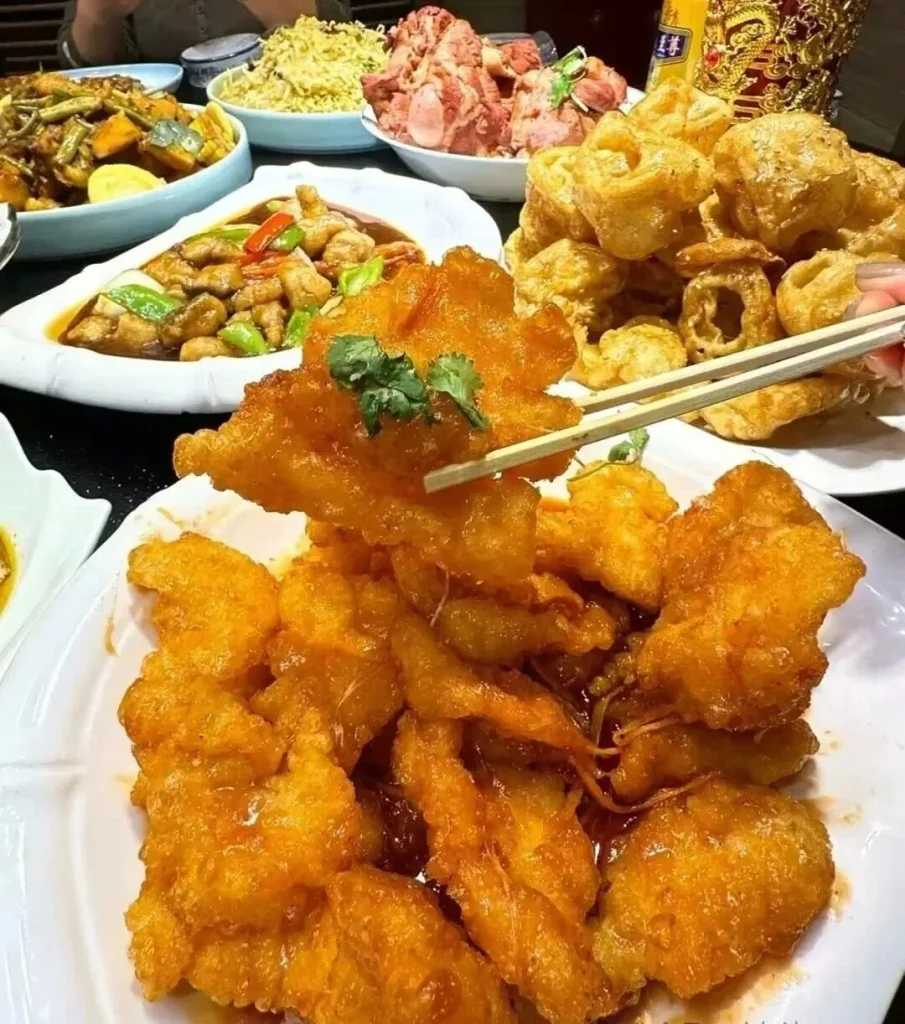
If you only try one iconic Harbin dish, start with Guo Bao Rou (锅包肉). Black龙江 cultural-tourism sources credit Lao Chu Jia founder Zheng Xingwen with creating the sweet-and-sour version while working at Harbin's former Daotai government kitchen. If you are wondering which is the best area to eat in Harbin for authentic local flavour, Daowai should top your list.
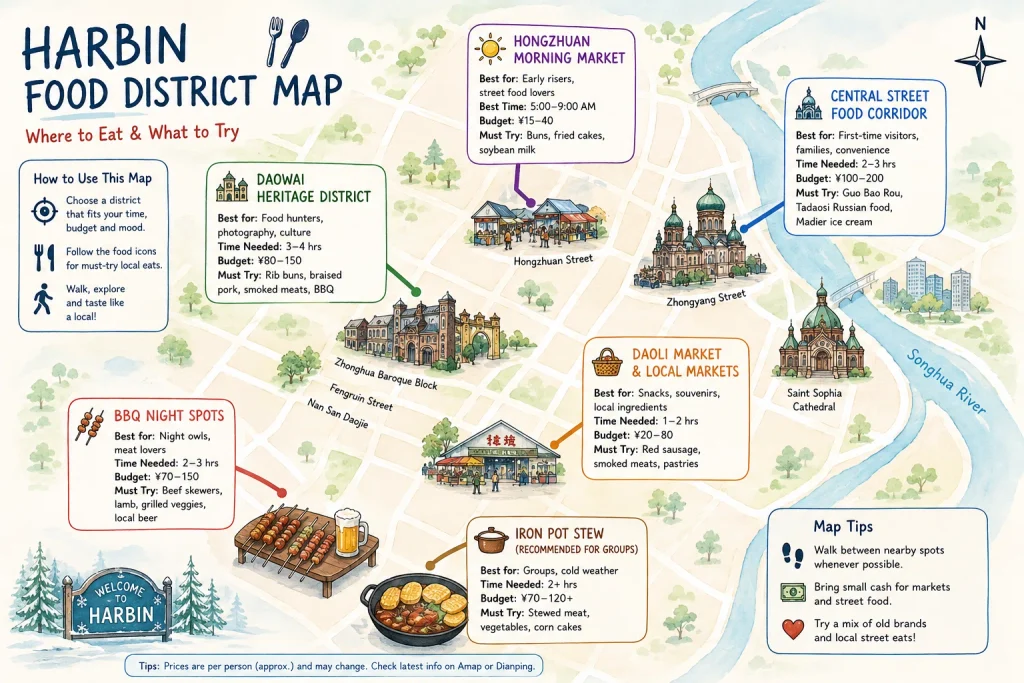
| Food Experience | Best For | Time Needed | Typical Budget | Group Size | Main Food | Main Trade-Off |
|---|---|---|---|---|---|---|
| Daowai Heritage Food Walk | Food lovers, photographers, culture travelers | 3–4 hrs | ¥80–150 | Any | Buns, braised pork, smoked meats | More navigation, limited English |
| Central Street Food Walk | First-time visitors, families, convenience | 2–3 hrs | ¥100–200 | Any | Guo Bao Rou, Russian-style food, ice cream | More tourist-oriented |
| Hongzhuan Morning Market | Early risers, street-food lovers | 1–2 hrs | ¥15–40 | Solo / small groups | Buns, fried cakes, soybean milk | Very early start |
| Iron Pot Stew | Groups, winter trips | 2+ hrs | ¥70–120+ | Best with 3+ | Stewed meat + corn cakes | Heavy meal, longer dining time |
| Harbin BBQ Night | Night owls, meat lovers | 2–3 hrs | ¥70–150 | Any | Beef/lamb skewers | Quality varies by restaurant |
| Everyday Budget Food | Solo travelers, backpackers | 30–60 min | ¥15–50 | Solo-friendly | Malatang, quick meals | Basic environment |
If you have one evening, use Central Street. If you have one full food day, use Daowai. The rest depends on your group size and how much cold you are willing to tolerate.
If you want a short must-eat list rather than a restaurant checklist, prioritize these foods:
| Dish / Food | What It Is | Why Try It in Harbin | Best Context |
|---|---|---|---|
| Guo Bao Rou 锅包肉 | Crispy pork with sweet-sour glaze | Harbin-origin story | Northeast restaurant |
| Iron Pot Stew 铁锅炖 | Meat and vegetables cooked communally | Classic Dongbei group meal | Dinner with friends |
| Smoked & Sauced Meats 熏酱 | Pork, chicken, sausage | Old Daowai specialty | Daowai |
| BBQ 烧烤 | Small grilled skewers | Major late-night eating culture | Evening |
| Dongbei dumplings / buns | Wheat-based comfort food | Northern staple | Breakfast / old shops |
Daowai is where Harbin's older food culture is easiest to understand on foot.
Around Zhonghua Baroque Historic Block, Nan Er Daojie, Nan San Daojie and the surrounding streets, old restaurants sit close enough together to turn eating into a neighborhood walk instead of a series of taxi rides.
Heilongjiang cultural-tourism material even quotes the local expression “吃在老道外” — “eat in old Daowai”, and identifies Nan Er Daojie as one of the historic district's key food streets.
One of the classic old Daowai food names.
Historical materials trace the shop to the late Qing period, when founder Zhang Ren arrived from Tianjin and established a bun shop in old Daowai.
Try: rib-meat buns / 排骨包
Best for: starting the walk with something filling but shareable.
📍 Open in Amap — Zhangbao Pu (张包铺)A classic Harbin-style braised pork stop.
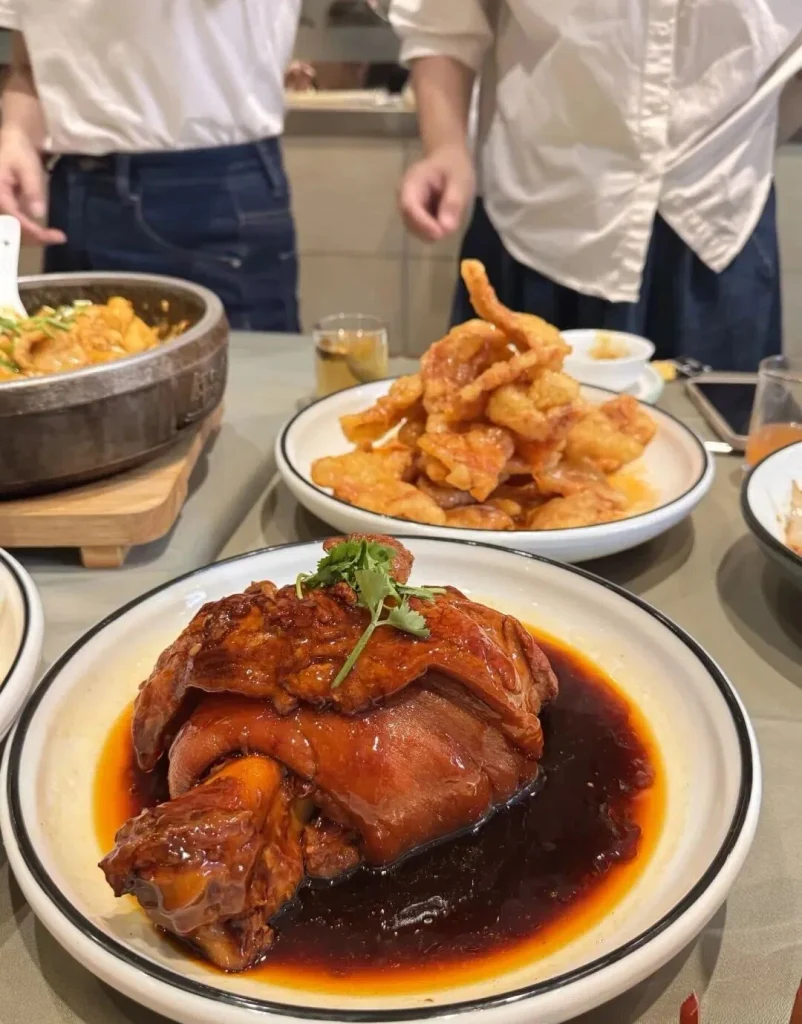
Try: braised pork with rice and pickled vegetables.
This is richer and heavier than the bun stop, so share if you're planning several restaurants.
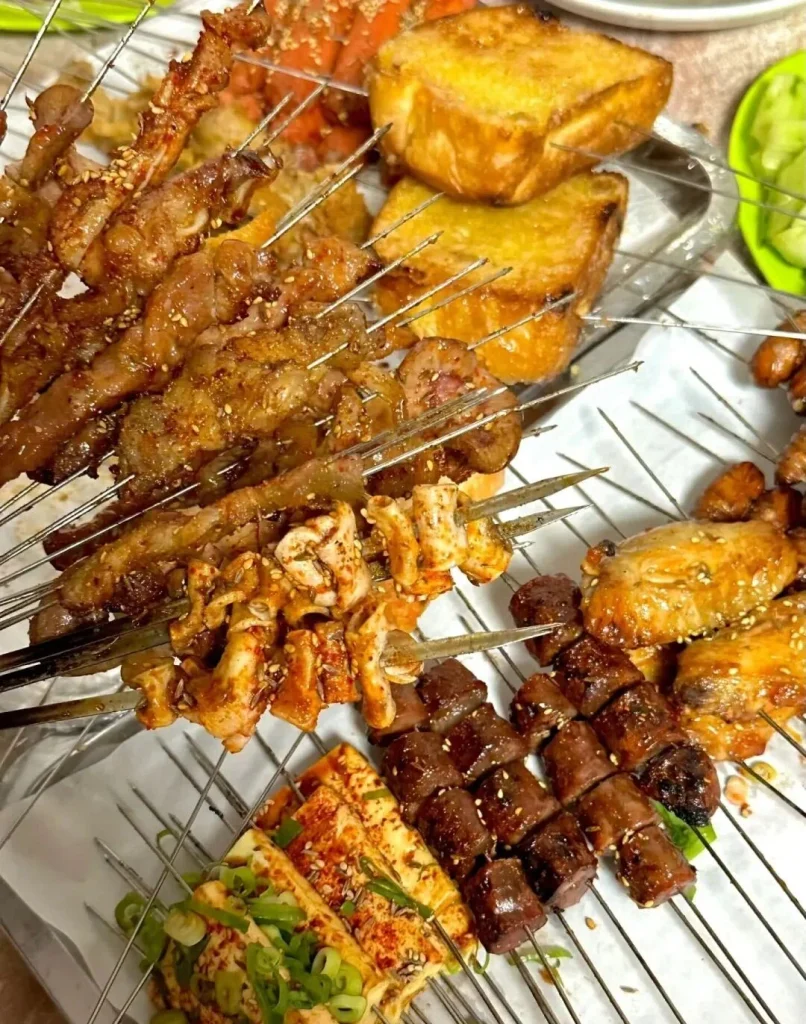
📍 Open in Amap — Zhang Fei Braised Pork (张飞扒肉)Traditional charcoal-grilled skewers fit naturally into the neighborhood's food culture.
Instead of committing to one permanently “best” barbecue restaurant, choose a busy established store with high turnover and recent local reviews.
Try: beef tendon, beef skewers, lamb.
Smoked and sauced meats are one of the easiest ways to understand Harbin's Russian and Northeast influences without eating a formal Russian meal.
Look for:
Buy smaller portions to share rather than ordering a full restaurant meal.
Finish with something portable rather than another heavy main course.
This is also a good point to buy food to take back to your hotel.
Choose it if: you care about local food history, photography, neighborhood culture and independently finding small places.
Tip: Save Chinese dish‑names as screenshots on your phone to show restaurant staff, since very few local eateries in Daowai provide English‑language menus.
Skip or shorten it if: mobility is limited, the weather is extreme, or you want guaranteed English menus.
If you have one full day devoted to food, build the day around Daowai rather than around Central Street.
Central Street is the easiest food area for a first-time visitor, especially if you want to combine sightseeing with Russian-influenced dining and classic Harbin tourist foods. It is convenient, but I would not send a serious food traveler there for every meal.
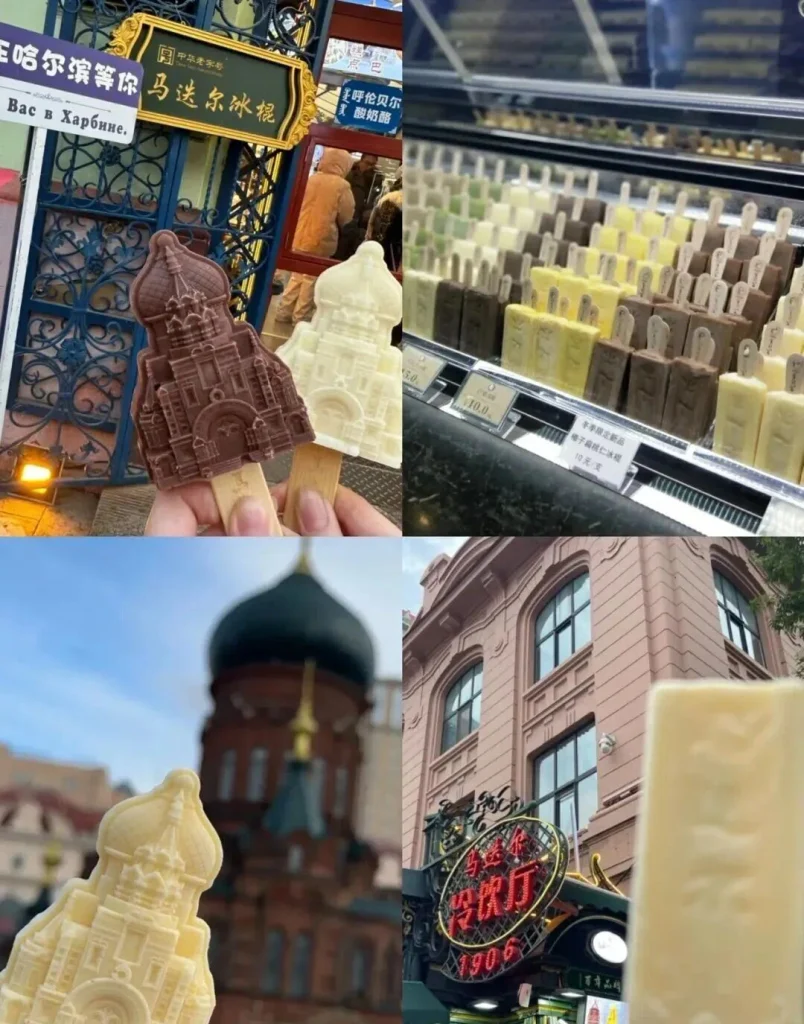
Madier is one of Harbin's best-known century-old food brands. The company's roots and hotel date to the early 20th century, and the brand still forms part of Central Street's identity.
Try one if you're already walking the street.
TripChina rule: if the queue is short, do it. If you are spending half an hour waiting for a simple ice cream, come back later.
📍 Open in Amap — Modern Hotel Cold Drinks Hall (马迭尔冷饮厅)One of the strongest history-focused restaurant choices in Harbin.
Xinhua/Heilongjiang reporting traces Tadaosi to 1901, when Armenian founder Tadaos established an early Western restaurant in Harbin. The current Central Street restaurant preserves historic materials and is recognized as a protected old brand / cultural heritage restaurant.
Try: borscht, beef dishes and Russian-Harbin classics.
Best for: travelers who care about the history as much as the food.
📍 Open in Amap — Tadaosi Western Restaurant (塔道斯西餐厅)This is the landmark restaurant where you can try Harbin‑style sweet‑sour Guo Bao Rou, whose origin we covered earlier.
Try: Guo Bao Rou.
Add one vegetable dish or Dongbei classic rather than ordering an entire table of meat.
📍 Open in Amap — Lao Chu Jia (老厨家)A convenient casual option when you want something easier and less ceremonial than another heritage restaurant.
Best for: families, solo travelers and a lighter lunch.
📍 Open in Amap — Lao Chang Spring Pancake (老昌春饼)| Central Street | Daowai | |
|---|---|---|
| Ease for foreigners | Better | Harder |
| Historic atmosphere | Excellent | Excellent |
| Local everyday feel | Medium | Stronger |
| Restaurant concentration | High | High |
| Russian food | Strongest | Limited |
| Old Harbin street food | Medium | Strongest |
| Best for first evening | ★★★★★ | ★★★ |
| Best for serious food travelers | ★★★★ | ★★★★★ |
Best answer: don't choose one exclusively.
Use Central Street for your arrival day and Daowai for your first full food-focused day. Central Street works better on your first evening because it is easier to find, has more English-friendly menus, and you are already there for sightseeing. Daowai is more rewarding when you have time to wander.
Yes — especially if you want to see how Harbin actually eats before the tourist day begins.
Hongzhuan Street Morning Market is now one of Harbin's best-known visitor markets, but it still functions as a morning-food environment rather than a conventional attraction.
Government and provincial reporting describes the market opening from around 5 AM, but you do not need to arrive at 5:00 sharp. The best window for most visitors is roughly 5:30–7:00 AM, when the atmosphere is lively but vendors are still active.
📍 Open in Amap — Hongzhuan Street Morning Market (红专街早市)Try a few small items instead of one giant breakfast:
Provincial reporting from 2026 describes buns, lamb soup, youtiao, pancakes, sausage, egg burgers and sticky-bean buns among the foods currently found there.
Best window: roughly 5:30–7:00 AM.
You do not need to arrive at 5:00 sharp unless you actively enjoy pre-dawn markets.
By 8:00 it can already be busy, and by around 9:00 vendors begin wrapping up.
During peak winter tourism periods, additional visitor facilities may be available, including warming areas, hot water and phone charging.
Combine:
Hongzhuan Morning Market → Saint Sophia Cathedral → Daoli Market
That creates a far better morning than eating breakfast in your hotel.
Yes — if you are traveling with other people.
Iron pot stew is less about a single recipe and more about the Dongbei communal meal:
one hot pot in the middle, everyone sharing, heavy food, slow eating, cold weather outside.
Meat, vegetables and sauce cook together, while corn cakes or dough may be attached around the side of the pot.
Best for:
Less suitable for:
Zaozuo Xiaoguo Hu Bing 灶座小锅烀饼
It has multiple locations and has appeared on major domestic consumer “must eat” lists. Other established iron-pot brands can work too.
Rather than insisting one chain is “the best,” choose based on:
Plan around 1.5–2+ hours.
The meal itself takes time, and some pots require cooking after you sit down.
Do this as your main dinner, not as stop No. 6 of a food crawl.
Harbin BBQ is a better late-night experience than a checklist attraction.
The core idea is:
small skewers + high turnover + beer + a busy room.
You don't necessarily need the most famous chain.
Start with:
Look for:
Avoid judging by interior design.
These remain useful candidates, but because restaurant branches, performance schedules and menu details change, search the Chinese name in Amap shortly before visiting instead of relying on a permanent address embedded in the article.
If you want a lively street‑food night scene with dozens of different vendors, visit Shida Night Market. Expect grilled skewers, fried snacks and a young, energetic local atmosphere. Bear in mind that most stalls close around 22:00‑23:00, and cash is recommended for small‑vendor payments.
Do not arrive expecting modern Moscow cuisine copied exactly.
Harbin's Russian food has evolved locally for more than a century.
The result is Harbin Russian-style / Sino-Russian cuisine:
Russian recipes, European techniques, Chinese ingredients, local preferences and decades of adaptation.
That hybridization is the interesting part.
| Restaurant | Best For | Why Choose It |
|---|---|---|
| Tadaosi | History | One of Harbin's oldest Western restaurant traditions |
| Portman | Lively dinner | More entertainment-oriented atmosphere |
| Lucia | Couples | Romantic / decorative setting |
| Kuziming | Budget | Simpler Russian-style meal |
| Lao Eqiao Private Kitchen | Personal/local story | Family-style Sino-Russian atmosphere |
Tadaosi for history.
For pure culinary quality, I would not claim any one restaurant is objectively “the most authentic” without fresh comparative testing.
That's an important distinction:
historically significant ≠ automatically best food today.
Absolutely.
In fact, budget eating often shows a more everyday version of Harbin than formal restaurants.
Morning Market Breakfast:Approximate budget ¥10–30
Easy for solo travelers.
Malatang:Choose your own ingredients, pay according to the shop's pricing model, then have everything cooked together.
Typical budget ¥20–50
Great when you want vegetables after several meat-heavy Dongbei meals.
Local Quick-Service / Cafeteria Meals:Simple self-service and cafeteria-style meals can be among Harbin's cheapest everyday food options, especially around offices and residential neighborhoods.
Daoli Market / Traditional Food Markets Good for:
Recent 2026 provincial reporting specifically highlights Daoli Market and old-style food markets as important Harbin food destinations used by both residents and visitors.
Many small‑market stalls, morning‑market vendors and family‑run local restaurants do not accept international credit cards. Mobile‑payment apps such as Alipay and WeChat Pay require a Chinese bank account. Carry a moderate amount of RMB cash when visiting Daowai, Hongzhuan Morning Market or residential‑area budget eateries to avoid payment problems.
| Style | Daily Budget | What It Can Cover |
|---|---|---|
| Budget | ¥60–100 | Morning market + local quick meal + malatang/snacks |
| Comfortable | ¥150–250 | Local restaurants + Daowai food + one better dinner |
| Food-focused | ¥250–400+ | Russian restaurant, BBQ, iron pot stew, drinks |
These are planning ranges, not fixed prices.
Harbin restaurant prices vary considerably by:
Instead of buying generic tourist candy boxes, look at foods tied more clearly to Harbin:
One of the safest classic gifts.
Look for established brands and vacuum-packed versions.
Large loaves can be inconvenient to carry, so consider smaller or packaged versions.
Choose vacuum-sealed products when traveling.
Best consumed locally unless you have checked airline liquid restrictions.
Daoli Market, old food stores and long-established Harbin brands are good places to compare.
| Mistake | Better Approach |
|---|---|
| Eating every meal on Central Street | Use Central Street once, then explore Daowai |
| Expecting every historic Russian restaurant to have the best food | Separate historical value from current dining quality |
| Visiting Hongzhuan Morning Market late | Aim for roughly 5:30–7:00 AM |
| Ordering iron pot stew solo | Choose it with a group |
| Scheduling heavy Dongbei meals back-to-back | Alternate rich meals with markets / lighter food |
| Picking an empty BBQ restaurant because it looks clean | Choose busy, high-turnover places |
| Trusting old restaurant addresses forever | Search the Chinese name in Amap before leaving |
| Treating Russian food as “inauthentic” because it changed | The local hybrid is the Harbin tradition |
| Ordering only meat | Add cold dishes, vegetables and noodles |
| Buying food souvenirs at the first tourist shop | Compare markets and established brands |
Finding satisfying Harbin vegetarian food can be more challenging than in Shanghai or Chengdu because many well‑known local specialties focus heavily on meat, sausage, barbecue and stew.
However, malatang, vegetable dumplings, cold dishes, potatoes, mushrooms, cabbage and vegetable stir-fries can make vegetarian travel manageable.
Be explicit that you do not eat meat or meat broth.
Generally, no.
Classic Harbin and broader Dongbei food is usually less chili-focused than Sichuan or Chongqing cuisine.
You'll encounter:
more often than intense chili heat.
Use Amap and search:
清真 / Qingzhen
and confirm the restaurant's current status before ordering.
Areas around established mosques and Muslim neighborhoods are a useful starting point, but this guide should not promise a specific shop's certification unless you have verified it.
This guide was researched for independent international travelers using Harbin and Heilongjiang tourism sources, local food and market information, and current reporting on restaurants, old brands and food districts.
Historical claims in this guide are drawn from official provincial and cultural-tourism sources where available. Restaurant branches, prices, opening hours and menus can change, so check the Chinese name in Amap before making a special trip.
The strongest current sources for this guide include:
TripChina.me creates practical China travel guides shaped by real local experience, helping independent travelers navigate transport, payments, food, neighborhoods, and the cultural details that make traveling in China easier and more meaningful. Find the guide for your destination at tripchina.me.