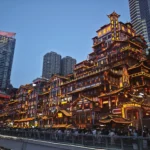
Our Location:
No. 99, Jiazi Road, Chengdu

 authorChris Lee
At first glance, Dongjiao Memory looks like one of Chengdu's most photogenic creative districts. Red-brick workshops rise behind cafés and fashion stores, old industrial pipes cross overhead, and young visitors pose beneath chimneys that once belonged to a working factory complex.
But the industrial backdrop isn't decoration. Much of what survives here belonged to the former Hongguang Electron Tube Factory, commonly known as Factory 773. For decades, this was not simply a place where people came to work. For generations of employees and their families, the factory helped shape where they lived, whom they knew, and how everyday life was organized.
For today's visitor, Dongjiao Memory is somewhere to explore. For some older Chengdu residents, it is somewhere to remember.
That difference changes the way you see the place.
Long before eastern Chengdu filled with apartment towers, shopping centers and metro lines, this part of the city was being transformed into one of southwest China's major industrial zones.
Beginning in the 1950s, factories producing electronics, machinery and other industrial goods were established across Chengdu's eastern suburbs. Among them was the state-owned Hongguang Electron Tube Factory, established in 1958 and associated with China's First Five-Year Plan and the Soviet-assisted industrial construction program commonly known as the 156 Projects.
The factory was also known as Factory 773, while Chengdu Mailbox 106 was used for external correspondence. To an overseas traveler, a name such as “Factory 773” can sound almost cinematic. But numbered factory identities and mailbox addresses belonged to a much broader system surrounding strategically important state industrial enterprises during that era.
The interesting part is not that the number sounds mysterious. It is that generations of workers could know a place by a number almost as naturally as they knew it by a name.
Hongguang eventually became an important part of China's early electronics and display industry. Historical accounts credit the factory with developing and producing several types of electronic tubes and some of China's early domestically manufactured television picture tubes.
The brick workshops, pipe corridors, water towers and chimneys visitors photograph today therefore did not originate as industrial-style decoration. They belonged to a functioning manufacturing complex.
And the factory's history was never only about what it produced.
It was also about the people whose lives grew around it.
One of the easiest things for a foreign visitor to misunderstand about factories such as Hongguang is the word factory itself.
A large Chinese state-owned factory during the planned-economy era could shape far more than a person's working hours. To understand why, it helps to understand the Chinese idea of the danwei (单位), usually translated as a “work unit.”
A large work unit could connect employment with housing and other parts of everyday community life. Workers and their families often lived within social networks closely tied to the enterprise, while residential areas and supporting facilities developed around major industrial compounds.
That meant the distinction between “workplace” and “neighborhood” could be much less clear than many visitors from Europe or North America might expect. Friendships, marriages, children's lives and everyday routines could all grow around the same industrial community.
For many families, the factory was therefore not somewhere life stopped when a shift ended.
It was part of the geography of life itself.
That is the human layer that is easiest to miss at Dongjiao Memory today. A rusted pipe may now provide an interesting background for a photograph. To someone who spent decades around Hongguang, the same industrial landscape may belong to memories of workshops, colleagues, family life and familiar routes repeated for years.
Two visitors can stand beside exactly the same wall and be looking at completely different places.
Some of those memories survive in published interviews with former employees.
One documented former worker, Yang Chunyan, joined the Hongguang community as a teenager and later worked in the factory's publicity department. Published accounts describe memories of machinery operating through the day, construction activity during the factory's development, and a working environment that occupied a large part of everyday life.
Decades later, that connection did not simply disappear when the factory changed. Accounts describe Yang continuing to live in former Hongguang residential housing near today's Dongjiao Memory and returning to the old factory grounds.
That small detail says something statistics cannot.
A younger visitor may stop beside a red-brick workshop because the afternoon light makes a good photograph. A former worker can stand near the same structure and recognize the physical setting of decades of working life.
Neither way of seeing the place is wrong.
They belong to different generations.
And they now occupy the same ground.
Hongguang's significance was not simply that it was a large industrial enterprise.
It became an important part of China's early electronics industry. Historical accounts describe engineers and technicians working with electronic beam tubes, oscilloscope tubes and television picture tubes at a time when China was still developing much of this technology domestically.
Accounts from former workers describe an environment in which production, installation and technical learning often happened together. Equipment had to be brought into operation, technical material understood, and manufacturing problems solved while the enterprise itself was still developing.
Later, Hongguang became closely associated with the development and production of television display components. Its products formed part of a much larger transformation in which televisions gradually entered ordinary Chinese households.
For a traveler, the technical specifications matter less than what they explain.
This was not simply a large brick factory that later happened to look attractive after industrial production ended. It belonged to the technological infrastructure of a rapidly industrializing country.
The screens that eventually became ordinary objects inside Chinese homes came from a larger world of engineers, workshops and workers like those who once occupied this site.
Factories such as Hongguang were originally built toward Chengdu's industrial outskirts.
The city did not stop growing around them.
By the end of the 20th century and the beginning of the 21st, eastern Chengdu was undergoing rapid urban expansion. Industrial technology was changing, land use was changing, and older factory districts increasingly sat inside a city that had grown far beyond the boundaries they were built for.
In 2001, Chengdu began the large industrial restructuring process commonly known as the “East Adjustment” (东调). More than 160 industrial enterprises in the eastern part of the city were subsequently relocated, restructured or upgraded.
Across eastern Chengdu, many old industrial landscapes disappeared beneath new development.
Others survived only in fragments.
Hongguang followed a less common path.
Its original industrial function faded, but part of its physical landscape remained.
That created a question familiar to many post-industrial cities around the world:
What should a city do with factories it no longer needs?
Demolition is one answer.
Reuse is another.
Chengdu ultimately chose to preserve important parts of the Hongguang site and allow them to serve a very different generation.
Beginning in 2009, the former factory site entered a new phase of adaptive reuse.
Instead of demolishing every industrial structure and constructing a completely new development in an “industrial style,” the redevelopment retained important parts of the existing factory environment, including workshops, chimneys, a water tower and elevated pipe structures.
The transformed site opened as Chengdu Eastern Music Park in September 2011. On November 1, 2012, it was officially renamed Dongjiao Memory.
The English translation—“Memory of the Eastern Suburbs”—captures something important about what happened here.
This was not simply the conversion of old buildings into new commercial space.
The new identity deliberately referred back to Chengdu's former industrial east.
Production spaces became cultural spaces. Former industrial buildings found new uses as performance venues, exhibition spaces, restaurants and creative businesses. Structures originally designed around manufacturing became useful for an entirely different reason: their height, scale and industrial character gave them a second architectural life.
The site was no longer a functioning factory.
But it was not entirely disconnected from the factory either.
Its second life was being built inside its first one.
Dongjiao Memory was never preserved as a frozen industrial museum.
That distinction matters.
Visitors are not walking through a factory kept exactly as workers left it. They are walking through a redeveloped cultural district in which parts of the original industrial environment survive alongside substantial new uses.
Among the most recognizable remnants are old workshops, elevated pipe structures, a water tower and three large chimneys. In 2018, the former Chengdu State-Owned Hongguang Electron Tube Factory was included in China's second group of National Industrial Heritage sites.
These surviving structures create the visual contradiction that defines Dongjiao Memory today.
Visitors walk past old industrial architecture on their way to live performances. Coffee shops occupy spaces surrounded by brick, steel and pipework. Young people photograph structures that an earlier generation regarded simply as part of the working environment.
Visitors from Europe or North America may recognize the general idea. Former industrial sites in Germany's Ruhr region, London, New York and other post-industrial cities have also found second lives through art, entertainment and culture.
But Dongjiao Memory carries a particularly Chinese layer.
Its buildings are connected not only to manufacturing, but also to the state-led industrialization and work-unit communities that shaped urban Chinese life during much of the 20th century.
Without that context, a foreign visitor sees industrial architecture.
With it, you begin to see a social world.
Dongjiao Memory today is not an abandoned factory ruin.
It can be crowded, commercial and highly stylized. Cafés, restaurants, fashion, music, exhibitions, events and social-media photography are now part of the site. If you arrive expecting a silent industrial complex preserved exactly as it stood decades ago, you may be disappointed.
But treating commercialization as proof that the history has disappeared is too simple.
The more interesting thing is that the site continues to be used.
Factory workers once arrived because this was where they worked. Families built parts of their lives around the surrounding industrial community. Today, younger visitors come for concerts, coffee, exhibitions and weekend gatherings.
The activities changed, the people changed and the city around the factory changed.
Some of the buildings stayed.
That does not make Dongjiao Memory perfectly “authentic,” nor does commercial redevelopment automatically make it meaningless. It is simultaneously heritage and consumption, memory and reinvention.
Cities rarely preserve the past without changing what the past means.
Dongjiao Memory makes that process unusually visible.
Hongguang did not exist in isolation.
It belonged to a much larger industrial landscape that once stretched across Chengdu's eastern suburbs. Factories, worker communities and supporting infrastructure helped turn this part of the city into a major manufacturing district.
That is why the broader historical idea of “Dongjiao”—the eastern suburbs—matters.
Today's famous Dongjiao Memory complex is the easiest place for a visitor to encounter that industrial past, but the transformation happened across a much wider area. As Chengdu expanded, former factory districts were absorbed into a new urban landscape of residential towers, commercial development, roads and cultural projects.
The old industrial city did not disappear in a single moment.
It was gradually rewritten.
Dongjiao Memory is valuable partly because enough of one earlier chapter remains visible for a visitor to read it.
You do not need to turn a visit to Dongjiao Memory into a history lesson.
But knowing what the site used to be changes what is worth looking at.
Pay attention to the scale of the old workshops. Their high interiors, wide structural spans and heavy industrial forms make more sense when you remember that they were built around production rather than tourism.
Look upward as well. Pipe corridors, water towers and chimneys reveal the site's former industrial logic much more clearly than newer decorative installations.
Some of the most interesting moments are transitions rather than individual attractions: old red brick beside new commercial signs, heavy industrial structures beside carefully designed cafés, or young visitors photographing something that earlier workers would never have thought of as scenery.
You are looking at the same architecture performing two very different social roles.
That is where the story becomes visible without needing a museum label.
Not everything that looks old or industrial should automatically be assumed to be an original Factory 773 artifact.
The site has been heavily adapted.
A better way to explore it is not to treat every object as historic, but to look for the larger surviving industrial structure: the workshops, chimneys, pipes, water tower and spatial scale of the former factory complex.
For travelers interested primarily in the industrial setting, 60–90 minutes is a reasonable starting point, though exhibitions and events can extend a visit considerably.
For practical transportation and city navigation, see the Chengdu Metro Guide. For planning the rest of your stay, start with the TripChina Chengdu Travel Guide.
If you are looking only for Chengdu's temples, historic neighborhoods or traditional architecture, Dongjiao Memory should not replace those experiences.
But if you want to understand a side of Chengdu that the usual image of pandas, hotpot and teahouses leaves out, this place adds something important.
Chengdu's modern identity was not shaped only in teahouses and restaurant kitchens. It was also shaped in factories, laboratories, workshops and worker communities such as Hongguang, where people learned unfamiliar technologies, spent decades at work and built everyday lives around industrial production.
Today, most visitors do not come because they are interested in picture tubes or planned-economy work units.
They come because Dongjiao Memory has become somewhere enjoyable to spend an afternoon.
That does not erase the earlier place.
It simply places another layer on top of it.
A young visitor can lean against an old red-brick wall while a friend takes a photograph. Decades earlier, someone else may have passed that same wall on the way to work, without ever imagining it would one day become part of a cultural district.
For one generation, these buildings belonged to work and ordinary life.
For another, they belong to music, coffee and weekends.
The same red brick stands behind both memories.
And once you know that, Dongjiao Memory becomes much harder to see as just another photogenic place in Chengdu.
Chengdu Metro Guide for Foreign Visitors
Chengdu Travel Pitfalls & Mistakes to Avoid
TripChina Chengdu Travel Guide
1. Sichuan Provincial Local Chronicles — Hongguang Factory and Dongjiao Memory
https://www.scsqw.cn/whzh/bsjy/content_55186
2. Chengdu News / Red Star News — Former Hongguang Workers and Factory 773
https://news.chengdu.cn/2026/0119/696de70155808711169cb233.shtml
3. Chengdu Media Group — Industrial Heritage and Dongjiao Memory Redevelopment
https://www.cmgchengdu.com/content-25-2456-1.html
4. Ministry of Industry and Information Technology, Sichuan Communications Administration — National Industrial Heritage at Dongjiao Memory
https://scca.miit.gov.cn/xwdt/gzdt/art/2024/art_1452d44252de460eae9d2a7f4891f0c7.html
Last researched: August 30, 2026. This story draws on government, local-history, industrial-heritage and Chengdu media sources, including documented memories from former Hongguang employees. Historical dates, Factory 773's industrial role, redevelopment and heritage status were cross-checked where possible. Broader explanations of China's work-unit system provide cultural context rather than claiming that every feature applied identically to every Hongguang family. Present-day interpretations of Dongjiao Memory are TripChina editorial analysis.