Our Location:
No. 99, Jiazi Road, Chengdu

 authorChris Lee
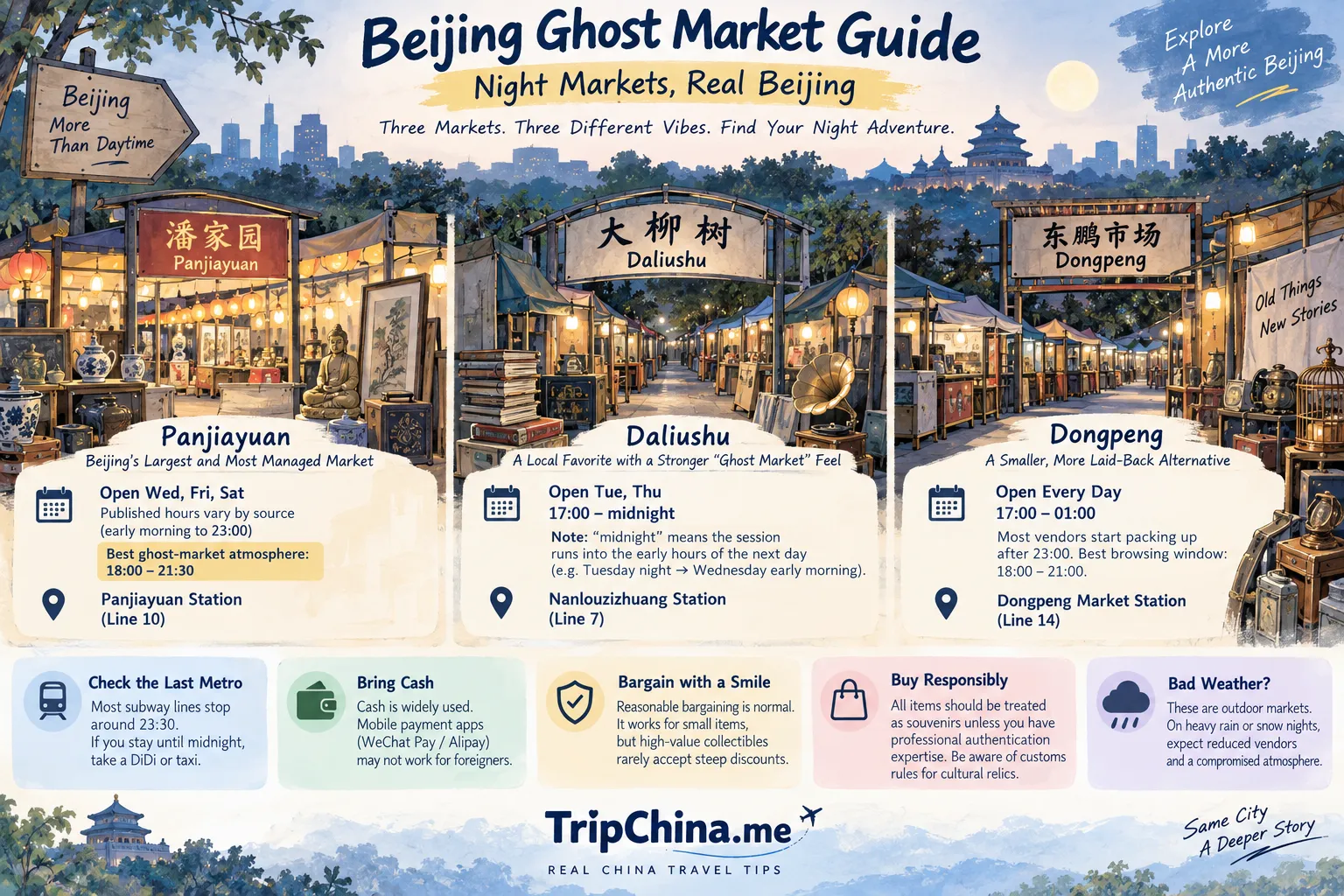
Beijing’s “Ghost Market” is not one single place. It is a choice between different worlds: the organized, beginner-friendly Panjiayuan, the rougher late-night atmosphere of Daliushu, and smaller alternatives such as Dongpeng.
This guide helps you choose the right Beijing ghost market, arrive at the right time, get there by metro, bargain without making a fool of yourself, and — importantly — get back to your hotel when the subway stops running.
For most first-time foreign visitors, Panjiayuan is the easiest choice. It has the widest selection, straightforward Line 10 access and a more organized market environment. Wednesday, Friday and Saturday all have extended market activity, with Friday particularly useful for travelers looking for a lively evening visit.
Choose Daliushu on Tuesday or Thursday night if atmosphere matters more than convenience. It is darker, less structured and more like a large local flea market than a polished visitor attraction.
Choose Dongpeng on Saturday night if you want a smaller, more local second-hand market with books, old goods and miscellaneous finds.
Do not visit any of these expecting to uncover a genuine Qing Dynasty treasure for 50 RMB. Treat the night as a cultural flea-market experience rather than an investment opportunity.
| Market | Open Nights | Best For | Atmosphere | Metro | Main Trade-off |
|---|---|---|---|---|---|
| Panjiayuan | Wed, Fri, Sat | First-timers, variety | Organized, busy, commercial | Line 10 | Less old-school |
| Daliushu | Tue, Thu | Atmosphere, bargains | Informal, local, flashlight-heavy | Line 7 | Late-night return usually requires taxi/DiDi; metro ends around 23:30 |
| Dongpeng | Sat | Books, second-hand goods, local scene | Smaller, local | Line 7 | Only one night per week |
Note: Published starting times for Panjiayuan vary across sources and have changed as the market has evolved. What matters for a ghost-market visit is the evening: the recognizable after-dark atmosphere develops after sunset, with roughly 18:00–21:30 the most practical window for foreign visitors.
Important: Ghost-market schedules can change because of weather, holidays or market management. Check current local information shortly before leaving your hotel.
A Beijing ghost market (鬼市, guǐ shì) is a late-day or night flea-market tradition associated with trading old objects, second-hand goods, curiosities and miscellaneous household items.
Historically, Beijing ghost-market culture was associated with trading under darkness, uncertain provenance and buyers inspecting goods by limited light. Stories link the tradition with people who wanted to sell possessions discreetly, including members of declining elite families.
The modern markets are different.
You will now see phone flashlights, QR-code payments, vintage cameras, toys, bracelets, old books, electronics, household junk, modern crafts and plenty of objects presented as “antiques.”
The darkness and flashlight browsing preserve part of the old ghost-market atmosphere, but today's markets are also social spaces. Younger locals come to browse, bargain, photograph unusual objects and see what turns up that night.
The point is not necessarily to find treasure.
It is the hunt.
The first question is not “Which one is best?”
It is what day is it?
Panjiayuan gives travelers the most schedule flexibility. Daliushu currently operates its regular night market on Tuesday and Thursday. Dongpeng is primarily a Saturday-night option.
For Panjiayuan, evening is the easiest choice if you want the night-market atmosphere without worrying about the last metro. Around 18:00–21:30 is a practical visitor window.
For Daliushu, arrive around 19:00–21:00. The market runs later, but staying until midnight creates a transportation problem because Line 7 service finishes around that time.
For Dongpeng, around 18:00–21:00 gives you plenty of browsing time without deliberately staying into the early hours.
Do not assume “later = better.” For an overseas traveler staying in central Beijing, transportation home matters as much as atmosphere.
Generally, yes.
The main risks are crowded-market problems rather than serious personal-safety threats: losing your phone or wallet, overpaying, buying something falsely described as old, or missing the last metro.
Keep your bag zipped and in front of you in dense crowds. Avoid displaying large amounts of cash.
If you are staying late, save your hotel name and address in Chinese before you leave. Having DiDi or another ride-hailing option ready is much easier than trying to explain your destination after midnight.
And unless you genuinely understand Chinese antiques, assume that an object being described as “old” does not establish authenticity.
For broader warnings beyond the markets themselves, see our Beijing travel pitfall guide.
Address: No. 18 Huaweili, Panjiayuan Road, Chaoyang District, Beijing / 北京市朝阳区华威里18号
Metro: Line 10, Panjiayuan Station
Entry: Free; no sightseeing ticket or reservation required
Current night-market days:
Published starting times vary between sources and have changed over time. Beijing Tourism has previously listed regular daily opening from 09:00, while newer information for the upgraded night-market program lists Wednesday and Friday from 11:00 and Saturday from 14:00. Opening times across sources range from 09:00 to 11:00, and closing times from 20:00 to 23:00. Use 18:00–21:30 as your practical window.
For travelers, this distinction is less important than it appears.
Panjiayuan is a daytime market with extended night-market sessions. Arriving in the morning or around noon gives you a normal flea-market experience. The recognizable night-market atmosphere develops after sunset.
For that experience, aim for approximately 18:00–21:30.
Individual vendor hours vary, and some stalls may leave earlier than the market’s published closing time. Check current opening information before traveling.
Panjiayuan is the most commercialized of the major Beijing ghost markets — and that is not necessarily a disadvantage.
It is now a managed cultural market rather than an informal gathering of night traders. Expect organized zones, defined stall areas and a mix of old goods, second-hand objects, collectibles and newly made crafts.
You may encounter both quiet sellers waiting for buyers to inspect their goods and more active vendors. The crowd mixes collectors, tourists and younger locals.
The atmosphere is lively rather than secretive.
That makes Panjiayuan a good introduction if the idea of walking through a poorly lit local flea market after dark sounds intimidating.
The range is enormous:
Prices range from inexpensive souvenirs to items costing thousands of yuan.
The crucial rule is simple:
Never let an “antique” story determine how much you spend.
If you cannot independently authenticate an item, value it as decoration or a souvenir rather than as an investment.
The biggest risk is overconfidence.
A foreign visitor who knows very little about antiques should not spend serious money because a seller claims an object is rare, imperial, excavated or several centuries old.
Do not confuse a convincing story with provenance.
Also keep an eye on your belongings when the market is crowded.
The trade-off at Panjiayuan is straightforward: you gain convenience, variety and easier transport, but lose some of the informal street-market atmosphere that makes Daliushu distinctive.
Driving is unnecessary for most visitors. Take the metro.
Location: Daliushu / Guanxin Market area, Chaoyang District, Beijing / 北京市朝阳区大柳树官鑫市场
Metro: Line 7, Nanlouzizhuang Station / 南楼梓庄站
Entry: Free
Current regular night-market schedule:
A January 2026 Xinhua report documents the regular market pattern as Tuesday and Thursday from 17:00 until midnight.
A note about “Wednesday”: The confusion arises because a Tuesday-night market running until midnight overlaps with the very beginning of Wednesday. If you arrive at 00:00 on Wednesday, you may still catch the tail end of Tuesday’s session, but you will not find a fresh Wednesday market.
For trip planning, use Tuesday and Thursday evenings as the regular market days rather than scheduling a separate Wednesday-night visit.
Outdoor markets are inherently less predictable than permanent indoor attractions. Heavy rain, extreme weather or temporary management changes can affect the number of sellers or the actual closing time.
Daliushu feels less curated than Panjiayuan.
Some sellers operate from vehicles or use the backs of vehicles as temporary selling spaces. Other goods appear on tables or ground-level displays.
The effect is informal and temporary rather than polished.
Bring a flashlight. Even if your phone has one, a small dedicated flashlight is much easier when you want to inspect objects repeatedly without draining your battery.
Expect old electronics, household goods, toys, mechanical parts, ornaments, ceramics, tools and objects whose purpose may not be immediately obvious.
Selection varies from one market night to another. That randomness is a large part of the appeal.
Daliushu is darker and less orderly than Panjiayuan.
Flashlights move across piles of objects while buyers stop, inspect something, ask a price and move on.
Do not romanticize it into a secret illegal market. Modern Daliushu is a functioning second-hand flea market with a strong connection to Beijing’s ghost-market culture.
It simply retains more of the temporary, rough-edged feeling associated with the tradition.
Daliushu is better suited to low-stakes browsing than serious antique collecting.
Look for:
Prices can be lower than Panjiayuan, but the selection is less predictable.
Buy something because you like it, not because somebody tells you it will become valuable.
This matters.
The nearby Nanlouzizhuang Station is on Beijing Subway Line 7. Current official subway information lists last trains at approximately 23:30: around 23:32 toward Beijing West Railway Station and 23:35 toward Universal Resort, with a later short-turn service in one direction.
If you stay until the market closes around midnight, do not count on the subway.
Use a taxi or DiDi instead.
The fare to central Beijing depends heavily on your exact hotel, traffic and time, so avoid planning around a fixed price. Check the live ride-hailing quote before leaving the market.
Save your hotel’s Chinese name and address on your phone before going out.
This single step solves many late-night transportation problems.
Address: Dongpeng Market, Taozhuang Road, Fatou, Chaoyang District / 朝阳区陶庄路东鹏市场
Metro: Line 7, Fatou Station; check live navigation for the best exit and walking route
Hours: Saturday, approximately 17:00–01:00
Sellers can begin entering and setting up earlier in the afternoon. Do not interpret 01:00 as the best arrival target. For a fuller selection and an easier trip home, 18:00–21:00 is the more practical browsing window. According to visitor reports, vendors are generally required to stay until at least 22:00, so arriving by 21:00 should give you a reasonably complete market.
Dongpeng is smaller and less famous than Panjiayuan. It attracts visitors looking for second-hand goods without the same level of tourist attention.
Goods include clothing, bags, toys, collectibles, old electronics, miscellaneous used objects and books.
It has a notable second-hand book presence, making it particularly interesting if you enjoy browsing old Chinese publications.
If Saturday fits your schedule and you have already seen Panjiayuan — or simply want something less famous — Dongpeng is a reasonable alternative.
A flashlight: Particularly useful at Daliushu and Dongpeng. A dedicated flashlight is more practical than repeatedly using your phone.
A working Chinese payment method: Many sellers use QR-code payments such as WeChat Pay or Alipay.
Some small cash as backup: 10, 20 and 50 RMB notes can be useful if mobile payment is inconvenient or a seller prefers cash.
Comfortable shoes: You may spend a couple of hours standing and slowly moving between stalls.
A translation app: English ability varies greatly and should not be assumed.
Your hotel address in Chinese: Essential if you stay beyond metro hours.
Bargaining is normal, but there is no universal rule saying every seller will accept half the asking price.
Start by asking:
多少钱?(Duōshao qián?) — How much?
If the price feels high, you can say:
便宜一点可以吗?(Piányi yìdiǎn kěyǐ ma?) — Can you make it a little cheaper?
For cheap small goods and random curiosities, opening well below the asking price can sometimes work. A 30–50% reduction can be a negotiating starting point in some low-value situations, but it is not a universal rule.
Higher-priced collectibles, jade-style pieces, calligraphy and specialist goods are much less likely to accept steep counteroffers.
Bundling several low-value items can make negotiation easier.
Walking away is also perfectly normal if you cannot agree on a price.
One traditional phrase associated with this market culture is “过手便是钱” — roughly, once the deal is made and the item changes hands, the transaction is considered settled.
This is local custom, not something automatically enforceable by law. But backing out after clearly agreeing on a price is widely seen as impolite among vendors. For details about negotiating in English, see our FAQ section.
If you are new to QR-code payments in China, our foreign-visitor China payment guide explains how international travelers can prepare Alipay and WeChat Pay.
Do not shine a powerful flashlight directly into a vendor’s face.
Ask before photographing an individual seller at close range. Photographing the general market scene is different from putting a camera directly in somebody’s face.
Handle fragile objects carefully.
Do not interrogate sellers about whether every object is “real.” If authenticity matters enough to affect how much you are willing to spend, you should have the expertise to judge it independently.
And remember that this is still a working local market, not an open-air museum staged for tourists.
Keep your phone and wallet secure in crowded areas.
Going with another person is useful if you plan to stay very late, but the markets are not inherently off-limits to solo travelers.
Have your return transportation planned before the metro closes.
Most importantly, be cautious with anything that appears to be an actual protected cultural relic.
Chinese law restricts the export of protected and certain other cultural relics. Cultural objects requiring export approval must be reviewed and legally cleared before departure.
Do not trust a vendor’s claim that something is an “old family heirloom” as proof that it can legally leave China. A suspected cultural relic may be stopped for inspection, while failure to make a legally required declaration can lead to penalties under China’s cultural-relic and customs rules.
If an object looks genuinely archaeological, historically important or unusually old, the safest tourist decision is not to buy it.
| Category | Market to Try | What to Expect |
|---|---|---|
| Calligraphy, decorative antiques, jade-style goods | Panjiayuan | Largest organized selection |
| Toys, figurines, trendy collectibles | Panjiayuan | Easy souvenir browsing |
| Second-hand books | Dongpeng | Notable book section |
| Random inexpensive curiosities | Daliushu | Highly unpredictable selection |
| Vintage cameras and electronics | Daliushu / Panjiayuan | Inspect condition carefully |
| Handicrafts and cultural products | Panjiayuan | Especially accessible to visitors |
For anything expensive, treat the object as a souvenir unless you have the knowledge to authenticate it independently.
18:30–19:00: Arrive by Line 10.
Start with the traditional old-goods and collectible areas while you still have plenty of time.
19:00–21:30: Browse the main market zones. Compare prices before buying anything expensive.
By 22:00–22:30: Start wrapping up if you want a stress-free metro ride back.
There is little reason for an ordinary visitor to chase the old “stay until 4 AM” version of Panjiayuan. Current published night-market information ends much earlier.
19:00: Arrive at Nanlouzizhuang Station and walk toward Guanxin Market.
19:00–21:30: Browse the main second-hand stalls. Use your flashlight to inspect anything you are considering buying.
21:30–22:30: Make final purchases and decide whether you want to stay late.
Before about 23:20: Head toward the metro if you want to return by train.
After that: Plan on DiDi or a taxi.
Do not schedule Daliushu for Wednesday evening — the current regular market pattern is Tuesday and Thursday.
17:30–18:00: Arrive after sellers have begun setting up.
Browse the second-hand book stalls first if books are your priority.
Then move through toys, electronics, clothing and miscellaneous old goods.
Leave around 21:00–23:00 for an easier return, even though the published market period can continue later.
| Scenario | Recommended Route | Why It Fits | Main Trade-off |
|---|---|---|---|
| First-timer | Line 10 → Panjiayuan | Easy access, broadest organized selection | More commercial |
| Local atmosphere, Tuesday | Line 7 → Nanlouzizhuang → Daliushu | Darker, informal flea-market atmosphere | Metro ends around 23:30; late return requires taxi/DiDi |
| Local atmosphere, Thursday | Line 7 → Nanlouzizhuang → Daliushu | Same regular night-market pattern | Less convenient than Panjiayuan |
| Book / second-hand hunter, Saturday | Line 7 → Fatou → Dongpeng | Books plus varied used goods | Saturday only |
| Heavy rain or snow | Skip the ghost market that night | Beijing’s current ghost-market options are predominantly outdoor or weather-exposed | No verified indoor ghost‑market alternative; pick other indoor Beijing evening activities instead |
Panjiayuan has more structured market infrastructure than Daliushu or Dongpeng, but it remains largely an outdoor experience.
On heavy rain or snow nights, expect reduced vendor turnout and a compromised atmosphere. Choose a different indoor Beijing evening activity rather than making a dedicated ghost-market trip.
Going on the wrong night. This is the easiest mistake to avoid. Daliushu’s regular market pattern is currently Tuesday and Thursday, not Wednesday evening.
Believing old opening-hour posts. Beijing night-market schedules change. Published Panjiayuan starting times themselves have varied over time, so prioritize the current evening schedule rather than an old daytime opening time.
Arriving too early for Panjiayuan’s ghost-market atmosphere. Panjiayuan also operates as a daytime market. Go after sunset if the night experience is your reason for visiting.
Planning a ghost-market night during heavy rain or snow. Panjiayuan, Daliushu and Dongpeng are weather-sensitive. Some sellers may not set up or may leave early. There is currently no verified indoor Beijing ghost market that should be relied on as a bad-weather substitute.
Arriving without a flashlight at Daliushu. Your phone works in an emergency, but a small flashlight makes browsing much easier.
Treating every “antique” story seriously. For expensive purchases, authenticity needs more than a seller’s story.
Taking close-up photographs of sellers without asking. Treat vendors as people, not exhibits.
Forgetting about the last metro. This matters especially at Daliushu and Dongpeng. Check your route home before you start browsing.
You may hear the expression 趟鬼市 (tàng guǐ shì).
The verb tàng can carry the sense of going through or wading through something. In ghost-market usage, it evokes moving through stalls and piles of objects, looking carefully for something worth stopping for.
That slow inspection is still central to the experience.
You move through the crowd, stop when something catches your eye, inspect it under the light, ask the price, bargain if appropriate, and keep going.
That rhythm is more important to understanding a modern Beijing ghost market than trying to recreate every romantic story about its past.
This article is part of the Beijing Travel Guide Hub.
Do not assume so. Many objects are reproductions, crafts, second-hand goods or items of uncertain age and provenance.
Unless you have relevant expertise, buy for decoration, curiosity or memory rather than investment.
Do not depend on a physical international credit card being accepted directly by individual stalls.
QR-code mobile payment is far more useful. Set up Alipay or WeChat Pay with a supported international card before visiting.
Carrying some small-denomination RMB cash as backup is also sensible.
Yes, but it is a different experience.
Daytime is better if your priority is browsing the broader old-goods market in good light. Wednesday, Friday and Saturday evenings provide more of the modern night-market atmosphere.
Weekend mornings have traditionally been important trading periods at Panjiayuan as well, so serious browsing does not require a night visit.
Yes.
Wednesday is one of Panjiayuan’s extended night-market days, with current Beijing Tourism information listing trading until 23:00.
If Wednesday is your only free evening, it is still a practical choice. Arrive after sunset if the night atmosphere is what you want.
Do not count on it.
Panjiayuan sees more international visitors, so you may encounter sellers with basic English or experience using calculators with foreign buyers.
At Daliushu and Dongpeng, Chinese is much more useful.
A translation app plus a calculator is enough for most simple purchases.
For simple bargaining, usually.
Numbers can be entered into a phone or calculator even when you and the seller share no language. More complicated discussions about condition, provenance or authenticity are much harder.
Keep negotiations simple and use a translation app when necessary.
Panjiayuan is the easiest option for families because it is more organized and better lit.
Daliushu is less comfortable for young children because of the darker environment, crowds, uneven walking conditions and late hours.
For any child, choose an earlier evening visit rather than staying close to midnight.
General handheld photography is usually practical, but ask before taking close-up photographs of individual vendors or their stalls.
Avoid shining flashlights or camera flashes directly into people’s faces. Commercial filming or professional equipment may be subject to market-specific rules.
Do not assume you can.
Beijing has extensive low-altitude and drone flight restrictions, and a crowded night market is not an appropriate place to launch a drone without confirming current legal and local requirements.
Check current official flight restrictions before bringing drone equipment.
There is no universal rule that all Beijing ghost markets close during public holidays.
Market schedules can be adjusted for holidays, weather, special events or management reasons. Panjiayuan may publish special arrangements, while Daliushu and Dongpeng can be more sensitive to vendor turnout and weather.
Check current information before making a dedicated trip.
Xinhua — Daliushu Night-Market Schedule and Second-Hand Market Culture
Beijing Tourism — Panjiayuan Night-Market Schedule
Beijing Tourism — Daliushu and Dongpeng Night-Market Information
Beijing Subway — Line 7 Official Station and Last-Train Information
This guide was rechecked in September 2026 against Xinhua, Beijing Tourism, Beijing Subway data and TripChina field observations. Published Panjiayuan starting times vary across sources and have changed over time; its practical ghost-market window is after sunset. Xinhua documents Daliushu’s regular Tuesday/Thursday pattern, while outdoor markets can change because of weather or management. Older Panjiayuan 04:00 closing information is not used. This guide prioritizes current, practical advice for foreign travelers over romanticized ghost-market folklore.
TripChina.me creates practical China travel guides shaped by real local experience, helping independent travelers navigate transport, payments, food, neighborhoods, and the cultural details that make traveling in China easier and more meaningful. Find the guide for your destination at tripchina.me.