Our Location:
No. 99, Jiazi Road, Chengdu

 authorChris Lee
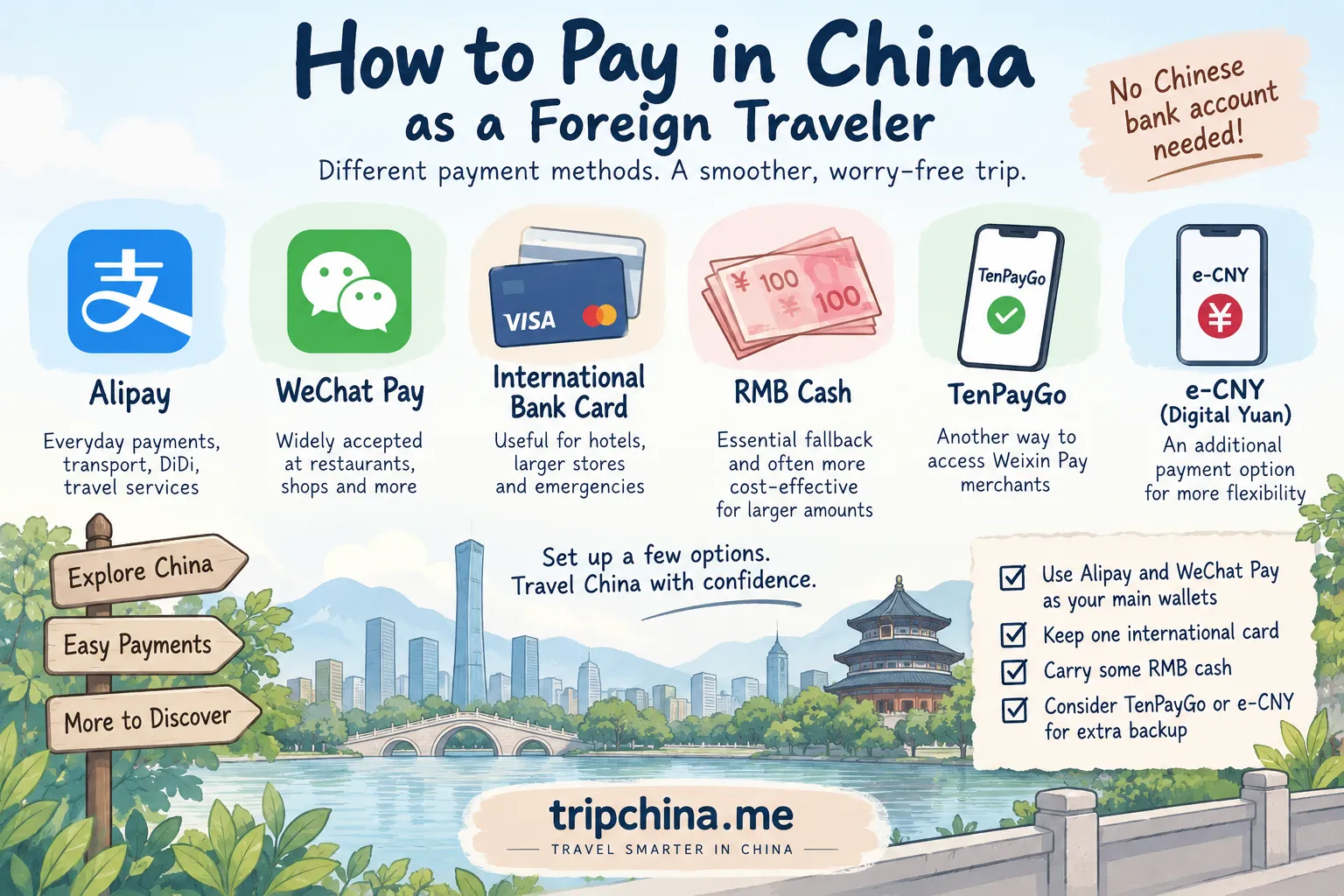
China is highly mobile-payment oriented, but that does not mean foreigners need a Chinese bank account—or that cash and foreign cards are useless. The easiest approach in 2026 is not choosing one “perfect” payment method. For most travelers, Alipay and WeChat Pay remain the best starting point, backed up by a physical card and some RMB cash. Newer options such as TenPayGo and the digital yuan (e-CNY) can provide additional flexibility, but you do not need to set up everything before you arrive.
For most independent travelers, use this four-layer payment setup:
• Alipay — primary or backup mobile wallet for everyday payments and travel services
• WeChat Pay — equally useful for everyday QR payments, especially if you already use WeChat
• One physical international bank card — useful for hotels, larger stores and emergencies
• RMB cash — essential fallback if mobile payment or card acceptance fails
You do not need a Chinese bank account to link supported international cards to Alipay or WeChat Pay. Current official guidance allows foreign visitors to register with overseas phone numbers and link major international card networks.
There are also useful alternatives. TenPayGo offers a more payment-focused route into the Weixin Pay merchant network, while e-CNY (the digital yuan) can provide another independent payment layer. Neither is essential for most first-time visitors, but both can be valuable backups if you want more redundancy.
As of September 2026, this is the most practical comparison for foreign travelers.
| Method | Setup | Typical Fee / Cost | Where It Works Best | Main Limitation |
|---|---|---|---|---|
| Alipay | About 10–20 min | No extra service fee ≤ RMB 200; 3% above RMB 200 under current general rules | Daily spending, transport, DiDi, travel services | Card issuer or app risk controls may block some transactions |
| WeChat Pay | About 10–20 min | No extra service fee ≤ RMB 200; 3% above RMB 200 under current general rules | Restaurants, shops, transport, everyday QR payments | Some functions remain restricted for overseas-card users |
| Physical international card | None | Issuer FX or overseas fees may apply | Hotels, airports, department stores, larger retailers | Not accepted at every small merchant |
| RMB cash | None | No payment-app fee | Backup and fee-aware spending | Change can occasionally be inconvenient |
| TenPayGo | Additional setup | Check the fee shown before payment | Weixin Pay merchants; alternative QR-payment route | Newer service; features and availability may evolve |
| e-CNY | Additional setup | Check current wallet/card terms | Participating e-CNY merchants; independent backup | Less integrated into tourist services than Alipay |
| UnionPay Tour Card | Additional setup | Check current app terms | UnionPay QR payments | Less integrated into tourist services |
| Supported overseas e-wallet | Often none | Depends on wallet | Travelers from supported regions | Depends on your home wallet |
Alipay is particularly convenient when your trip involves China's broader travel and lifestyle ecosystem.
It can be useful for:
• merchant QR payments
• DiDi ride-hailing
• public transport services in many cities
• attraction and travel-related mini services
• services embedded inside Alipay
Foreign visitors can register with an international mobile number and link supported overseas cards without opening a mainland Chinese bank account.
Yes—and for many visitors, this is one of Alipay's most useful travel features.
You do not necessarily need to download and set up the standalone DiDi app. Foreign travelers can open Alipay → Transport → Taxi and book a ride through the integrated ride-hailing service.
This can be particularly useful if your Alipay account and foreign card are already working. Instead of creating another account and configuring another payment method, you can keep the ride and payment flow inside an app you have already set up.
A typical flow is:
This does not mean the standalone DiDi app is unusable for foreigners. Current Chinese government guidance also supports DiDi registration with overseas mobile numbers and international cards.
The Alipay route is simply a useful alternative when you want fewer apps—or when your standalone DiDi payment setup is giving you trouble.
For pickup locations, airport and railway-station rides, payment options and the standalone app, see TripChina's complete DiDi guide for foreign travelers.
For the full Alipay setup process, see TripChina's Alipay guide for foreigners in China.
WeChat Pay is particularly natural if you already use WeChat for messaging, restaurants, mini-programs or attraction reservations.
For ordinary merchant payments, it works much like Alipay: scan the merchant's QR code or show your own payment code.
As of September 2026, eligible first-time users linking an international bank card to WeChat can receive a promotional waiver of the 3% transaction fee for 90 consecutive calendar days, covering daily spending of up to RMB 1,000 under the current campaign.
This is a promotional offer rather than the permanent base fee rule.
Promotion availability and eligibility can change, so check the terms displayed in WeChat Pay after linking your card rather than budgeting on the assumption that you will definitely receive it.
For step-by-step setup, see TripChina's WeChat Pay guide for foreign visitors.
Sometimes.
Under the current general rules for foreign cards linked to Alipay and WeChat Pay:
| Single Transaction | General Published Rule |
|---|---|
| RMB 200 or less | No additional wallet service fee |
| More than RMB 200 | 3% service fee |
That means cash should not be thought of as an emergency-only payment method.
For a RMB 30 lunch or RMB 80 attraction ticket, mobile payment is usually the obvious choice. But once a foreign-card-funded wallet transaction exceeds RMB 200, the fee can become noticeable.
For example:
• RMB 400 payment → about RMB 12 at 3%
• RMB 1,000 payment → about RMB 30
• RMB 2,000 payment → about RMB 60
For larger purchases, compare three options before paying:
linked foreign card through Alipay/WeChat Pay vs direct physical-card payment vs RMB cash.
Your physical card may have its own foreign-transaction or currency-conversion fee, so cash is not automatically cheaper. The point is to check rather than assume.
Always look at the fee displayed on the final payment screen before confirming a larger transaction.
Yes, they can—but think of e-CNY as an optional additional payment layer, not something every visitor must set up.
Foreign visitors can use the official e-CNY app with an overseas mobile number. Current official guidance also allows supported Visa and Mastercard cards to be used for eligible wallet funding/payment flows.
One useful difference is that e-CNY does not depend on your Alipay or WeChat account. If you want another payment route outside those two ecosystems, it can add genuine redundancy.
There are two practical routes.
1. e-CNY app
You can register using an overseas mobile number, open a wallet through a participating operator, and use supported international cards such as Visa or Mastercard in eligible funding or payment flows.
In supported configurations, you can top up the wallet before spending. Remaining wallet funds can also be transferred back to the overseas bank card according to the current wallet rules.
This can be useful if you prefer to preload money rather than have every purchase depend on a fresh international-card authorization.
2. e-CNY hardware wallet
Foreign visitors can also encounter physical e-CNY hardware wallets at selected airports, banks, hotels and visitor-service locations.
These can take card-like or other hardware forms and are designed to make digital-yuan payments possible without relying entirely on a conventional mobile-wallet setup.
Some hardware-wallet payment functions can work without a normal mobile-data connection, which gives them a different role from Alipay or WeChat Pay.
It makes the most sense if:
• your Alipay or WeChat Pay card authorization is unreliable
• you want an additional payment system independent of those apps
• you prefer preloading travel spending
• you encounter an e-CNY hardware-wallet service at your arrival point
• you simply want to try China's central-bank digital currency
But most short-term tourists do not need to install every available payment app.
If you already have:
Alipay + WeChat Pay + physical card + RMB cash
you already have a strong payment setup.
Treat e-CNY as a useful fifth option rather than a mandatory replacement for the first four.
TenPayGo is a newer Tencent app designed specifically for international visitors to China.
Its payment capabilities are powered by the Weixin Pay merchant network, allowing eligible travelers to pay at merchants that accept Weixin Pay without needing to use the full WeChat ecosystem.
That makes its role different from Alipay or WeChat.
Alipay and WeChat combine payment with large ecosystems of mini-programs and local services. TenPayGo is more payment-focused.
For some visitors, that simpler approach is attractive.
It can currently cover common travel spending such as:
• restaurants
• shopping
• transportation
• hotels
• attractions
• entertainment
• other merchants accepting compatible Weixin Pay payments
However, TenPayGo is still a relatively young service. App availability, card authorization, payment features and account flows can continue to change.
For this reason, I would treat it as an additional payment route, not as the only payment method you bring to China.
If Alipay and WeChat Pay already work reliably, you do not need to install TenPayGo simply because it exists.
If you want a third QR-payment option—or prefer a more focused payment interface—it becomes much more interesting.
For supported cards, current setup, fees, iPhone/Android availability and known limitations, see TripChina's complete TenPayGo guide.
Most failures come down to bank authorization, account verification or the type of QR code being used.
Your overseas bank may be blocking the request.
This is one of the most underestimated problems with foreign-card payments in China.
A card can work normally for days and then suddenly fail after multiple purchases, travel between cities, unusual merchant categories or a larger-than-normal transaction triggers the issuing bank's fraud-detection system.
Before a multi-city China trip, check whether your bank still uses travel notifications. Many issuers no longer require them, but some allow you to confirm overseas use or manage international-payment controls inside their app.
Also make sure you can receive:
• banking-app approval requests
• fraud alerts
• SMS verification codes
• 3-D Secure authentication
If a payment is declined, do not repeatedly submit the same transaction.
Instead, check your bank app for an alert, switch to another payment method, and contact the issuer if necessary.
Use this order:
1. Stop retrying the same payment.
Repeated failures can create more risk-control problems.
2. Check your issuing bank.
Open the bank app and look for a declined transaction, fraud alert or authentication request.
If the bank blocked the transaction, call the number on the back of your card and explain that you are in China and are intentionally authorizing the transaction through Alipay or WeChat Pay.
Ask the issuer to approve or unblock the payment if its security system is rejecting legitimate wallet transactions.
3. Switch cards.
If you have another international card, try it rather than repeatedly forcing the same card through the same transaction.
4. Switch wallets.
If Alipay fails, try WeChat Pay. If WeChat Pay fails, try Alipay.
This is exactly why installing both before departure is useful.
5. Try a direct physical-card payment.
Hotels, major malls, airports and larger retailers may accept your international card directly.
6. Use RMB cash.
Cash remains one of the simplest emergency payment methods when the problem is your phone, app, internet connection or issuing bank.
7. Contact the payment platform if the bank says the card is fine.
For Alipay account or payment problems, customer support is available through the app, and the official Alipay customer-service number in mainland China is 95188. From overseas, Alipay also publishes +86 571 95188.
For Weixin Pay international-card issues, TenPay Global currently lists 95017 inside mainland China and +86 571 95017 from overseas, Hong Kong, Macao or Taiwan.
The important diagnostic question is:
Is the payment being rejected by the merchant, the payment platform, or my card issuer?
Those are three different problems.
The second code may be a personal collection code rather than a merchant code, or the transaction may fall outside the foreign-card functionality of your account.
Try another wallet or cash rather than assuming every QR code should behave identically.
If you are having trouble with the standalone DiDi app, try booking through Alipay → Transport → Taxi instead.
That gives you another route into ride-hailing without depending on exactly the same app setup.
If the underlying problem is your foreign card rather than DiDi itself, however, switching interfaces may not solve it. In that case, check your bank authorization, switch to another linked card or payment method, and keep enough cash or another working wallet available for transport emergencies.
For the full ride-hailing setup and pickup advice, see TripChina's DiDi guide for foreign visitors.
Your card may work perfectly at the hotel and fail at the noodle shop downstairs.
Set up mobile payment first.
If your only wallet triggers verification, you immediately lose your main payment method.
Using two wallets creates useful redundancy.
TenPayGo or e-CNY can provide an additional layer if you want even more backup, but most visitors do not need every payment app available.
Merchant and personal collection codes are not always equivalent for overseas-card users.
Keep a fallback available.
When offered dynamic currency conversion, choose CNY unless you deliberately prefer the quoted home-currency conversion.
Promotions and fee rules change.
As of September 2026, the general published foreign-card wallet rule remains no extra platform service fee at or below RMB 200 and 3% above RMB 200, but always look at the fee displayed before confirming a larger payment.
Before departure, confirm that international transactions are enabled and that you can receive verification messages or approve transactions through your banking app.
If your issuer offers travel notifications, adding China before a multi-city trip can reduce surprises.
Working internet matters just as much as working payment apps. If you land and cannot get online, see TripChina's China arrival internet troubleshooting guide.
| Traveler | Recommended Setup |
|---|---|
| First-time visitor | Alipay + WeChat Pay + physical card + cash |
| Solo traveler | Both mobile wallets + card + emergency cash |
| Family | At least two adults with working mobile payment + card + shared cash |
| Business traveler | Both wallets + multiple physical cards + cash |
| Short stopover | One verified wallet + physical card + small cash reserve |
| Traveler with repeated card-authorisation problems | Two wallets + second card + cash; consider e-CNY or TenPayGo |
| Traveler whose home wallet works in China | Compatible home wallet + card + cash |
The core principle is simple: avoid relying on a single payment method that could fail unexpectedly.
For most visitors, Alipay and WeChat Pay remain the first two mobile-payment tools to set up. TenPayGo and e-CNY are useful additional options—not replacements you must install.
👉 Explore more essential travel tips in our China Basics Hub.
Do not assume this is allowed.
The merchant may refuse, and repeated transactions can trigger risk controls. For a legitimate large purchase, compare the wallet fee with the cost of paying directly by physical card.
It is better for each adult to have their own working payment method. Sharing one phone makes both travelers dependent on the same battery, account and risk-control status.
For couples or families, redundancy is more useful than minimizing the number of payment accounts.
Use your physical card and cash while securing your mobile-payment accounts.
Contact your card issuer if the lost phone contained accessible payment credentials, and remotely lock or erase the device if your platform allows it.
That depends entirely on your card issuer and how the transaction is categorized.
A wallet payment may not necessarily code as dining, travel or another bonus category. Check the card issuer's reward terms rather than assuming mobile-wallet payments earn the same bonus as a direct card purchase.
Sometimes, but hotels may prefer a physical card for deposit pre-authorization.
International and upscale hotels are more likely to use conventional card holds, so carry a physical card even if you expect to pay the final bill through a mobile wallet.
Usually not.
For most short-term visitors, Alipay + WeChat Pay + a physical international card + RMB cash already provides strong redundancy.
e-CNY becomes more useful if you want another independent payment route, prefer preloading funds, or encounter an easy-to-obtain hardware-wallet option during your trip.
Not necessarily.
TenPayGo uses payment capabilities powered by Weixin Pay but is designed as a more focused visitor-facing app.
Think of it as another way to access everyday merchant payments rather than a replacement for WeChat's much larger ecosystem.
See TripChina's TenPayGo guide for the detailed comparison.
Yes.
Foreign travelers can access ride-hailing through Alipay's Transport/Taxi services instead of relying only on the standalone DiDi app.
This is particularly convenient if your Alipay account and international card are already working.
First check your bank app for a fraud alert or authentication request.
If necessary, call the issuing bank and confirm that you are intentionally making transactions in China through Alipay or WeChat Pay.
Then try a second card.
If the problem continues, use your physical card where accepted or pay with RMB cash while resolving the account issue.
Do not repeatedly retry a declined transaction.
Do not try to find one payment method that works everywhere.
A better way to think about China payments is in layers:
Everyday small payments: Alipay or WeChat Pay
Ride-hailing: Alipay's DiDi/Taxi integration or DiDi
Larger purchases: compare wallet fees, physical-card costs and cash
If one wallet fails: switch wallet or card
If your issuer blocks the transaction: contact the bank and authorize it
If mobile payment fails completely: use your physical card or RMB cash
Optional extra backup: TenPayGo or e-CNY
Once you have backup layers in place, paying in China becomes much easier.
The mistake is not choosing the “wrong” payment app.
It is assuming you only need one.
Chinese Government — Guide to Payment Services in China
Shanghai Municipal Government — Payment Methods for Foreigners
People's Bank of China / Shanghai Municipal Government — e-CNY Payment for Overseas Visitors
Tencent / TenPayGo — Official TenPayGo App
Tencent — Weixin Pay for International Visitors
Beijing Municipal Government — WeChat Pay International-Card Fee Promotion
Updated and fact-checked in September 2026 using Chinese government, SAFE, municipal payment guidance and current official platform information. Particular attention was given to foreign-card wallet fees, WeChat Pay's temporary 60-day promotion, ATM withdrawal limits, Apple Pay compatibility, card-payment limits and refund handling. Claims that could vary by issuing bank or payment platform—especially refund timing and Apple Pay acceptance—are intentionally described conditionally rather than as universal rules.
TripChina.me creates practical China travel guides shaped by real local experience, helping independent travelers navigate transport, payments, food, neighborhoods, and the cultural details that make traveling in China easier and more meaningful. Find the guide for your destination at tripchina.me.






The four-layer setup is exactly how I'd frame it after living through the cash-to-QR transition here. Two things I'd add from experience: first, the 3% fee above RMB 200 on foreign cards surprises most newcomers — it makes cash genuinely competitive for mid-size purchases, not just emergencies. Second, issuer risk controls are the silent killer: a card that works fine for weeks can suddenly get blocked during a travel-heavy stretch, and the decline always happens at the worst register. Calling your bank before a long domestic train trip saves real pain.
Does the guide plan to cover the Alipay mini-program workaround for DiDi? That's the piece returning visitors ask about most.
Indeed! Your experience and suggestions are excellent. I will update this guide and include information on using the Digital RMB and TenPayGo, as these two payment methods might be more convenient for most foreign tourists.