Our Location:
No. 99, Jiazi Road, Chengdu

 authorChris Lee
There is a particular sound I associate with Chengdu: the soft clink of a porcelain lid against a tea bowl.
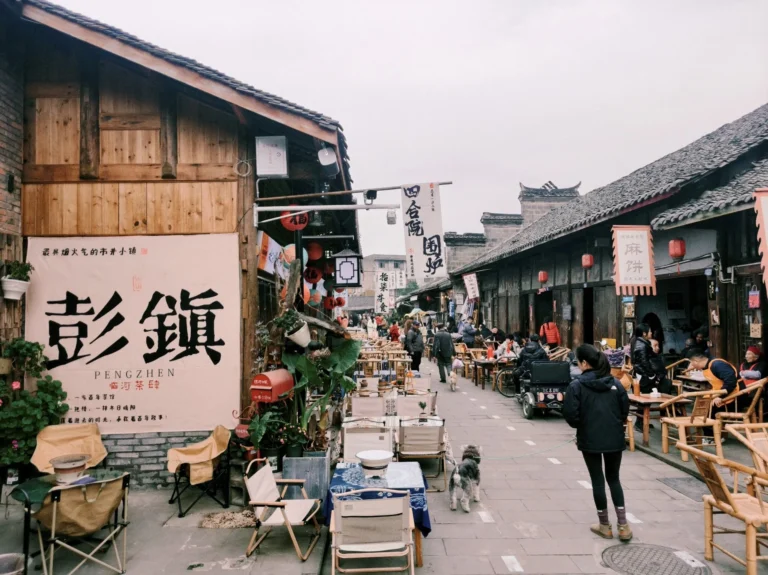
You hear it beneath old trees, beside rivers and inside neighborhood courtyards, wherever bamboo chairs gather around small wooden tables. To a first-time visitor, a Chengdu teahouse can look almost too simple — a chair, a table, a gaiwan and a kettle of hot water.
Stay for an hour, however, and the place begins to make sense. The tea is only part of what you are paying for. What really matters is the permission to sit, talk, watch the city and allow an afternoon to pass without needing to accomplish anything.
A Chengdu teahouse is not simply where the city drinks tea. It is where the city becomes easiest to understand.
A traditional Chengdu teahouse is closer to a public living room than a modern café or formal tea ceremony. Locals come to drink gaiwan tea, but they also chat, play cards, read, meet friends or simply sit for hours.
The basic experience is remarkably simple: order a bowl of tea, settle into a bamboo chair and refill the same leaves with hot water. There is usually no need to rush.
The easiest way to understand the culture is this:
The tea gives you a reason to sit. The teahouse gives you permission to stay.
| What you may expect | What a Chengdu teahouse is actually like |
|---|---|
| A quiet tea ceremony | A relaxed everyday social space |
| Tea is the main attraction | Tea is often the reason to stay |
| Order → drink → leave | Order → sit → refill → stay |
| Rare tea matters most | A simple jasmine tea may be enough |
| Complicated etiquette | Mostly relaxed, practical customs |
| A historical attraction | A tradition still used in daily life |
| Something tourists observe | Something locals continue to participate in |
That distinction is the key to understanding why teahouses occupy such a special place in Chengdu.
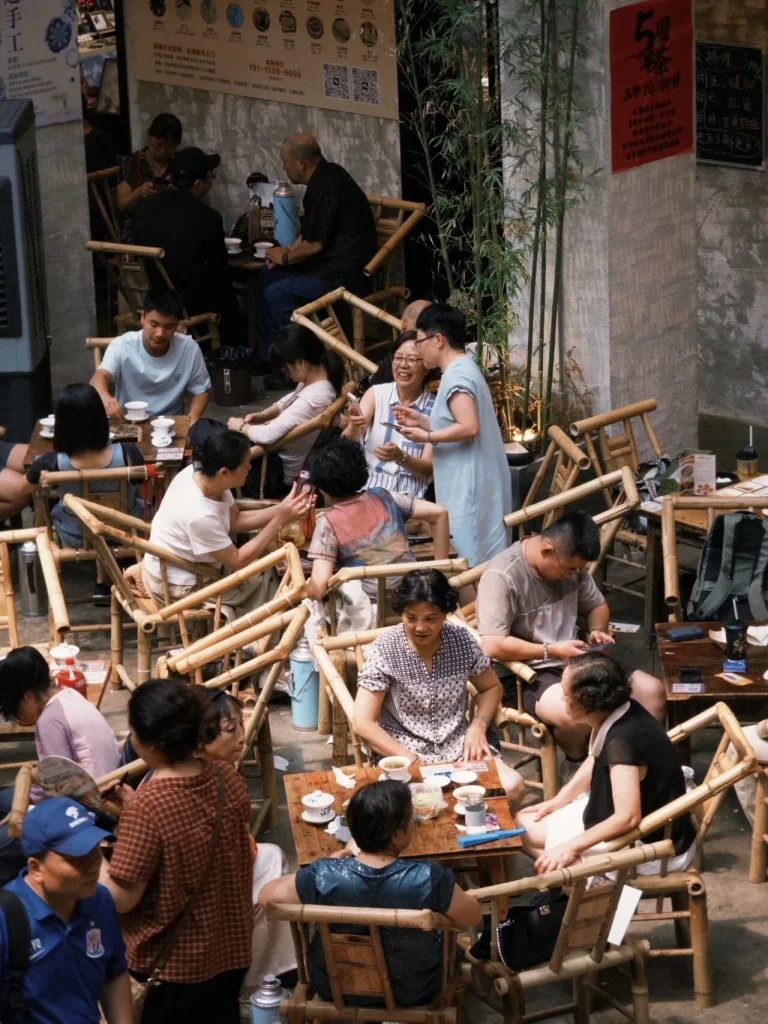
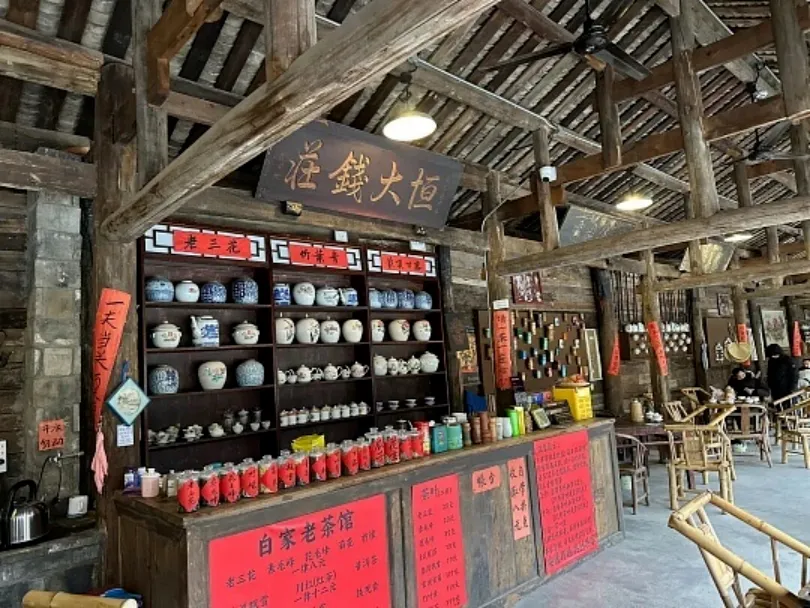
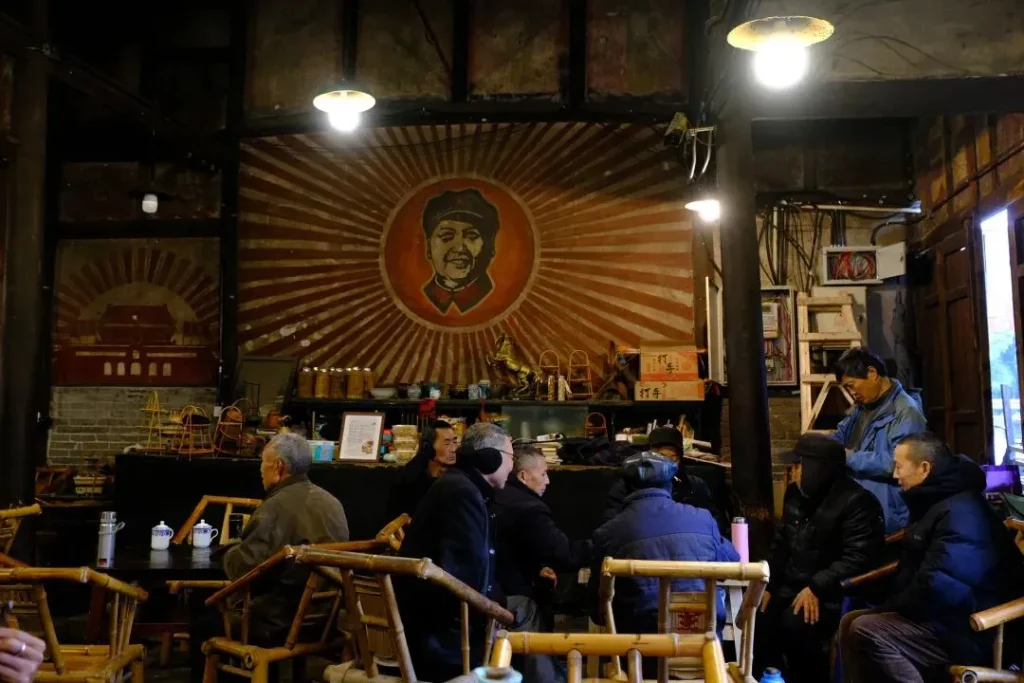
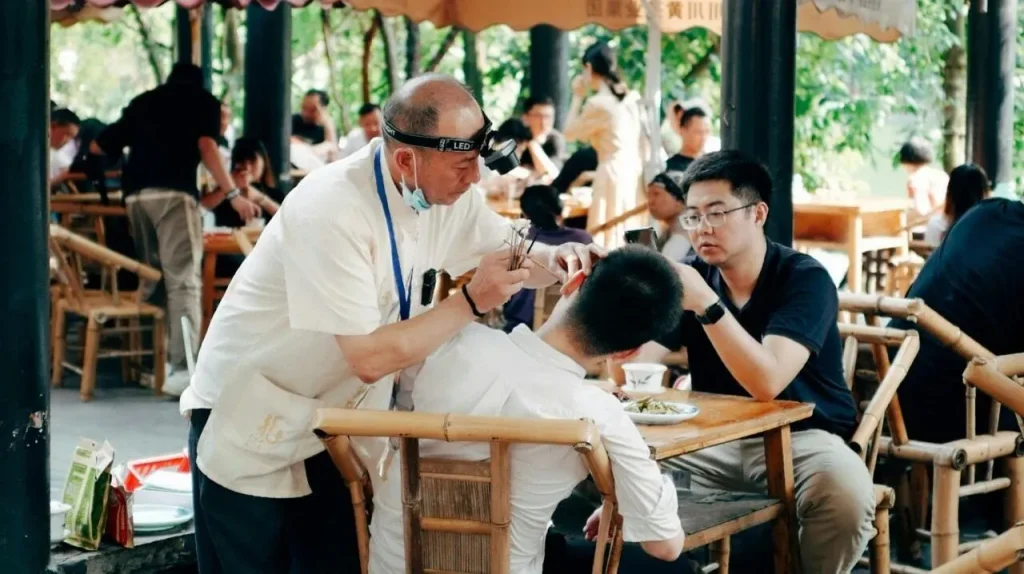
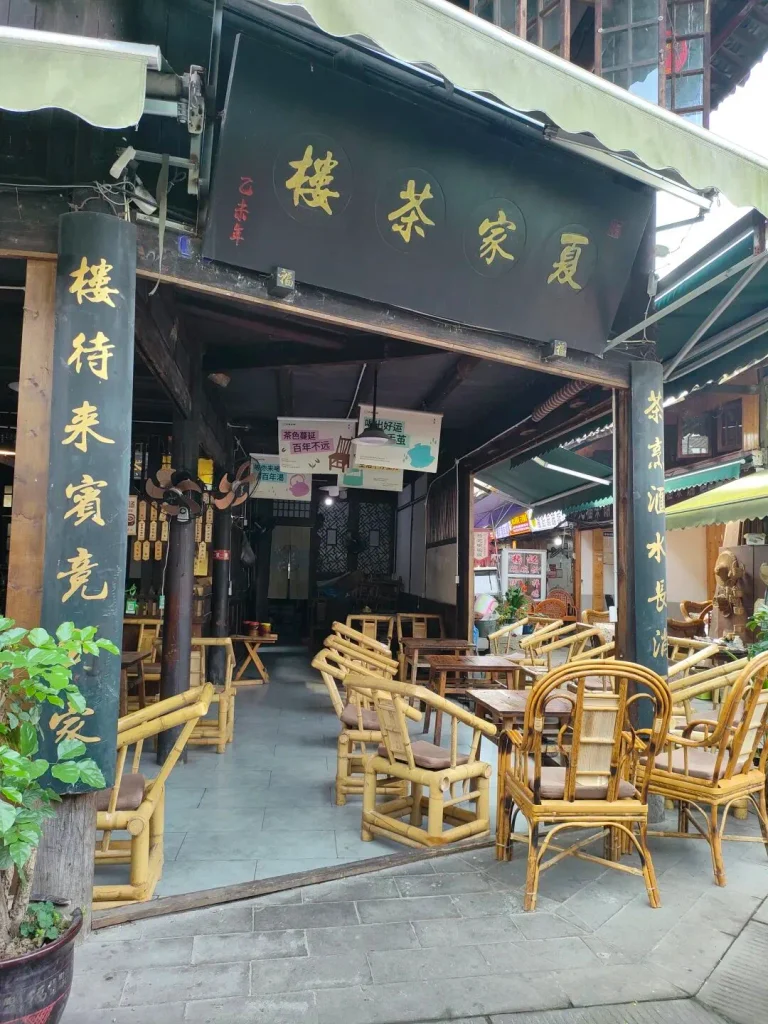
Chengdu's teahouses historically functioned as far more than places to buy tea. They became meeting rooms, entertainment venues and places where information, business and neighborhood news circulated. People came to talk, listen to storytelling, watch performances, play games or simply spend time together.
Some teahouses even served as informal places for settling local disputes. Sichuan historical records describe people bringing disagreements to a teahouse, inviting respected intermediaries and talking things through over bowls of tea. The teahouse occupied useful territory between the private home and formal institutions.
That helps explain why Chengdu's teahouse culture survived modernization. The furniture, customers and neighborhoods may change, but the fundamental purpose remains recognizable: a shared place where people have time for one another.
Not entirely. Tea is the transaction, but time, space and social life are the experience.
In a modern café, you normally order a drink, occupy a table for a while and eventually leave. Traditional Chengdu teahouses developed around a different rhythm. One bowl of leaves can be topped up repeatedly with hot water, allowing a customer to remain with the same tea for a long time.
Look around and relatively little may appear to be happening. Someone is reading. Two people are playing cards. A group nearby has been talking for an hour. Someone else may simply be leaning back in a bamboo chair watching the afternoon pass.
For travelers accustomed to tightly scheduled sightseeing, this can initially feel strangely unproductive.
After a while, you realize that is the point.
The biggest difference is not the drink. It is what the space expects from you.
| Traditional Chengdu Teahouse | Modern Café | Formal Tea Experience | |
|---|---|---|---|
| Main purpose | Social life and lingering | Drinks, work, meetings | Tea appreciation |
| Typical drink | Gaiwan tea | Coffee / modern tea | Selected specialty teas |
| Atmosphere | Informal, social, sometimes noisy | Variable | Usually quiet and structured |
| Time pressure | Usually low | Moderate | Session-based |
| Refills | Hot-water refills common | Usually another purchase | Depends on service |
| Typical seating | Bamboo chairs / simple tables | Café furniture | Dedicated tea table |
| Cultural focus | Everyday life | Contemporary lifestyle | Tea knowledge and technique |
| Best mindset | Sit and observe | Drink, work or socialize | Learn and taste |
This is why arriving at a Chengdu teahouse expecting hushed voices and an elaborate tea ceremony can produce the wrong impression.
Traditional Chengdu tea culture is often ordinary rather than ceremonial — and that ordinariness is exactly what makes it interesting.
To understand a Chengdu teahouse, start with the object sitting directly in front of you: the gaiwan (盖碗).
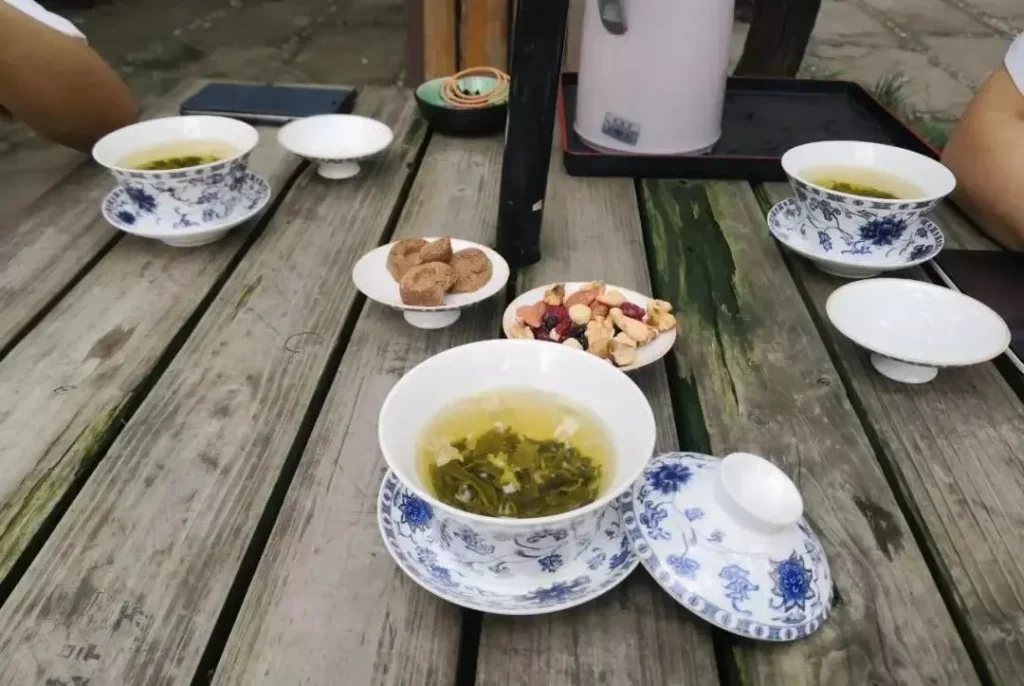
A traditional gaiwan consists of three pieces: a lid, a bowl and a saucer. In Chengdu tea culture it is also known as a sancai wan (三才碗), or “Three Talents Bowl.” The lid represents heaven, the bowl humanity, and the saucer earth — a small piece of traditional Chinese cosmology contained in an everyday object. Chengdu's official tourism information specifically describes this heaven–human–earth symbolism.
But the design is practical as well as symbolic.
| Part | Practical purpose | Traditional association |
|---|---|---|
| Lid 盖 | Retains heat, moves floating leaves aside and helps control each sip | Heaven |
| Bowl 碗 | Holds the tea and gives the leaves room to infuse | Humanity |
| Saucer 托 | Makes the hot bowl easier to hold and catches spills | Earth |
Historical Sichuan records describe essentially the same practical logic: the wide-topped bowl helps the leaves infuse, the lid can control heat and keep leaves away from the mouth, and the saucer protects the drinker's hand from the hot bowl.
There is a popular story that the saucer originated in Tang-dynasty Sichuan after the daughter of military governor Cui Ning wanted a way to hold a hot tea bowl without burning her fingers. The story has circulated widely in accounts of Chengdu tea culture, but it is better treated as a traditional origin story rather than established historical fact.
For a visitor, however, you do not need to understand any of this before taking your first sip. The gaiwan was designed to be used, not merely admired.
The technique is simpler than it looks.
Hold the saucer steadily, lift or tilt the lid slightly with your other hand, and use its edge to move floating leaves away from the part of the bowl you are drinking from. Sip slowly — the tea can be very hot.
You may see experienced drinkers gently skim the surface with the lid before drinking. There is no need to imitate every movement perfectly. After a few minutes, handling the gaiwan becomes surprisingly natural.
One useful habit is not to drain the bowl completely before a refill. Traditional descriptions of Chengdu gaiwan tea recommend leaving some tea in the bowl before adding more hot water, helping the next infusion retain its flavor.
The same leaves can therefore accompany you through multiple rounds of hot water.
That is one reason a single bowl of tea can last much longer than a cup of coffee.
Because repeated hot-water refills are part of the traditional teahouse experience.
The attendants serving tea have long been an important part of Sichuan teahouse culture. Historical sources describe skilled servers moving between tables with long-spouted kettles, quickly refilling gaiwans without spilling water. Some developed elaborate pouring techniques that turned an everyday job into a kind of performance.
You may hear such attendants described as tangguan (堂倌) or, more playfully and traditionally, chaboshi (茶博士) — literally “tea doctor.”
The dramatic long-spout pour makes a good photograph, but its original purpose is wonderfully practical: one server can move efficiently through a crowded room and refill tea without constantly picking up everyone's bowl.
The refill itself also changes the economics and psychology of the space. You are not repeatedly buying new drinks.
You are staying with the same tea.
You may encounter guides describing elaborate “secret codes” involving the position of the gaiwan lid — for example, using it to request hot water, indicate a temporary absence or signal that you have finished.
Such customs have existed in Chinese teahouse culture, but do not assume that every modern Chengdu teahouse follows exactly the same system. Practices vary by venue, generation and setting.
For a foreign visitor, there is no need to memorize a chart of lid positions before sitting down.
If you need more hot water, making eye contact with the server or politely asking is perfectly acceptable. If you are leaving your seat temporarily, make sure your intentions are clear rather than relying on a gesture that may be interpreted differently.
This is an important rule for understanding Chengdu teahouse etiquette in general:
Observe first. Keep it simple. Do not turn a relaxed local custom into an etiquette exam.
If gaiwan explains what Chengdu drinks, bai longmenzhen (摆龙门阵) helps explain what people do while drinking it.
There is no perfect English translation. It roughly means sitting together and chatting freely — telling stories, exchanging news, gossiping or allowing a conversation to wander wherever it wants. Chengdu tourism material specifically connects longmenzhen with friends gathering in teahouses over tea and conversation.
A longmenzhen does not necessarily need a purpose or conclusion. Conversation can drift from family to food, neighborhood news, football, prices, travel or something that happened twenty years ago.
The teahouse makes this easy. Nobody needs to invite everyone home, prepare a meal or organize an event.
You simply sit down over tea.
In a sense, yes — although they existed long before anyone used that term.
Before smartphones and social media, information still needed places to travel. Teahouses provided them.
People met acquaintances, discussed business, heard neighborhood news, encountered performers and exchanged information. The result was something much larger than a beverage business: the teahouse became part of the city's social infrastructure.
A useful modern analogy is to imagine a neighborhood group chat, community center, café, entertainment venue and informal meeting room occupying the same physical space.
Then add tea.
Because teahouses already possessed something performers needed: an audience with time.
People sitting for long periods created a natural setting for storytellers, musicians and performers. Historical Sichuan records describe teahouses hosting Sichuan opera singing, qingyin, storytelling, chess and other forms of popular entertainment.
Tea and performance therefore grew alongside one another rather than as completely separate activities. If you want to see how that tradition survives today, our Chengdu Sichuan Opera guide explains where to watch face-changing and what kind of performance experience to expect.
The teahouse did not need to become a theater.
The theater could come to the teahouse.
Ear cleaning is one of the details foreign visitors often associate with Chengdu, particularly after seeing it offered in outdoor or tourist-friendly teahouses.
But it is better understood as part of the wider service ecosystem that grew around places where people spent long periods. If customers were already sitting in bamboo chairs for an afternoon, food sellers, performers and small personal services naturally found an audience there.
For travelers today, ear cleaning is completely optional. You do not need to try it to have an “authentic” Chengdu teahouse experience.
Its existence is more interesting for what it reveals about the teahouse itself: traditionally, this was never merely a shop selling tea. It was a place built around people having time.
Much less than you might think.
Chengdu teahouses are generally relaxed social spaces rather than formal ceremonial environments. You do not need to memorize complex rules or perform a traditional tea ritual correctly.
A few practical habits are enough:
| Situation | What to do |
|---|---|
| Sharing a table | Ask before taking an apparently occupied seat |
| Choosing tea | Jasmine tea is an easy traditional starting point |
| Drinking from a gaiwan | Use the lid gently to move leaves aside and sip slowly |
| Getting a refill | Leave some tea in the bowl and ask or signal naturally for hot water |
| Someone pours for you | A simple “xiexie” is always enough |
| Taking photos | Avoid photographing strangers closely without permission |
| Moving furniture | Do not move another customer's chair or belongings without asking |
| Staying a long time | Usually normal — that is part of the experience |
You may also see people lightly tap the table with their fingers after tea is poured as a gesture of thanks. You can copy it if it feels natural, but you do not need to.
Most importantly, do not turn etiquette into anxiety. The purpose of a Chengdu teahouse is not to test how much you know about Chinese tea culture.
It is to make you comfortable enough to stay.
For a first experience, allow at least one hour. Two hours is even better if your itinerary permits. If you want to build a teahouse stop into a day of exploring, our Chengdu City Walk guide compares several routes rather than forcing every traveler into the same itinerary.
Twenty minutes is enough to photograph a teahouse. It is usually not enough to understand one.
At first, you notice the bamboo chairs, gaiwans and long-spouted kettles. After a while, you begin noticing relationships: who knows whom, which customers have clearly been sitting there all morning, how conversations overlap and how naturally people occupy public space without needing constant entertainment.
Eventually, you stop looking at the teahouse and begin looking at Chengdu from inside it.
That transition is the experience.
No. Treating it that way misses the most interesting part.
Modern Chengdu is a huge city of metro lines, office towers, smartphones, delivery riders, shopping malls and technology companies. Traditional teahouses exist inside that modern city rather than outside it.
A smartphone beside a gaiwan is not necessarily evidence that the old culture is disappearing. It may be evidence that the tradition has remained useful enough to adapt.
That is what makes Chengdu's teahouses more interesting than a reconstructed historical attraction. If you are also visiting Kuanzhai Alley, it helps to treat the two experiences differently: the historic district is a sightseeing stop, while a working teahouse is somewhere to slow down and observe everyday life.
The culture changed without disappearing.
A visit to the Chengdu Panda Base tells you something about Sichuan's wildlife. Pandas tell you something about Sichuan's wildlife. Chengdu hot pot tells you something about its appetite. Temples and museums reveal layers of its history.
A teahouse reveals how Chengdu lives.
It shows a city comfortable with shared public space, where different generations can occupy the same room and where conversation does not always need a purpose. It also demonstrates how tradition can survive without becoming a museum exhibit.
That may be the most important distinction for an overseas visitor:
Chengdu's teahouses are not simply performances of local culture. They are places where local culture continues to happen.
Yes. Tea appreciation is not really a prerequisite.
If you are interested in understanding everyday Chengdu rather than simply seeing its attractions, spending an unhurried hour in a traditional teahouse can reveal something that another rushed sightseeing stop cannot.
Do not go because you need to taste the finest tea in Sichuan.
Go because sitting there changes the way you see the city.
Order something simple. Put your phone away for a while. Listen to porcelain lids touching bowls, conversations drifting between bamboo chairs and kettles returning with hot water.
Nothing dramatic may happen.
That is precisely the point.
You are not doing nothing. You are learning how Chengdu lives.
Once you understand what a Chengdu teahouse actually is, choosing one becomes much easier. Some places are better for old-neighborhood atmosphere, some for traditional architecture, some for performances, and others simply make an easy first stop for travelers.
Rather than duplicating those recommendations here, see our dedicated Chengdu teahouse guide for specific teahouses, prices, locations, transport and what each place is actually like.
This article explains why Chengdu teahouses matter. That guide helps you decide where to experience one.
For smaller neighborhood teahouses, save the Chinese name and address before you go; our China navigation app guide explains why relying on Google Maps alone can be frustrating in China.
Chengdu teahouse culture is an everyday social tradition centered on gaiwan tea, conversation and spending time together. Historically, teahouses also served as meeting spaces, entertainment venues and places for information exchange.
A gaiwan is a three-piece Chinese tea vessel consisting of a lid, bowl and saucer. In Chengdu tea culture, the three parts are traditionally associated with heaven, humanity and earth.
Hold the saucer, gently tilt the lid to move floating leaves aside and sip from the bowl. The tea may be very hot, so drink slowly. The same leaves can normally be infused several times.
Bai longmenzhen (摆龙门阵) roughly means sitting together and chatting freely — telling stories, exchanging news or simply talking without a fixed agenda. It is closely associated with Chengdu teahouse life.
No. Basic courtesy is enough. You do not need to master formal tea ceremony or memorize traditional gaiwan signals before visiting a Chengdu teahouse.
No. Some famous teahouses attract many visitors, but teahouse culture itself remains part of everyday Chengdu life. The important distinction is between visiting a teahouse as scenery and spending enough time there to observe how the space is actually used.
This guide focuses on how Chengdu teahouse culture works and what it reveals about the city, rather than ranking individual teahouses. Historical customs vary by period and venue, so traditional stories and etiquette have been separated from practices travelers can reasonably expect today. Specific teahouse recommendations, prices and transport details are covered in TripChina's separate teahouse guide.