Our Location:
No. 99, Jiazi Road, Chengdu

 authorChris Lee
After several days of walking, sightseeing, unfamiliar food and disrupted sleep, many travelers eventually want one thing from their itinerary:
a slower half-day.
In Chengdu, that break can become part of the travel experience itself.
Instead of simply booking another spa massage, you can see how tuina (推拿) works inside a Chinese medical setting, spend a few hours around tea and traditional wellness culture, combine Mount Qingcheng with Taoist traditions, or — if you are staying longer — arrange a routine health check.
The point is not to turn your holiday into a medical trip.
It is to use something Chengdu already does well to add rest, recovery time, cultural depth or practical health awareness to a trip you were taking anyway.
And many of these experiences take only a few hours.
Medical note: This guide is for travel planning and general information. TripChina does not diagnose medical conditions or recommend treatments. Medical TCM, health screening and other healthcare decisions should be discussed with an appropriately qualified healthcare professional.
It can be — if you choose the right type of experience.
The biggest mistake is treating everything labeled “Chinese wellness” as the same thing.
| What you actually want | Better fit | Time to allow |
|---|---|---|
| Relax after several sightseeing days | Reputable massage / spa | 60–90 min |
| Experience traditional Chinese manual therapy | Licensed TCM institution | 1–2 hrs |
| Understand TCM culture without treatment | Cultural / herbal experience | 1–3 hrs |
| Combine wellness with sightseeing | Qingcheng / Dujiangyan / Pengzhou | Half or full day |
| Slow overnight break | Hot-spring / wellness stay | Half day–overnight |
| Routine preventive screening | Health-check provider | Usually a morning |
| Help with an existing medical concern | Appropriate hospital | Varies |
That distinction matters.
If your legs are simply tired after walking 20,000 steps around Chengdu, you probably do not need a hospital.
If you are curious about how tuina is actually practiced as part of Chinese medicine, a licensed TCM institution makes more sense.
And if you want a routine health check, treat it as a separate practical appointment rather than another “Chinese experience.”
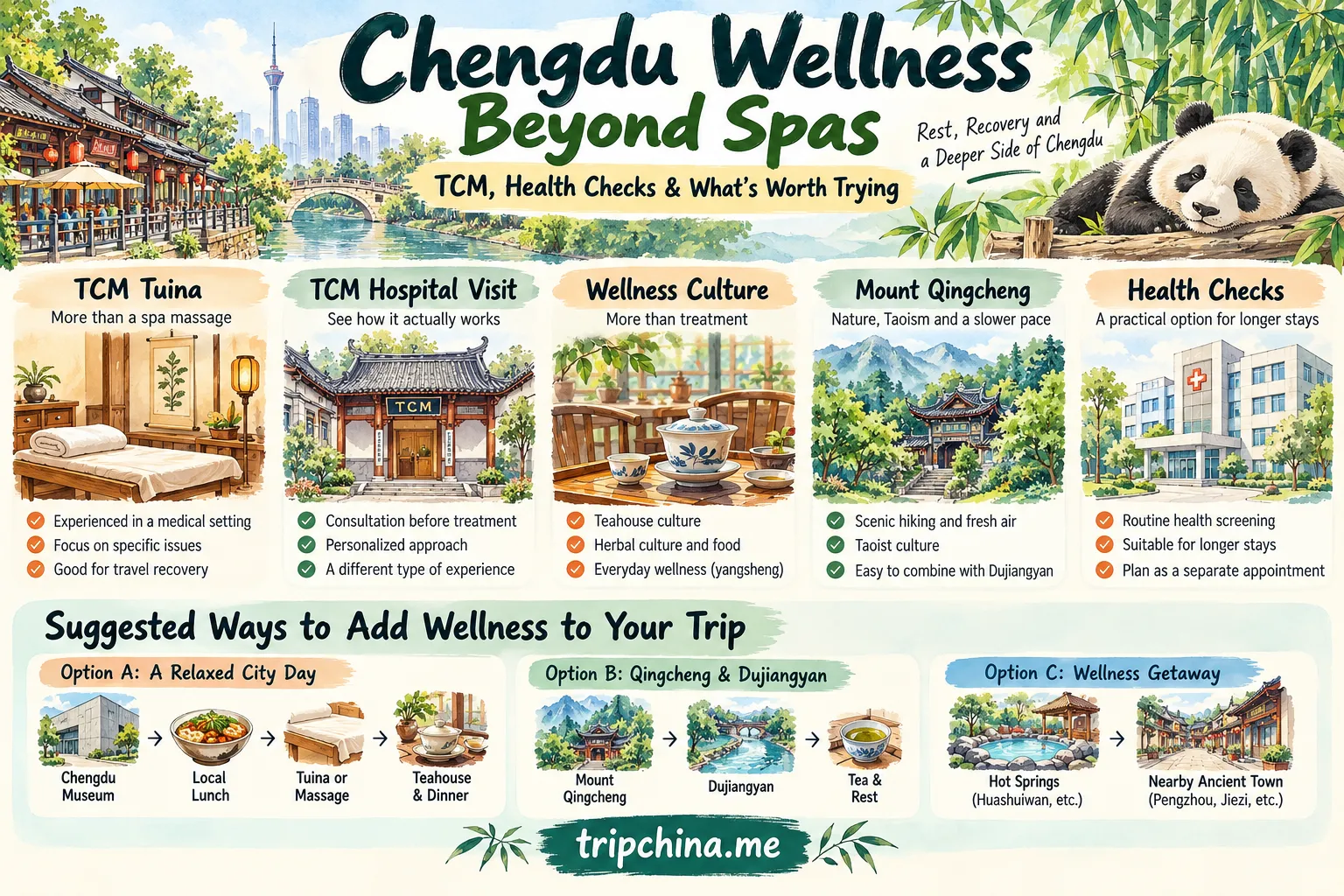
Tuina (推拿) is often translated simply as “Chinese massage,” but that translation can be misleading.
A normal massage shop or spa primarily provides relaxation.
Tuina performed in a Chinese medical institution takes place in a healthcare setting. You may first be asked about discomfort, previous injuries and other relevant health information before a practitioner decides whether manual treatment is appropriate.
The session itself may also feel different.
Rather than a continuous full-body massage, attention may be concentrated on particular areas.
Because it does not necessarily require sacrificing a sightseeing day.
A traveler staying around central Chengdu could spend the morning sightseeing, leave a quieter afternoon for a pre-arranged appointment, and still have the evening free.
For someone who has already spent several days walking through museums, old streets and scenic areas, that slower afternoon can also provide something many overloaded China itineraries lack:
time to rest.
That alone can be valuable.
Just don't turn relaxation into a medical claim. Tuina should not be presented as a guaranteed treatment for jet lag, poor sleep, back pain or travel fatigue.
This is simpler than it sounds.
Choose a spa or reputable massage business when your main goal is relaxation.
Choose a licensed TCM medical institution when you specifically want to experience or receive medical TCM.
Choose an appropriate hospital department when you have actual symptoms or an existing medical concern.
Do not go to a hospital simply because you assume:
hospital massage = stronger = better.
And don't ask for painful manipulation because it seems more “authentically Chinese.”
More painful does not mean more effective.
This is one of the details many English-language travel guides skip.
You may expect:
walk in → massage → leave
but a medical visit can be closer to:
registration → consultation → assessment → payment → treatment
The practitioner may ask where you feel discomfort, how long it has been present, whether you have previous injuries and whether you have relevant medical conditions.
Traditional Chinese medicine may also describe health using concepts such as qi, meridians and pattern differentiation.
These belong to the traditional theoretical framework of TCM and should not automatically be interpreted as established mechanisms in modern anatomy or physiology.
轻一点,谢谢。
Qīng yìdiǎn, xièxie.
A little gentler, please.
这里疼。
Zhèlǐ téng.
It hurts here.
我以前受过伤。
Wǒ yǐqián shòuguò shāng.
I have had an injury before.
The first phrase is particularly useful.
If something hurts or feels wrong, say so. You do not need to tolerate excessive pressure because you think that is how tuina is “supposed” to feel.
One established option in central Chengdu is Sichuan Provincial Second Hospital of Traditional Chinese Medicine (四川省第二中医医院).
It is a public Grade 3A TCM hospital in Qingyang District with established TCM specialty resources and traditional medical inheritance programs.
For a traveler, however, the useful question is not:
“Is this the best TCM hospital in Chengdu?”
A better set of questions is:
Can I register with my passport?
Which department handles what I want?
Do I need an appointment?
Can someone assist me in English?
How much time should I allow?
What are the current fees?
These practical details can change and can matter more to a foreign visitor than another long list of hospital credentials.
If navigating Chinese hospital websites or phone systems becomes the difficult part, TripChina can help check practical information such as foreign-passport registration, current availability and booking procedures before your trip.
Treatment decisions remain between you and the healthcare provider.
These are familiar images of Chinese medicine, but they should not be collected like tourist stamps.
Acupuncture (针灸) involves needles and should be treated as healthcare.
Cupping (拔罐) commonly leaves temporary circular marks or bruising.
Gua sha (刮痧) can also produce visible redness or bruising.
That last point matters more than it sounds.
If you are planning a swimming day, spa stay, formal event or photos shortly afterward, visible marks may be inconvenient.
And if you are flying to Chengdu for tourism, there is no reason to book acupuncture, cupping and gua sha all together simply to say you have “tried TCM.”
Choose experiences because they make sense for you, not because they make a better checklist.
Tell the healthcare provider before treatment if you are pregnant or may be pregnant, have a recent fracture or acute injury, significant osteoporosis, a bleeding disorder, take anticoagulant medication, have an open wound or skin infection, or have another relevant medical condition.
This is not a complete contraindication list.
And there is an important dividing line for travelers:
wellness should never delay necessary medical care.
Chest pain, breathing difficulty, serious injury, neurological symptoms or other significant unexplained symptoms require appropriate medical assessment rather than a massage appointment.
This is where Chengdu becomes much more interesting.
Traditional health culture here is not confined to hospitals.
Chengdu's teahouse culture, medicinal plants, food traditions, Taoist culture, hot springs, exercise and everyday ideas about balancing work and rest all overlap with the much broader Chinese idea of yangsheng (养生) — literally, “nourishing life.”
For a traveler, this can be more approachable than medical TCM.
You can experience the culture without having needles inserted, taking herbal medicine or receiving any treatment at all.
And several options fit naturally into places you may already be visiting.
This is exactly the kind of experience that works well for TripChina readers because it requires almost no extra itinerary time.
Du Fu Thatched Cottage is already one of Chengdu's major cultural attractions.
Recent projects there have connected Du Fu's historical relationship with medicinal plants to herb gardens, traditional herbal scenes, cultural products, drinks and hands-on activities.
You do not need to regard a herbal drink as medicine to enjoy this.
The value is cultural:
poetry + plants + traditional Chinese ideas about food and wellbeing.
Instead of adding another attraction, you are seeing an attraction you already planned to visit from a different angle.
Extra time needed: minimal.
If you already plan to visit Mount Qingcheng, don't think of Chinese wellness as another item you need to squeeze into your schedule.
It is already embedded in the destination.
Qingcheng is closely associated with Taoism, and the wider Dujiangyan area has been developing experiences around Taoist culture, tai chi, wellness traditions, local food and relaxation.
This gives you a much more coherent day than:
temple → photo → bus → next attraction.
A slower version can be:
mountain → Taoist culture → tea / local meal → quiet evening
or, where suitable experiences are available:
morning tai chi → Qingcheng sightseeing → tea → hot spring / hotel
The benefit here is primarily the pace.
China itineraries can become exhausting surprisingly quickly. A Qingcheng day can still be culturally substantial without feeling like another urban sightseeing marathon.
Travelers visiting Xiling Snow Mountain can consider Huashuiwan as an overnight extension rather than rushing directly back to Chengdu.
The area is known for hot-spring resorts, and some properties combine hot springs with Chinese wellness elements, food and related services.
A winter itinerary could therefore look like:
Xiling Snow Mountain → Huashuiwan → hot spring → overnight stay → Chengdu
That is different from inserting a random “wellness attraction” into the trip.
You were already traveling through the area; the overnight stop simply gives your body and schedule some recovery time.
Just keep the categories clear.
A hot spring is a leisure experience. If a resort separately offers acupuncture, medical tuina, moxibustion or another healthcare service, check who provides it before booking.
For repeat visitors, Pengzhou offers something different.
The attraction is less about receiving treatment and more about seeing how traditional herbal culture is being turned into contemporary lifestyle.
Newer TCM-themed spaces combine medicinal-plant culture with markets, exhibitions, drinks, food, cultural products and wellness-related goods.
You may encounter everything from traditional herb displays to herbal-inspired coffee and modern products built around old ingredients.
Some of it is traditional.
Some of it is very modern.
And that contrast is precisely what makes it interesting.
It shows that Chinese wellness culture is not frozen in an ancient pharmacy. It is still evolving — sometimes seriously, sometimes commercially, and sometimes rather playfully.
Worth a special trip?
For a first-time Chengdu visitor with only three days, probably not.
For a repeat visitor or someone genuinely interested in Chinese herbal culture, potentially yes.
That is the kind of distinction a useful travel guide should make.
Jiezi Ancient Town has historical connections with Song Dynasty pharmacologist Tang Shenwei and has incorporated that connection into newer herbal and TCM cultural experiences.
Again, don't visit purely because somebody labels it a “wellness destination.”
Visit if the combination appeals to you:
old town + local history + medicinal plants + food + slower pace.
That makes considerably more sense than traveling there solely for one TCM-themed activity.
| Your Chengdu trip | What makes sense |
|---|---|
| First trip, only 2–3 days | Keep it simple: tea, Du Fu Cottage or a massage |
| 4–5 days | Consider a pre-arranged tuina experience |
| Already visiting Qingcheng | Add a slower wellness/Taoist element |
| Visiting Xiling Snow Mountain | Consider Huashuiwan overnight |
| Repeat Chengdu visitor | Pengzhou or Jiezi becomes more interesting |
| Staying a week or longer | A routine health check becomes easier to fit in |
| Existing medical concern | Use an appropriate healthcare provider |
This is an important TripChina principle:
Don't add an experience simply because it exists.
A good China itinerary is not the one with the most activities.
It is the one where the experiences fit together.
Yes — and this can make sense for some longer-stay visitors.
China has a large health-screening industry, with both hospitals and dedicated health-management providers offering routine examinations.
But this is where “more for your money” can become misleading.
A package containing dozens of tests may look like extraordinary value compared with prices in another country.
That does not mean you need every test.
More screening can produce false positives and incidental findings, while CT involves ionizing radiation.
So don't buy the biggest package simply because it looks cheap.
A better question is:
What screening is actually appropriate for me?
That is a medical question, not a travel-shopping question.
For travelers who value international-patient support, West China Hospital has a dedicated international medical pathway.
Current official contact information includes:
Appointment: +86-28-85422408
Inquiry: +86-28-85421283
International appointment email: [email protected]
Verify current details before using them.
The advantage for an international traveler is straightforward: navigating passports, appointments, medical terminology, insurance and follow-up can be easier when an international-patient system already exists.
But don't assume:
International Medical Center = walk-in tourist checkup.
Contact the center before your trip.
For travelers who want routine screening rather than hospital treatment, a dedicated health-check provider such as iKang may offer a more straightforward appointment-based experience.
The key word is may.
Before choosing a specific Chengdu location, check:
Passport accepted?
English assistance?
English report available?
Fasting required?
How long will it take?
When is the last blood draw?
Do not assume every branch handles foreign visitors in exactly the same way.
For a traveler, this is often more important than price.
A routine package may fit into one morning.
More extensive testing, imaging, specialist consultations or follow-up may not.
So if you are staying in Chengdu for several days:
good: health check early in your stay → sightseeing afterward → time available if follow-up is needed.
bad: health check at 8 a.m. → flight home at 3 p.m.
An unexpected result can create questions that require discussion or further testing.
Give yourself some breathing room.
If you're planning a longer Chengdu stay, choosing a convenient base can also make early-morning appointments much easier. See our Chengdu accommodation guide for the best areas to stay.
Possibly.
Many packages involving blood tests or abdominal ultrasound require fasting, but requirements depend on the tests.
Ask before the appointment:
Can I eat?
Can I drink water?
Should I take my normal medication?
What time should I arrive?
When is the final blood-draw time?
Never change prescribed medication simply because you assume a health check requires it. Ask the healthcare provider.
Do not assume so.
An international medical department may be more likely to provide English assistance or documentation, but the exact service varies.
Ask before paying:
Can you issue my final report in English?
If the answer is no, ask whether an English summary, translated laboratory results or formal translation service is available.
A phone translation app is fine for finding the blood-test room.
It is not what you want to rely on for understanding a significant abnormal result.
Sometimes, but routine screening and elective wellness services are often treated differently from unexpected illness or injury.
Do not assume that having international insurance means:
hospital accepts it + direct billing works + routine checkup is covered.
Those are three separate questions.
Confirm them with your insurer before the appointment if reimbursement matters.
The easiest approach is not to create a separate “medical tourism day.”
Instead, use quieter parts of your existing itinerary.
Morning: a Chengdu museum / People's Park
Lunch: local lunch
Afternoon: pre-arranged massage or TCM visit
Evening: tea, dinner or early night
Keeping the day within central Chengdu also makes it easier to move between sightseeing and a pre-arranged appointment; see the Chengdu metro guide for foreign travelers if you are planning the route yourself.
Morning: Mount Qingcheng
Afternoon: Taoist culture, tea or a slower wellness activity
Evening: Dujiangyan or overnight nearby
Morning: pre-arranged routine health check
Afternoon: rest / light sightseeing
Next days: normal Chengdu itinerary
Day: Xiling Snow Mountain
Evening: Huashuiwan hot spring
Night: stay locally
Next morning: return to Chengdu
Notice what all four have in common:
wellness fills the natural slow periods of the trip rather than competing with sightseeing.
That's the real value.
Generally, yes, but registration procedures vary. Bring your passport and check the current appointment process before visiting.
Not necessarily.
They serve different purposes. A spa massage is primarily about relaxation; hospital-based tuina takes place in a medical context.
Do not treat tuina as a proven cure for jet lag.
If massage helps you relax during a slower afternoon, that can still make it an enjoyable part of the trip without making a medical claim.
Yes — and for many travelers this may be the better introduction.
Herbal gardens, cultural exhibitions, tea, traditional food culture, workshops and Taoist wellness traditions can all provide context without becoming medical treatment.
Usually not if you only have two or three days in Chengdu.
For travelers staying longer, it becomes much easier to fit a morning checkup into the itinerary without sacrificing major sights.
Not simply because it contains more tests.
Screening should be appropriate to your circumstances.
Foreign patients can use passports at providers that accept international patients, but procedures vary. Confirm with the specific institution.
Discuss it with an appropriately qualified clinician.
Request copies of laboratory results, imaging and relevant medical records if you may need follow-up after returning home.
Herbal medicine should not be treated like an ordinary souvenir.
Tell the practitioner about medications you take and relevant health conditions before using herbal medicines.
Say:
轻一点,谢谢。
Qīng yìdiǎn, xièxie.
A little gentler, please.
You can also ask the practitioner to pause or stop.
For most travelers, the difficult part is not understanding that Chengdu has TCM and health-check services.
It is dealing with the details:
Which type of place do I need? Can they register my passport? Do they speak English? How do I book? How much time should I leave? Can it fit naturally into my itinerary?
If Chinese-language booking systems make that difficult, TripChina can help check current practical information and communicate with relevant providers before your trip.
Send us:
your Chengdu dates + what you're interested in + whether you need English assistance.
We'll help check the practical options.
TripChina is a travel information and coordination service, not a healthcare provider. We do not diagnose medical conditions, recommend treatments, determine which medical tests are appropriate or interpret medical results. Medical services are provided independently by the relevant licensed healthcare provider.
This guide was reviewed in September 2026 using official government, hospital and healthcare-provider information.
TripChina distinguishes between cultural wellness experiences and healthcare. We do not endorse unverified therapeutic claims. Hospital procedures, prices, English support, insurance arrangements, experience schedules and report formats can change.
Where medical assessment or treatment is involved, decisions should be made between the traveler and an appropriately qualified healthcare professional.