Our Location:
No. 99, Jiazi Road, Chengdu

 authorChris Lee
Most first-time visitors come to Chengdu thinking about pandas, hotpot, and teahouses.
Bamboo weaving in Chengdu rarely makes the first itinerary.
But once you have seen the pandas, sat down with a gaiwan of tea, and started looking for something quieter and closer to everyday Sichuan culture, bamboo weaving becomes surprisingly worthwhile.
The first thing you discover is that it is nowhere near as easy as it looks.
A few bamboo strips lie on the table. The pattern seems simple: over, under, over, under.
Then one strip slips. The pattern bends. Pull too tightly and the whole shape changes; leave it too loose and the structure refuses to hold.
Meanwhile, the artisan beside you may glance over, move their fingers a few times, and quietly bring everything back into line.
That small moment often explains more than a long lecture about “intangible cultural heritage.”
It shows you why someone might spend decades training their hands.
Around Chengdu, you can join a simple city workshop, travel to a bamboo-art village in the countryside, watch raw bamboo become weaving strips, or see how an old rural craft has moved into tea ware, lighting, jewelry, furniture, and contemporary design.
This guide is not meant to turn you into a bamboo-weaving expert.
It is here to answer the questions that actually matter when you are traveling:
Where should you go? Is it worth the time? Can you do it without speaking Chinese? Do you need any craft skills? And should you book ahead?
| What to Know | Quick Answer |
|---|---|
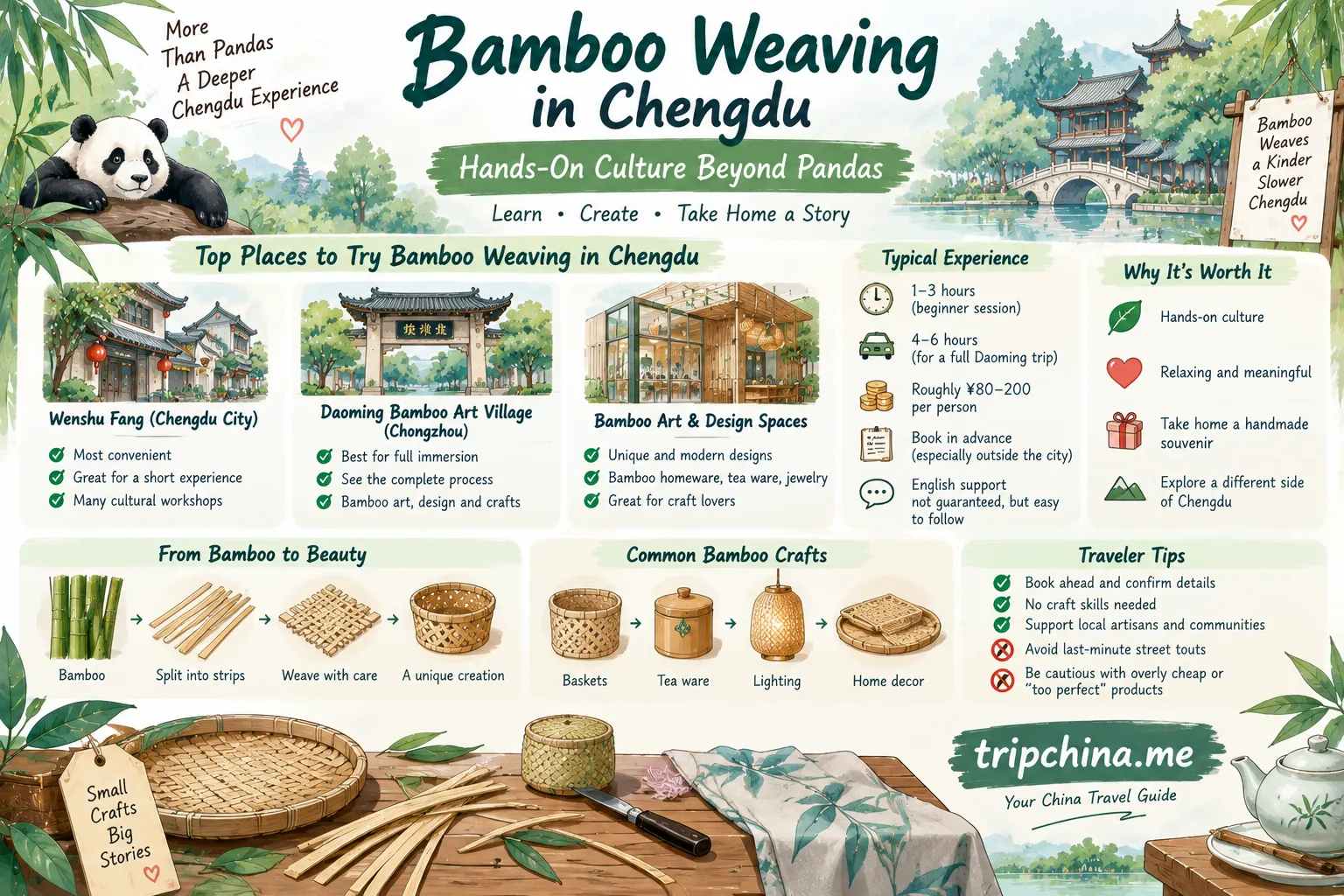
| Best for a first experience | A pre-booked city workshop or Daoming Bamboo Art Village |
| Most convenient | Cultural spaces around Wenshu Fang |
| Best overall immersion | Daoming Bamboo Art Village in Chongzhou |
| Best for design and craft lovers | Specialist bamboo-art spaces in Daoming |
| Inclusive creative-employment option | Public events connected with the Rongguang Beautiful Workshop network |
| Typical beginner session | Around 1–3 hours |
| Full Daoming trip | Allow at least 4–6 hours including transport |
| Typical beginner budget | Roughly ¥80–200 per person; confirm when booking |
| Booking | Strongly recommended, especially outside central Chengdu |
| English support | Not guaranteed, but beginner weaving is highly visual |
For travelers searching for a bamboo weaving Chengdu experience, the choice usually comes down to one question: do you want a short city workshop, or do you want to spend half a day understanding the craft in a wider rural setting?
Information checked to September 2026. Small workshops often change schedules, prices, instructors, and activity formats, so confirm a specific session if the hands-on experience is an important part of your trip.
What makes bamboo weaving different from many traditional-cultural experiences is that you do not need much background knowledge to appreciate it.
You understand it through your hands.
Bamboo looks hard, yet once split into thin strips it becomes remarkably flexible. A repeated pattern looks simple, but keeping it even requires constant control.
That feeling—when your hands finally understand something your eyes thought was easy—is part of the appeal.
Many cultural experiences are mainly about looking.
Bamboo weaving is different.
For a short while, you begin working in the way an artisan works.
That is also why a slightly uneven coaster you made yourself can end up meaning more than a perfectly finished souvenir bought from a shop.
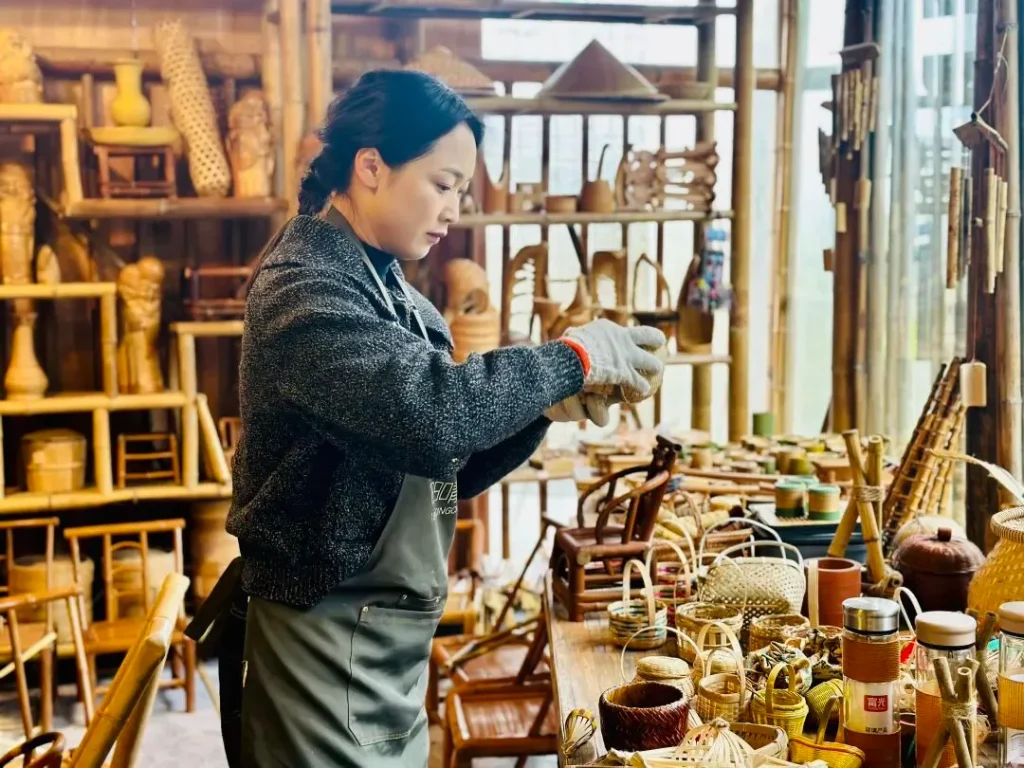
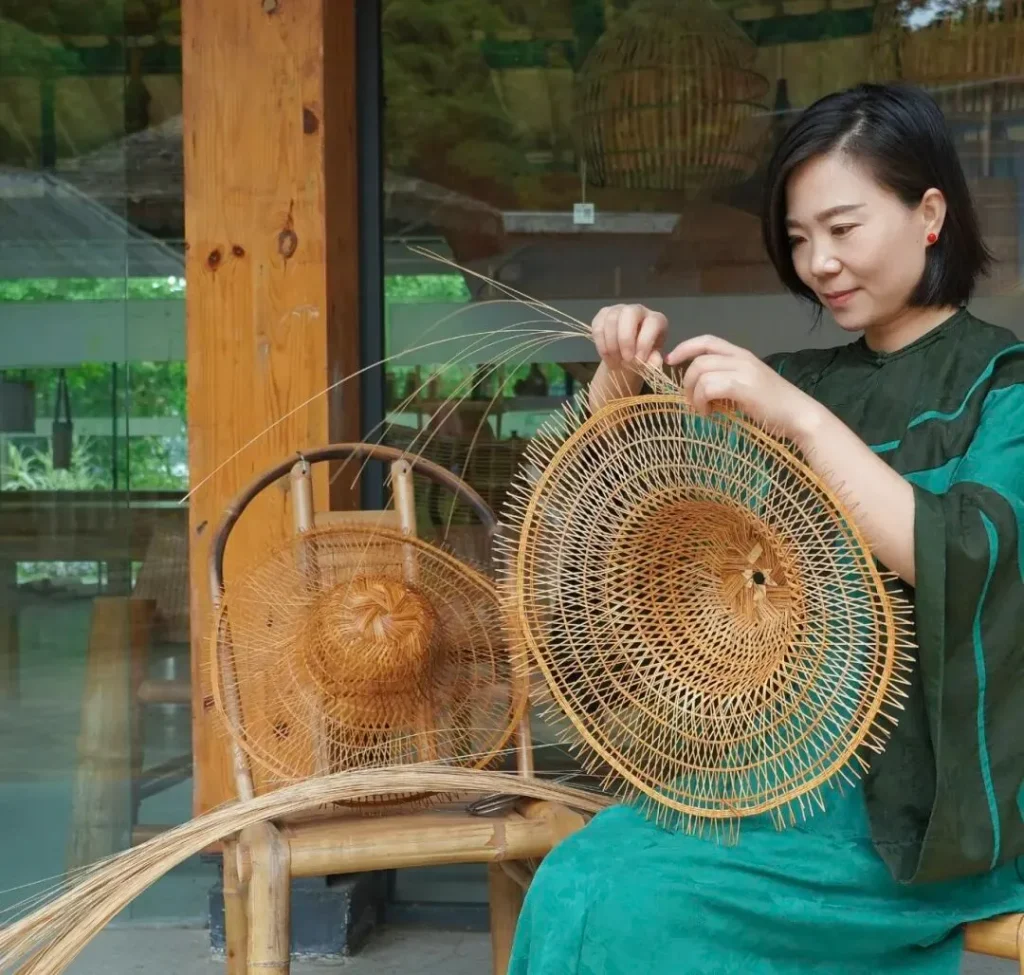
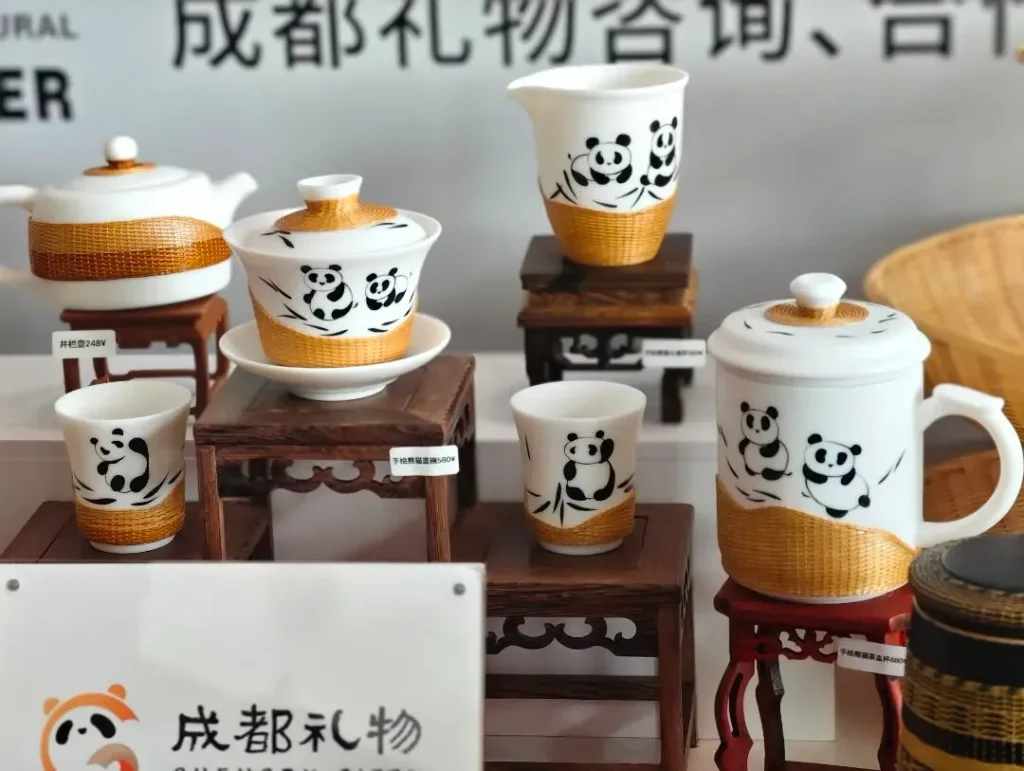
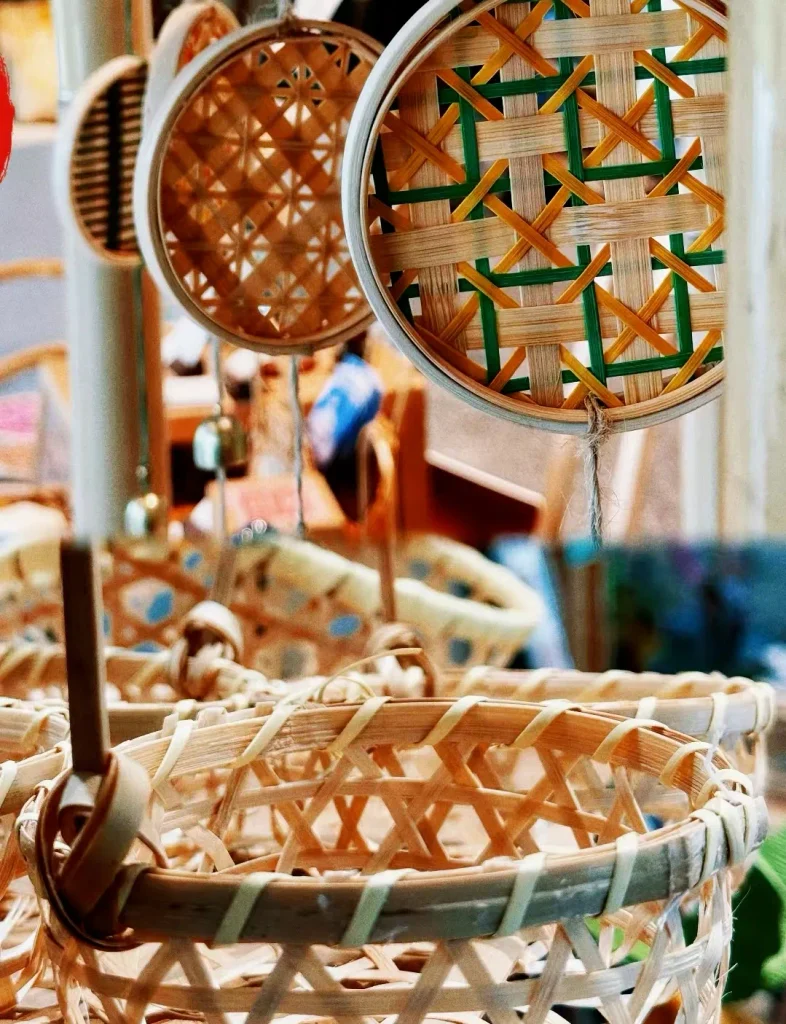
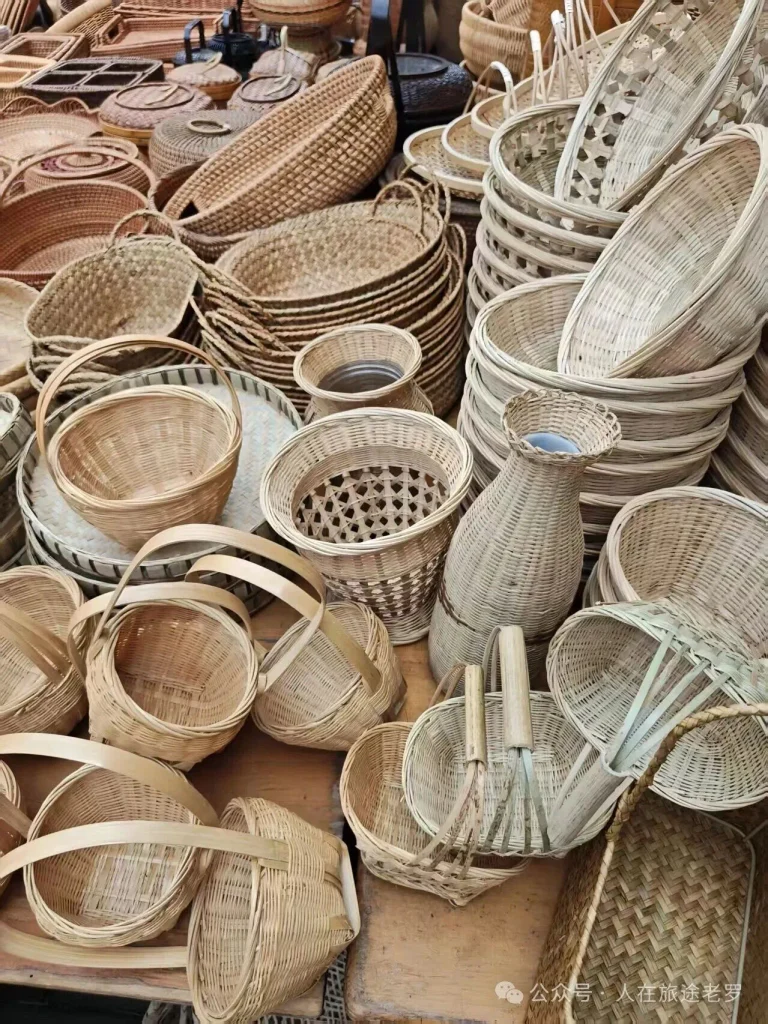
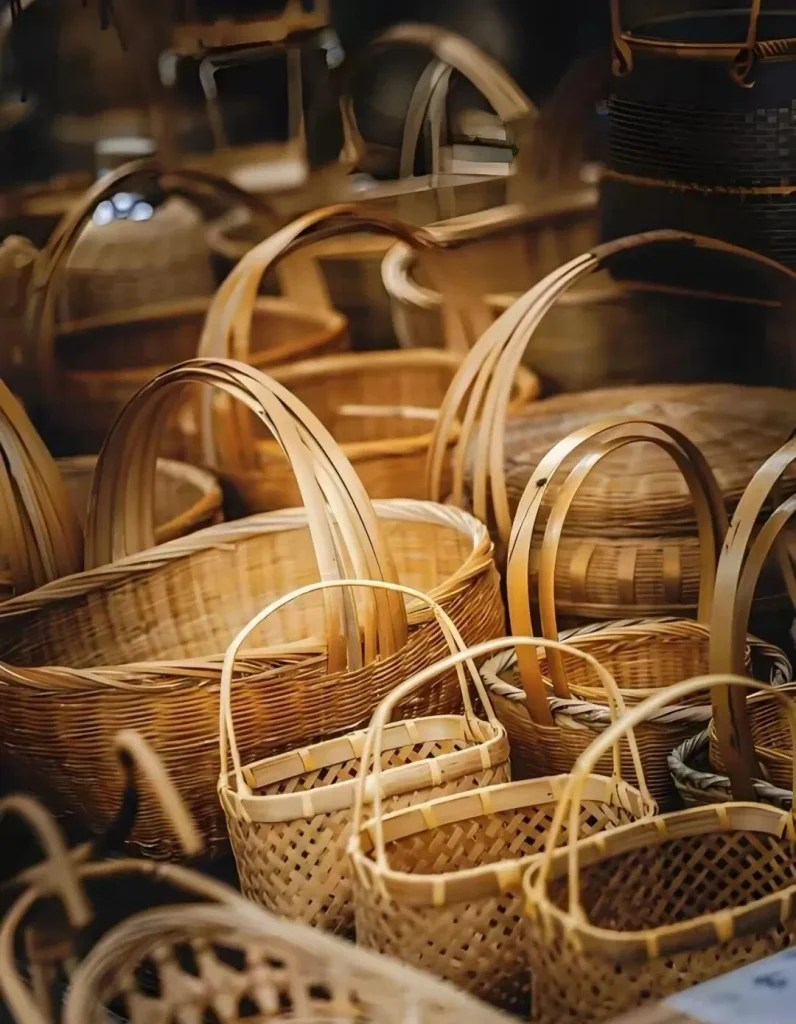
Bamboo weaving exists across many parts of China, so it would be misleading to present the craft as uniquely Sichuan.
What makes Sichuan distinctive is the close relationship between bamboo, the local environment, everyday rural life, tea culture, and Chengdu’s long tradition of skilled handicrafts.
The Chengdu Plain and western Sichuan are warm, humid, and rich in bamboo. One important local material is cizhu (慈竹), valued for its flexibility and for the way it can be split into fine strips.
Historically, woven bamboo was first practical rather than decorative. People used it for baskets, carrying frames, sieves, trays, containers, and farm tools.
Over time, the same material knowledge moved into finer craft and, today, into tea ware, lighting, jewelry, furniture, and contemporary design.
The actual weaving is only one stage.
A bamboo pole may need to be selected, cut, scraped, split, divided into thinner layers, refined into strips, dried, dyed, and finally woven.
Traditional Daoming bamboo work can involve more than 20 preparation and production steps.
Most visitor workshops skip the dangerous knife work and give you pre-prepared strips.
That is a good thing.
But if possible, ask to watch an artisan split and prepare bamboo first.
Seeing a thick bamboo pole gradually become thin, even strips makes the finished work much easier to appreciate.
At one end are sturdy household baskets.
At the other, bamboo can become so fine that it resembles textile.
One distinctive Chengdu tradition is porcelain-cased bamboo weaving, or citai zhubian, where fine bamboo strands are woven closely around porcelain vessels.
You do not need to study every regional school before your trip.
A simple comparison is enough:
At one end of Sichuan bamboo craft is a farmer’s basket. At the other, bamboo becomes fine enough to look as though someone is weaving fabric around porcelain.
That contrast gives you enough context to appreciate what you see in a workshop without turning your trip into a craft-history lesson.
Bamboo weaving suits travelers who enjoy traditional craft, design, slower travel, local culture, or making something with their own hands.
It is especially appealing if you have already visited Chengdu once, or if another crowded photo stop is not what you want from the day.
This is also one of the better bamboo weaving Chengdu experiences for travelers who want to do something rather than simply look at another attraction.
It is less of a priority if this is your first 48 hours in Chengdu and you have not yet seen the pandas, visited a teahouse, eaten hotpot, or explored the city center. If you are still deciding how to spend your limited time, our Chengdu Citywalk Guide can help you choose a route before committing half a day to a craft experience.
And if you genuinely dislike sitting still and doing repetitive handwork, there is no reason to force yourself to enjoy it simply because it is “intangible heritage.”
Cultural travel is not homework.
Bamboo weaving is not a must-see Chengdu attraction.
That is exactly why it can be rewarding.
It works best for travelers who are moving from simply seeing Chengdu toward wanting to touch a small part of how Chengdu culture is made.
If you are looking for a bamboo weaving Chengdu workshop, the options are easiest to understand in three groups:
a short city experience, a deeper visit to Daoming, or a contemporary creative-employment space.
You do not need to visit every workshop or collect every regional style.
If you only have an hour or two, staying in the city is the easiest choice.
The Wenshu Fang area has long had traditional crafts and intangible-heritage spaces, including bamboo-related cultural activities.
Past visitor projects have included small pieces such as bamboo brooches, necklaces, and coasters.
The main advantage is convenience.
You can combine a short bamboo-weaving activity with Wenshu Monastery, the surrounding streets, and a teahouse in the same half day.
But do not assume a workshop runs every day.
Some activities depend on instructor schedules, group bookings, school programs, or special events.
If making something yourself matters, confirm the session beforehand.
If you are willing to give bamboo craft half a day—or even most of a day—Daoming Bamboo Art Village offers a much fuller experience.
It lies in Chongzhou, west of Chengdu.
Daoming’s real value is not one famous master or one particular workshop.
It is the place as a whole.
Here, bamboo becomes part of the landscape.
You can encounter bamboo groves, village life, traditional objects, contemporary work, workshops, public installations, bamboo-inspired architecture, tea, food, and rural leisure spaces.
That is why I prefer to think of Daoming as a representative Sichuan bamboo-art destination, rather than one “must-visit shop.”
For most travelers, there is no need to chase a specific master workshop.
If you are a designer, researcher, or serious craft collector, arranging a specialist visit can make sense.
If the tea side of Chengdu culture interests you just as much as the craft, our guide to Chengdu’s local teahouses explains where the city’s tea culture feels most distinctive.
Allow at least 4–6 hours for the complete outing from central Chengdu.
A relaxed plan might be:
arrive → explore the village → watch bamboo preparation → join a workshop → lunch or tea → browse contemporary bamboo design → return to Chengdu
Daoming does have cafés, guesthouses, design spaces, and tourism facilities.
But that does not mean the bamboo tradition is artificial. Tourism has simply added new ways to present and support an older local craft.
If you prefer a quieter experience, visit on a weekday and avoid major Chinese public holidays, when popular countryside destinations can be much busier.
A dedicated Daoming Bamboo Art Village guide can go deeper into the half-day itinerary, transport choices, village layout, and what is worth seeing beyond the workshops. For this main bamboo weaving Chengdu guide, the important point is simpler: choose Daoming when you want the craft to feel like part of a place, not just a one-hour class.
Pingle and other places around Chengdu also have links with refined bamboo traditions, including porcelain-cased bamboo weaving.
If your itinerary already takes you there, it can be worth paying attention to the craft.
But most international visitors do not need to design an entire trip around every regional bamboo tradition.
If you simply want one good experience, a city workshop or half a day in Daoming is enough.
Rongguang Beautiful Workshop is not a bamboo-weaving brand.
Nor is it a single tourist workshop.
It is better understood as a Chengdu-wide platform supporting creative employment, skills training, production, exhibitions, and sales for people with disabilities.
Bamboo weaving is only one of the craft categories represented.
The network also includes Shu embroidery, clothing, paper art, and other cultural and creative products.
By 2026, Chengdu had developed 24 Beautiful Workshops within a broader citywide system.
For travelers, the best way to understand it is:
a professional creative-employment platform centered on the skills of disabled makers.
Not a charity stop.
Why include it in a travel guide?
Because it shows another way traditional craft can remain relevant today.
Heritage can become professional skill, product design, income, employment, and participation in the market.
The interesting question is not:
“What is their inspirational story?”
It is:
Can an old craft still become a real profession today?
Here, the answer can be yes.
Public markets, exhibitions, and scheduled activities are usually easier for travelers than trying to enter a working production space.
If you specifically want to visit, confirm public access in advance.
A future dedicated guide to the Rongguang Beautiful Workshop network can explore how Chengdu connects craft, employment, disability inclusion, exhibitions, and public markets in greater depth. In this article, it is included because it gives travelers a useful glimpse of what “heritage in modern life” can actually look like.
| Experience | Best For | Time | Main Advantage | What to Know |
|---|---|---|---|---|
| Central Chengdu workshop | First-timers, tight schedules | 1–2 hr | Easy to combine with city sightseeing | Sessions may not run daily |
| Daoming Bamboo Art Village | Travelers wanting deeper immersion | Half to full day | Village, craft, landscape, and design together | Requires travel time |
| Specialist workshop | Designers and serious craft lovers | 2+ hr | Deeper technical understanding | Usually needs advance booking |
| Beautiful Workshop public event | Travelers interested in inclusive design and creative employment | Varies | Shows how craft connects with real jobs today | Not a conventional tourist attraction |
The simplest rule is:
Only 1–2 hours? Stay in the city.
Half a day available? Go to Daoming.
Serious about craft? Arrange a specialist workshop.
Interested in inclusive creative employment? Look for a Beautiful Workshop public event.
Most workshops are designed for complete beginners.
You will normally receive prepared bamboo strips rather than being asked to work from a full bamboo pole.
Common projects may include coasters, pendants, small baskets, ornaments, bamboo pandas, or simple fan panels.
Choose something you can realistically finish.
A small completed piece is usually more satisfying than a complicated object that the instructor has to finish for you.
Not necessarily.
Bamboo weaving is highly visual.
The instructor demonstrates, you watch their hands, follow the strip, and repeat.
Language matters more for booking, price, timing, address, and choosing the project.
It helps to save a few Chinese terms:
竹编体验 — bamboo-weaving experience
破竹 — splitting bamboo
劈篾 / 开篾 — preparing bamboo strips
Useful phrases:
我想体验竹编。
I’d like to try bamboo weaving.
今天可以体验吗?
Can I do a workshop today?
可以看一下破竹吗?
Can I watch the bamboo-splitting process?
多少钱?大概需要多久?
How much is it, and roughly how long does it take?
That depends on what you enjoy.
Bamboo weaving is not fast or exciting in the usual sense.
Its pleasure comes from watching something messy slowly become orderly.
At first, the pattern makes little sense. Then your hands begin to understand it.
A little later, there is an actual object in front of you.
The craft makes you slow down because rushing usually makes the pattern worse.
That quiet sense of progress is the fun.
For a basic visitor experience, ¥80–200 per person is a reasonable working budget.
But there is no standard bamboo weaving Chengdu price.
Cost varies with project complexity, session length, group size, materials, instructor, and whether interpretation or other services are included.
Specialist workshops or private sessions can cost more.
Treat the figure as a planning range, not an official price.
A better question than simply “How much?” is:
“What does the price include, and how long does the session take?”
There is currently no single English-language booking platform covering bamboo weaving Chengdu experiences.
Small studios may take reservations through WeChat, phone, Chinese event platforms, social media, hotel staff, or direct contact.
If you do not speak Chinese, your hotel front desk can be surprisingly useful.
Ask them to confirm four things:
date, time, price, and whether the session is actually hands-on.
Do not travel an hour into the countryside based only on an old event post.
For most first-time international travelers, DiDi or a private car is the easiest option.
From central Chengdu, allow roughly 1–1.5 hours each way, depending on traffic and where you start.
Save the Chinese name:
道明竹艺村
If you have never used Chinese ride-hailing before, see our DiDi Guide for Foreign Travelers in China.
Outside central Chengdu, Amap or Baidu Maps is usually more practical than relying exclusively on Google Maps.
Our China Navigation Apps Guide explains the differences.
Many small workshops prefer QR payment.
Alipay and WeChat Pay are widely used, while an independent studio may not have a terminal that accepts international cards.
The safest approach is to set up mobile payment before leaving the city and carry a little RMB cash as backup.
For setup details, see our China Payment Guide for Foreign Travelers.
The easiest rule is:
Treat the workshop as a workplace, not a stage.
Ask before taking close-up portraits.
Do not pick up knives or unfinished pieces without permission.
Do not enter private residential or working areas unless invited.
If an artisan is busy with an order, do not insist that they stop and perform a demonstration.
The same applies in creative spaces involving makers with disabilities.
Communicate naturally. Some people may prefer text, gestures, or visual demonstration.
There is no need to make the interaction emotionally heavy.
Yes.
Several bamboo traditions around Chengdu are protected at different levels of China’s intangible cultural heritage system.
Daoming bamboo weaving was added to China’s national representative intangible cultural heritage list in 2014.
For most visitors searching for bamboo weaving Chengdu, a scheduled workshop or a visit to Daoming is the simplest way to experience that heritage directly.
Yes, if you enjoy craft, design, rural culture, or slower travel.
If you only have two days in Chengdu and have not yet seen the pandas or explored the city, it does not necessarily need to be your top priority.
Yes, you can still explore the village.
But visiting Daoming and guaranteeing a hands-on workshop are two different things.
Book ahead if making something yourself is the main reason you are going.
Yes. Cultural spaces around Wenshu Fang and elsewhere in central Chengdu sometimes host bamboo-weaving activities. Confirm the current session before going specifically for a workshop.
Often, yes.
If local provenance matters to you, ask who made the piece.
Do not assume every bamboo souvenir sold in a tourist area was handmade by the artisan standing nearby.
No special craft supplies are usually needed.
Wear comfortable clothing and avoid very loose sleeves that can catch on bamboo strips.
For a Daoming day trip, bring water and sun protection, especially in warmer months.
Finished and processed bamboo handicrafts are generally easier to travel with than raw or untreated plant material.
But agricultural and customs rules vary by country.
Check your destination country’s customs or agricultural requirements if the item contains untreated bamboo.
For the right traveler, yes.
The value of a bamboo weaving Chengdu experience is not really about taking home a coaster.
And it is not about adding “national intangible cultural heritage” to a checklist.
What makes it worthwhile is seeing an ordinary bamboo pole gradually become something else.
It is split, prepared, woven, and shaped.
Then suddenly it becomes an object with structure, function, and beauty.
Spend an hour doing it yourself and you begin to understand the patience behind the craft.
Spend half a day in Daoming and the picture becomes broader: bamboo groves, village life, traditional objects, modern design, and tourism begin to connect.
And if you encounter a creative platform such as Rongguang Beautiful Workshop, you see another form of continuity.
Traditional skills are not only being “protected.”
They can still become work, income, design, and a modern way of life.
That is why bamboo weaving deserves a place in a Chengdu itinerary.
Not because everyone must do it.
But because for travelers who want something quieter, slower, and more tactile than another sightseeing stop, it offers a rare chance to use your hands and enter a small piece of Sichuan life for a while.
Ministry of Culture and Tourism of China — Sichuan Traditional Craft and Tourism
Chengdu Museum — Porcelain-Cased Bamboo Weaving
Red Star News — Chengdu’s Rongguang Beautiful Workshop Network
China Tourism News — Daoming Bamboo Weaving and Cultural Tourism
Updated September 2026. This guide focuses on bamboo weaving as a practical travel experience for international visitors to Chengdu. Historical and craft background is included only where it helps travelers understand what they will see and do. Daoming Bamboo Art Village is treated as a representative bamboo-culture destination rather than a showcase for any single workshop. Rongguang Beautiful Workshop is described as a wider creative-employment platform supporting makers with disabilities, not as a charity attraction. Workshop prices, schedules, English support, and public access can change, so confirm current arrangements before making a dedicated trip.
TripChina.me creates practical China travel guides shaped by real local experience, helping independent travelers navigate transport, payments, food, neighborhoods, and the cultural details that make traveling in China easier and more meaningful. Find the guide for your destination at tripchina.me.