Our Location:
No. 99, Jiazi Road, Chengdu

 authorChris Lee
Booking a hotel in China as a foreign traveler is much easier than many older guides suggest. The old idea that you must search only for a specially “foreign-qualified” hotel no longer reflects current national policy.
The real challenge in 2026 is more practical: choosing a property familiar with foreign passports, entering your booking details correctly, and knowing what to do if the front desk gets confused.
Information checked and updated: September 2026.
Yes. Foreign travelers can stay in Chinese hotels using a valid passport or other accepted travel document.
For the smoothest experience:
• Use an international-facing booking platform such as Trip.com, Booking.com or Agoda.
• Enter your name exactly as it appears on your passport.
• Check the individual hotel's Guests Accepted or Property Policies section.
• Prefer hotels that clearly welcome guests from all countries or regions.
• Bring your original physical passport to check-in.
• Save your booking confirmation and Chinese hotel address offline.
• Standard hotels normally handle accommodation registration for you.
• If you stay outside a hotel, separate 24-hour registration rules apply.
Bottom-line takeaway: National policy no longer restricts foreigners to specially licensed hotels, but you should still verify each hotel's current guest-acceptance policy before arrival.
For most first-time visitors, Trip.com is the easiest place to start—not because using Trip.com legally guarantees check-in, but because its China inventory, international interface and individual property information make it easier to check what you are actually booking.
There is also useful official confirmation here. China's 2026 government guide for foreign business travelers specifically lists Trip.com—through its website, app or Alipay mini program TripHotels—and HopeGoo.com—through its website, app or Alipay mini program HopeGoo—as online hotel-booking channels. The guide states that international bank cards can be used for direct payment through these platforms.
That does not mean these are the only platforms foreigners can use. Booking.com and Agoda remain useful alternatives, particularly when comparing prices, cancellation terms and international-chain inventory.
| Booking Method | Ease for Foreign Travelers | Main Advantage | Main Limitation | Best For |
|---|---|---|---|---|
| Trip.com | Very high | Strong China inventory and useful property policies | Still check each hotel individually | Most first-time travelers |
| Booking.com | High | Familiar interface and international chains | Inventory varies by destination | Major cities |
| Agoda | High | Useful for price comparison | Property detail varies | Comparing deals |
| HopeGoo | High | Listed in China's 2026 official guide; supports international travelers | Smaller international profile than Trip.com | Alternative booking option |
| Chinese domestic platforms | Lower | Very broad inventory | More language/account/payment friction | Experienced China travelers |
| Direct hotel booking | Varies | Direct confirmation from the property | Communication may be harder | A specific hotel |
| Private apartment/homestay | Varies | More residential experience | Registration requires more attention | Longer or local-style stays |
TripChina Pick: Start with Trip.com, but compare other platforms if price or cancellation flexibility matters. The individual property's current policy matters more than the platform logo.
A hotel should not refuse an overseas guest simply because it claims it lacks a special qualification to accommodate foreigners.
In July 2024, China's Ministry of Commerce and six other national authorities issued nationwide measures stating that local authorities and online platforms should not use qualification requirements as a barrier preventing accommodation providers from receiving overseas visitors.
Accommodation businesses and platforms also should not improperly publish notices saying they do not receive overseas guests.
The policy also calls for improved staff training, multilingual services, registration procedures, payment convenience and foreign-guest support.
That is an important change in how travelers should understand the issue.
You may still see old advice saying:
“Foreigners can only stay in licensed foreigner hotels.”
That is no longer a useful way to plan your trip.
No.
National policy and real-world front-desk operations are two different things.
A hotel can still encounter legitimate or mistaken operational problems involving:
• reservation details;
• room availability;
• payment;
• identification;
• late arrival;
• registration procedures;
• staff unfamiliarity with foreign passports.
So the useful approach is:
Understand your rights, but verify the individual hotel anyway.
When a problem happens today, do not immediately assume there is a national rule prohibiting the hotel from accepting foreigners.
Ask what actually went wrong.
This remains one of the most practical sources of friction.
Hotels must register foreign guests and submit accommodation information to the local public-security authorities. A small property that rarely handles international travelers may have staff who are less familiar with entering foreign-document information into the relevant registration process.
That does not automatically mean the hotel is legally prohibited from accommodating you.
It can happen.
Some employees may still work from the old assumption that only certain hotels can receive international guests.
If the staff specifically says:
“We cannot accept you because we don't have foreign guest qualification,”
politely ask them to confirm the current policy with a supervisor or their booking-platform contact rather than immediately escalating the situation.
This sounds trivial until it causes a 10:30 p.m. front-desk problem.
Common mismatches include:
• booking under a nickname;
• spelling your name differently from your passport;
• reversing surname and given name incorrectly;
• one traveler booking for another person;
• wrong room or check-in date.
Use the passport name whenever possible.
Yes.
The property may simply have:
• lost the reservation;
• overbooked the room;
• closed the front desk;
• encountered a payment problem;
• experienced a temporary system issue.
Do not let “I'm a foreigner” become the assumed explanation before you know the actual reason.
The most useful evidence is the hotel's current property information and recent guest experience.
On many international-facing hotel listings, look for wording indicating that guests from all countries or regions are welcome.
Then check the practical details.
| What to Check | Why It Matters |
|---|---|
| Guests Accepted / Property Policy | Shows how the hotel currently describes guest eligibility |
| Passport name matches reservation | Prevents identification mismatch |
| Recent international-guest reviews | Reveals current front-desk experience |
| Front-desk opening hours | Essential for late arrival |
| Payment terms | Shows prepaid vs pay-at-property rules |
| Deposit policy | Deposits vary by property |
| Cancellation policy | Protects you if plans change |
| Chinese hotel name and address | Useful for taxis and DiDi |
| Room window status | Some cheaper rooms have no external window |
TripChina Tip: Be more cautious with small guesthouses, rural properties and hotels in places that receive relatively few international visitors. A quick message before arrival can prevent a surprisingly complicated conversation later.
For a small or unfamiliar hotel, send something simple:
“Hello, I would like to confirm that I can check in using a foreign passport. I will arrive on [date]. My booking name will be [full passport name]. Thank you.”
You are not asking the hotel to explain Chinese immigration law.
You are giving the front desk a chance to tell you before you pay if they foresee a practical problem.
There is no single platform that is objectively best in every city.
The better question is which platform creates the least friction for your trip.
For many first-time travelers, yes.
Its strengths include:
• large China-focused inventory;
• international-language interfaces;
• foreign-friendly payment options;
• Chinese addresses and maps;
• customer support;
• detailed property information on many listings.
There is also a useful trust signal: the Chinese government's 2026 guide for foreign business travelers explicitly lists Trip.com as an online hotel-booking channel, including its website, app and Alipay TripHotels mini program.
But a Trip.com booking is not a substitute for checking the individual hotel.
Yes.
HopeGoo is another international-facing booking channel specifically listed in China's 2026 official guide. Foreign travelers can use HopeGoo.com through its website or app, or the HopeGoo mini program inside Alipay, and the guide states that direct payment with international bank cards is supported.
For most Western first-time visitors, Trip.com will probably feel more familiar and offer broader China-related travel integration, but HopeGoo is a legitimate additional option rather than an obscure workaround.
Yes, particularly for:
• international hotel chains;
• major tourist cities;
• travelers already comfortable with the platform;
• refundable international bookings.
Inventory can be thinner in some smaller destinations than on China-focused platforms.
Yes.
I would mainly use it as another comparison point for:
• prices;
• international chains;
• refundable rates;
• room availability.
Again, inspect the property rather than assuming that being listed on Agoda automatically means every front-desk procedure will be friction-free.
They can, but first-time visitors may encounter more friction with:
• Chinese-language interfaces;
• China-oriented account systems;
• local payment workflows;
• customer-service communication.
They become more useful once you are comfortable navigating Chinese apps.
The lower-friction choices are usually properties that regularly receive international guests.
That does not mean you must stay in an expensive international chain.
Often.
Brands such as Marriott, Hilton, Hyatt, IHG and Shangri-La commonly have staff and systems accustomed to international guests.
They can be especially useful for:
• first-time visitors;
• business travelers;
• families;
• late-night arrivals.
The trade-off is usually price.
Yes.
Chains such as Atour and JI Hotel can offer good locations, clean rooms and strong value.
But check the actual branch.
A branch in central Shanghai may process foreign passports every day, while a branch in a small county may have much less experience.
| Hotel Type | Main Advantage | Possible Drawback | Best For |
|---|---|---|---|
| International chain | Familiar procedures and more English support | Higher price | First-time visitors |
| Chinese mid-range chain | Good value and widespread locations | English varies by branch | Independent travelers |
| Independent city hotel | Character and competitive rates | Procedures vary | Experienced travelers |
| Small guesthouse | Local atmosphere | Less experience with foreign documents | Travelers willing to confirm ahead |
| Private apartment | Residential experience | Registration requires more work | Longer stays |
Bring your original valid passport or other accepted travel document.
China's accommodation-registration rules require hotels to register foreign guests and submit their accommodation information to the relevant local public-security authority.
Also keep these available on your phone:
• booking confirmation;
• reservation number;
• payment confirmation;
• hotel's Chinese name;
• hotel's Chinese address.
A screenshot of your passport is useful as a backup record, but do not plan to use a phone photo instead of carrying your original travel document at check-in.
Yes.
Under Article 39 of China's Exit and Entry Administration Law, hotels are responsible for registering foreign guests and submitting their accommodation-registration information to the public-security authority where the hotel is located.
For an ordinary hotel stay, you normally do not need to make a separate trip to a police station.
The hotel handles the registration as part of check-in.
This is one important reason formal hotels are usually simpler for a first trip to China.
The registration responsibility changes.
If a foreign visitor resides or stays somewhere other than a hotel, the foreign visitor or the person accommodating them must complete accommodation registration with the local public-security authority within 24 hours after arrival.
This can apply to:
• a friend's home;
• a relative's home;
• a private apartment;
• some homestays;
• other non-hotel accommodation.
If you are deciding between the two, TripChina's hotel vs. private-stay registration guide explains the registration responsibilities in more detail.
In some parts of China, yes.
As of September 2026, the National Immigration Administration's online non-hotel accommodation-registration service is being piloted in seven provincial-level regions:
• Hebei;
• Liaoning;
• Zhejiang;
• Hubei;
• Guangxi;
• Chongqing;
• Sichuan.
The pilot began on March 20, 2026 and is intended to expand gradually based on implementation.
Either the foreign guest or the person providing the accommodation can use the online system.
However, the NIA's official policy interpretation adds an important practical detail: because the host is normally more familiar with the residence information, the initial registration should be completed with the host's assistance to ensure the information is accurate. The host can be either a Chinese citizen or a foreign national.
After that, a foreign traveler may complete the registration independently in certain situations, including:
• when they have previously registered through the NIA Government Service Platform and are registering again at the same residence; or
• when they are staying in a self-owned residence.
This distinction is useful for repeat visitors and longer-term foreign residents: the first registration may require more coordination with the host, while later registration at the same address can be simpler.
In the seven pilot regions, use:
After creating an account and completing identity verification, select the Accommodation Registration function under Foreigner Service and follow the prompts.
The NIA states that online registration has the same legal effect as registration completed on site.
Important: This pilot concerns accommodation outside hotels. Normal hotels continue to register their own foreign guests.
Do not assume that the national online service is already available everywhere.
The official 2026 announcement says the service will gradually expand nationwide after the seven-region pilot.
If the online service is unavailable where you are staying, use the local public-security registration channel applicable to the address. In-person registration remains available.
Your first goal is not winning an argument.
It is getting checked in—or getting another room.
Ask whether the problem concerns:
• passport processing;
• guest name;
• reservation;
• payment;
• late arrival;
• room availability;
• accommodation registration.
This immediately tells you whether you have a foreign-guest policy problem or an ordinary booking problem.
Open the booking page or confirmation.
If the property explicitly said international guests were accepted, show that wording calmly to the front desk.
A screenshot saved before arrival is useful if your mobile connection is poor.
If the employee appears unsure how to process your passport, asking a manager to check the procedure is often more useful than debating the policy with the first person you meet.
Ask the platform to speak directly with the property.
Keep:
• booking confirmation;
• screenshots of the hotel policy;
• chat records;
• payment records;
• the reason staff gave you for refusal.
You do not need to turn the front-desk encounter into a confrontation to preserve evidence.
If the problem cannot be solved quickly, ask about:
• refund;
• rebooking;
• relocation to another property;
• platform-arranged alternative accommodation.
At 11 p.m. after a long flight, finding a safe room is usually more valuable than winning the legal argument at the desk.
The National Immigration Administration's 12367 service platform handles immigration-related policy consultation, feedback and assistance.
As of September 2026, 12367 provides round-the-clock immigration-service support, with English-language assistance among its foreign-language service options.
This is particularly useful when the dispute concerns foreign-guest registration or immigration policy rather than a normal commercial disagreement.
For an ordinary reservation problem, contact the hotel and booking platform first.
Not usually as your first response.
China's 110 number is the police emergency line. A normal hotel-booking dispute is generally better handled first through the hotel, the booking platform and—if immigration-policy clarification is required—12367.
If there is a genuine safety or public-security emergency, that is a different situation.
Yes, but they require more attention than a normal hotel stay.
China has private-accommodation and homestay platforms, including domestic services such as Tujia.
The important distinction is not simply “hotel vs Airbnb.”
It is:
Who will complete your legally required accommodation registration?
Before paying for a private apartment, ask the host:
• whether foreign passports are accepted;
• how accommodation registration will be completed;
• whether building access requires local ID or special verification;
• how you will collect the key;
• who you contact if registration fails.
For a first China trip, I normally prefer a formal hotel because it removes one administrative task from the trip.
Sometimes.
International-card acceptance varies by property, especially outside major international hotels.
China's 2026 official guide specifically advises foreign travelers who plan to pay at the hotel to confirm in advance whether Mastercard, Visa or other international bank cards are accepted. It also notes that some properties accept Apple Pay or PayPal.
For many visitors, prepaying through an international booking platform removes uncertainty.
Also carry a backup payment option. TripChina's complete China payment guide for foreign travelers explains how international cards, Alipay, WeChat Pay and cash fit together in 2026.
Sometimes, but there is no universal deposit amount.
A property may require:
• no deposit;
• a cash deposit;
• a card pre-authorization;
• another property-specific arrangement.
Do not rely on claims that “every Chinese hotel requires ¥200” or “all hotels block ¥500.”
Read the individual property's deposit policy.
No nationwide rule means every foreign traveler must go through the exact same facial-recognition procedure at every hotel.
Some properties may use cameras or electronic identity-verification equipment as part of their local check-in system.
The consistent requirement is identification plus accommodation registration; the technology used to process it can vary by hotel.
Earlier than you would for an ordinary week.
Popular hotels in major destinations can sell out quickly around:
• Spring Festival;
• May Day;
• National Day Golden Week;
• other major public-holiday travel periods.
Avoid fake precision such as “always book exactly 60 days ahead.”
The right timing depends on the city, hotel class and cancellation policy.
For Golden Week, I would reserve a well-located hotel as soon as the itinerary is reasonably firm, ideally using a flexible cancellation rate.
Hotel booking problems are not always about passports.
A few small details can make a much bigger difference to the trip than an extra star in the rating.
Some lower-priced rooms are interior or windowless rooms.
Read the exact room description rather than assuming every hotel room has an exterior window.
This matters when your flight lands after midnight or a train arrives very late.
Large hotels often operate 24-hour reception, but do not automatically assume the same for small guesthouses.
In Beijing, Shanghai and other large cities, staying near a metro station can dramatically reduce daily friction.
In scenic destinations, proximity to a railway station, tourist shuttle or easy DiDi pickup point may be more useful.
If you plan to use ride-hailing frequently, see TripChina's DiDi guide for foreign travelers.
👉 Explore more essential travel tips in our China Basics Hub.
Yes, but make sure the actual guest's name and passport information are entered correctly wherever the platform requires them. If the reservation holder and guest are different people, messaging the hotel in advance can prevent confusion at check-in.
Hotels need your passport information for check-in and accommodation registration, but you should not assume the property needs to retain your original passport for your entire stay. If staff asks to keep it longer than needed for processing, politely ask why and when it will be returned.
Check the property's front-desk hours and late-arrival policy before booking. Send the hotel your expected arrival time so your reservation is not mistakenly treated as a no-show.
Do not rely on it. Hotels generally need an accepted original travel document to process foreign-guest check-in and registration, so contact the property and the relevant immigration authority in advance if your original passport is unavailable.
For a first trip, a refundable or flexible rate can be valuable when your itinerary includes changing train schedules, weather-sensitive destinations or uncertain arrival times. Compare the cancellation deadline carefully rather than choosing solely on the lowest displayed price.
For most first-time travelers, the safest strategy is straightforward:
Book through an international-facing platform, check the individual hotel's guest policy, enter your name exactly as shown on your passport, and bring the original passport to check-in.
China's current policy framework is much more foreign-traveler-friendly than many old English-language guides imply.
But policy does not eliminate every front-desk mistake.
So do not spend hours searching for a mythical “foreigners-only hotel list.”
Instead, look for:
• a legitimate, well-reviewed property;
• clear current guest policies;
• accurate passport-matching reservation details;
• convenient payment options;
• recent evidence that international travelers check in successfully.
And if something does go wrong, solve the immediate accommodation problem first.
The booking dispute can be escalated afterwards.
National Immigration Administration — Online Accommodation Registration Policy Interpretation
National Immigration Administration — Online Accommodation Registration Pilot
This guide was re-verified in September 2026 using current Ministry of Commerce and National Immigration Administration sources. Key checks included the 2024 removal of qualification-based accommodation barriers, the 2026 official hotel-booking guidance listing Trip.com and HopeGoo, Article 39 accommodation-registration requirements, and the March 2026 seven-region online registration pilot. The NIA's policy interpretation was also used to verify who may complete initial and repeat online registrations. Hotel deposits, card acceptance, staffing and individual check-in procedures remain property-specific.
TripChina.me creates practical China travel guides shaped by real local experience, helping independent travelers navigate transport, payments, food, neighborhoods, and the cultural details that make traveling in China easier and more meaningful. Find the guide for your destination at tripchina.me.



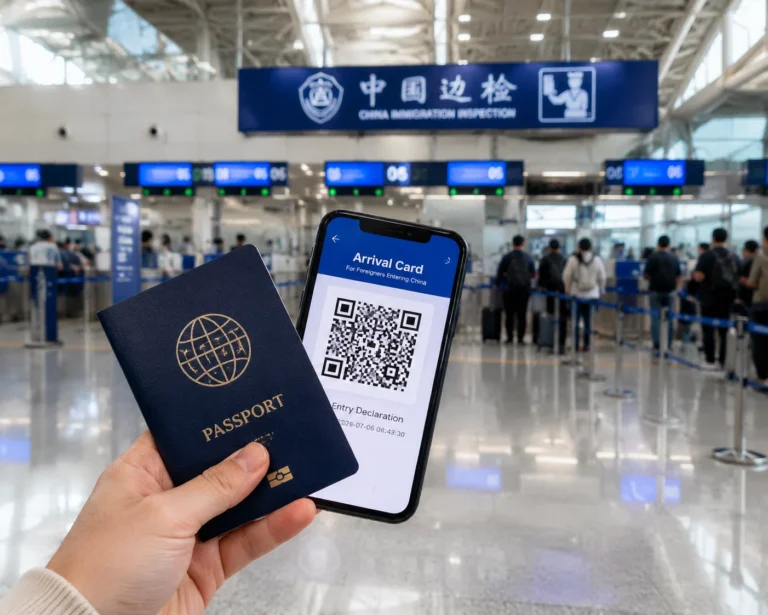




[…] visitors should confirm that their accommodation can correctly handle guest registration. See our China hotel booking guide for foreigners before booking a small independent […]