Our Location:
No. 99, Jiazi Road, Chengdu

 authorChris Lee
Most first-time travelers build their China itinerary around Beijing and Xi’an. Datong is easy to overlook.
That is exactly why this northern Shanxi city is worth considering.
Within a few days, you can stand beneath 1,500-year-old Buddhist grottoes, walk through surviving Liao-Jin temples, see a monastery attached to a cliff, and use a relatively compact ancient city as your base.
This guide focuses on what is actually worth your time, what needs advance booking, and how to build a Datong itinerary without spending half your trip in transit.
| Question | Short Answer |
|---|---|
| Is Datong worth visiting? | Yes, especially for Buddhist art, ancient architecture and travelers looking beyond China’s busiest tourist cities. |
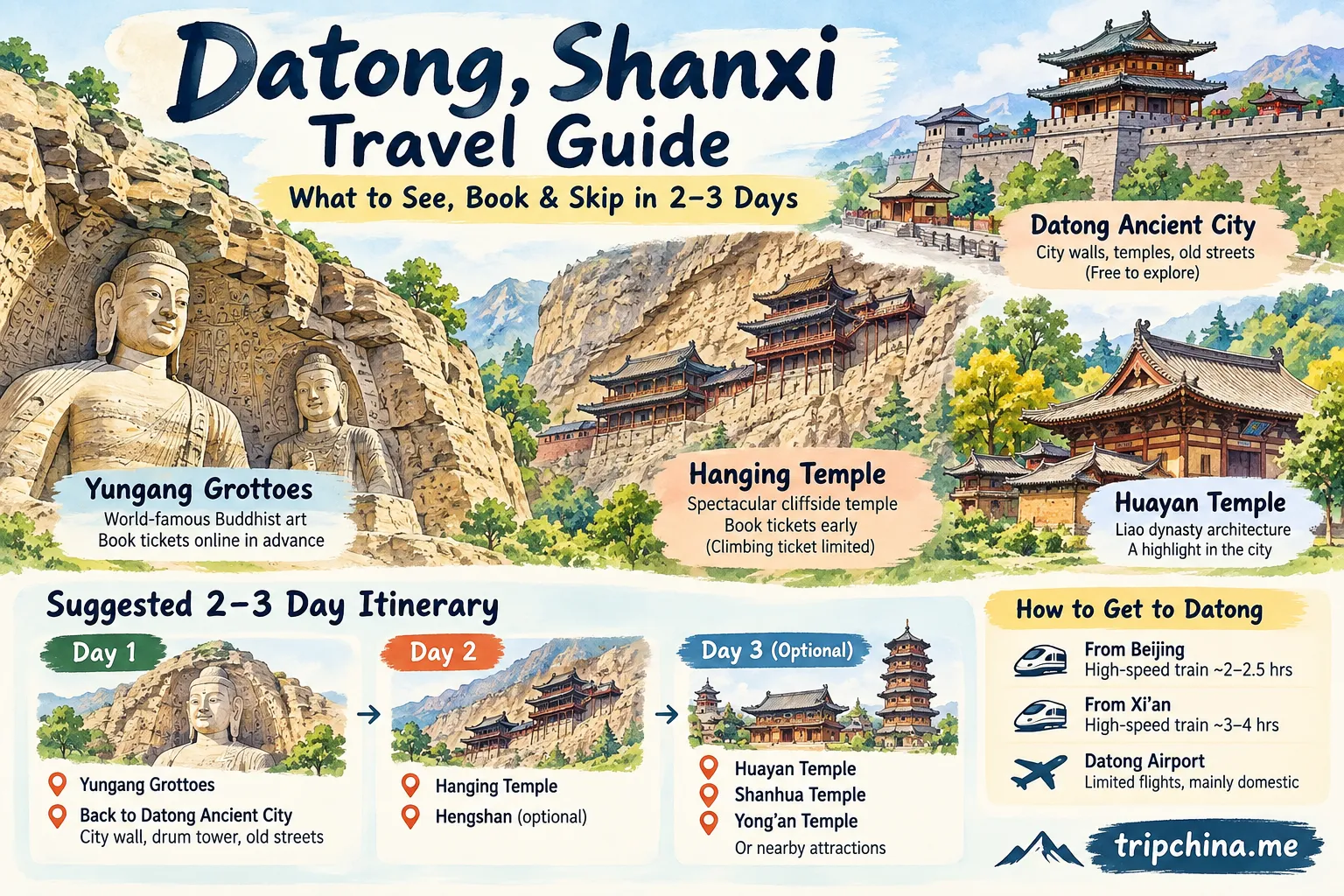
| How many days? | 2 full days for the essentials; 3 days for Hengshan, Hunyuan or Yingxian without rushing. |
| Top sights | Yungang Grottoes, Hanging Temple, Huayan Temple, Shanhua Temple and Datong Ancient City. |
| Best area to stay | Around Huayan Temple / Drum Tower inside or beside the ancient city. |
| What needs advance planning? | Yungang Grottoes and especially Hanging Temple climbing access. |
| Do you need a car? | Not for downtown or Yungang. A car or tourist direct bus is more useful for Hunyuan and Yingxian. |
TripChina Pick: If this is your first visit, spend Day 1 at Yungang and Datong Ancient City, Day 2 at the Hanging Temple and Hunyuan, and add a third day only if you want Hengshan, Yingxian Wooden Pagoda or a slower architectural trip.
Datong works best for travelers who care more about history, Buddhist art and architecture than shopping or nightlife.
Its historical importance comes from several layers.
Datong—then known as Pingcheng—was the capital of the Northern Wei dynasty. Later, it became an important center under the Liao and Jin dynasties and a strategic frontier city in northern China.
That history survives in unusually different forms.
At Yungang, it is carved into sandstone.
At Huayan and Shanhua temples, it survives in timber architecture and sculpture.
At the Hanging Temple, architecture is pushed onto a cliff.
And in the ancient city, reconstructed streets sit alongside surviving monuments from much earlier periods.
Datong is therefore not just a city with “several old attractions.” The sites make more sense when you understand them as different chapters of the same northern Chinese story.
That is why I recommend starting with context rather than simply collecting landmarks.
If Datong looks strangely familiar, there may be a reason. Six heritage sites in the Datong area were featured among the real Chinese locations associated with Black Myth: Wukong: Yungang Grottoes, Hanging Temple, Huayan Temple, Shanhua Temple, Yong’an Temple and Jueshan Temple.
The game helped introduce Shanxi’s ancient architecture to a much wider international audience. But these are not attractions created around the game. They are historic sites—some more than 1,000 years old—that inspired or appeared in its visual world.
If Black Myth: Wukong brought you to Datong, this guide effectively covers five of those six locations, while Jueshan Temple requires a separate trip farther east.
For a first trip, prioritize the attractions like this:
| Priority | Place | Why Go? | Typical Time |
|---|---|---|---|
| Essential | Yungang Grottoes | Northern Wei Buddhist art and UNESCO World Heritage | 3–4 hours |
| Essential | Hanging Temple | Cliff architecture and an unusual spatial experience | 1.5–2.5 hours |
| Essential | Huayan Temple | Liao-Jin architecture, sculpture and Buddhist art | 1.5–2 hours |
| Highly recommended | Shanhua Temple | Quieter Liao-Jin architecture and sculpture | 1–1.5 hours |
| Recommended | Datong Ancient City | Easy base for temples, walls, food and evening walks | Half day / evening |
| Recommended | Datong Museum | Best historical introduction to the city | 2–3 hours |
| Optional | Hengshan | Mountain scenery and religious landscape | Half to full day |
| Optional | Yong’an Temple, Hunyuan | Exceptional historic murals | 1–1.5 hours |
| Extension | Yingxian Wooden Pagoda | One of northern China’s great historic timber structures | 1.5–2 hours |
Yungang Grottoes is the reason many travelers first discover Datong.
UNESCO describes the site as one of the outstanding examples of Chinese Buddhist cave art. The complex contains 252 caves and niches and around 51,000 statues, created primarily during the Northern Wei period in the fifth and sixth centuries.
The scale matters, but the real value is in the details.
Faces, clothing, musical instruments, architectural forms and decorative patterns show how Buddhist art arriving from farther west interacted with political power and artistic traditions in northern China.
If you simply walk from cave to cave looking for the largest Buddha, you miss much of what makes Yungang important.
Do not treat Yungang as a checklist, but several areas help first-time visitors understand the site.
Cave 6 is especially useful if you have a guide. Its dense relief carvings include scenes from the life of the Buddha, turning the walls into something close to a stone narrative.
Caves 9–13 are known for elaborate decoration and traces of color.
Caves 16–20, associated with the early imperial phase of Yungang, contain some of the site’s most monumental figures.
Cave 20 is the visual icon of Yungang: the large seated Buddha exposed to the open air after the original front section of the cave disappeared.
Individual caves can close temporarily for conservation. Do not build your entire visit around a rigid “must-see cave list.” Check the latest notice from Yungang Research Institute or the official mini program shortly before you go.
If Caves 5, 16 or 18—or any other major cave—appear on the current conservation list, adjust your route rather than relying on older travel posts.
As of September 2026, Yungang uses an online real-name reservation system with a 15-day booking window, excluding the day of booking.
Visitors should reserve through official channels such as:
Policy-based free-admission groups are also required to complete real-name reservations under the April 2026 notice.
The standard adult ticket is CNY 120 during the peak season and CNY 100 during the off-season.
Foreign visitors should use their passport details exactly as shown on the travel document.
Yungang has also introduced multilingual self-service ticketing facilities for overseas visitors. Passport workflows and supported payment methods may change as the system is updated, so use the official visitor service if the mini program does not accept your document.
TripChina Local Note: The reservation window was expanded from 7 to 15 days in April 2026. Older English and Chinese travel posts may still show the previous seven-day rule.
Yungang is west of central Datong and is much easier to reach than the Hanging Temple.
A taxi or DiDi is the simplest option for most foreign independent travelers. Public buses also connect the city with the grottoes.
You do not need a private driver just for Yungang.
Allow roughly half a day from leaving your hotel to returning to the city, and longer if you want a guide or enjoy studying sculpture in detail.
Yes—you can comfortably combine Yungang with Datong Ancient City in one day.
A practical plan is:
Morning: Yungang Grottoes — about 3–4 hours
Afternoon: Huayan Temple + Shanhua Temple
Evening: Datong Ancient City
Huayan and Shanhua can generally be combined in under four hours if you are not doing an in-depth architectural study.
This is a much better one-day plan than trying to combine Yungang + Hanging Temple + Yingxian Wooden Pagoda.
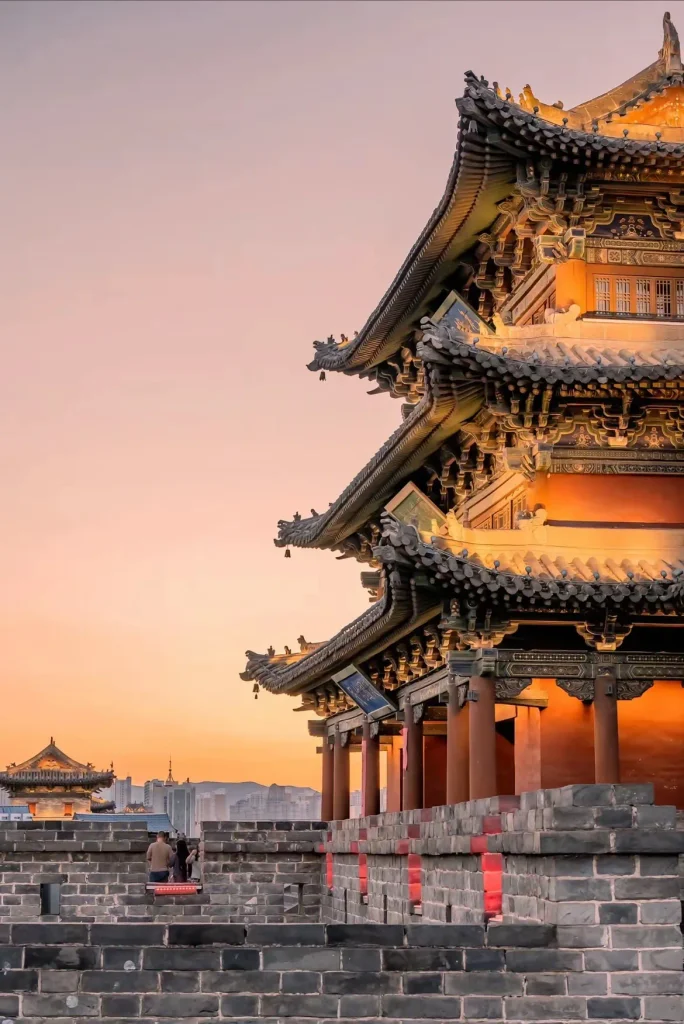
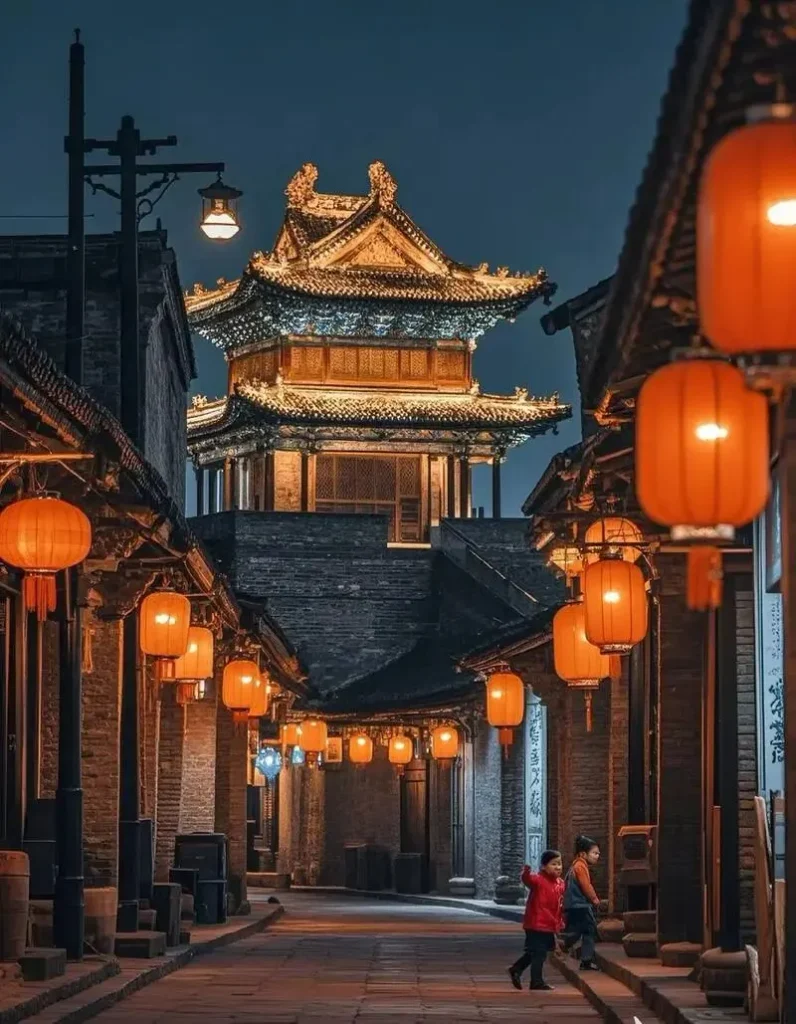
Datong Ancient City is useful because several important sites sit within a relatively compact area.
But there is one thing worth understanding before you arrive: much of the urban fabric you see today has been reconstructed or substantially restored.
That does not make the ancient city pointless.
Instead of treating the entire district as one historical artifact, focus on the individual monuments that retain much older architectural and artistic value.
Huayan Temple and Shanhua Temple are the two priorities.
Then use the streets, walls and squares between them as the connective tissue of the trip.
Huayan Temple is one of the strongest reasons to spend real time inside Datong rather than using the city only as a base for Yungang and the Hanging Temple.
Its architecture and Buddhist art preserve important Liao and Jin traditions.
The Bhagavat Sutra Library Hall is particularly important. Inside are historic sculptures and an extraordinary arrangement of miniature wooden architectural structures along the walls.
The famous Bodhisattva with clasped hands and exposed teeth, sometimes nicknamed the “Eastern Venus,” is another detail worth looking for.
This is exactly the kind of site where a guide—or even 15 minutes of reading before entering—changes the experience.
As of September 2026, the regular peak-season full-price admission is CNY 50.
The most recently published official off-season policy sets the November 1–March 31 full-price ticket at CNY 40, with opening hours of 8:30–17:00.
Seasonal schedules can be adjusted, so verify the current notice before visiting.
Yes, especially if Huayan leaves you wanting more architecture rather than more crowds.
Shanhua is smaller and usually feels calmer.
Its value is not simply that it is “another temple.” The surviving buildings and sculptures provide another opportunity to look closely at Liao-Jin architectural forms without the scale and visitor flow of Huayan.
The full-price ticket is CNY 40.
Opening hours vary seasonally, so check the current official notice before visiting. 1–1.5 hours is enough for most first-time visitors, although architecture enthusiasts may want longer.
Yes, if you are already walking through the ancient city.
It is a short stop rather than a reason to rearrange your itinerary.
The full-price ticket is CNY 10. Seasonal opening hours can change, so check the current notice before visiting.
For most travelers, 20–30 minutes is enough.
Yes—and for travelers who genuinely want to understand what they are seeing, I would put it near the beginning of the trip.
Think of Datong Museum as the city’s instruction manual.
The collections help explain what existed here before the Northern Wei capital, how Pingcheng developed, and why Northern Wei, Liao and Jin history matters to the monuments you will see later.
That context makes Yungang, Huayan and Shanhua much easier to read.
As of September 2026, Datong Museum generally operates on a Tuesday–Sunday schedule, with Monday normally used as the weekly closing day except where holiday arrangements apply.
Opening hours and reservation requirements can change for exhibitions, equipment maintenance and public holidays.
Check the museum’s official WeChat account shortly before visiting rather than building a tight itinerary around an older timetable.
TripChina Local Note: If your first day is rainy or you arrive too late to justify going to Yungang, the museum is one of the best ways to begin the trip.
Yes, but it requires more planning than Yungang.
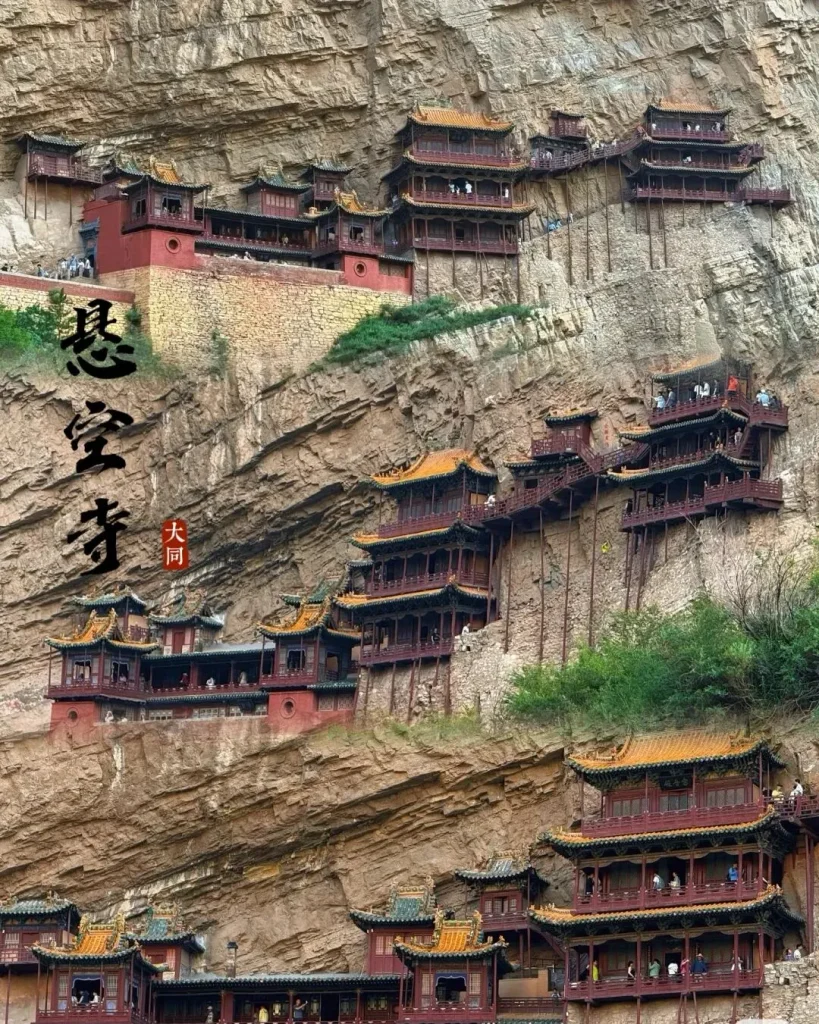
The Hanging Temple, or Xuankong Temple, is built against the cliff face near Hengshan in Hunyuan County.
From below, the building looks almost impossibly light.
Once you enter, the experience changes. Narrow stairs, small platforms and cliffside passages make the structure feel much more spatially complex than photographs suggest.
If you are comfortable with heights and can secure climbing access, entering the structure is significantly more memorable than only viewing it from below.
The Hanging Temple uses separate tickets for scenic-area entry and climbing access.
| Ticket | Experience | Peak-Season Price |
|---|---|---|
| Scenic-area entry | View the Hanging Temple from below | CNY 15 |
| Climbing ticket | Enter and walk through the elevated structure | CNY 100 |
The climbing ticket is the difficult one.
Daily climbing capacity is limited because the historic structure has extremely narrow circulation space.
Use the official Beiyue Yunyou (北岳云游) mini program and check the current release schedule before your trip.
Advance reservations are used for climbing access, but release procedures can be adjusted during holidays, peak periods or operational changes.
Do not rely on unofficial “ticket hacks” or pay a reseller promising guaranteed climbing access.
TripChina Tip: If climbing the Hanging Temple matters to you, solve this ticket first when planning Datong. Yungang has much greater visitor capacity; the Hanging Temple does not.
Traffic management around Hengshan and the Hanging Temple can change during busy periods.
Visitors may be directed through the Hengshan Tourist Center and transferred to scenic-area shuttle buses, particularly when private-vehicle access is restricted.
A commonly published shuttle fare is around CNY 20, subject to seasonal adjustment.
Do not build your route around old blog advice telling you to bypass the visitor center or park beside the attraction. Check the current transport arrangement before departure.
Only if you genuinely want to hike or explore the mountain.
The Hanging Temple and Hengshan are geographically close, but they are not the same experience.
The temple is primarily an architectural visit.
Hengshan is a mountain excursion.
Trying to “add Hengshan because it is nearby” can turn a comfortable day into a rushed one.
If you have two days in Datong, I would prioritize the Hanging Temple and use the remaining time for Hunyuan or return to Datong.
If you have three days and enjoy hiking, Hengshan becomes much easier to justify.
For travelers interested in historic art, Yong’an Temple is one of the strongest additions.
Its surviving murals make it much more than a filler stop after the Hanging Temple.
Hunyuan also gives you a different atmosphere from reconstructed central Datong: smaller scale, older streets and a much slower rhythm.
If murals and historic towns interest you more than hiking, choose Hunyuan over Hengshan.
| After Hanging Temple | Choose This If… |
|---|---|
| Hengshan | You want mountain scenery, hiking and a more physical day |
| Hunyuan + Yong’an Temple | You prefer murals, architecture, food and slower cultural travel |
Not administratively.
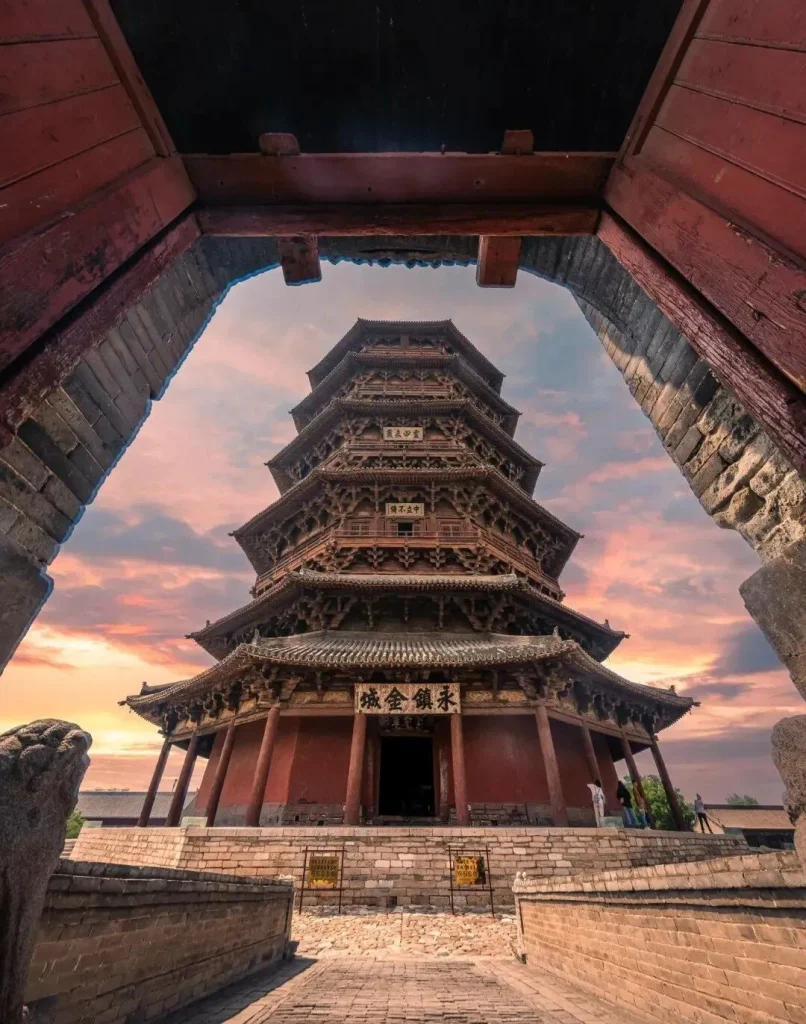
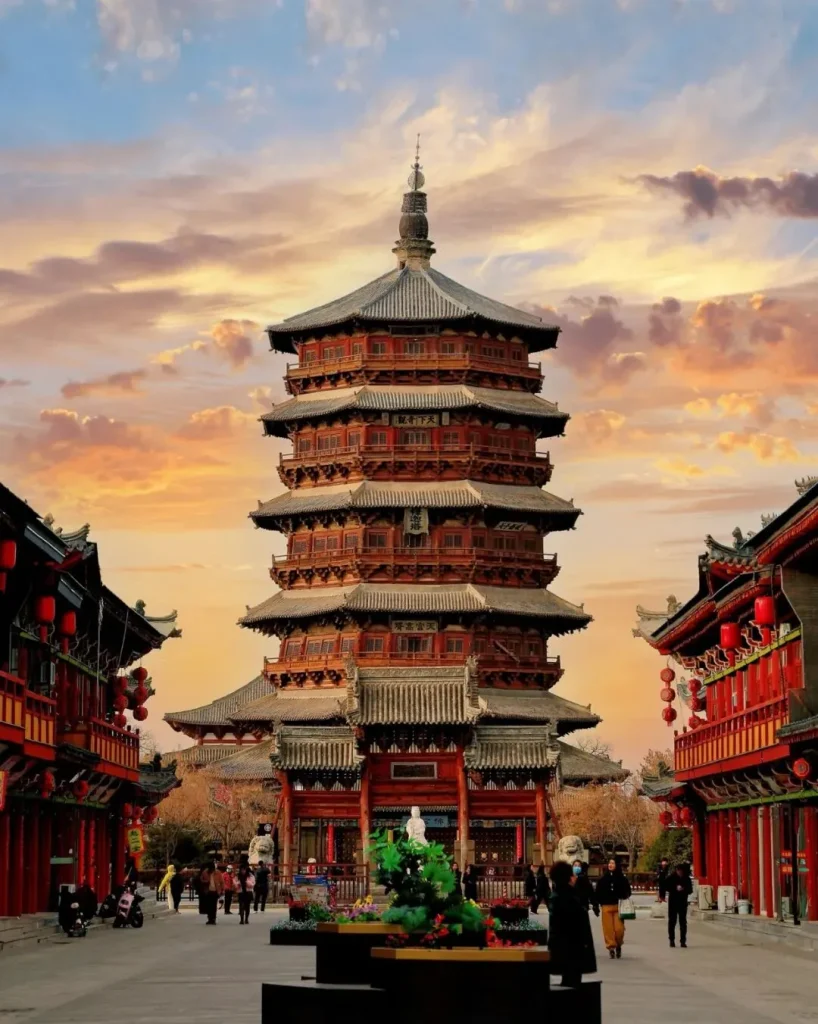
Yingxian Wooden Pagoda is in Ying County, Shuozhou, south of Datong.
But it fits naturally into a northern Shanxi itinerary, which is why so many Datong trips include it.
The pagoda is especially worthwhile for travelers interested in historic timber construction.
Do not add it simply because a map says it is “near Datong.” Add it because the building itself interests you.
If you have only two days, Hanging Temple + Yingxian on the same day can be done with efficient transport, but it produces a more intensive schedule.
For most first-time visitors:
Morning
Afternoon
Evening
Early morning
Midday
Afternoon
Evening
This gives you Northern Wei Buddhist art, Liao-Jin architecture, cliff architecture and a smaller historic town without forcing three distant sites into one day.
Do this:
Yungang Grottoes → Huayan Temple → Shanhua Temple → Ancient City evening
Skip the Hanging Temple.
It is not because the Hanging Temple is less important. It is because the travel time and ticket uncertainty consume too much of a one-day visit.
Yungang plus the ancient city gives you a much more coherent day.
Use Day 3 according to your interests.
| Your Interest | Day 3 |
|---|---|
| Ancient timber architecture | Yingxian Wooden Pagoda |
| Hiking | Mount Hengshan |
| History/context | Datong Museum + slower ancient-city visit |
| Murals and small-town atmosphere | More time in Hunyuan |
| Geology/landscape | Datong volcanic landscape |
There is no need to force every famous attraction into the same trip.
Datong rewards looking more carefully, not simply seeing more places.
High-speed rail is the easiest option.
Trains run from Beijing toward Datong South Railway Station, with the fastest services taking roughly under two hours depending on the train.
Schedules and fares change, so search your actual travel date rather than planning around a fixed number in a blog post.
If this is your first Chinese train journey, read TripChina’s guide to buying China train tickets with 12306 or Trip.com.
For the wider train experience—stations, luggage, boarding and what foreign travelers should expect—see the China train travel guide for foreigners.
Xi’an and Datong can also be combined by rail, making Datong a useful stop on a longer northern China route.
The Datong–Xi’an rail corridor is connected through China’s high-speed rail network, but journey times and whether a particular service is direct vary by train.
A practical route can therefore be:
Beijing → Datong → Xi’an
or:
Xi’an → Datong → Beijing
This works particularly well if your trip combines the Terracotta Warriors and Tang-era Xi’an with Northern Wei and Liao-Jin heritage in Datong.
Search your actual travel date in China Railway 12306 rather than relying on a fixed timetable in a travel article.
Downtown Datong is straightforward.
For Huayan, Shanhua, the city wall and nearby old-city attractions, walking plus DiDi is usually enough.
Yungang can be reached independently by public transport or taxi.
Hunyuan and Yingxian require more planning.
In 2026, Datong’s official scenic-area direct-bus network was reported by the municipal government as covering 29 routes connecting 11 major attractions and transport hubs, including Yungang, Datong Ancient City, Hengshan/Hanging Temple, Yingxian Wooden Pagoda and Datong South Station.
Routes, departure times and holiday services can change, so use the 晋游宝景区直通车 WeChat mini program for the current schedule rather than relying on a timetable copied from a travel article.
For a first trip, staying inside or close to Datong Ancient City is the easiest choice.
The Huayan Temple / Drum Tower area works especially well because you can walk to restaurants and several major sights, while DiDi remains practical for the railway station and Yungang.
You do not need to stay beside Datong South Station simply because you arrive by train.
For foreign travelers, the more important question is whether the hotel is comfortable handling passport registration.
Before booking, read TripChina’s guide to booking hotels in China as a foreign traveler.
Datong food is built around northern Chinese wheat, lamb and hearty flavors.
Start with knife-cut noodles (刀削面).
Other local foods worth looking for include lamb dishes, shaomai, bean-based noodles and regional Shanxi staples.
The ancient city has plenty of restaurants, but you do not need to queue for the most famous internet restaurant to eat well.
A busy local noodle shop can be a better introduction to Datong than spending two hours waiting for a viral restaurant.
Datong is not difficult for independent travelers, but English becomes less common once you leave the major hotel and attraction environment.
Before arriving, make sure you have:
If you have not yet set up mobile payment, use TripChina’s China payment guide for foreign visitors.
For connectivity, see the China eSIM vs SIM guide.
And if you are still preparing your phone, the essential apps for foreigners in China covers the core setup.
Do not assume every traveler needs a standard Chinese tourist visa.
China has several visa-free arrangements depending on nationality and itinerary.
For travelers building Datong into a wider Asia trip, the most relevant is China’s 240-hour visa-free transit policy.
Under the current policy, eligible travelers with confirmed onward travel to a third country or region may enter through an approved port and remain for up to 240 hours within Shanxi Province’s permitted zone, which includes Taiyuan and Datong.
That means an eligible itinerary may include Datong without a conventional tourist visa—but only when all transit requirements are satisfied.
This is not a general 10-day tourist visa exemption. Nationality, entry port, onward destination and itinerary all matter.
Check the latest official immigration rules before departure.
Mistake 1: Trying to see Yungang and the Hanging Temple in the same rushed day.
They are in different directions. You spend too much time moving and too little time looking.
Mistake 2: Treating Yungang as a giant-Buddha photo stop.
Without context, much of its artistic and historical importance disappears.
Mistake 3: Following old Yungang booking advice.
The official reservation window was expanded in April 2026. As of September 2026, reservations can be made up to 15 days ahead, excluding the booking day. Check the official Yungang system rather than relying on an older third-party guide.
Mistake 4: Assuming a Hanging Temple entrance ticket means you can climb.
The scenic-area ticket and climbing access are separate.
Mistake 5: Adding Hengshan automatically.
Being nearby does not mean it fits every itinerary. Add it because you want a mountain day.
Mistake 6: Skipping all historical context.
Datong becomes far more interesting once Northern Wei, Liao and Jin stop being unfamiliar dynasty names.
Datong itself can be relatively affordable.
Your main sightseeing costs are tickets and transport to outlying attractions.
| Item | Typical Cost |
|---|---|
| Yungang Grottoes | CNY 120 peak / 100 off-season |
| Hanging Temple scenic entry | CNY 15 |
| Hanging Temple climbing | CNY 100 |
| Huayan Temple | CNY 50 peak / 40 off-season |
| Shanhua Temple | CNY 40 |
| Nine Dragon Wall | CNY 10 |
| Local noodles / simple meal | Often inexpensive |
| DiDi within central Datong | Generally modest |
| Hunyuan / Yingxian transport | Largest variable |
The biggest budget difference is not food or admission. It is whether you use public/direct buses or private transport for the outer attractions.
| Attraction | Book Ahead? | What Matters Most |
|---|---|---|
| Yungang Grottoes | Yes | Current official window is up to 15 days ahead; all visitors need real-name reservation |
| Hanging Temple entry | Recommended | Separate from climbing access |
| Hanging Temple climbing | Yes—priority | Strictly limited; verify the current release schedule in Beiyue Yunyou |
| Datong Museum | Recommended | Verify current opening day and reservation requirements |
| Huayan Temple | Usually easier | Peak/off-season prices and hours differ |
| Shanhua Temple | Usually easier | CNY 40 full price; check seasonal hours |
| Nine Dragon Wall | Usually easy | Short old-city stop; check seasonal hours |
| Yingxian Wooden Pagoda | Check before travel | Located in Shuozhou, not Datong |
For most travelers, May–June and September–October offer the easiest balance of temperature and outdoor sightseeing.
September is particularly attractive because the air is cooler and the surrounding northern landscape begins shifting toward autumn.
Summer can still be pleasant compared with many hotter Chinese cities, but major holiday periods create much heavier demand at attractions such as the Hanging Temple.
Winter is a very different trip.
Crowds can be much lighter, but Datong is cold. If your priority is architecture rather than comfortable outdoor sightseeing, that trade-off may still be worthwhile.
Technically, yes.
But I would not recommend trying to see both Yungang and the Hanging Temple.
If you only have one day, take an early train, visit Yungang, spend the afternoon in Datong Ancient City, and return to Beijing in the evening.
Two nights is much better.
Yes. Yungang’s real-name reservation system includes foreign visitors, and passport information can be used for ticketing.
The site has also introduced multilingual visitor-service facilities.
If the online workflow does not accept your passport or payment method, use the official visitor service rather than buying from an unofficial reseller.
No, but some preparation helps.
Major attractions are manageable, while local transport, restaurants and mini programs may have limited English.
Keep Chinese place names saved on your phone and use a translation app.
Yes.
The main challenge is logistics rather than the city itself. The farther you move from central Datong, the more useful advance transport planning becomes.
Potentially, yes.
Under the current policy, Taiyuan and Datong are included within Shanxi Province’s permitted stay area for eligible 240-hour visa-free transit travelers.
However, this is a transit policy, not a general 10-day tourist visa exemption.
You must satisfy the nationality, approved-port and onward-travel requirements, including continuing to a third country or region.
Always confirm your exact itinerary against the latest official immigration rules before booking.
No.
It is in Ying County, Shuozhou.
It is commonly included in Datong itineraries because of its location and historical importance, but geographically and administratively it is a separate destination.
Do not try to “finish” Datong.
Start with Yungang. Give the ancient city enough time for Huayan and Shanhua. Make the Hanging Temple your main logistical challenge rather than squeezing it between other attractions.
Then choose your third layer according to what actually interests you: Hengshan for mountains, Hunyuan for murals, Yingxian for timber architecture, or the museum for historical context.
That approach produces a much better Datong trip than collecting the largest possible number of pins on a map.
Last researched: September 2026. This guide was cross-checked against UNESCO, Datong municipal government notices, Yungang Research Institute information, current immigration guidance, official scenic-area transport information and published attraction policies. Prices and reservation rules are dated where appropriate because Datong has adjusted several visitor procedures in recent years. Opening hours, individual Yungang cave closures, Hanging Temple ticket releases, shuttle arrangements and holiday schedules can change at short notice, so check official channels shortly before travel.