Our Location:
No. 99, Jiazi Road, Chengdu

 authorChris Lee
Most solo female travel advice focuses on rare, dramatic dangers. The problems more likely to disrupt a trip in China are usually more ordinary: a lost phone, a badly located hotel, a traffic situation you misread, or a moment of carelessness in a crowded place.
This guide focuses on the practical precautions that matter most for women traveling China alone.
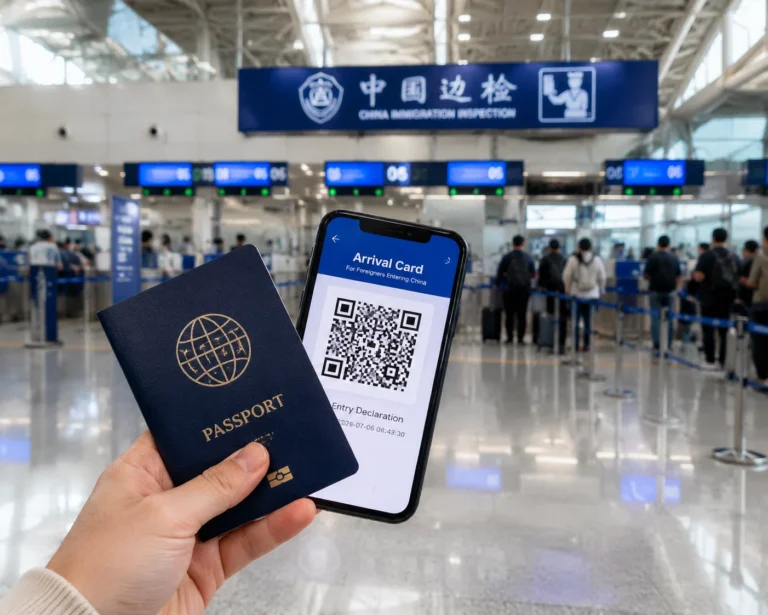
Before worrying about day-to-day safety, confirm that you are eligible to enter China.
China has significantly expanded its visa-free entry and transit policies. As of August 20, 2026, nationals of 57 countries — including the United States, United Kingdom, Canada, Australia, and many European countries — may qualify for China's 240-hour visa-free transit policy.
Eligible travelers can enter through 65 designated ports in 24 provincial-level regions and stay within the permitted areas for up to 240 hours, or 10 days.
This is a transit policy, not a general 10-day tourist visa exemption.
To use it, you generally need:
For example:
United States → China → Japan may qualify.
United States → China → United States does not satisfy the third-country/region transit requirement.
China also has separate unilateral and mutual visa-free arrangements for nationals of various countries. Check the latest rules for your nationality and itinerary before departure.
If you're unsure which entry policy applies to your passport and itinerary, check our complete guide to China visa requirements before you apply.
Official guidance: China's 240-hour visa-free transit policy.
If you do not qualify for visa-free entry or transit, obtain the appropriate visa before traveling. Requirements, fees, and processing arrangements vary by nationality and application location.
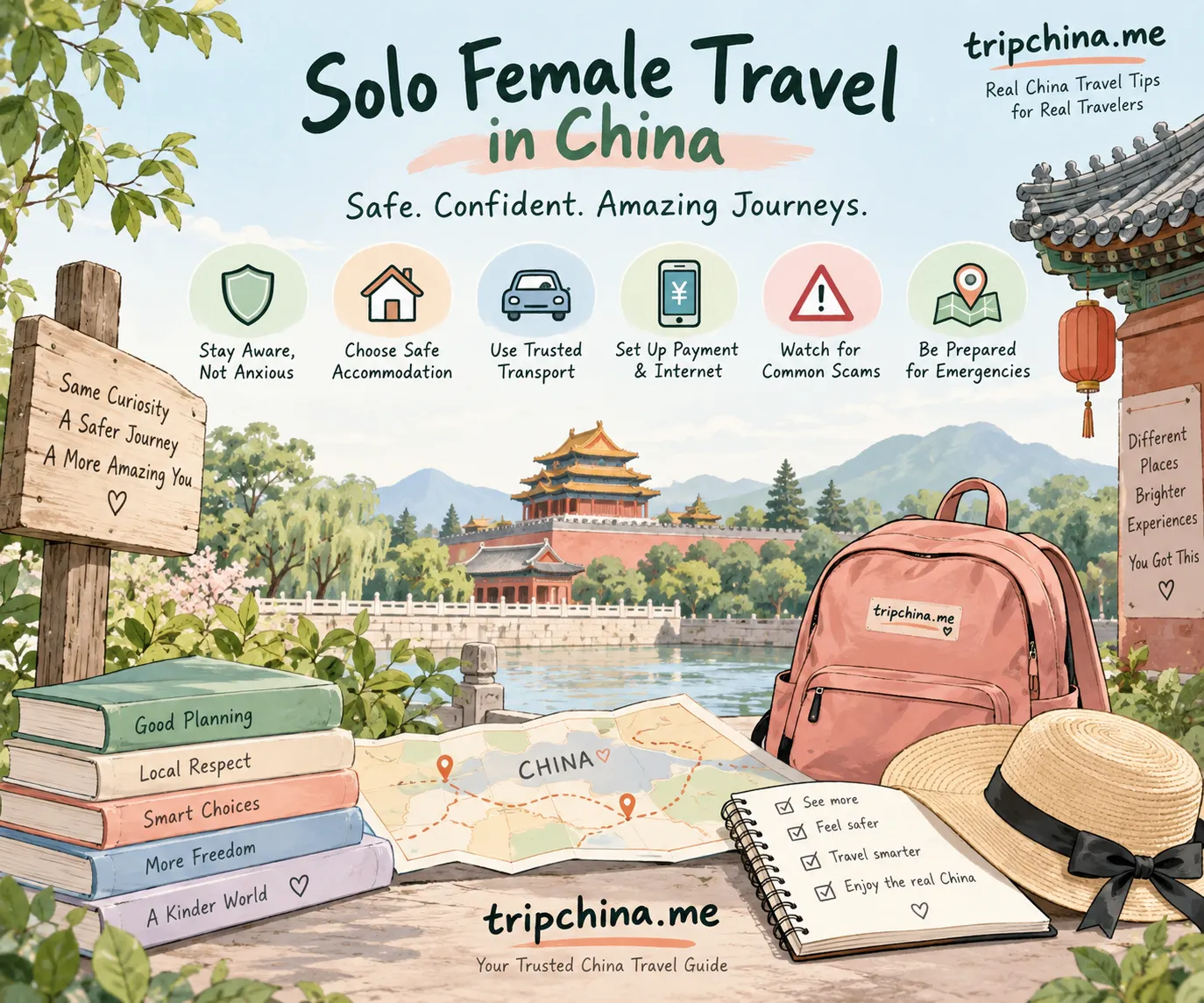
Solo female travel advice often focuses on dramatic scenarios such as being followed, assaulted, or drugged.
Those possibilities should not be ignored, but they should not dominate your preparation for China either.
The problems that more commonly disrupt an independent trip are usually less dramatic: a phone disappearing from an open bag, accommodation in an inconvenient or uncomfortable location, an overpriced tourist scam, confusion at a busy road crossing, or becoming ill without a backup plan.
Preparation in four areas makes the biggest practical difference: accommodation, digital security, transport, and social boundaries.
For first-time solo travelers, established hotels can be easier to assess because they often have staffed reception, standardized check-in procedures, and large numbers of recent guest reviews.
Common domestic chains include Hanting (汉庭), Home Inn (如家), and Jinjiang Inn (锦江之星).
That does not mean every chain hotel is automatically safer than every independent hotel.
Independent hotels, hostels, and guesthouses vary widely. Some are excellent. Others may have limited overnight staffing, inconvenient locations, or weaker room security.
Before booking, check recent reviews for:
TripChina.me Insight: Do not choose accommodation based on photos alone. For a solo trip, a predictable property with strong recent reviews and a convenient location is usually more useful than an Instagram-friendly stay with questionable security or access.
Before choosing a property, it also helps to understand how hotel booking works for foreigners in China, including registration requirements and what to do if a property says it cannot accommodate international guests.
A useful target is accommodation within roughly a 10-minute walk of a metro station or another convenient transport connection, preferably on a street with shops, restaurants, and regular foot traffic.
Before booking, look at the route between the nearest station and the hotel — not just the hotel's pin on the map.
Be more cautious with properties that require a long walk through poorly lit backstreets or isolated construction areas.
Around major railway stations, ignore unofficial accommodation and transport touts and use your confirmed booking or an official platform instead.
Once you check in, take a few minutes to check your room:
Basic door wedges commonly cost around ¥20–30 on Chinese shopping platforms.
If the room door does not secure properly or staff cannot resolve a genuine security problem, request another room or change accommodation.
Keep digital copies of your:
Store them somewhere you can access from another device.
Copies do not replace your original passport when official identification is required, but they can make recovery much easier if something goes wrong.
Act quickly.
First, retrace your route and contact the last hotel, restaurant, station, taxi, or attraction you visited. Airports, railway stations, metro systems, and major attractions commonly have lost-property procedures.
Use Apple Find My, Google's device-location tools, or your manufacturer's equivalent if already enabled.
If you believe the phone was stolen, call 110 or go to the nearest police station.
CCTV is widespread in Chinese cities and may assist an investigation, but do not assume that every lost or stolen phone can be recovered.
Before traveling, keep your device serial number or IMEI and important account-recovery information somewhere separate from the phone.
If your passport is lost or stolen, report the loss to the local police and contact your embassy or consulate for replacement-document procedures.
Learn how your own phone's Emergency SOS function works before departure.
Do not wait for an emergency to discover which buttons activate it.
Add at least one emergency contact and make sure that person has a basic copy of your itinerary.
Also keep one or two important phone numbers somewhere outside your main phone.
Alipay and WeChat Pay are widely used throughout China, and international bank cards can be linked to these payment platforms.
Direct acceptance of foreign cards still varies considerably between merchants.
Your backup should therefore not depend entirely on one phone.
Carry approximately ¥300–500 in RMB cash as an emergency reserve and split it between two secure locations. For the full setup — including Alipay, WeChat Pay, international cards, and when cash still matters — see our guide to how foreigners pay in China.
The exact amount you need depends on your destination and travel style. The point is not to fund your trip with cash — it is to have enough flexibility to handle basic expenses if your phone, mobile data, or payment app temporarily fails.
For setup instructions before arrival, read our China Payment Apps Setup guide.
Didi (滴滴) is China's largest ride-hailing platform and includes in-app trip and safety functions.
Before getting into a booked vehicle:
If the information does not match, do not get in.
When traveling alone, sitting in the rear seat is generally the more comfortable choice.
Use the app's trip-sharing or safety functions when useful, particularly for unfamiliar routes or late-night rides.
For a full walkthrough of Didi, including its interface and safety features, see our Didi for Foreign Travelers guide.
Traffic can take some adjustment for first-time visitors.
At busy intersections, cars, buses, bicycles, delivery riders, and electric scooters may all be moving around you. Some two-wheelers are also much quieter than cars, making them easy to miss if you are distracted.
Chinese road traffic law requires drivers approaching pedestrian crossings to slow down and to stop when pedestrians are crossing.
Pedestrians are also required to use pedestrian crossings or designated crossing facilities and follow traffic signals where provided.
The practical rule is simple:
Having the right of way does not replace looking before you cross.
When crossing:
At a complicated intersection, take a few extra seconds to understand the traffic pattern before crossing.
Metro systems in major Chinese cities are heavily used and generally straightforward for solo travelers.
Stations normally have security checks, staff, lighting, signs, and surveillance systems.
Buses can be more difficult for first-time visitors because routes and stops may be less intuitive. Gaode Maps (Amap) and Baidu Maps can help you follow your position.
At railway stations, airports, and tourist attractions, ignore unofficial drivers who approach you directly.
Use:
A regular licensed street taxi is not the same thing as an unlicensed driver soliciting passengers.
There is no universal rule that a solo woman needs to return to her hotel by a particular hour in China.
Instead, judge the street and situation.
After dark, favor:
Avoid unnecessary shortcuts through isolated construction sites, dark alleys, or unfamiliar areas with little foot traffic late at night.
If something makes you uncomfortable, enter an open hotel, convenience store, shopping mall, restaurant, metro station, or another staffed public place and reassess from there.
You do not need to tell unfamiliar people that you are traveling alone.
If someone you do not know asks about your plans, keep the answer vague:
You do not owe strangers details about where you are staying or whether anyone is expecting you.
Most spontaneous interactions are harmless: someone may ask for a photo, a shopkeeper may try to sell something, or a curious local may start a conversation.
Be friendly if you want to be — but keep control of the interaction.
Avoid casually giving unfamiliar people:
If someone becomes persistent, say no and leave.
Tourist scams become much easier to recognize once you understand the setup.
Teahouse or "friendly stranger" invitation: Someone near a tourist attraction starts a friendly conversation and quickly suggests tea, drinks, an art exhibition, or another activity at a second location. The final bill may be unexpectedly high.
Unofficial transport offer: Someone approaches you outside an airport, railway station, or attraction and offers transportation outside an official taxi queue or booking platform. Use a licensed taxi or recognized ride-hailing service instead.
Unsolicited bracelet, charm, or "gift": Someone gives you an item and then pressures you for money or a donation. Do not accept unsolicited items if the terms are unclear.
The useful warning sign is not how someone looks.
It is the pattern:
unexpected approach → quick trust → pressure to move somewhere or accept something → unclear price → pressure to pay.
Scam patterns also vary by destination. Our guides to common Beijing tourist scams and tourist traps in Shanghai cover the situations travelers are more likely to encounter in China's two biggest international gateways.
If a person or situation makes you uncomfortable, leave.
You do not need to prove that something is dangerous before removing yourself from it.
That applies to strangers, other travelers, accommodation staff, tour operators, drivers, and anyone else.
These are optional tools, not substitutes for choosing good accommodation and staying aware of your surroundings.
Check current airline and railway rules before traveling with a power bank.
Pack an amount of luggage you can comfortably manage yourself.
The goal is mobility.
You should be able to move your bags through railway stations, security checks, metro transfers, stairs, and crowded platforms without depending on strangers.
Wear whatever is appropriate for the weather, activity, and setting. There is no general need for female travelers to dress inconspicuously in China simply because they are traveling alone.
This article is part of the China Basics Travel Guide Hub.
There is no single item that guarantees safety.
For most independent travelers, a reliable power bank is especially useful because a phone may handle navigation, payments, translation, bookings, and ride-hailing.
A portable door stopper or personal alarm can be useful secondary items if they make you more comfortable.
Either can work.
Hotels usually offer more privacy and often have staffed reception. Hostels can also be suitable if they have strong recent reviews, secure lockers, good access control, and a convenient location.
If booking a dorm, look for female-only rooms if that is your preference.
Keep your phone in a zipped pocket or secure bag rather than an open backpack pocket.
Store digital copies of important documents somewhere accessible from another device.
Keep your original passport secure and available because a photo or scan does not replace it when official identification is required.
At minimum, consider setting up:
Install and test essential apps before departure, particularly those requiring identity, phone-number, or bank-card verification.
Around ¥300–500 is a reasonable emergency reserve for many travelers, although your needs may vary.
Split it between two secure locations rather than keeping everything in one wallet.
Mobile payment is dominant, but RMB cash gives you another option if your phone, data connection, or payment app fails.
Do not assume your normal internet setup will work the same way on mainland Chinese networks.
Access to Google services and several major international social-media platforms is restricted on mainland networks.
Your experience can differ depending on whether you use a mainland SIM, international roaming, hotel Wi-Fi, or a travel eSIM whose data is routed outside mainland China.
Before departure, make sure you have reliable ways to handle navigation, communication, translation, bookings, and payments under the connectivity setup you plan to use. If staying connected is critical to your trip, check our complete guide to using Google, WhatsApp, and other international services in China before choosing your SIM, eSIM, or roaming setup.
For a medical emergency, call 120.
Major cities have large hospitals, and some hospitals and private clinics offer international or English-language services.
For minor problems, pharmacies are widespread in urban areas, but product names, formulations, and availability may differ from those in your home country.
Bring enough of your regular medication for the trip and keep prescription medicines in their original packaging when practical.
The main emergency numbers in mainland China are:
If communication is difficult, show responders your hotel's Chinese name and address or your current destination in Chinese.
Save that information as a screenshot so it remains available even without mobile data.
For immigration-related questions, China's National Immigration Administration also operates the 12367 service hotline.
This guide prioritizes official Chinese immigration, traffic, and emergency-service information, supplemented by practical travel guidance for independent visitors. Entry rules can change, so check the National Immigration Administration before departure. Safety conditions also vary by city, neighborhood, time of day, and individual circumstances.
TripChina.me creates practical China travel guides shaped by real local experience, helping independent travelers navigate transport, payments, food, neighborhoods, and the cultural details that make traveling in China easier and more meaningful. Find the guide for your destination at tripchina.me.