
Our Location:
No. 99, Jiazi Road, Chengdu

Most travelers assume Badaling is the only option. Mutianyu is actually better for most visitors — here’s why.
Badaling Great Wall (八达岭长城)📍 is famous. It’s in every textbook, every tour brochure, every “must-see” list. But fame comes with a cost: crowds. On a typical summer weekend, Badaling sees over 60,000 visitors. Mutianyu sees roughly a third of that.
| Factor | Mutianyu Great Wall | Badaling Great Wall |
|---|---|---|
| Crowds | Moderate, even on weekends | Very crowded, especially peak season |
| Foreign visitors | 60%+ of total visitors | Mostly domestic tourists |
| Toboggan | Yes — 1,580-meter slide | No |
| Cable car | 8-person enclosed cabin | 4-person open chairlift |
| Hiking difficulty | Moderate, with steep sections | Steeper overall |
| Distance from Beijing | ~73 km, 1.5-2 hours | ~80 km, 1.5-2 hours |
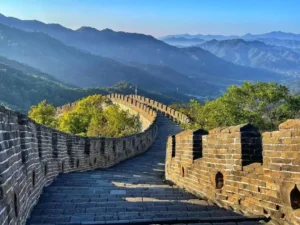
The real difference isn’t distance — it’s experience. Mutianyu feels more like a hike through nature. Badaling feels like a tourist attraction. Mutianyu’s vegetation coverage exceeds 90%, making it a natural “oxygen bar” in spring and summer. In autumn, the hillsides turn red and gold. In winter, the snow-covered wall looks like a sleeping dragon.
But there is a trade-off. Mutianyu is slightly farther from central Beijing, and public transport options are fewer. If you’re short on time and just want to say you’ve been to the Great Wall, Badaling is fine. If you want to actually enjoy it, choose Mutianyu.
The fastest way to reach Mutianyu is by direct bus. The most comfortable is by private car. The cheapest is by public bus — but it takes twice as long.
Several companies operate direct buses from central Beijing to Mutianyu. The most reliable are Busda (巴士达) 📍 Open in Amap — 巴士达Busda慕田峪长城专线直通车(北京平西桥地铁站) (Busda Mutianyu Great Wall Special Express Direct Coach (Beijing Pingxiqiao Subway Station))and Beijing Tourism Distribution Center (北京旅游集散中心).📍 Open in Amap — 北京旅游集散中心(前门) (Beijing Tourism Distribution Center (Qianmen))
The Busda experience: Clean bus, professional driver, no shopping stops. The guide on board will explain routes and sell tickets for cable car and toboggan at the same price as the official counter. You can buy your tickets on the bus and skip the queue at the ticket office.
One catch: The bus drops you at the P4 parking lot. From there, you walk about 10 minutes to the shuttle bus stop. The shuttle bus takes you up the 3.5 km mountain road to the ticket gate.
Best for: Groups of 3-4 people, families with young children, or anyone who values time over money. The driver can drop you directly at the shuttle bus entrance and wait while you hike.
Warning: Bus H24 runs only twice per day. Bus H23 has long intervals. If you miss the return bus, you’ll be stuck in Huairou. This option is only for budget travelers with flexible schedules.
Mutianyu has 20 open watchtowers, numbered 1 to 20. The wall runs east-west along a mountain ridge. The three main routes break down like this:
| Route | Entry | Best For | Trade-off |
|---|---|---|---|
| West Line (Towers 14–20) | Cable car from north entrance | First-timers, families with young kids, anyone wanting the iconic photo | Crowded at Tower 14 and 20; no toboggan option |
| East Line (Towers 1–6) | Chairlift from south entrance | Thrill-seekers, kids, anyone who wants the toboggan ride | Less dramatic views; chairlift can be scary for some |
| Middle Line (Towers 6–14) | Cable car up, walk east | Best balance of views, effort, and fun | Requires planning two separate tickets |
Direct Answer: For 80% of visitors, the middle line is the right choice — cable car up to Tower 14, walk east to Tower 6, then toboggan down. It gives you the best views, the easiest walk (mostly downhill), and the most fun exit.
This is what most people do. Take the cable car from the north entrance to Tower 14. From there, walk west toward Tower 20 (Hero Terrace). The section between Tower 19 and Tower 20 is the steepest — 430 steps at nearly 80 degrees. It’s called Haohan Slope (好汉坡), and it’s where you earn the “hero” title.
The west line has the most photo spots: the “I Am Not a Hero” stele at Tower 14, the If You Are the One 2 filming location at Tower 15, and the white stone characters “Loyal to Chairman Mao” visible from Tower 17. Each character is 12 meters in diameter — a whole mountainside used as a message board.
Honest take: The west line is spectacular, but it’s also where everyone goes. On a weekend, Tower 14 feels like a train station. The cable car queue can hit 45 minutes by 10:00 am.
Take the open chairlift from the south entrance to Tower 6. Walk east to Tower 1 (Big Corner Tower — 大角楼), then back to Tower 6. If you want, ride the toboggan (滑道) down — 1,580 meters of stainless steel track through the forest, taking about 7–10 minutes.
The east line has two architectural highlights. Tower 4 (Zhengguan Terrace — 正关台) is the only watchtower in the Great Wall system built as three connected hollow towers. It’s 20 meters high and 40 meters wide — essentially a four-story building on the wall. Tower 1 (Big Corner Tower) connects three sections of wall: east to Gubeikou, west to Badaling, and south to a branch wall called “Teweibian.” From any angle, it looks like a corner, hence the name.
Local truth: The east line is where the foreign tourists go. On any given day, 60% of visitors here are international. The vendors near Tower 6 speak English fluently — some better than the staff at the ticket office.
Take the cable car to Tower 14, then walk east to Tower 6. This is the opposite direction of the crowd. The walk is mostly downhill, the path is gentler, and you end at the toboggan.
This route requires two separate single-trip tickets: one cable car up (100 RMB) and one toboggan down (100 RMB). Total: 200 RMB per person. Compare that to a round-trip cable car ticket at 140 RMB — you pay 60 RMB more for the toboggan experience. Worth it.
Who this is for: Families with kids, anyone who wants the toboggan ride, people who don’t want to climb 430 steep steps.
Mutianyu has 20 watchtowers, divided into east (1-6), middle (6-14), and west (14-20). Each section has a different character.
Best for: First-time visitors, families, anyone who wants the full experience without excessive hiking
This is the most popular route for good reason. Here’s how it works:
Total time: 2-3 hours on the wall, plus 30 minutes for the cable car and toboggan
Cost: 100 RMB (cable car up) + 100 RMB (toboggan down) = 200 RMB per person
Honest take: The toboggan queue can be 30-60 minutes on busy days. If you see a long line, consider taking the chairlift down instead — it’s the same company, same price, and usually has no queue.
Best for: Fit hikers, those who want the “Hero” experience
This route is for people who want to earn their “Good Man” status.
Total time: 3-4 hours on the wall
Cost: 140 RMB (cable car round-trip)
What you’ll see along the way:
Warning: The section from Watchtower 19 to 20 is steep and narrow. The steps are high — each one requires a full leg lift. Many people end up climbing on all fours. If you have knee problems or fear of heights, stop at Watchtower 19.
Best for: Families with young children, anyone who wants the toboggan experience without the long hike
What makes this route special: Watchtower 4, called Zhengguan Tai (正关台), is the only watchtower on the Great Wall built as three connected hollow towers. It was built in 1404 during the Ming Dynasty and originally served as the main gate of Mutianyu Pass.
Total time: 2-3 hours on the wall
Cost: 100 RMB (chairlift up) + 100 RMB (toboggan down) = 200 RMB per person
Here’s what actually happens on each section.
This is where the cable car drops you. There’s a large platform, a “World Cultural Heritage” stele, and the famous “I Am Not a Hero” stone. On a busy day, there’s a 20-minute queue just for a photo with the stone.
TripChina Insight: The queue is for the main stone. Walk 50 meters east — there’s a second, identical stone with no line. Most people don’t know this.
Tower 15 is the If You Are the One 2 filming location. Couples queue here for photos. The view west from Tower 15 is the best on the entire wall — you can see Towers 16 through 20 in a straight line, climbing the ridge like a spine.
This section is relatively flat. You pass Tower 16, 17, and 18. At Tower 17, look west at the mountain — you’ll see five white characters: “Loyal to Chairman Mao” (忠于毛主席). Each character is 12 meters in diameter. It’s the Mutianyu equivalent of the “I Am Not a Hero” stone, but on a mountain scale.
Tower 18 has a stone tablet from the Chenghua era (1465–1487) of the Ming Dynasty. It marks the western boundary of the Mutianyu garrison. The inscription reads: “East is Mutianyu territory, west is Jia’erling territory.” It’s a small detail most people walk past, but it’s a direct connection to the people who lived and died here.
This is the test. 430 steps, continuous uphill, no flat sections. The steps are high — about 30 cm each — and narrow. You’ll see people crawling on their hands and knees. I’ve done it twice. The first time, I stopped three times. The second time, I made it without stopping and felt genuinely proud.
At the top is Tower 20 (Hero Terrace — 英雄台), the highest open point at 1,039 meters. The view is worth the climb. Beyond Tower 20, the wall continues toward Jiankou (箭扣) — the “wild” section that is not open to visitors. You can see it from here: steeper, more ruined, more dangerous.
Honest take: If you have bad knees, skip this section. The descent is harder than the climb. The steps are uneven, and there’s no handrail for most of it.
Most people go west. Few go east. This means the section from Tower 6 to Tower 1 is almost empty, even on busy days.
Tower 4 (Zhengguan Terrace) is the highlight. Three hollow towers joined together — the only one of its kind in the entire Great Wall system. You can walk inside, climb to the second floor, and see the arrow slits where soldiers would have shot from.
Tower 1 (Big Corner Tower) is the eastern end. From here, you can see three directions of wall. It’s also where the wall turns south toward a branch called “Teweibian” — literally “bald tail edge,” because it ends abruptly.
The toboggan is the most fun part of Mutianyu — but only if you time it right.
The toboggan is a metal sled that runs on a stainless steel track. You control the speed with a hand brake. Pull back to slow down, release to accelerate. It’s safe — children as young as 3 can ride with an adult.
If the queue is too long: Take the chairlift down instead. It’s the same company, same price, and usually has no queue. The view from the chairlift is actually better than the toboggan — you can see the entire wall from above.
The reality: On busy days, the queue for the toboggan can hit 45 minutes to 2 hours. The ride itself is fun but short. If you’re behind a slow rider, you’ll spend half the ride braking.
When it’s worth it: Arrive before 9:00 am, or go on a weekday. The queue is manageable. If the queue is over 30 minutes, take the chairlift down instead — no queue, similar view, and you skip the wait.
Who cannot ride: Anyone over 60 years old. Children under 1.35 meters must ride with an adult. The toboggan closes in rain.
The single most common mistake at Mutianyu is buying the wrong ticket. Here’s the rule: cable car and toboggan are two different companies. Their tickets are not interchangeable.
| Feature | Cable Car (West) | Chairlift / Toboggan (East) |
|---|---|---|
| Company | Mutianyu Cable Car | Shibide (施必得) |
| Goes to | Watchtower 14 | Watchtower 6 |
| Type | Enclosed cabin, 8 people | Open chairlift (up), slide (down) |
| Single ticket | 100 RMB | 100 RMB |
| Round-trip | 140 RMB | 140 RMB |
| Kids under 1.2m | Free | Free |
Yes, buy the shuttle bus ticket. It’s 15 RMB round-trip and saves you a 3.5 km uphill walk.
From the parking lot or bus drop-off point, the ticket gate is 3.5 km up a winding mountain road. Walking takes about 40 minutes uphill. The shuttle bus takes 5 minutes.
Cost: 10 RMB single, 15 RMB round-trip
Who can skip it: Fit hikers who want to warm up before the wall. But honestly, save your energy for the wall itself.
Note: Some direct bus companies include the shuttle bus ticket in their fare. Confirm when booking.
The best time to visit Mutianyu is 7:30-8:30 AM on a weekday. This gives you 2 hours of near-empty wall before the crowds arrive.
| Time | Crowd Level | Wait Time for Toboggan |
|---|---|---|
| 7:30-9:00 AM | Low | 0-10 minutes |
| 9:00-11:00 AM | Moderate | 15-30 minutes |
| 11:00 AM-2:00 PM | High | 45-60 minutes |
| 2:00-4:00 PM | Moderate | 20-40 minutes |
Seasonal considerations:
Monday is actually busier than Tuesday-Thursday because many museums in Beijing are closed on Mondays, so tourists redirect to the Great Wall.
These are the things I only learned after multiple visits — and they make a real difference.
1. The “Good Man” tablet is at Watchtower 14, not Watchtower 20.
Most people assume the famous “He who has not been to the Great Wall is not a true man” (不到长城非好汉) tablet is at the highest point. It’s actually at the cable car platform at Watchtower 14. You’ll find a long queue of people waiting to take a photo with it. If you want a photo without the crowd, arrive before 9:00 AM.
2. The graffiti wall is at Watchtower 14.
There’s a designated graffiti wall where visitors can write messages. This is the only place where writing is allowed. Writing on the ancient bricks anywhere else is illegal and can result in fines or detention.
3. The best photo spot is Watchtower 15.
This is where the movie If You Are the One 2 filmed its proposal scene. The view west toward the mountains is stunning, especially in late afternoon light. This is also where I’ve taken my favorite photos of the wall.
4. The XR experience is worth it for kids.
Near the visitor center, there’s a “Dragon Soaring Ten Thousand Miles” XR experience (龙腾万里长城XR超感体验中心). Kids wear XR headsets and use controllers to interact with historical scenes — defending the wall as a Han Dynasty soldier, trading as a Tang Dynasty merchant, watching iron flower performances as a Ming Dynasty civilian. It costs extra but adds historical context that most children find engaging.
5. The cats of Mutianyu.
There are dozens of stray cats living around the wall. They’re well-fed by staff and visitors, and most are friendly. The hotel even has a dedicated cat shelter. If you’re a cat person, bring some treats.
The wall has no shade, no water fountains, and no restrooms beyond the watchtowers. Pack accordingly.
What NOT to bring:
The easiest way is by direct bus from central Beijing. Busda (巴士达) picks up at Hepingxiqiao subway station. Beijing Tourism Distribution Center picks up at Qianmen. Both cost 80 RMB round-trip and take 1.5-2 hours. Private car or taxi costs 400-600 RMB round-trip.
Route A — cable car up to Watchtower 14, walk east to Watchtower 6, then toboggan down. This gives you the best views, the most fun descent, and requires the least hiking effort.
Yes. The toboggan runs from Watchtower 6 to the base. It costs 100 RMB per person. Children under 1.2 meters ride free with an adult. The toboggan closes in rain. People over 60 are not permitted to ride.
For most visitors, yes. Mutianyu has fewer crowds, better scenery, and the toboggan. Badaling is more famous and has slightly better public transport connections. If you want a relaxed, enjoyable experience, choose Mutianyu.
A typical visit takes 3-5 hours including transport to the wall and back. On the wall itself, plan 2-3 hours for Route A, 3-4 hours for Route B, and 2-3 hours for Route C.
Weekday mornings between 7:30 and 9:00 AM. Autumn (September-November) offers the best weather and scenery. Summer is hot and crowded. Winter is cold but beautiful with fewer visitors.
Yes, with the right route. Route A (cable car up, walk east, toboggan down) is the easiest. The walk from Watchtower 14 to 6 is mostly downhill with gentle slopes. The cable car and toboggan are safe for children. Elderly visitors with mobility issues should skip the Watchtower 19-20 section.
Adult ticket: 40 RMB (winter) or 45 RMB (summer). Shuttle bus: 15 RMB round-trip. Cable car: 100 RMB single, 140 RMB round-trip. Toboggan: 100 RMB single. Total for Route A: 40 + 15 + 100 + 100 = 255 RMB per person. Children under 18 and seniors over 60 enter free with valid ID.
If you are planning a trip to Beijing, TripChina publishes practical destination guides designed to help you navigate the real logistics — from high-speed rail and payments to city itineraries, local food, and the cultural context that most travel content skips. Find the guide for your destination at tripchina.me.