
Our Location:
No. 99, Jiazi Road, Chengdu

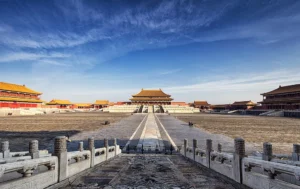
The first time I went to the Forbidden City, I did everything wrong. I walked through Tiananmen (天安门), stood in a security line for 45 minutes, arrived at the Meridian Gate (午门) at 10:30am already exhausted, and then walked the central axis at 11am with thousands of other people. I saw the Hall of Supreme Harmony (太和殿) from behind someone’s selfie stick. I left thinking: this is just a crowded museum.
The second time, I entered through East Flowery Gate (东华门), arrived at 8:15am, and had the central axis almost to myself for the first hour. I saw the Treasure Hall (珍宝馆) exhibits without a crowd. I sat in the Imperial Garden (御花园) at 4pm when the light turned golden on the red walls.
The difference wasn’t luck. It was knowing how the system actually works.
If it’s your first time visiting the Forbidden City, the smartest strategy is:
1. Avoid entering through Tiananmen
2. Use the East Flowery Gate route instead
3. Arrive before 8:30am
4. Book Treasure Hall tickets in advance
5. Visit Jingshan Park after exiting Shenwu Gate
The single biggest mistake first-time visitors make is entering through Tiananmen (天安门). It seems logical — Tiananmen is the iconic gate, the Forbidden City is behind it. But here’s what actually happens.
Tiananmen East Station (天安门东站) and Tiananmen West Station (天安门西站) on Metro Line 1 drop you at the edge of Tiananmen Square (天安门广场). To reach the Meridian Gate, you need to cross the square, pass through two security checkpoints, walk through Tiananmen Gate itself, then through Duanmen (端门), and finally arrive at the Meridian Gate. In peak season, this process takes 40–60 minutes. On busy days, I’ve seen it hit 90 minutes.
The alternative takes 20 minutes and involves zero queues.Take Metro Line 8 to Jinyu Hutong Station (金鱼胡同站), Exit C. Walk straight east for about 8 minutes to East Flowery Gate. Turn left and follow the moat (筒子河) south for 5 minutes. You arrive at the Meridian Gate from the east side, bypassing all Tiananmen security.
Honest answer: I’ve done both routes. The Tiananmen route adds 30–45 minutes of standing in lines. The East Flowery Gate route adds 10 minutes of walking. The choice is obvious.
If you’re already at Tiananmen Square: You can also cut through the Working People’s Cultural Palace (劳动人民文化宫, 2 RMB entry) on the east side, or Zhongshan Park (中山公园, 3 RMB entry) on the west side. Both have exits near the Meridian Gate and bypass the main security line. But the East Flowery Gate route is still faster.
The Forbidden City has no on-site ticket sales. None. Every ticket is sold online through the official “Palace Museum” WeChat mini-program (故宫博物院). This is the only legitimate channel.
Tickets go on sale exactly 7 days in advance at 8:00pm Beijing time. For example, if you want to visit on May 20th, tickets open on May 13th at 8:00pm.
What happens at 8:00pm: The system gets hammered. The mini-program may lag, show errors, or say “sold out.” Don’t panic. Tickets are released in batches — the system doesn’t dump all tickets at once. Keep refreshing. Many people succeed between 8:05pm and 8:30pm.
The 8:05am trick: The next morning between 8:05am and 8:30am, returned tickets (from people who cancelled or failed to pay) are released. This is a reliable backup window.
What to prepare before 8:00pm:
| Season | Main Ticket | Treasure Hall | Clock Hall |
|---|---|---|---|
| Peak (Apr 1–Oct 31) | 60 RMB | 10 RMB | 10 RMB |
| Off-peak (Nov 1–Mar 31) | 40 RMB | 10 RMB | 10 RMB |
Discounts (foreign visitors eligible):
If you miss Treasure Hall or Clock Hall tickets: Try the 8:05am return window. If that fails, you can sometimes buy them on-site at the hall entrances, but this is not guaranteed. Book them with your main ticket when possible.
The Forbidden City is 72 hectares. You cannot see everything. These three routes are designed for different priorities.
Best for: First visit, limited time, want to see the iconic buildings.
Route: Meridian Gate → Hall of Supreme Harmony (太和殿) → Hall of Central Harmony (中和殿) → Hall of Preserving Harmony (保和殿) → Palace of Heavenly Purity (乾清宫) → Hall of Union (交泰殿) → Palace of Earthly Tranquility (坤宁宫) → Imperial Garden (御花园) → Shenwu Gate (神武门) exit.
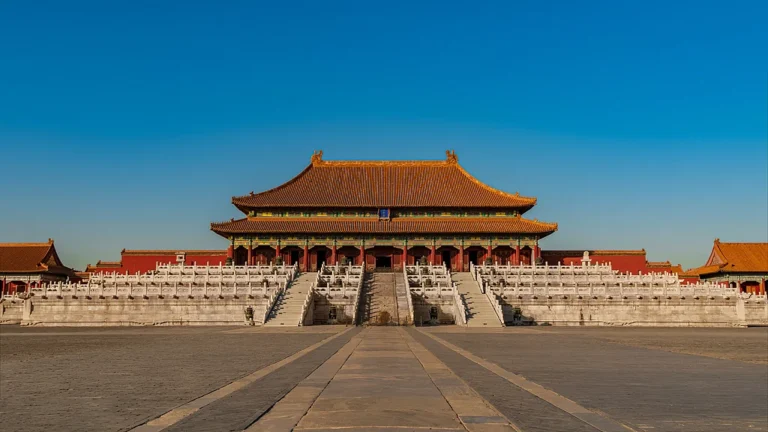
This is the central axis. It’s the most crowded section, but it’s also where the most important buildings are. The Hall of Supreme Harmony is the largest wooden structure in China — 11 roof ridges (the highest possible number), 10 mythical beasts on the eaves (a historical anomaly — normal buildings have 9 max), and a gilded dragon throne inside.
Trade-off: You skip the Treasure Hall and Clock Hall. If you only have 2 hours, this is the route. But if you have 3 hours, add the Treasure Hall.
Best for: Photography, avoiding crowds, Instagram-worthy shots.
Route: Meridian Gate → west side red wall → Hall of Supreme Harmony square (shoot from the sides, not the center) → East Six Palaces (东六宫) corridor → Palace of Prolonging Happiness (延禧宫) → Treasure Hall (珍宝馆) → Imperial Garden (御花园) → Shenwu Gate exit.
Key photo spots:
Best light: Before 9:00am and after 4:00pm. The red walls glow in late afternoon sun.
Best for: History enthusiasts, architecture lovers, full experience.
Route: Meridian Gate → Hall of Martial Valor (武英殿, Ceramics Hall) → Three Main Halls → Hall of Mental Cultivation (养心殿) → West Six Palaces (西六宫) → Treasure Hall + Clock Hall → Shenwu Gate exit.
What makes this route different:
Honest take: This route is exhausting. I did it once and hit 28,000 steps. Bring water, snacks, and a power bank.
These two halls cost 10 RMB each. They are worth more than the main ticket.
Located in the Palace of Tranquil Longevity (宁寿宫区), this is where the Forbidden City keeps its most valuable objects.
Must-see pieces:
Housed in the Hall of Ancestral Worship (奉先殿), this collection includes 200+ mechanical clocks from the 18th and 19th centuries.
Must-see piece:
When to go: The clocks perform on the hour (10am, 11am, 2pm, 3pm). Arrive 10 minutes early.
Trade-off: These halls get crowded by 10:30am. Visit them first — enter at 8:30am, go straight to the Treasure Hall, then the Clock Hall, then the central axis. You’ll have them nearly empty.
I spent my first two visits looking at buildings. On my third visit, I started looking up.
The caisson ceilings (藻井) in the Forbidden City are something most visitors miss entirely. These are the ornate, multi-layered ceilings above the main halls — carved dragons, painted clouds, gilded details, all built without a single nail, using only mortise-and-tenon joinery.
Where to find the best ones:
The corners towers (角楼) are another detail most people walk past. There are four, one at each corner of the palace wall. Each has 9 beams, 18 columns, and 72 roof ridges — all connected without a single nail. The best view is from outside the wall, looking across the moat at sunset.
Shoes: 15,000–25,000 steps is normal. The ground is uneven stone. I wore fashion sneakers once and regretted it by 11am. Wear proper walking shoes.
Colors: Light colors photograph better against the red walls. Avoid bright red — you’ll blend into the background.
The Forbidden City has two distinct seasons that affect your experience.
My recommendation: If you can choose, go in November or March. You get the off-peak crowds with tolerable weather. December–February is fine if you dress properly, but you’ll spend less time outdoors.
You exit through either Shenwu Gate (神武门, North Gate) or East Flowery Gate (东华门, East Gate). Your choice affects what you do next.
Best for: Continuing to Jing Shan Park (景山公园, 2 RMB entry). Walk across the street, climb Wanchun Pavilion (万春亭), and see the entire Forbidden City from above. This is the classic postcard view — the golden roofs stretching south, the central axis perfectly aligned.
Also nearby: Beihai Park (北海公园, 10 RMB entry) — 10 minutes by taxi. Shichahai (什刹海) area — 15 minutes walk.
Best for: Getting to the subway (Line 8, Jinyu Hutong Station) or heading to Wangfujing (王府井) shopping street.
Trade-off: You miss the Jing Shan Park view. If you have energy, exit via Shenwu Gate, climb Jing Shan (it takes 15 minutes), then walk down to the subway.
The only entrance is the Meridian Gate (South Gate). But the best way to reach it is via East Flowery Gate — take Metro Line 8 to Jinyu Hutong Station, Exit C, walk to East Flowery Gate, then follow the moat south. This avoids Tiananmen security queues entirely.
Use the “Palace Museum” WeChat mini-program. Tickets go on sale 7 days in advance at 8:00pm Beijing time. No on-site sales. Book your main ticket plus Treasure Hall (10 RMB) and Clock Hall (10 RMB) at the same time.
Arrive at 8:15–8:30am for the 8:30am opening. The first hour is the quietest. Avoid arriving between 10am and 12pm, when crowds peak on the central axis.
Technically yes, but it’s a bad idea. You need to pass through Tiananmen Square security (40–60 minute queue in peak season), then walk through Tiananmen Gate and Duanmen to reach the Meridian Gate. Use the East Flowery Gate route instead.
2–3 hours for the central axis only. 3–4 hours for the central axis plus Treasure Hall. 5–7 hours for a full visit including the Hall of Mental Cultivation, West Six Palaces, and both special halls.
Yes. November–March has 50–60% fewer visitors. The cold is manageable with proper clothing. Snow days are spectacular — the red walls against white snow is one of Beijing’s best views.
Tripods, drones, selfie sticks over 1.3m, wheeled luggage, and lighters are all banned. Security will confiscate them. Bring only a small bag with your passport, phone, power bank, water, and snacks.
Yes. The official audio guide costs 40 RMB and is available in Chinese, English, French, German, Japanese, and Korean. Pick it up at the Meridian Gate after passing security. The free mini-program voice guide is also available in English.
If you are planning a trip to Beijing, TripChina publishes practical destination guides designed to help you navigate the real logistics — from high-speed rail and payments to city itineraries, local food, and the cultural context that most travel content skips. Find the guide for your destination at tripchina.me.